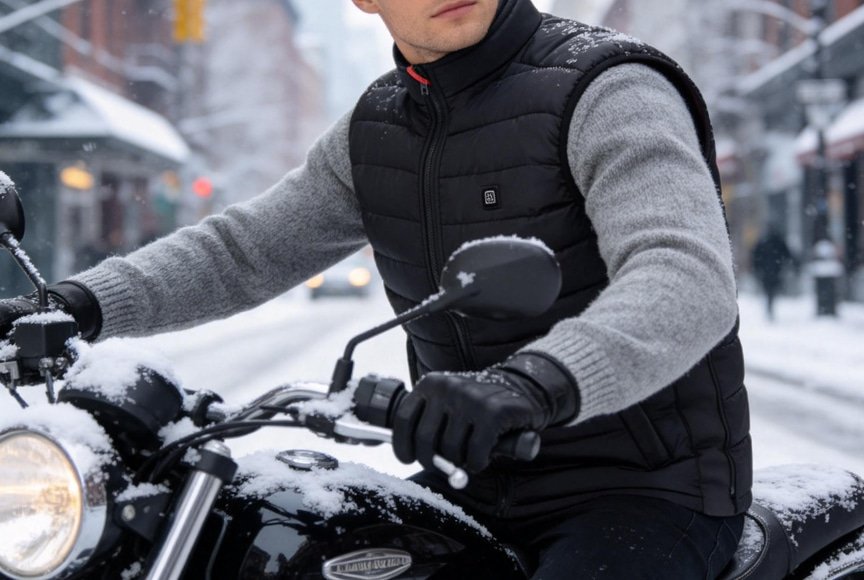

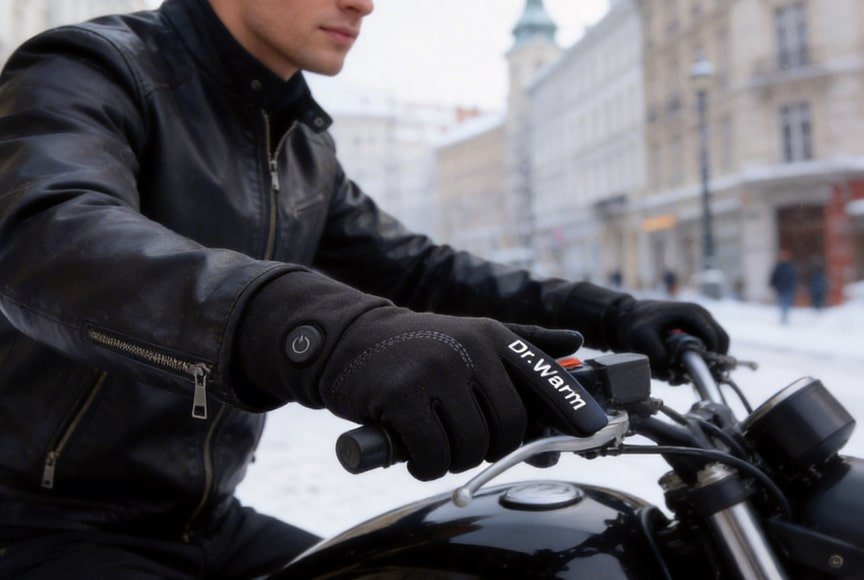
Heated gear used on motorcycles places higher requirements on batteries compared to the regular use of heated clothing, where the power requirements are discontinuous, and are not subjected to as many environmental extremes. Riders on a bike are exposed to unremitting wind chill at the speed of over 50 mph, which removes the heat more rapidly and necessitates a consistent high-output heating to remain comfortable. Combine this constant vibration caused by the engine and road surfaces and it means that batteries need to contend with mechanical influences that are able to loosen connections or wear away cells as time passes. A common misconception among riders is that assumed battery used with heated clothing will also work in a motorcycle but the workload of the ride will have a drastically different effect on the battery, resulting in significantly reduced run time, lacks uniform heating, or even fails during the ride.
Battery stability when under continued load and in the environment, and not headline specifications, is important in motorcycles. Heated gear motorcycle batteries have to be chosen based on sustained output, vibration resistance, and high airflow stability, not capacity, or voltage ratings. Based on years of product validation testing in the actual riding conditions, this guide compares the options to the ones available and helps the motorcycle gear brands, OEMs, product managers, engineers, and riders to make the right decisions. To learn more about system integration, explore our heated apparel battery solutions for motorcycle gear.
Why Motorcycle Heated Gear Needs Different Battery Considerations
The environment in which motorcycle heated gear functions is remarkably hostile and puts increased pressure on battery needs compared to the demands of the battery in everyday outdoor heated clothing. Whereas in walking, hiking there is limited wind exposure to the individual, and the movement rate is relatively low, it is in riding where the wind blows at high speeds and the individual being ridden gets a wind chill effect that could potentially lower perceived temperatures by 20-30 degrees Fahrenheit on a highway. This requires sustained vigorous heating of jackets and the use of gloves or liners to combat heat loss that subjects the battery to a constant load as opposed to the intermittent bursts experienced in regular heated clothing.
The other factor to be considered is vibration; there are continuous mechanical shocks produced by motorcycles on uneven roads, engine vibration, and acceleration, which can cause internal stress on the battery, resulting in micro-fractures in cells or dislocated wires. Generalized heated garment and battery formulations designed to be lightweight and used infrequently may fail in this case with voltage drops, decreased capacity with repeated use, or even complete breakdowns when put under sustained riding. An example is a battery tested in a dynamic test and found good but when applied on a vibrating bike frame, the battery only had 15-20% efficiency because internal resistance accumulates. The validation of the heated riding gear by engineers should focus on the use of batteries that are designed to handle such stresses in order to maintain road performance and safety.
Wind Chill and Sustained Power Draw
Due to the heat dissipation, wind chill speeds up at higher rates of cruising which causes heating elements to be operated at a higher setting and to last longer. This continuous load can drain a standard battery 30-50 times quicker than rated, which is why purpose-built alternatives are necessary.
Vibration and Mechanical Durability
The vibrations of roads are directly passed through the bike to the mounted or pocketed batteries and they are tested on their structural integrity. In the absence of reinforced casings and shock-absorbing design, the cells may shift causing intermittent power or degrade over time.
Key Battery Performance Criteria for Motorcycle Use
Choosing the battery of heated motorcycle clothing entails placing an emphasis on criteria that are specific to the dynamics of riding, in which generic measures such as mAh ratings can be highly deceptive out of context. The ability to continue discharging is the most important, as it means that the battery keeps the voltage output constant even though heating components will be drawing consistent power throughout long highway journeys.
Stability at load Voltage stability eliminates heating variability that would otherwise keep the riders too cold at speed, whereas vibration resistance prevents the regular jolts that characterize motorcycle usage. Safe connectors are also very important because bumps have loose fittings, which would break power during the middle of the ride, making the experience unsafe and uncomfortable.
| Performance Factor | Why It Matters for Motorcycles |
| Discharge stability | Stops heat loss when traveling at speed, keeping her warm even in the wind. |
| Vibration tolerance | Does not experience intermittent shocks due to road when there is a power blackout, so when driving in rough conditions, it is reliable. |
| Runtime consistency | Long rides without sudden loss is supported, essential to touring. |
| Connector security | Stops intermission of rides due to vibrations or motion interruptions. |
All these reasons, confirmed during field experiments on different bikes, support the point why batteries should be tested under simulated riding conditions and not laboratory tables.
Defining Sustained Discharge
This means that a battery can provide constant current without voltage drop which is necessary since heating systems can require 5-10W at a constant rate with highway speeds.
Importance of Voltage Stability
With load, unstable stability causes heat output to dim, strong batteries maintain 7.4V nominal at 20% power.
Battery Types Commonly Used in Motorcycle Heated Gear
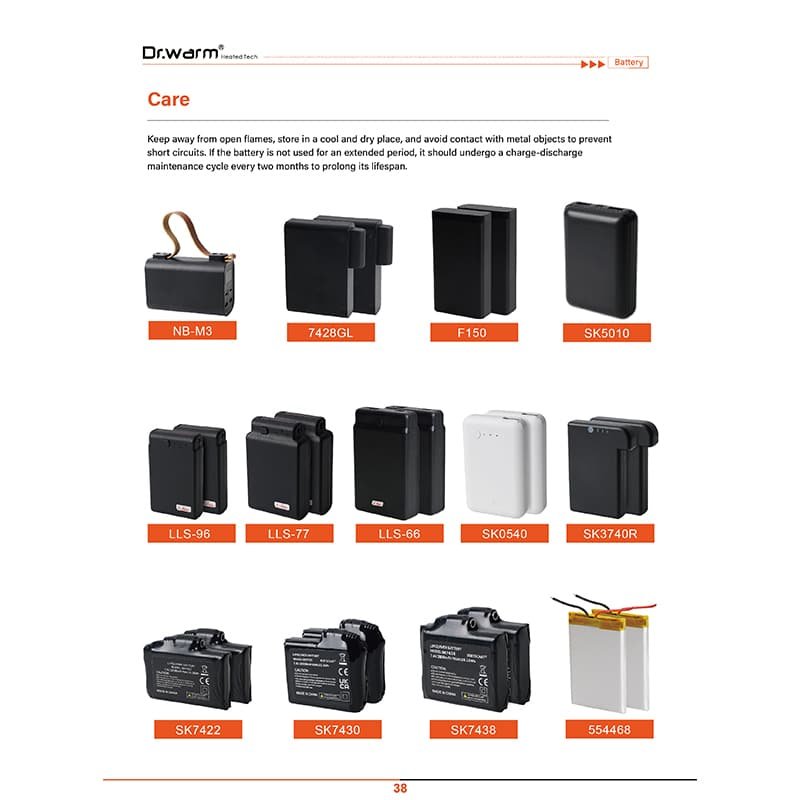
Motorcycle heated gear is dominated by lithium-based batteries, as they are compact in terms of energy density, but the difference between the two types depends on the trade-offs related to the riding. Li-ion packs, that have their cylindrical cells in hard casings are better vibration resistant and are suitable in rigorous conditions such as off-road rides or touring rides.
Lithium-polymer packages, typically in soft packets, are flexible to use on slender profiles on gloves or liners, but can need extra protective shells to resist mechanical forces. Hard-cased designs are superior in drop or impact resistance, whereas soft-pouch designs are more concerned with saving weight, but may be punctured by sharp vibrations. Lithium-ion has demonstrated 20% superiority of cycle life at constant load than polymers at high airflow situations, and polymers win over lithium-ion in rapid charge times on the urban commuter.
Lithium-Ion Packs: Pros and Cons
ros: The vibration threshold is very high, steady output; cons: It is slower to charge in cold weather typical of winter rides.
Lithium-Polymer Packs: Pros and Cons
Advantages: Portable, (can be bent into various shapes) disadvantages: Weaker when subjected to repeated shock loads, can swell when overheated in jackets.
Hard-Cased vs. Soft-Pouch Designs
Hard cases offer extra protection when using on the highway, soft pouches fit integrated gear, and require a reinforced installation.
To understand more about the behavior of these types under a load, one can take as an example the behavior of battery technology in hot clothes battery technology behavior in heated apparel.
Comparing Battery Options Across Riding Scenarios
The choice of batteries used to power heated gear on motorcycles needs to match to particular riding conditions because the stop and go in the city and the 120 miles on the highway are two complete spheres. Smaller batteries with fast response time are adequate when going around short urban routes and focus should be on warm-up speed as opposed to marathon performance.
High capacity packs with steady discharge are required in touring at long distance to overcome hours of continuous draw without dying out. The high-output batteries used in cold-weather highway riding are required in robust casing against increased wind chill and performance at sub-zero temperatures.
| Riding Scenario | Recommended Battery Characteristics |
| City commuting | Minimal, fast-acting traffic intermittent heat packs. |
| Touring | Large capacity, stable discharge of long disclosure period on open roads.. |
| Winter highway riding | Large production, strong casing to withstand loss of capacity due to cold and vibrations. |
Such recommendations are the results of validation tests carried on simulated real routes, in which mismatched batteries can fail by 25-40 per cent under taxing conditions.
Urban Commuting Considerations
This means that a battery can provide constant current without voltage drop which is necessary since heating systems can require 5-10W at a constant rate with highway speeds.
Touring and Endurance Rides
At load the stability is poor, causing heat output to dim, and strong batteries retain 7.4V nominal at the point of 20 percent capacity reduction.
Extreme Cold Highway Scenarios
Use batteries that have built-in heaters or cold-capable chemistry to avoid voltage drop to less than 20 o F.
How Battery Capacity and Runtime Translate on the Road
Riding on highways also makes battery-powered motorcycle gloves or jackets drain faster because of increased wind resistance, which can reduce the runtimes mentioned by the manufacturer by half. The recommended values are usually that of low winds, and moderate conditions but at 70mph, the airflow requires the maximum heat load and the consumption increases by fifty percent or more.
This variation is due to the fact that lab ratings do not take into account dynamic aspects such as efficiency losses due to vibrational induced effects or cold air that decreases the performance of the cells. A 5000mAh battery may say 4-6 hours, however, only give 2-3 on the road in field testing, which highlights the importance of riding-specific testing. More on this is in our guide to real riding battery runtime expectations.
Factors Influencing Highway Drain
The wind chill compels a greater power setting and speed causes even more aerodynamic cooling, doubling the load.
Adjusting Expectations from Advertised Specs
They should always be derated by 30-50 percent to use on a motorcycle, and previously in wind tunnels or on-road tests should be expected to be accurate.
Safety and Stability Under Motorcycle Conditions
The issue of battery use in heated riding gear is one that cannot be bargained, since minimal airflow in jackets can become a heat trap, increasing the chances of overheating when worn over a long period of time. To ensure that cell temperatures are observed, cell over-discharge is prevented, and power is cut in case of anomalies, a powerful Battery Management System (BMS) is essential.
Safe housing is immune to shorting caused by vibration and certifications such as UL are also used to guarantee this. During validation, we have noticed unprotected packs get ruined after riding 500 miles in rough conditions, and this explains why in-built protection is necessary. Discover additional battery safety considerations for heated gear.
Overheating Risks in Enclosed Gear
Jackets reduce ventilation and thus batteries require thermal cutoffs to prevent them reaching the point of 140 degrees F.
Role of BMS in Riding Stability
BMS balances cells and offers protection against shocks giving the output even on wavy surfaces.
System Matching and Power Management
A rightful match of battery output to heating systems avoids underpowered installations which wear out soon or over-stressed installations which overheat. In the case of motorcycle heated gear, the C-rate of the battery must match the wattage of the elements, e.g. 10W glove requires minimum sustained draw of 1.5A without sag.
Never match low-voltage packs with high-resistance wires, such as high-resistance speaker wires, or you can lose 20 percent of the effective heat. Validation- This is done by load testing the entire system with simulated rides. To see how, refer to our guide to the compatibility of matching battery output to heating systems.
Output Matching Essentials
Calculate peak draw, and make sure battery is higher by 20% in cold conditions.
Power Management Strategies
Variable settings should be done using controllers to increase the run time by optimizing the draw based on speed and temp.
Conclusion — Motorcycle Heated Gear Requires Purpose-Built Batteries
Motorcycle heated gear is a niche application that needs batteries to be capable of sustained high loads, mechanical forces and environmental features that generic types are not reliable against. The focus on the actual performance in the field of riding, which includes the ability to ride long distances, comfort, and resistance to vibration, is much more important than the fundamental specifications and guarantees that the systems would provide steady levels of warmth and protection on the road. Engineering-informed choices made in both brands and riders have considered these special constraints and give rise to gear that works as intended miles after miles.
Frequently Asked Questions
Can a jacket pack be used for riding?
Physically yes, practically no. A pack sized for walking is asked to hold higher output for much longer at speed, against wind that keeps stripping the heat away. It will work, then cut out earlier than the rider expects, and the connector takes a beating it was not specified for.
Is a hard case always better on a bike?
It is better for the cell and worse for the wearer. A hard case protects against vibration and impact, but it is bulky inside a jacket pocket and can press against the rider. Pouch packs win on comfort and lose on mechanical protection — which is why the housing and its mounting point matter as much as the cell format.
Why does the heat fade at highway speed?
Two things at once: wind chill raises the heat the garment must replace, and the sustained load pulls the cell voltage down so output sags. A pack with poor voltage stability under load shows it first at speed, which is exactly when the rider cannot do anything about it.
Should the pack live in a pocket or on the bike?
On the body for warmth and simplicity, on the bike only if you accept a tether cable and a connector that will be cycled constantly. Bike-mounted packs stay warm and take weight off the rider, but the cable becomes the weak point and the failure mode is a rider who loses heat mid-ride.