
Battery Solutions for
Heated Products
Engineered battery systems designed specifically for wearable heated apparel, balancing power output, comfort, safety, and long-term reliability at the system level.

More Than Just a Battery Pack
A battery solution for heated apparel is a system-level power architecture, not a standalone battery pack.
It is designed to deliver stable thermal output while accounting for wearability, safety protection, and regulatory requirements.
System Components
- Customized Battery Management System (BMS)
- Ergonomic Housing Design
- User Interface & Control Integration
- Thermal Regulation Logic
- Connector & Cabling Architecture
- Environmental Protection (Water/Impact)
End-to-End Engineering Capabilities
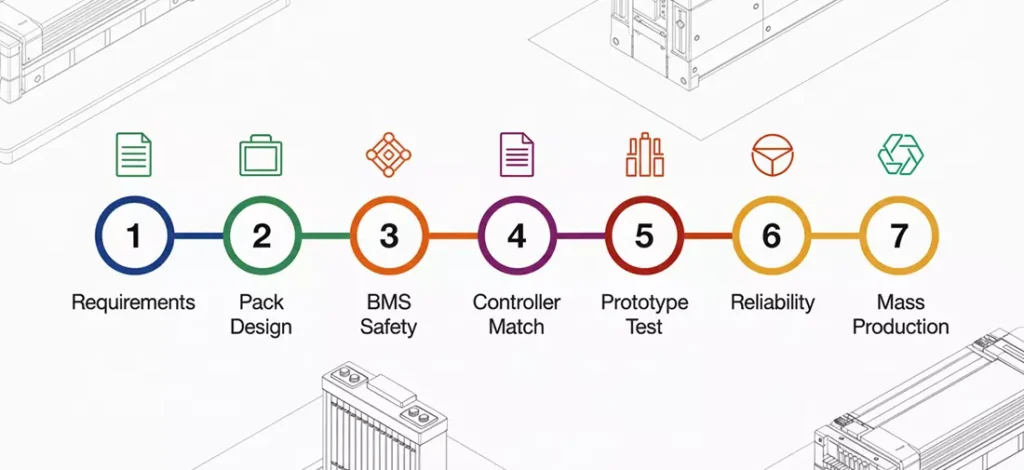
Reliable battery performance in heated apparel depends on engineering control across the entire battery lifecycle, from architecture design to validation and production.
Requirement mapping: heating power, runtime targets, garment constraints, market requirements
BMS & protection design: safety thresholds and fault handling
Controller matching: output stability, heat-level logic, UX requirements
Prototype build & validation: basic electrical checks, thermal behavior, connector reliability
Reliability screening: aging, vibration/handling simulation (only list what you actually do)
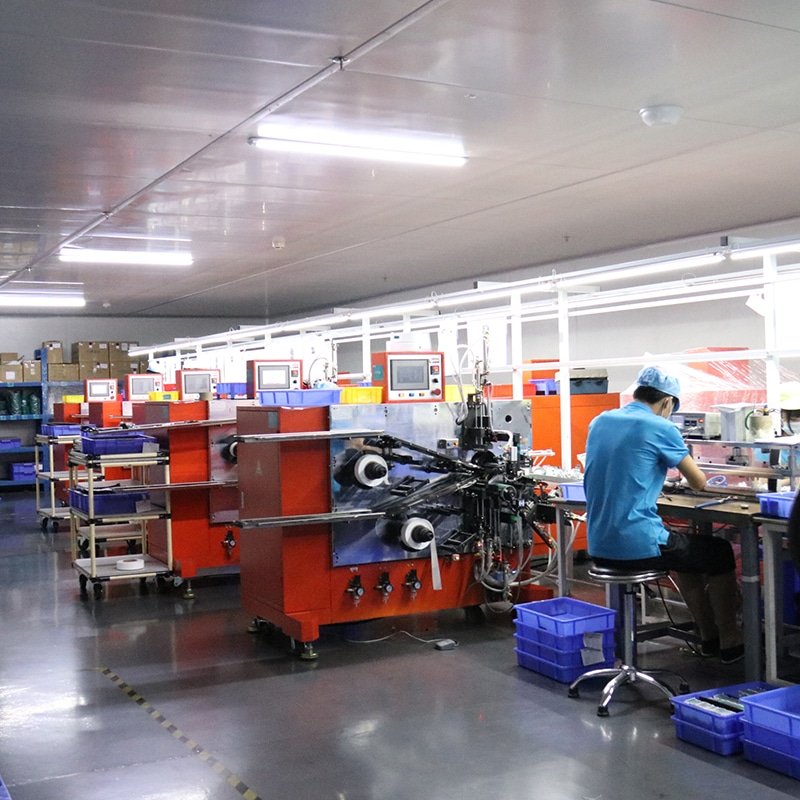
Pilot run to mass production: consistency controls and incoming/outgoing inspection
Cell & pack architecture: voltage/capacity selection, parallel/series design, enclosure constraints

Battery Solutions by Application
Application
Voltage System
Capacity Range
Key Requirement
Heated Gloves
3.7V / 7.4V
2000mAh - 3000mAh
Compact size, curved form factor for comfort
Heated Socks / Insoles
3.7V
2200mAh - 4000mAh
Ultra-slim profile, remote control integration
Heated Jackets / Vests
5V (USB) / 7.4V / 12V
5000mAh - 10000mAh
High output for multi-zone heating, USB-C PD
Base Layers
7.4V
2200mAh - 4000mAh
Lightweight, washability protection
Industrial Workwear
12V / 24V
5000mAh - 20000mAh
Ruggedized casing, extended runtime, impact resistance
Battery Pack Specifications
Every pack is built to the specification the customer approves. The platforms below are our standard builds — capacity, connector and firmware are adjusted per order, so there is no single fixed configuration.
Standard Battery Platforms
| Model | Voltage | Capacity | Interface | Typical use |
|---|---|---|---|---|
| PH05 | 3.7V | 2,500 mAh | DC | Insoles |
| LLS-96 | 3.7V | 3,200 mAh | DC | Insoles, slippers |
| JDP5000 | 3.7V | 5,000 mAh | DC | Slippers, extended runtime insoles |
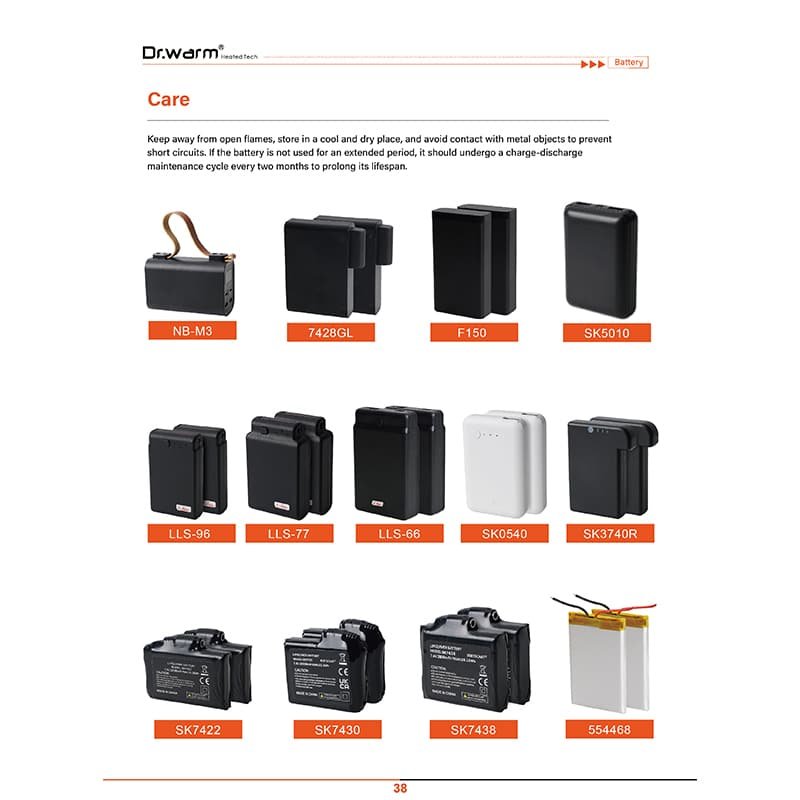
| SK7422 | 7.4V | 2,200 mAh | DC | Gloves, socks, base layers |
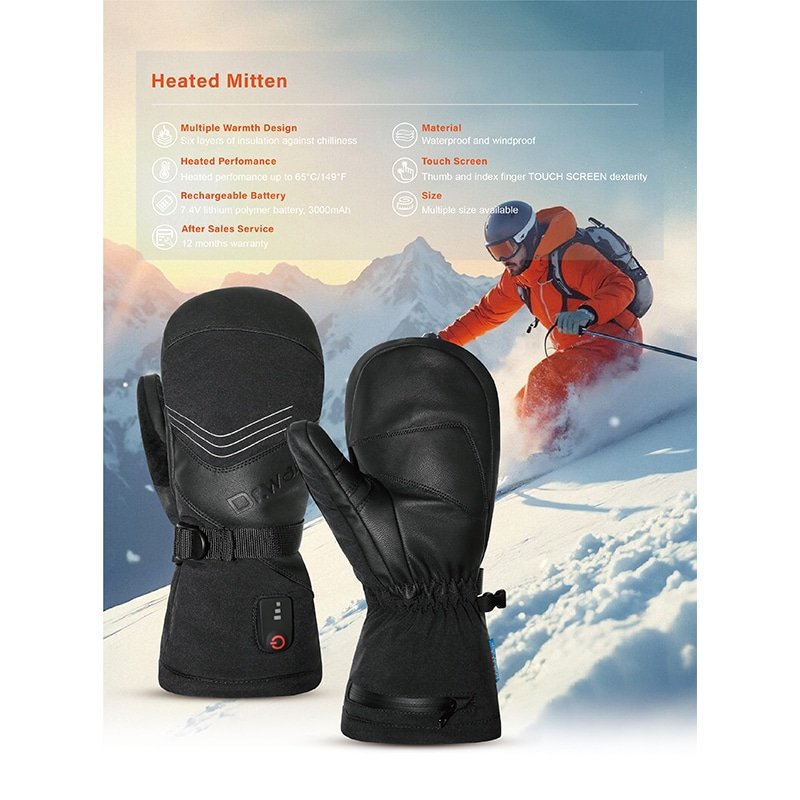
| SK7430 | 7.4V | 3,000 mAh | DC | Gloves, apparel |
| SK7440 | 7.4V | 4,000 mAh | DC | Jackets |
| SK7422-5C | 7.4V | 2,200 mAh | Type-C | Gloves, socks |
| SK7430-5C | 7.4V | 3,000 mAh | Type-C | Apparel |
| SK7440-5C | 7.4V | 4,000 mAh | Type-C | Jackets |
| SK7430-S/R | 7.4V | 3,000 mAh | APP / Remote | App-controlled apparel |
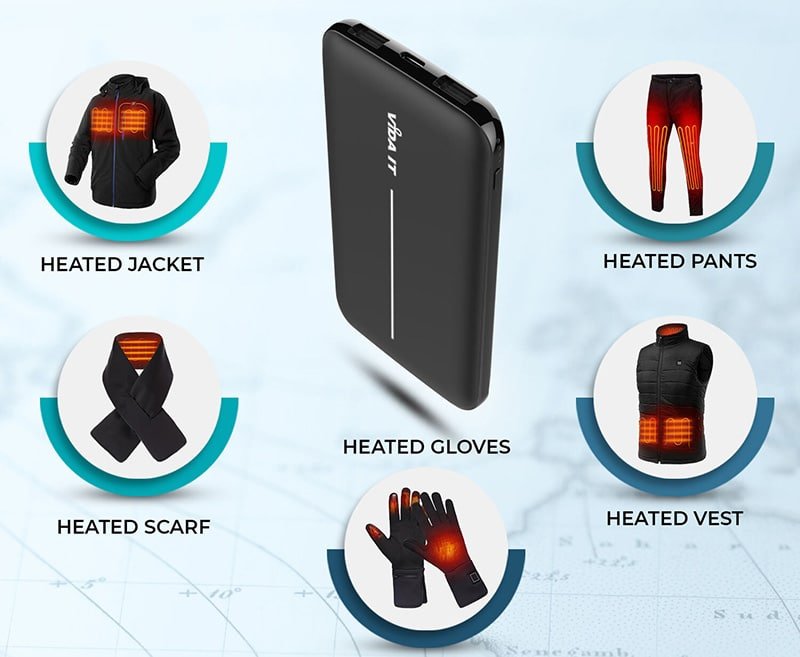
| SK5010 | 5V | 10,000 mAh | USB-A power bank | Vests, scarves, cushions, blankets |
| SK5020 | 5V | 20,000 mAh | USB-A power bank | Extended-runtime 5V garments |
| 12V platform | 12V | 5,000 mAh | DC | PTC / carbon-fibre jackets, dual-control systems |
| 24V platform | 24V | Custom | Custom | Industrial and heavy-duty workwear — custom build on request |
Charger Matching
The charger is matched to the pack voltage, not ordered separately. Charging time follows pack capacity and charger current.
| Pack voltage | Charger output | Note |
|---|---|---|
| 3.7V | 5V / 2A | Insoles, slippers |
| 5V | 5V / 2A or 5V / 3A | 3A used on high-capacity 5V systems |
| 7.4V | 8.4V / 1.5A | Gloves, socks, shoes, apparel |
| 12V | 5V / 3A | PTC and carbon-fibre jackets |
Plugs available: US, EU, UK, AU and multi-plug. Cable ends available: USB/DC-male, USB/Micro, USB-Type-C, USB/DC, USB/magnetic and USB/DC-female.
Protection and Endurance
| Parameter | Specification |
|---|---|
| Over-charge and over-discharge protection | BMS cut-off thresholds set per cell type |
| Short-circuit prevention | Dedicated protection logic plus redundant safety circuits |
| Thermal monitoring | NTC sensor with thermal cut-off |
| Cell balancing | Balancing for pack longevity |
| Cycle life | 500+ charge cycles |
| Water resistance | IPX4 as standard, IPX5 optional |
| Warranty | 12 months |
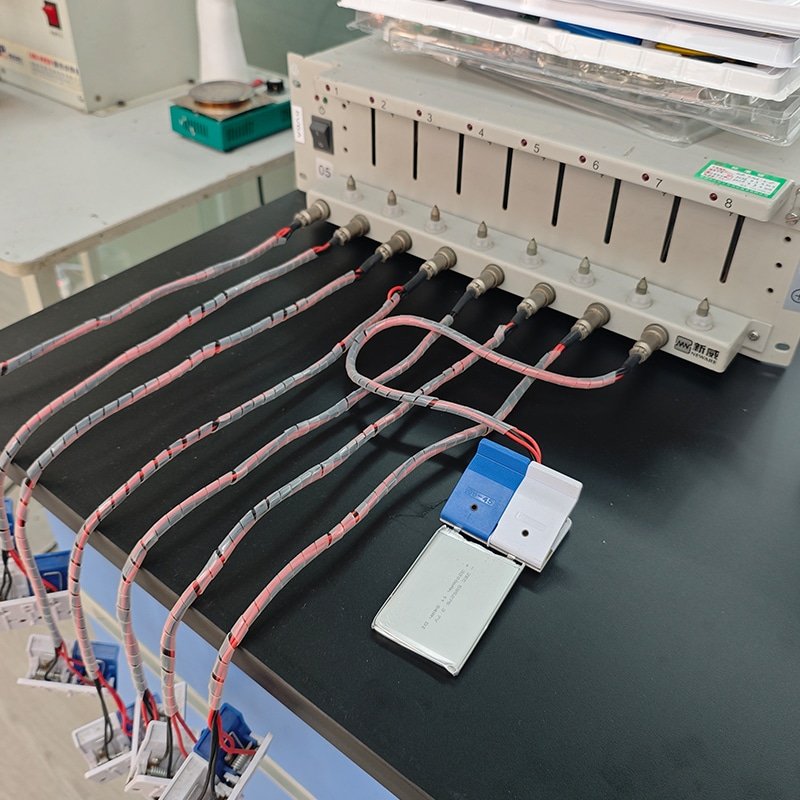
| In-house validation | Battery aging tester, battery comprehensive tester, high and low temperature chamber, thermal imager, pressure resistance tester |
Compliance
Packs are CE, UKCA, UL, FCC, RoHS, Reach, DOE and UN38.3 (T1–T8) compliant, built under ISO 9001, and tested to GB 47372-2026 with CCC certification. A UN38.3 test summary and an SDS accompany every shipment.
Safety & Compliance Built-In
Battery safety in heated apparel is not an add-on feature, but a design constraint defined at the system level.
Multi-Level Protection
- Over-charge & Over-discharge Protection
- Short Circuit Prevention Logic
- NTC Thermal Monitoring & Cut-off
- Cell Balancing for Pack Longevity
- Redundant Safety Circuits
Compliance Readiness
Our designs are pre-validated to meet stringent international standards, streamlining your certification process.
RoHS
FCC
UL
UN 38.3
IEC

Comfort, Wearability & Industrial Design
In wearable heated apparel, battery form factor decisions directly influence pressure points, mobility, and long-term wearing comfort.. We focus on the “wearability” of power, ensuring that the battery integrates naturally with the garment without causing discomfort or restricting movement.
By utilizing curved cell technology and slim-profile housings, we create battery packs that contour to the body. Weight distribution is optimized to prevent sagging or imbalance in the apparel.
Our industrial design team considers tactile feedback, button placement, and visual indicators to ensure the user interface is intuitive, even when wearing gloves.
OEM & ODM Battery Solution Support
OEM and ODM battery solution support focuses on reducing development risk while ensuring system compatibility and production consistency. See the Dr. Warm battery options for the retail products we power.
OEM Services
Manufacturing based on your existing specifications, drawings, and product requirements.
- Build-to-print manufacturing
- Cost-down engineering analysis
- Supply chain consolidation
ODM Services
Complete battery development support from initial concept and product design to testing and mass production.
- Product Design & Development
- Prototype Testing & Validation
- Tooling & Mold Development
Battery System Matching Logic
A common failure point in heated apparel is the mismatch between the battery’s output characteristics and the heating element’s requirements. Using an off-the-shelf power bank with a specialized heating system often leads to poor performance or safety risks.
Improper matching can result in rapid voltage sag, premature cutoff, or overheating of the connector terminals. Our system-level approach ensures that the battery’s discharge curve is perfectly aligned with the load profile of the heating elements, guaranteeing consistent warmth and maximizing runtime.
Battery Knowledge Center
Choosing the right battery voltage is critical for heated clothing performance and safety. This article compares 7.4V and 12V battery systems, explaining how voltage influences heating efficiency, runtime, comfort, and garment design. Written from an engineering perspective, it helps brands and OEMs make informed battery decisions for different heated apparel applications.
Battery performance plays a critical role in how heated apparel actually feels and functions in real use. This article explains how battery technology—beyond voltage and capacity—affects heating stability, runtime consistency, safety, and user comfort. Written from an engineering perspective, it helps brands and OEMs understand why battery design choices directly shape heated apparel performance.
Lithium-ion and lithium-polymer batteries are both used in heated clothing, but they deliver very different real-world results. This article compares the two battery chemistries from an engineering perspective, explaining how they affect heating stability, safety, form factor, and garment design. It helps OEMs and brands choose the right battery chemistry for different heated apparel applications.
Battery capacity plays a major role in how heated apparel performs and feels in daily use. This article explains how to choose the right battery capacity for heated gloves, jackets, and socks, focusing on runtime expectations, wear comfort, and system efficiency. Written from an engineering perspective, it helps brands and OEMs avoid common capacity selection mistakes in heated clothing design.
Battery Pack & Shipping FAQs
Straight answers on compliance, MOQ, customization and lead time for custom battery packs.
Are your batteries compliant with international shipping and safety standards?
Yes. Our battery packs are tested to UN38.3 (T1–T8) and certified to GB 47372-2026 and CCC — China’s national lithium battery safety standards, which impose stricter testing requirements than the EU and US baseline. A UN38.3 test summary is provided with every shipment for air and sea freight compliance. Available voltages cover 3.7V, 5V USB, 7.4V, 12V and 24V, and capacity is specified per project. Common 7.4V options include 2200 mAh and 4000 mAh. Each pack includes over-heat and short-circuit protection and delivers 500+ charge cycles.
What is your MOQ for custom battery packs?
Our standard MOQ for ODM battery projects — custom voltage, capacity or connectors — is 500 packs per specification. OEM orders where you supply the design and we apply your branding start at 100 packs. Stock battery packs can be ordered from 1 pack. Sampling takes 7–30 days and the sample cost is credited against your bulk order.
Can you customize the capacity, housing and connectors for our garment?
Yes. Capacity starts at 2,200 mAh and scales to 2,500 mAh, 3,200 mAh, 4,000 mAh, 5,000 mAh and higher, while jackets and vests can run on 10,000–20,000 mAh power banks. The housing is tooled to the pocket geometry of the garment, the connector is matched to your controller, and BMS thresholds are set per cell type. Custom combinations are quoted per specification after a sample review.
What is your production lead time and warranty?
Sampling takes 7–30 days depending on tooling and validation scope. OEM production runs 20–25 days after sample approval, full ODM development takes 50–60 days, and standard production ships within 45 days. Every pack carries a 12-month warranty and is rated for 500+ charge cycles with over-heat and short-circuit protection built in.


