
Compliance & Documentation
Certifications & Compliance
Every Dr. Warm product leaves our factory with the documentation that your buyers, customs brokers and marketplace compliance teams ask for — certificates, independent test reports and safety data sheets, all held on file and ready to send.
The certificates are held by our group company Dongguan S-KING Limited, the owner of the Dr. Warm brand. They cover the manufacturing operations of our plant, Dongguan Ditewang Intelligent Technology Co., Ltd., in Dongguan, China — where our OEM and ODM programs are run. Below, every document is grouped by what it actually is, so it is clear which is a certificate, which is a test report, and which is a compliance file.
1. Certifications
Certificates held on file, covering our heated gloves, socks, insoles, jackets, vests, heated systems and battery packs.
| Certificate | What it covers | Market |
|---|---|---|
| ISO 9001:2015 | Quality management system, applied across the whole plant | Global |
| ISO 13485 | Quality management system for our insoles and foot-care line. A system certificate — not a medical device approval | Global |
| CE | Product compliance for heated wearables, controllers and battery packs | European Union |
| UKCA | Product compliance for heated wearables and controls | United Kingdom |
| RoHS | Restriction of hazardous substances in electronics and materials | European Union |
| FCC | Electromagnetic compliance for controllers and electronics | United States |
| DOE | Energy efficiency requirements for battery chargers | United States |
| CEC | Energy efficiency requirements for battery chargers | California, US |
| UL | Cell-level battery safety for the lithium cells used in our packs | North America |
| ETL | Safety mark for heated garments and their controllers | North America |
| TUV | Safety mark for heating elements and control electronics | Germany / EU |
| CCC (3C) | Compulsory product certification for lithium battery packs | China |
Also on file, available on request: GS, GCC and CB (IECEE) certificates.
2. Test Reports
Independent laboratory testing carried out by accredited third-party labs — these are reports, not certificates.
| Report | What it covers | Market |
|---|---|---|
| IEC 60335 | Safety of electrical appliances — applies to our heating elements, controllers and battery packs | International |
| UN 38.3 | Lithium battery transport testing (T1–T8). A test summary accompanies every shipment for air and sea freight | International |
| BV Total Fluorine Content | Independent testing of our materials for total fluorine content — result: PASS. Useful for PFAS-related due diligence | EU / US |
| IEC 62321 | The test method behind our RoHS reports | European Union |
Also on file, available on request: detailed IEC 62321 test reports.
3. Compliance Documents
Documents we prepare and maintain ourselves — these are not certificates, but they are what customs, marketplaces and your legal team usually ask for first.
| Document | What it covers | Availability |
|---|---|---|
| SDS — Safety Data Sheet | Safety data sheets for our battery packs, in the current GHS format | Available on request |
| PPWR | Packaging and Packaging Waste Regulation conformity for EU-bound shipments | On file |
| GB 47372-2026 | China’s lithium battery safety standard — the standard our battery packs are tested and certified against | On file |
Battery Compliance: GB 47372-2026 and CCC
Our battery packs are tested to UN 38.3 (T1–T8) and certified to GB 47372-2026 and CCC (3C) — China’s national lithium battery safety standard. Several of its abuse, thermal and protection requirements go beyond the baseline requirements commonly applied in North America and Europe, which is why we treat it as our minimum bar rather than a market-specific add-on.
Every pack includes over-heat and short-circuit protection and delivers 500+ charge cycles. If you are entering a market with its own battery rules, tell us during development and our engineers will map the design to it — the same team handles battery and BMS design in-house.
How We Verify
A certificate says a design passed a test once. What matters on your order is whether every unit shipped still matches it, so every order passes three inspection stages:
- Incoming material inspection — we produce our own heating elements, so control starts at the raw material stage.
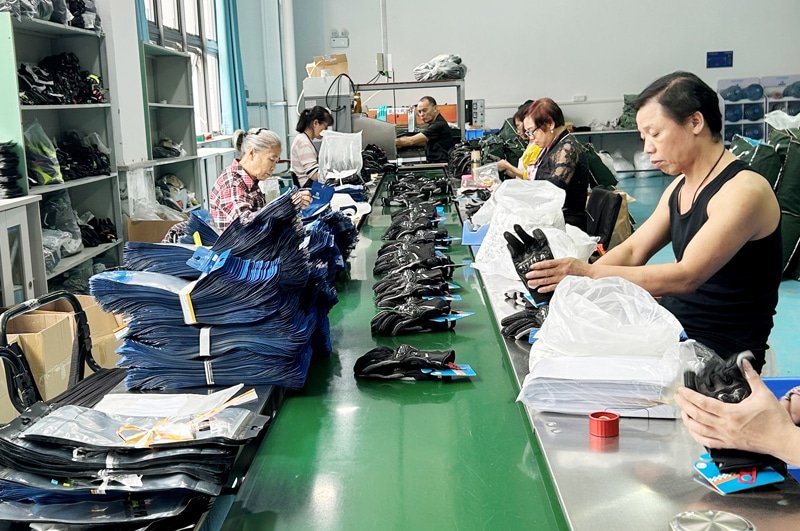
- In-process checks — verified at each production station rather than only at the end of the line.
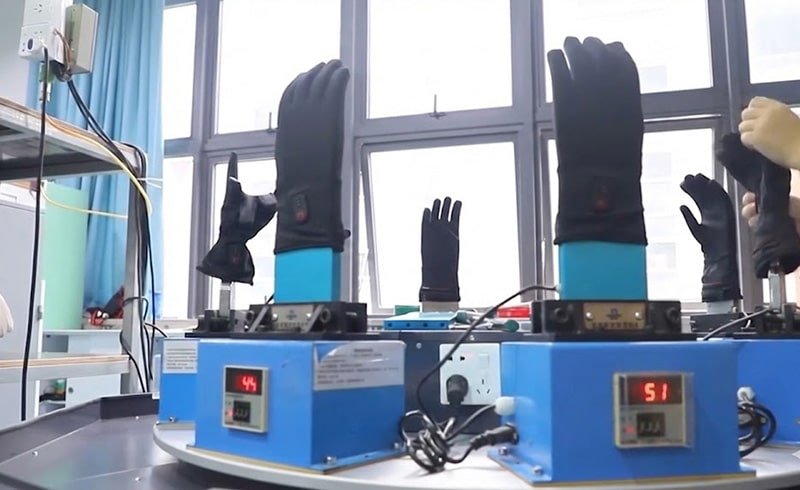
- 100% final testing in our in-house lab — battery aging tests, high/low temperature cycling, waterproof testing to IPX4 (IPX5 available) and thermal imaging verification.
Test records can be shared with your team on request. For more on how orders are run end to end, see our full FAQ.
Certifications FAQ
What certifications do your products have?
Our factory holds ISO 9001:2015 certification and has been audited on site by Intertek. Our heated products carry CE, RoHS, TUV, EMC and FCC compliance. Material Safety Data Sheets (SDS) are available on request. Our battery packs are tested to UN38.3 (T1–T8) and certified to GB 47372-2026 and CCC — China’s national lithium battery safety standards, which require stricter testing than the EU and US baseline.
Who holds the certificates — S-KING or the factory?
The certificates are held by Dongguan S-KING Limited, the group company that owns the Dr. Warm brand. They cover the manufacturing operations of our plant, Dongguan Ditewang Intelligent Technology Co., Ltd., in Dongguan, China. When we send documents we include the certificate holder name, so your compliance team can match them to the supplier record it has on file.
Can you send certificates before we place an order?
Yes. Tell us the markets you are selling into and we will share the relevant certificates, test reports and SDS before you commit to anything. GS, GCC, CB (IECEE) certificates and detailed IEC 62321 reports are available on request. We do not publish certificate numbers online, so the documents we send you are the source of truth.
How do I verify that a certificate is genuine?
Every certificate we issue names the issuing body and carries a certificate number, and each one can be verified directly with that body — for example Intertek for the ETL mark, TUV for the TUV mark, or the relevant national authority for CCC. Send us the document you received and we will tell you exactly which body can confirm it.
Request the full documentation pack
Tell us your target markets and product type — we will send the certificates, test reports and SDS that apply to your project, usually within one business day.
Request Documentation