

Many overly common warm-up clothing brands continue to treat battery packs as something that can be added at the end of the product development process, when the shape and heating design of the garment, as well as the controller, is already largely fixed. Such end-stage attitude is among the keenest causes of cost overruns, schedule slippage, as well as field performance issues.
Gloves that are heated, as well as jackets, have extraordinarily different requirements towards a battery design. Gloves have very high demands of miniature sizes, lightness and strong limitation of space-size and weight. More flexible with regard to both volume and positioning, jackets require much longer runtime and more consistent power delivery throughout extensive areas of heating.
In hot clothes, only a battery decision-making process will be considered as an essential component of the system design.
The development and design of OEM battery packs to provide cooling effects to the heated apparel is not about a late battery selection as well.
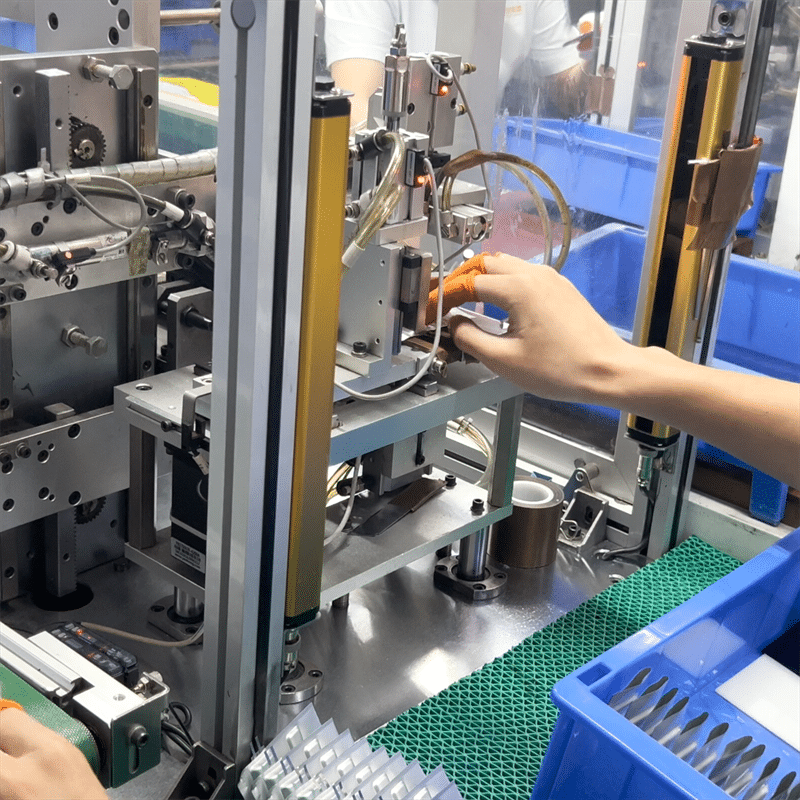
Why Battery Pack Development Is a System-Level OEM Decision
Heated clothes do not have the battery pack as an independent system. It is in the heart of an interdependent electrical and thermal system that comprises:
- Heating components (carbon fiber, heating wire or flexible film)
- PID-based or PWM temperature controllers.
- Feedback loops and thermal sensor.
- Wiring structure and junctions.
- The clothing and insulation modeling.
Battery voltage of the selected battery influences directly the current draw, heat-up time and efficiency of the system as a whole. Real world realistic operation is by battery capacity. The discharge curve on the pack, internal resistance, and also the protection logic should work in harmony with the controller behavioral characteristic within the entire temperature space.
The opposite engineering constraints are formed by gloves and jackets:
- The gloves drive designers to reduce all millimeters and grams, and sometimes the high cells have to be very dense for use in small cuff pockets or in small wrist pockets.
- Jackets have the capacity to receive larger packs but need to sustain a uniform power amount throughout most but substantial relationship over freezing field temperatures in 8-12+ hours.
The assumption that the battery is a generic and interchangeable component nearly always necessitates trade-offs: not enough run time, too heavy, overheating problems or safety concerns not realized until the last testing or use in the field.
Business-savvy OEMs have as a result, been integrating battery issues into even the first system architecture conversations. To have a strategic overview of the approaches of leading brands with regard to this important choice that needs to be taken promptly, see our OEM-oriented battery solution framework.
Defining Battery Requirements for Heated Gloves vs Jackets
The need of battery in the heated gloves and the heated jacket is so dissimilar that almost always the battery pack used will compromise unacceptably.
Heated Gloves – Ultra-Compact Constraints
- Weight target normally 70130 g/pack.
- Only placed in cuff, back of hand or else on very small underside of wrist.
- Require high current bursts of high current in fingers.
- Normal run-time objective: 4-8 hours medium setting – Result: it should consume more energy per cell, with all the thermal and safety factors becoming narrower.
Heated Jackets – Runtime & Capacity Priority
- Allowable volume 120–300 cm³ or more
- Weight target usually 150–280 g
- Adjustable position (lower back, sides pockets, waistband)
- Sanitary, present, chest, back and sleeve, even current.
- Typical runtime target: 814 hours – Result: The larger lower-rate cells will become feasible, and have superior cycle life and thermal characteristics.
These core disparities imply that glove-protected batteries tend to be excessively tiny to operate in jackets, and jacket batteries are excessively huge and heavy to work on gloves. The appropriate category specific requirements need to be defined prior to the commencement of cell chemistry or form factor.
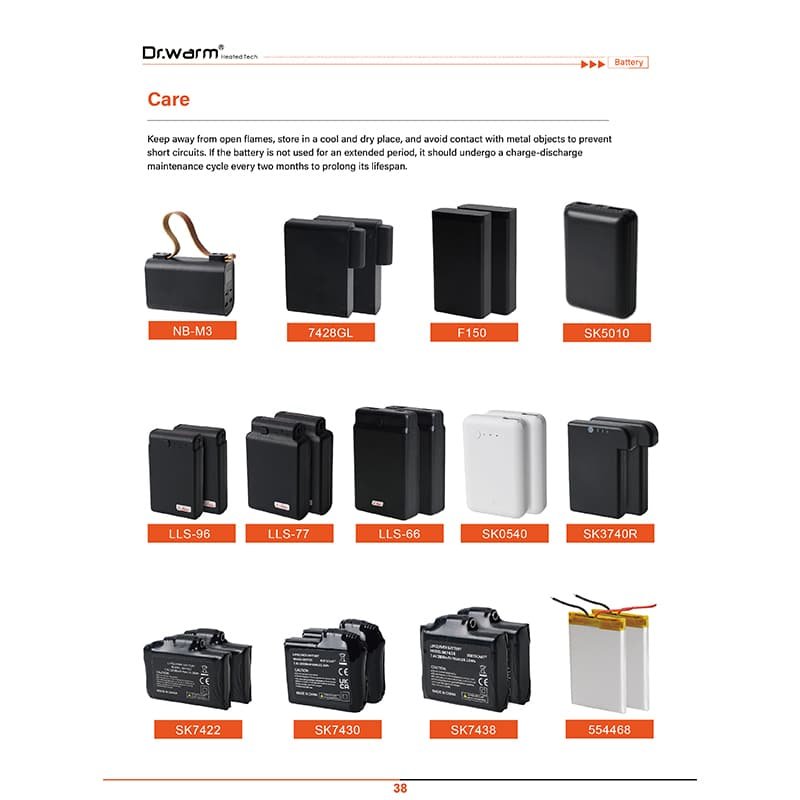
Key Stages in OEM Battery Pack Development
High-performance custom battery packs of heated apparel wearables are not developed in an adult-fashioned, design things as we go way, but are engineered in a gated, one-way manner.
- Requirement Definition (4–6 weeks) Complete mapping of power profiles, runtime targets, environment extremes, physical limitations, and duty cycles → the formal Battery Specification Document is a product of this step.
- Electrical + Mechanical Design (814 weeks) Cell selection BMS architecture Protection strategy Thermal simulation Enclosure design Studies 3D integration with garment CAD.
- Prototyping & Validation (10 to 16 weeks) Series of prototype cycles → electrical testing → thermal testing with camera mode – tests – drop /vibration testing – runtime testing with real garmment samples.
- Design freeze/Production Readiness (8+ weeks) Tooling release pilot production full reliability suite (cycle life, high-temp storage, safety abuse testing) complete certification documentation package.
Such a rigorous progression significantly diminishes changes at late stages. To gain a pragmatic insight into how this workflow can be performed between PCB layout and end housing, refer to our systematic description of structured OEM battery development process.
Safety, Compliance, and Validation Planning
Safety planning should start as a requirement and not afterwards.
Redesigned heated apparel batteries must be multi-layered: cell-level + pack-level overcharge, over-discharge, short circuit, over-current, and most importantly over-temperature protection is necessary. Since the heating elements are very close to each other, thermal runaway risk management becomes especially important.
Captured certification specifications (CE, UL, FCC, RoHS, UKCA) also impose detailed test documentation, risk assessments, and construction technical documentation – much of which is impossible to achieve with a frozen design. Compliance activities that do not begin until after a design freeze usually introduce 4-8 months of latitude.
Best practice: within the first 4 weeks develop a compliance roadmap, conduct pre-compliance testing on early prototypes, and involve accredited labs early.
In the case of brands which are comparatively new to the heated apparel market, the following outline of the key conditions is a good place of departure: battery certification planning for heated apparel.
Manufacturing Readiness and Scale-Up Considerations
What may be perfect on the engineering bench may not always be so perfect in mass production without being bridged.
Key differences appear in:
- Cell-to-cell variation
- Connection consistency and spot-welding.
- BMS component tolerances
- Enclosure sealing quality
- Aging behavior under duty cycles in reality.
A pack with 600 cycle in laboratory conditions (labs) might degrade to 350450 cycles in the field in case supplier process control is lax.
The scale-up activities to be carried out critically involve:
- Audit of supplier factory + process capability analysis.
- ≥500-cycle aging followed by 60 o C storage test.
- Weld strength and key dimensions statistical process control.
- In-line electrical and visual inspections 100 per cent.
- Focused on vibration/drop compliance validation, with random sampling.
These realities need addressing at the beginning of the struggle what makes the difference between smooth ramp-up and months of firefighting to improve the yield. Learn more about the most frequent issues in our practical guide to production risk factors in heated apparel batteries.
Common OEM Mistakes in Battery Pack Development
Out of various dozens of programs of real heated apparel that we dealt with, some recurring errors are noticeable:
- Over-optimizing to utilize maximum capacity – Increasing capacity by 20-40 percent of maho is often tempting on the paper but in practice often results in larger heavier packs with decreasing empirical benefits.
- Failure to predict certification time schedules– It is far more realistic to assume 14 24 weeks (with potential re-tests) for UL/CE than 68 weeks.
- Battery choice followed by system optimization – It is almost always inefficient or thermopolytically inefficient or unsafe to pick the battery after deciding on the system.
- Bypassing early garment built-in thermal validation Lab data alone seldom predicts actual hot/cold spots inside the actual jackets or gloves.
These are not imaginary risks – they are recorded costly lessons of production programs.
Conclusion — OEM Battery Development Is a Planning Discipline
Taking on the OEM battery pack development of the case with the heated gloves and heated jackets is in essence a systems engineering and risk-managing field of study, quite simply it is not a component shopping excursion.
The most successful brands are always able to accomplish three things:
- Make battery selections in the system design at the conceptual stage.
- Elaborate category-specific (gloves vs jackets) requirements early and strictly.
- Adhere to a provided, process based development process that is safety conscious, compliant, and manufacturing prepared.
Following these principles, redesign loops are reduced, certification paths are predictable, production yields get stable and end-users get reliable long-lasting performance.
The powerful choice that a brand cannot make is to consider battery pack as part of the core system, which must have been planned not as the last resort.