
Failures in heating elements in heated clothing are not usually accidental, but must be due to foreseeable mechanical, electrical or environmental stresses that were not adequately accounted for in the design, or in the validation process.
One trend that is evident in the years of research I had done in field returns and root-cause analyses on a piece of heated apparel is that in the majority of the cases, the failures can be observed after hundreds of uses, but not directly upon the delivery of the item. However, user abuse is not most of the cases as many people think. Most of them date back to the loopholes in design options, material requirements, or lack of verification test to allow stress to build up throughout the years.
The article dissects the major types of failure that I have observed over and over and how they work together, as well as how experienced manufacturers avoid them in a systematic manner.
The Most Common Failure Categories in Heated Clothing
The failures of heating elements in wearable applications can be successfully classified into three main categories since the conditions of operation subject the elements to comparable stresses: recurrent physical deformation, changes of electrical loads, and moisture or chemical exposure.
These categories enable the engineers to fast track the root causes when investigating a failure.
Here’s a quick overview:
| Failure Category | Typical Symptoms | Primary Stressors |
| Mechanical | Switch heating, dead space, open circuits. | Folding, compression, bending. |
| Electrical | Occasionally overheating, abrupt closures, uneven heating. | Hotspots of resistance, existing hotspots. |
| Environmental | Corrosion, destruction of insulation, slow power loss. | Hydraulic intrusion, perspiration, laundry. |
The initial step of successful prevention is learning such differences.
Mechanical Fatigue and Repeated Bending Failures
Mechanical strain due to constant bending and flexing is the most common reason of outright failure in heated clothing.
Clothing, clothing such as jackets, gloves, insoles, are subject to the flex cycle thousands of times in normal wear -bend the elbow, curl fingers, compress feet with each step. Heating components should be able to withstand this and not break or fracture.
One of the common ways in which stress concentrations occur is in sharp folds, seams or connection points where the element changes to rigid connectors and is no longer flexible. With time, brittle materials build up micro-cracks, which contribute to resistance increase, hot spots and finally open circuits.
The tows made of carbon fiber is however lightweight and efficient but may fracture individual strands when subject to high strain bending to form cold areas. Cyclic strain of the adhesive or encapsulation used in the printed heating films can cause the films to delaminate.
To get a further understanding of these issues, see our discussion on flexible heating element challenges.
Electrical Instability and Resistance Drift
Silently, over time, electrical performance can decline in the presence of mechanical integrity.
The heating elements undergo resistance drift as a result of thermal cycling, slight oxidation or changes within the microstructure of the conductor. When resistance increases the current per unit voltage decreases, yet localized regions might still attract more current than is needed, developing hotspots that further increase the rate of further degradation.
This incompatibility interferes with temperature control devices leading to unpredictable actions or premature shutdowns of the controllers. In severe situations, it causes thermal runaway in unguarded areas.
Such problems tend to compound with wear and tear of the mechanism and when early detection is not checked then it becomes tricky to detect them. To have more information about the effects of these changes on the overall performance, refer to our article on heating element efficiency loss.
Material Degradation and Internal Conductor Damage
Another silent killer is the material-level degradation.
Carbon fiber heating coils may fracture internally following recurrent strains or mismatch of thermal expansion, whereas layers of printed films may fracture or delaminate as a result of inadequate adhesion or incompatible substrates. Effect of aging- e.g. brittle due to long exposure to heat- further decreases ductility.
These changes are experienced as slow loss of power as opposed to abrupt failure, which is usually hard to notice until performance decreases significantly.
The selection of materials is a trade-off; a more comprehensive view of the aspects of durability, carbon fiber vs heating film durability.
Moisture Ingress, Washing, and Environmental Exposure
There are hardly any stressors as damaging as moisture.
Water and salts introduced by sweat, rain or washing machine cycles percolate insulation and form corrosion routes along conductors or at solder joints. The breakdown of insulation ensues causing short circuiting, leakage current or total breakdown.
Even water resistant designs may fail where encapsulation is not uniform or where means of ingress are provided through seams in the long term.
True washability of designs needs special barriers and closing methods. Get to know more about the robust methods in our tutorial to washable heating element design.
Poor Heat Distribution and Localized Overheating
Lack of even heat distribution provides its way of failure.
In case the heating element design does not take body profiles or stretch areas into account, the hot spots appear at areas where heat is concentrated. There is increased thermal stress, accelerated aging, and increased risk of material breakdown in these areas.
There is a fine line between the comfort balance and the safety balance: excess power in a single point is likely to burn or cause damage to the components, whereas under-heated areas are not all that efficient.
The layout optimization is an essential issue; a detailed examination of the problem is provided in our heat uniformity problems.
Control System Mismatch and Protection Failures
Each element does not work in a vacuum, the controller should be identical in its characteristics.
An imbalance in the resistance curves or thermal response time may delay over-temperature protection, which leaves the hotspots to develop freely. Cut-offs are absent or poorly calibrated which increases risks.
Integration on a system level is necessary. To find out the specifics of how elements are connected to electronics, check PCBA and temperature control integration.
Why Many Failures Originate at the Design Stage
This is the bitter pill: no amount of testing can allow basic design flaws to be excused.
Early choices include material choice, bend radius allowances, encapsulation thickness which determines the limit of reliability. Unless such decisions consider stresses in the real world, even strict validation will naughtily postpone the natural order of things.
That is why careful heating element design remains the foundation of long-term performance.
How Manufacturers Prevent Heating Element Failures
Established manufacturers consider prevention as a multi-layered approach.
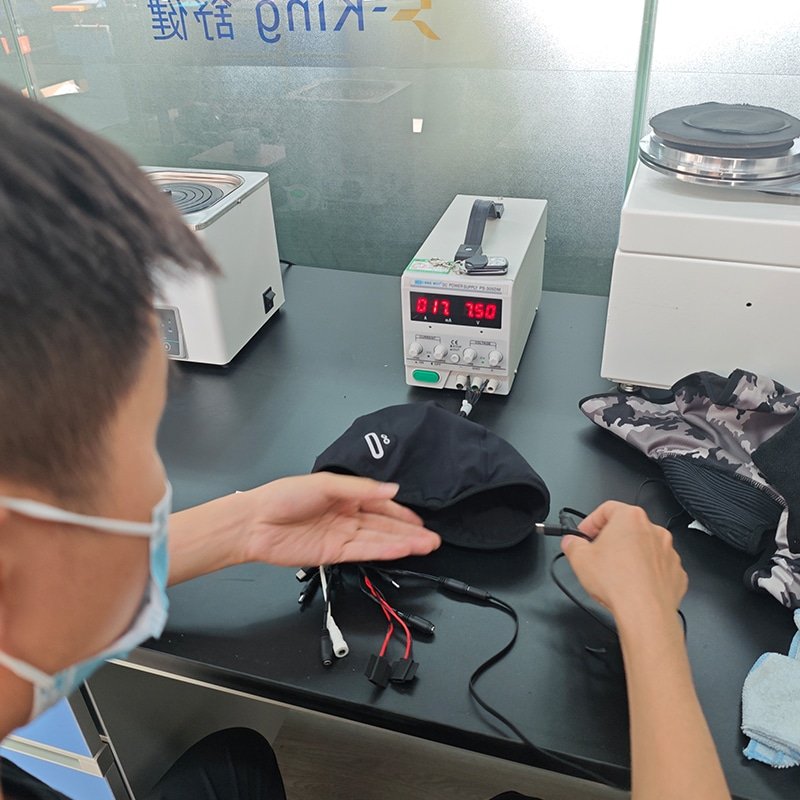
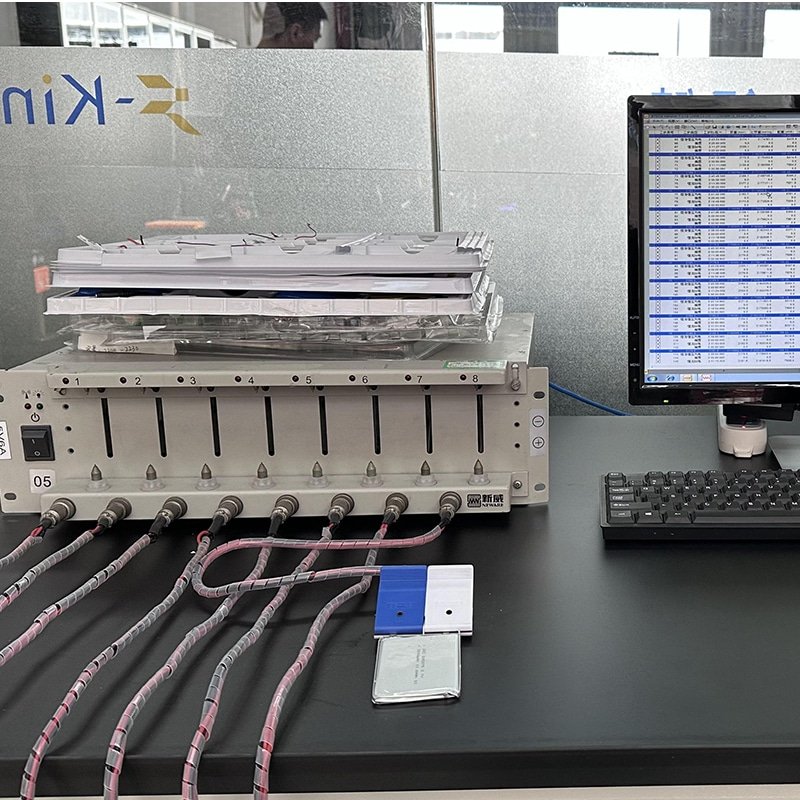
Their work starts with a design validation based on FEA simulations to estimate the stress concentration. Extreme bend cycles (usually 10,000 or more) and thermal shock, humidity exposure, and power cycling are also performed on prototypes to reveal weaknesses early in the development.
The selection of the material is biased towards fatigue-resistant conductors that have a consistent resistivity. Encapsulation involves malleable impermeable walls that have been tested to withstand stress.
The process controls consist of in-line checks on uniformity and automated electrical checks at various stages.
To understand structural considerations that can be used to inform these approaches, see our explanation of wearable heating element structure.
Failure Prevention Is a System, Not a Feature
There is no material, test, or coating that can wipe out all hazards but consistency comes through the integration of inter-disciplinary efforts.
Mechanical engineers streamline layouts, materials professionals pick materials that resist fatigue, electronics staff makes sure that protection aligns, and quality staff makes sure that processes are disciplined.
Failures of different technologies exhibit varying failure modes;for a contrast between common types, review heating wire vs heating film failures.
Conclusion — Most Heating Element Failures Are Predictable
The failure of heating elements in heated clothing is hardly an accident but a result of detectable strains that can be avoided through careful design, choice of materials, and testing.
Recognizing trends based on real life inquiries and employing engineering discipline at each phase of the process will allow manufacturers to decrease the failure rates by a significant margin and produce products that will work well over a period of time.