

Flexibility is not a cosmetic property in wearable electric heating products, it is a mechanical and electrical question that has a direct impact on reliability of heating elements, safety, and lifetime.
The third common myth of product developers is that flexibility is easily obtained by choosing either soft or thin conductive material. As a matter of fact, the design of really dependable wearable flexible heating is a multi-dimensional system level engineering issue that needs to consider the behavior of materials, structural geometry, electrical compensation mechanism, and extreme durability testing. Flexibility brings about failure mechanisms which other rigid heating systems never experience.
This article describes the main issues and the working methods of engineering to solve them, depending on the years of trial and error design, fatigue tests, and failure analysis of the clothes and accessories in the field during hot weather.
Why Flexibility Is a Core Requirement in Wearable Heating
The flexibility cannot be compromised since wearable heating products should be able to deform with the human body all the time.
Such daily actions as bending the elbows, bending the knees, twisting the backs, crouching, reaching make the garments and accessories alter their shapes several times and in various ways. When sitting or lying down, compression occurs, when tight-fitting layers are used, stretching is observed, whereas shear forces are observed during dynamic activities. Heaters that are stiff, cause points of pressure or limit natural movement will not be accepted by users. Wearable heating elements may be discussed in more detail as to the basic features that make see wearable heating elements.
Mechanical Stress and Repeated Bending Challenges
Repeated bending has been the most common mechanical risk factor to the reliability of flexible heating elements.
The strain created in each cycle of deformation is localized and is caused especially at locations where the bending radius is the least or where the structure is subjected to sudden changes. After the repeated cycles of micro-straining this results in fatigue cracking of conductive paths, interlayer separation, or total conductor fracture.
Stress concentration is found at garment seams, joints and in areas where the element changes region to another. In general, common situations are summarized in the table below:
| Stress Type | Typical Cause | Resulting Risk |
| Bending | Elbows, knees, shoulders | Conductor fatigue & cracking |
| Folding | Storage, packing | Local breakage, crease damage |
| Stretching | Tight garments, body expansion | Resistance drift, conductor pull-out |
Electrical Stability Issues Caused by Flexing
Flexing is not only a threat to mechanical integrity, but also directs electrical performance.
Any strain in the conductive network may result in a change in resistance of a few percent. The result of these changes is uneven distribution of current, and thus where the current is low, it causes resistance to be high, and where small areas are potentially hot, it causes the current to be low. In severe situations, controller instability or safety cut-offs may be experienced due to sudden jumps in resistance. These dynamics are crucial to the performance of a system; see heating efficiency for related factors.
Material Selection for Flexible Heating Elements
The material selection can have a very important impact on the survivability of a heating element to repetitive flexing.
The old metal wire has a constant resistance with fast failure of fatigue due to high cyclical bending. Carbon-based fibers and conductive films are typically much more enduring to cyclic, but are typically more resistant at the start and susceptible to environmental variations. Softness, fatigue life, resistance stability, and cost are always compromised in the key engineering decision. To make a practical comparison between the two prevailing technologies, refer to carbon fiber vs heating film.
Structural Design Solutions for Improved Flexibility
Intelligent structural design is equally important to make the best increment in the reliability of flexible heating elements, as opposed to material enhancement.
There are a number of techniques that engineers utilise:
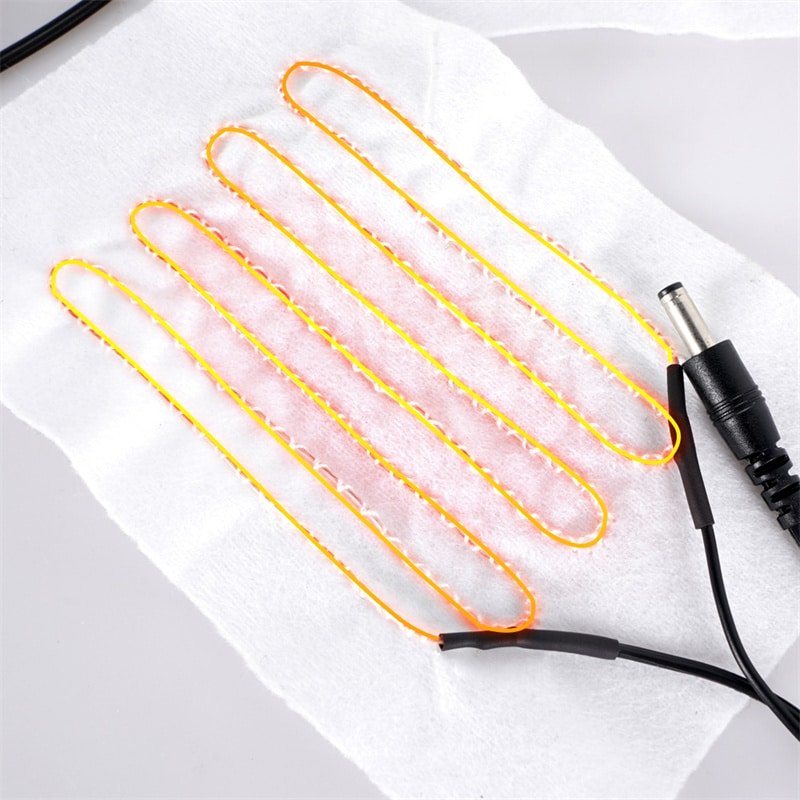
- Routing patterns to be serpentine or meandering to enhance effective length and spread strain.
- Installation of vital conductive circuits in the vicinity of the neutral axis of the layered structure.
- Zoned designs separating high-flex regions of constant-heat regions.
- Slow shapes and rounded shapes along stress concentration points.
Pattern and layout options are colossal in terms of durability and thermal experience.See heat layout for more on optimization strategies.
Complete solutions to such decisions regarding the structure are within the broader field of heating element design — choices taken at an early stage of the development have long-term implications on the product life.
Durability and Washability Considerations
Every wash cycle is a mixture of mechanical agitation, moisture exposure, temperature changes as well as chemical assault of detergents. Moisture may enter into micro-cracks, corrosion or electrical leakages may occur. In cases where encapsulation has not been implemented properly, delamination tends to increase exponentially once there are 2050 wash cycles. To achieve long-term wash durability in design, it is necessary to use specific types of barrier films, edge sealing methods, and rapid life test procedures. Practical advice on the same subject is provided in washable design.
System-Level Integration for Flexible Heating Elements
The flexible heating elements are to be in the presence of rigid components PCBs, connectors, sensors and wiring.
Flexing induced resistance variations need smart control logic that is able to compensate in real time without either over- or under-heating. Strain relief connector is important in avoiding early failures at interface, transition reinforcement and proper routing of leads. These integration challenges can be viewed in detail at, see PCBA integration.
Why Flexibility Must Be Addressed at the Design Stage
It is not possible to fix the flexibility issues in the future after the fundamental architecture has been established.
Attempts to increase tolerance to bends, such as later efforts to encapsulate with even thicker materials, make the substrates stiffer, or include additional conductors, almost always lead to loss of comfort, mass, or power efficiency. Its top-performing flexible heating components are the results of early and parallel engineering, which takes mechanical, electrical, and thermal needs into account at the same time.
Conclusion — Flexible Heating Requires Engineering Trade-Offs
The art of designing such flexible heating elements to wearables is a trade-off activity.
Engineers need to compromise between mechanical stability and electrical stability, washability and softness, cost versus life and also; user comfort versus safety margin. No material or even universal solution exists as the best one, but success is achieved through making conscious, well-informed decisions throughout the design stack and testing them with realistic accelerated testing.
It is this disciplined, system minded engineering process that can bring reliable and performance-driven heating elements to give the reliability and performance desired in the modern wearable heating products.