

When it comes to heated apparel, there is a trade-off between heating wire and printed heating film in terms of durability, thickness, distribution of heat, and the complexity of production, rather than a performance hierarchy.
Having worked on both systems over a 10 year period in real production runs, lightweight fashion jackets and heavy-weight construction gloves, I have come to realize that the technologies are mature, popular, and can deliver great results, once correctly implemented. The choice is hardly ever reduced to either of the two options: which is better overall or which is better in this specific garment, price point, and durability target.
Heated clothing presents loading to heating components unlike any other application:
- Flexes shoulders, elbows, knees and fingers thousands of times.
- Washing and drying of machines (an average of 30-60 cycles is expected of the consumer)
- Peak Comfort: no stiffness, no visible lines, no pressure points
- Safe low-voltage (7.4 V -12 V) operation at low battery capacity.
This is a crucial myth in the industry and exists because the common belief is that more heavy and industrial-looking heating elements are more durable. Practically, too thick often causes issues in comfort – the element can be felt, and it can add extra weight, and can also cause pressure ulcers. The actual engineering problem lies in the fact of toughness and wearability.
Overview of Heating Wire and Printed Heating Film Technologies
Both heating wire and printed heating film are proven commercially, and solutions to the problem of heating apparel.
Heating wire refers to wires composed of fine resistive metal (typically stainless steel, nichrome alloys or copper-nickel) patterned and typically covered by silicone, PVC or TPU.
Printed heating film (sometimes known as flexible printed heaters or conductive carbon film) consists of printed heaters, made by using conductive inks, normally a form of carbon with traces of silver to reduce resistance, on flexible polymer films (PET, PI, or TPU) by screen printing or gravure methods, and then an insulation layer and protection layer.
These two methods still co exist as they work on the design, cost and performance priorities of different combinations. They have not rendered either other obsolete and have both established robust niches of application.
| Aspect | Heating Wire | Printed Heating Film |
| Structure | Individual routed conductive wire(s). | Conductive printed on a continuous basis. |
| Thickness | 0.4–1.5 mm (including encapsulation) | 0.08–0.35 mm |
| Heat spread | Linear (follows wire path) | Planar (across printed area) |
| Typical use | Work clothes, gloves, combat stuff, heavy socks. | Base layer, jackets, insoles, vests, thin socks. |
| Production scale | Semi-automatic routing-manual routing. | Die-cutting and printing very automated. |
Structural and Manufacturing Differences
The primary contrast between the use of heating wire and the use of heating film which is printed is the way the two are manufactured and incorporated into clothing.
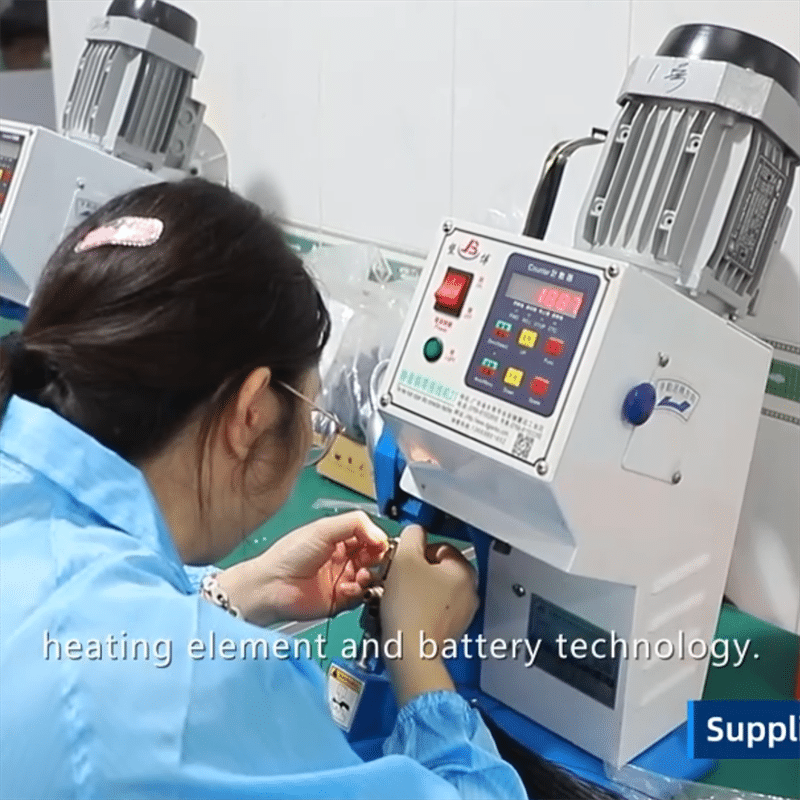
Production with heating wire is done by laying strands of individual wire in serpentine curves, with either a hand-guided machine, CNC wire placers or an entirely manual stitching factory. Lock-stitch sewing or ultrasonic spot welding is used to fix the wire which is then encapsulated. Comparatively lenient to pattern adjustment, this process is labor-consuming and slower in scale.
Printed heating film begins with large-format roll-to-roll printing of conductive and dielectric inks, curing, protective film lamination and fine die-cutting. After completing the panel, integration typically entails either full-surface lamination or high-frequency welding – both of which require very strict registration and cannot readily accommodate mid-run design mods.
The trade-off between manufacturing complexity is obvious: the wire systems need more physical labor and manual craft, and the film systems need more initial investment in tools and tools control but are more cost-effective at larger quantities.
To be fully explained on the overall wearable heating element structure, see: wearable heating element structure.
Heat Distribution and Comfort Implications
The most common area where users are likely to have observed the variation between the two technologies is heat delivery behavior.
Distinct linear heat paths are formed in heating wire. Even when 800 mm -15 mm is optimized, there are temperature differences between wires. In thin clothes this may result in a faint stripe feeling; in padded clothes which are thicker, it is normally invisible.
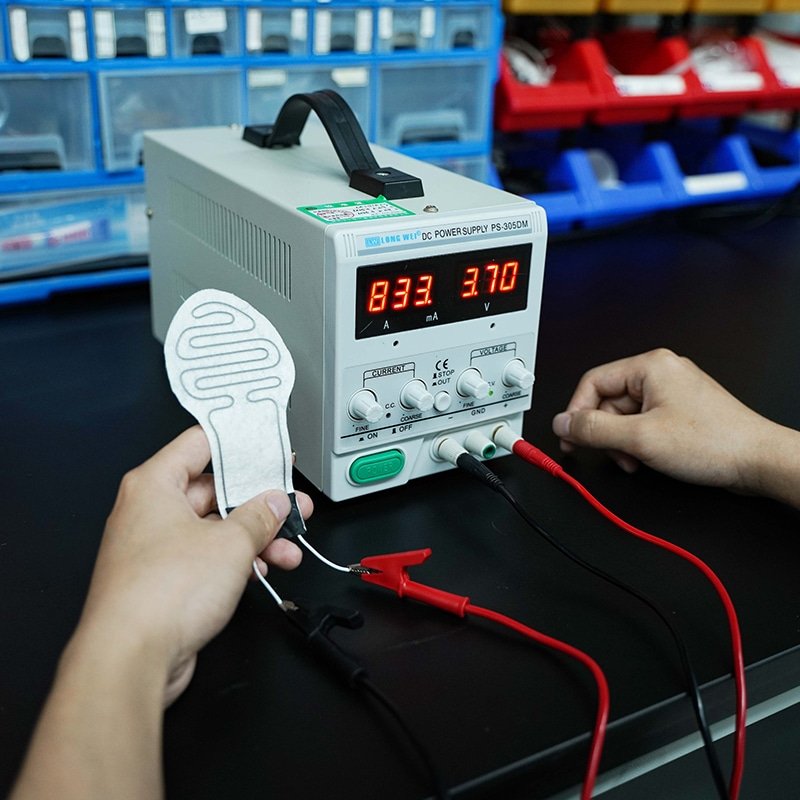
Printed heating films are able to heat a larger area at once, and offer much more even temperature distribution. Hot spots are not common except when the lamination is poor and localized delamination or cracking of ink.
The effects of comfort are specific to the body area:
- Large, flat (upper back, mid-chest, lumbar) panels → film almost always desired.
- Very mobile areas (fingers, thumbs, toes) → wire may be easier to pass through without being bulky.
- Tight based layers → film prevails because of low thickness added.
We have a detailed guide on the effects of layout patterns on the perception of overall warmth: heat uniformity in heated clothing.
| Factor | Heating Wire | Printed Heating Film |
| Uniformity | Moderate | High |
| Hot-spot risk | Higher (especially if bunched) | Very low |
| Perceived comfort | Variable | Generally more consistent |
| Best suited zones | Fingers, palms, small areas | Large body panels |
Efficiency and Power Utilization Differences
Both technologies in theory convert electricity to heat with nearly 100% efficiency. Inequalities are experienced in real working conditions.
Resistance of heating wire is normally very constant throughout the operating temperature range (typical TCR <0.001/ deg C ) and therefore predictable power output is exhibited at all temperatures.
Printed heating film (especially carbon-based inks) may often have similar positive temperature characteristics – resistance increases 15-40 percent with temperature. This self-limiting effect has the capability of enhancing safety and can somewhat extend battery life under higher settings, though must be more finely tuned on the controller in order to provide a level of constant perceived heat.
Differences in battery run time can be quite small (usually 310 percent) and can be easily obscured by insulation, total area heated, and efficiency of the controller.
Additional information on the factors impacting on heating efficiency is found here: factors affecting heating efficiency.
Durability, Flex Life, and Washability Trade-Offs
The only significant distinction that many brands make is long-term reliability.
Properly encapsulated and routed heating wire systems (which have strain relief) consistently pass 50,000 flex cycles and 50-80 wash cycles. Extreme kinking can be a single-strand break, however, system redundancy is generally good.
Printed heating film may also reach the same numbers of washes, though is usually more susceptible to frequent sharp creasing and shear forces. Micro-cracks in the conductive layer or adhesive delamination at edges are the most widespread failures and both progressive and hard to notice at an early stage.
Integration Constraints in Heated Apparel Design
Theoretical merits are often outcompeted by integration facts.
Heating wire is the best when designers require the greatest routing liberty, simple sectional substitution, and the merging of this structure with current seam designs. The negative is increased bulk and weight.
Printed heating film can be best used to reduce thickness and create smooth look but large continuous lamination spaces are needed and a cut off service is more difficult after production.
This step describes in detail the decision tree of the whole heating element design, including selecting the required material, all the way up to the final integration:heating element design.
Application-Based Pros and Cons Summary
The dissimilarity of the apparel types dictates various priorities, and that is why both technologies are still a necessity.
| Apparel Type | Preferred Option | Primary Reason |
| Heated jackets & vests | Printed heating film | Superior uniformity + minimal thickness |
| Heated gloves & mittens | Heating wire | Precise finger routing + mechanical toughness |
| Heavy workwear & outerwear | Heating wire | Best crush & flex fatigue resistance |
| Heated socks & insoles | Printed heating film | Lowest profile + even footbed coverage |
| Ultra-light base layers | Printed heating film | Almost imperceptible when worn |
Conclusion — Choosing Based on Manufacturing Reality
In hot wear, manufacturing limitations, comfort needs, and expectations of a long service life should determine the choice of heating wire or printed heating film instead of a performance metric.
The two systems have the potential to provide safe, dependable and comfortable warmth when properly designed and produced. The most effective products are the products that come about as a result of a good comprehensible of the trade-offs and aligning the heating technology with the final applications of the garment, volume production and target price positioning.
To gain more information about the issues of material selection, refer to: see: flexible heating element materials.