

The speed with which problems in electronic architecture can be addressed is directly dependent on the control in the electronics architecture in the sphere of heated apparel development.
The majority of timeline slip in the case of heated apparel projects is not due to the lack of technical ability in the crew or due to abnormal challenges in the physics of heating. The actual inefficiencies nearly always occur in the interstitions between disciplines between electronics and garment engineering between hardware and the software that runs it between design purpose and the reality of production. These gaps turn into the chasms when core electronics decisions are outsourced and they are filled with emails, review cycles, clarification meetings, waiting until partners in other time zones reply.
Most OEMs and brands still assume that by outsourcing the electronics part to an extraneous third-party solution provider, they will be automatically developing faster. The reverse often occurs in practice: outsourcing is often a disaggregation of system-level ownership, increased latency of communication, and a small design trade-off into a multi-week negotiation cycle. What comes out is a project that would be fast during the first three months and slow during the remaining nine months.
With an experience of overseeing several of our seasonal heated clothing initiatives since conception to mass delivery, the single largest accelerator I have experienced is unequivocal inside proprietorship of the electronics structure. In garment-constrained and circuit-constrained, when the same group of individuals is in charge of the circuit decisions, iteration takes days more than weeks.
Why Heated Apparel Development Timelines Commonly Slip
Timelines Heated apparel timelines notoriously have a low tolerance due to the fact that the product is at the nexus of three largely dissimilar languages fluencyes: flexible textile engineering, high-current power electronics, and battery safety logic.
Any modification of heating floor plan, battery location, connector routing has a downstream impact on power delivery, thermal sensor, and protective circuitry. These decisions, when the core development staff is not directly in the development team, can require 24 weeks or more to make even minor changes; a sort of chain reactions involving questions, redlining, and countersuggestions. Late finds, like a thermal sensor location that causes stitches to break, or a current peak that causes protection circuit activation during typical operation, usually necessitate rerethinking of subsystems once fabric patterns and tooling are already finalized.
The main source of schedule risk lies in the dependency chain that is formed by the outside electronics partners. With every handoff, there is a latency, context loss and the likelihood that vital interactions of the systems will not be found out until much sunk cost has taken place.
How In-House Electronics Ownership Changes Development Dynamics
Electronics internal ownership seriously changes the speed of completing problems.
Trade-offs are analysed on the fly when the same engineering group is in charge of the schematic decisions and the garment integration constraints. A designer may make twenty steps to the apparel engineer, sketch the suggested board outline on the actual pattern, and instantly tell whether the proposed connector position kills the seam integrity or causes an objectionable bulge to a pocket. Minutes then, rather than weeks of toing and froing drawings, are used in that conversation.
Lack of alignment amongst teams is significantly minimised. Hardware designers sit beside the firmware engineers, which means that the calibration constants, fault-handling states and temperature-control algorithms can be tightened off in parallel instead of in sequence. The outcome is a reduction in the number of revision loops, as well as a significant reduction in the amount of revisions under the guise of the latter.
To gain this benefit in an organized way, organizations interested in seizing it can take the first step centralized electronics architecture for heated product development early in the project lifecycle eliminates most of the coordination drag that plagues outsourced models.
Iteration Speed — The Hidden Advantage of In-House PCBA Teams
The one most potent contributor to the pace of development in projects involving hardware is iteration velocity, which can be provided by internal PCBA capability in the manner it can hardly be outside of the industry.
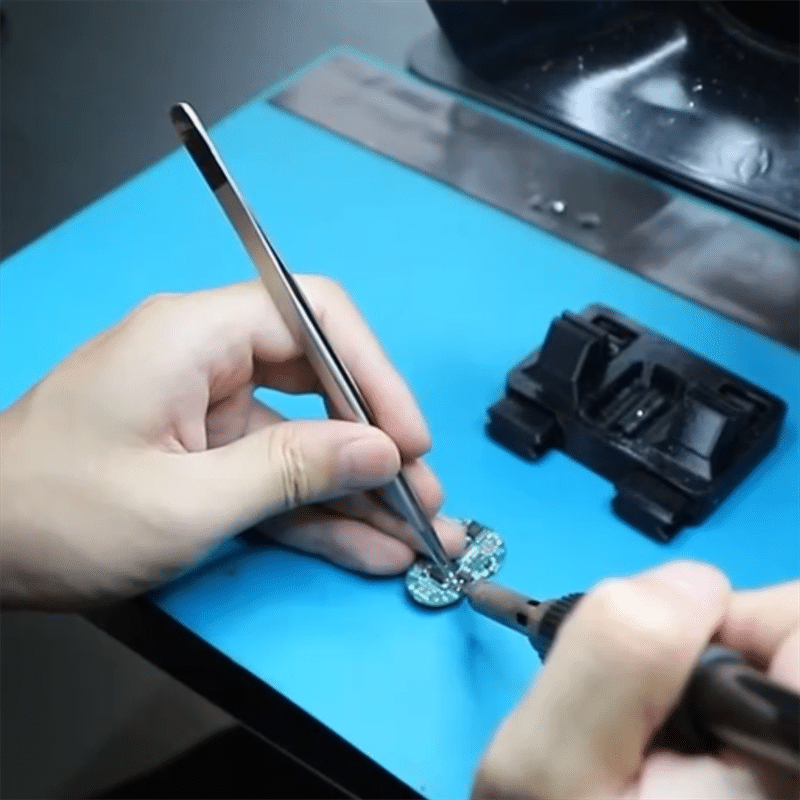
Having an internal team, schematic modifications can be made, laid out and ordered to basically have quick-turn prototyping in 4872 hours. On the occasion when a measurement of heating element resistance is returned 8% less than desired, re-simulation and re-selection of MOSFETs are possible and a new revision can still be fabricated during the same week. The following day, the new board can be flashed with the firmware, and the new thermal behavior should have been tested with a real garment sample by Friday.
This narrowing loop cannot be done easily when one depended on a partner. Formal ECR, new review of partners, new quotation on additional engineering hours, new PO and 2-4 weeks wait to receive the updated prototype would be needed to implement the same change; this would mean that the next milestone of an integration would be delayed at least a month.
With seasonal business where market windows are predetermined, such variation in the speed of iteration translates directly into a product being shipped to the current winter or sent on hold to the next.
Reducing Rework Caused by Late-Stage Electronics Changes
One of the most expensive and time consuming processes in the development of the heated apparel is late-stage electronics changes.
When an outsourced electronic design uncovers a fatal defect in the fabric patterns once cut, injection molds once cut, it is vile: tooling changes, re-sampling, re-testing, and a few times, a total re-quality assurance of safety systems. All these measures have the potential to lengthen every single project by between 8 and 16 weeks and tens of thousands of non-recurring expenses.
Most of these problems are internalized at a much earlier stage due to participation of the electronics team in garment fit tests, battery placement tests and early textile prototyping. The risks of the system are identified and removed when the changes are still cheap and quick.
A closer examination of the common causes of such cascading delays can be seen in the error in systemic electronics errors that delay heated garment launches.
Faster Compliance and Safety Validation Through Internal Control
The bad ones in terms of timeline killers in the process of heating clothing are regulatory compliance and safety validation.
CE, FCC and UL specifications require fault mode analysis to be detailed, measure creepage, test thermal runaways, and test abnormal operation. These requirements when externalized as electronics design need to be converted into design inputs, and checked under conditions of repeated review, and later checked (after delivery) of samples- usually to find gaps where significant redesign is needed.
The compliance thinking is developed into the architecture by internal teams based on the original schematic. During layout reviews, creepage checks are made, fault-injection tests are run on early breadboards and safety margins are verified using an iterative approach instead of found out at certification. It creates the outcome of a smoother submission package, the reduction in test failures and the reduction of the possibility of schedule resets to a considerable level.
Important regulatory planning considerations are covered in electronics compliance planning for CE FCC and UL approval.
Development Speed vs Long-Term Stability — Avoiding False Trade-Offs
One thing that a lot of people worry about when it comes to faster development is the fact that speed will lead to loss of the long term stability of the product.
Practically, the reverse is so when acceleration is done in the form of superior organizational control, compared to short-cuts. Internal ownership is a type of ownership that enables teams to test system behavior under a broader set of conditions at an earlier stage of the process. The effects of battery aging, connector deterioration, textile compression and corners cases of firmware can be investigated during development and not necessarily realized in the field.
The speed created by decreasing the time to make a decision and the closeness of cross-functional profile actually leads to greater confidence in the finished product. Shortcuts, i.e. not doing a proper margin, habits of not taking time in compliance, perpetuate instability. Control creates both.
When In-House PCBA Capability Makes the Biggest Time Difference
All three situations are the strongest when it comes to the time compression advantage of owning internal electronics.
To begin with, there are seasonal releases of products having pre-determined time frames in the market. The loss of a single month of winter collection can result in one year of revenue. Second, multi-model product families which differ in core electronics but differ in heating zones, battery size, or form factor. Internal teams stand to benefit as the reuse and adaptation of proven blocks can be completed in a very short time compared to renegotiating scope with an external partner when each variant is considered unique. Third, smart or app-controlled heated clothing, where the application of Bluetooth, mobile app interaction, and sophisticated state machines generates a lot of edge cases.
According to all three instances, the capability to make quick, system based decisions, free of external dependencies, can be the reason behind the on time delivery and a tremendous delay.
These integration complexities are explored further in electronics system integration challenges in app-controlled heated clothing.
Conclusion — Development Speed Is an Organizational Choice
This is done through shorter development spans in the dominant apparel through heating, but not by increasing the pace of work, but the process of cutting the development interval is made shorter. When decisions such as the electronics architecture are owned internally, system-level problems get resolved before it develops costly schedule risk. The friction in coordination reduces, loops in the iterations are reduced, unexpected situations that occur at the end of the day are reduced and the route of compliance becomes preditable.
Right down to it, the rate of development is never an issue of engineering horsepower but a question of organizational structure. Making the ownership of the electronics part of the core team is one of the strongest structural decisions that a firm can make in case time-to-market is a competitive factor. With seasons determining success, such a decision often determines first to customers and, more importantly, profitability in doing so.