

During hot wearables, the safety is defined by the control of power, temperature and battery behavior, which is not by the fabric or heating components but rather by the PCBA. Being a person, who has spent years developing electronics in heated clothes, I personally experienced how a properly designed PCBA may avoid disasters, and a badly designed one may be closer to them. This is not a marketing hype thing but instead the hard engineering decisions that can ensure safety of users in the real world scenarios.
We are going to plunge into the reasons why PCBA is the safety pinch point, the risks that are likely to be encountered as a result of design shortcomings, and the practical decisions that would improve reliability. By this point, you will know how to make PCBA a priority in your heated wearable project.
Why Safety in Heated Wearables Starts at the PCBA Level
The most effective heating components and fabrics cannot ensure the safety of users without a well-built PCBA background.
PCBA- Printed Circuit Board Assembly is the brain of the heated wearable gloves, jackets or insoles. It controls how power is distributed by controlling voltage and current to heating components to make sure that energy is effectively used and there are no overloads. The temperature response is managed using built-in sensors and logic to dial heat output in real time to avoid the spikes that may inflict burns. The operation of the battery is regulated through protection circuits which check the charge level and eliminate risks such as over-discharge in order to reduce battery performance or pose a safety risk.
Basically, PCBA is a comprehensive assemblage of corporate software and hardware aimed to decide within a few seconds, transforming raw materials into a safe and operational product. And skimp it here, and all the system is at a loss.
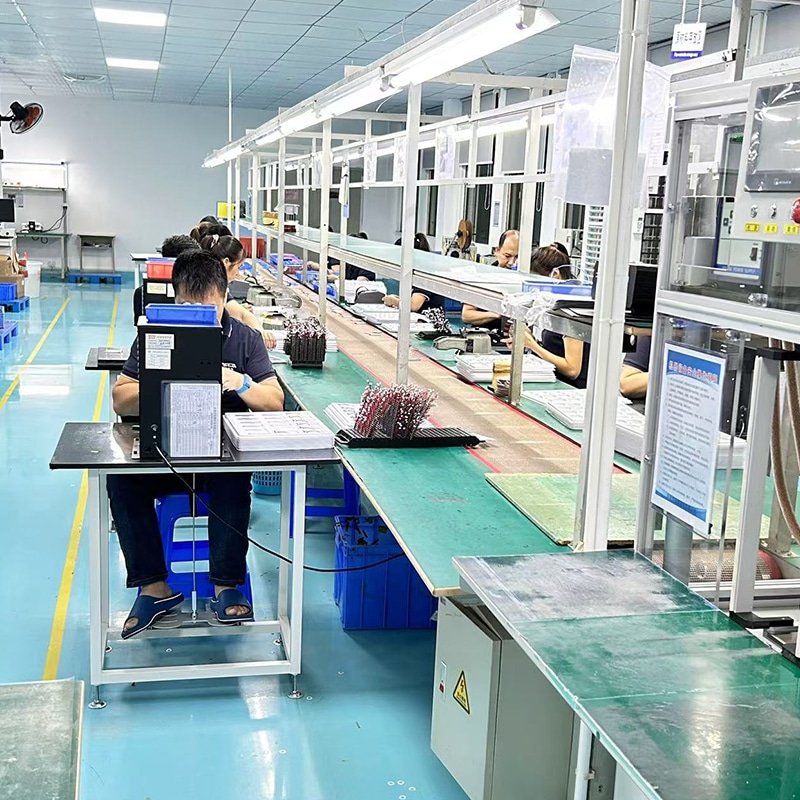
Key Safety Risks That Originate From Poor PCBA Design
The majority of the accidents in heated wearables can be related to PCBA weaknesses and not to external influence such as user error or wear.
| Safety Risk | PCBA Design Cause | Potential Outcome |
| Local overheating | Poor temperature feedback logic | Skin burns |
| Battery over-discharge | Lacking security padlocks. | Battery damage |
| Short circuit | Inadequate trace spacing | System failure |
| Thermal runaway | No current limiting | Fire hazard |
| Heating instability | Poor regulation | User discomfort |
The above-presented risks underline the fact that the PCBA design determines the safety of heated wearables directly. As an example, the lack of proper feedback loops may lead to the uncontrolled rise of temperatures, whereas the loose trace layout may be exposed to electrical faults during flexion or exposure to moisture.
Addressing Overheating Through Better Design
The causes of overheating are usually the partial sensor integration or careless firmware calibration, which makes a promising prototype into a liability.
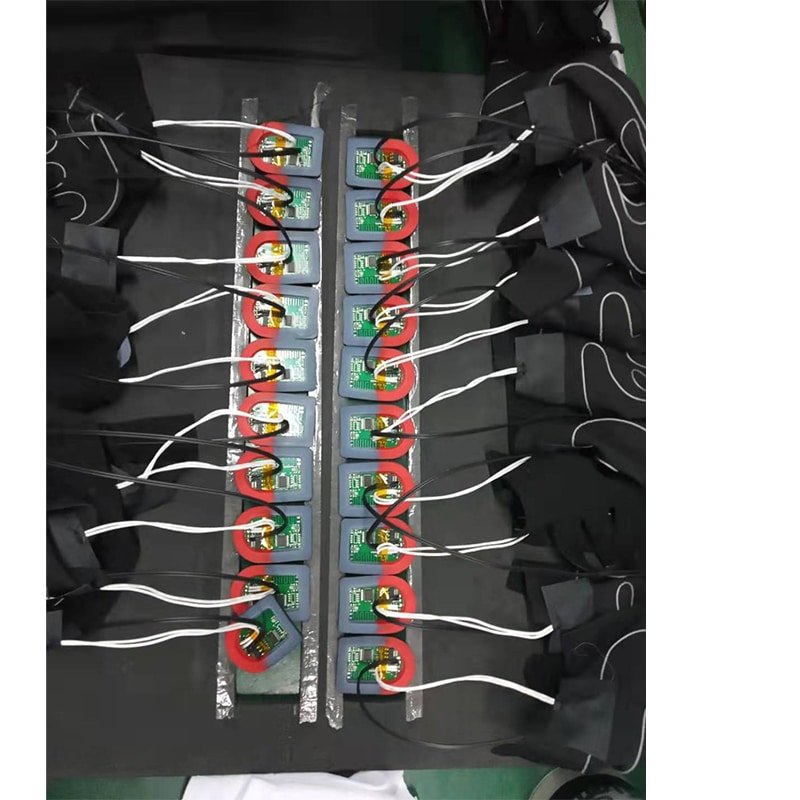
How PCBA Controls Temperature Stability and Prevents Overheating
Temperature management of heated wearables requires a rigorous PCBA engineering, and control causes avoidable risks.
The mechanism is closed-loop temperature control, the garment has sensors that send data to the PCBA, which processes the data with firmware logic to control power. This forms a dynamic system that reacts to the ambient conditions, motion of the user or the insulation. As an illustration, PCBA design for heated wearable products, must be able to incorporate NTC thermistors and PID controls to keep heat within a safe range such as 40-50 o C of skin contact.
A material failure is uncommon in overheating, typically it is a control problem, delayed sensor response or inadequate calibration. Fair PCBA installation will expect these and will have redundancies such as auto-shutoff triggers in order to ensure stability.
Firmware’s Role in Real-Time Adjustments
Data from sensors is then processed by firmware on the PCBA within milliseconds and the output is modified so that the sensor does not reach high levels which might be uncomfortable or even harmful to the user.
Battery Protection Circuits as a Core Safety Layer
The Lithium batteries used in hot wearables are very strong yet unstable and PCB-built safety cannot be compromised.
Li-Ion batteries are associated with some risks such as swelling, leakages, or explosions in case they are not handled properly. PCBA-levels of protection encompass over-current protection to limit discharge rates, over-charge circuits that terminate input when it has reached full capacity and over-discharge prevention to prevent deep cycling that would reduce life or introduce instability.
So what is so special about this as opposed to battery specs alone? Even a good battery with no strong PCBA support may fail when subjected to variable loads such as when used under high heat conditions. In battery protection circuit design for heated clothing, current and temperature simultaneously so that when conditions become dangerous the system can be shut down before they are hazardous.
Integrating BMS for Enhanced Protection
The PCBA is equipped with a Battery Management System (BMS) that creates an additional cell balancing layer that is required in multi-cell packs of high-output wearables.
Why Safety Failures Often Appear During Real Use, Not Lab Testing
Simulation of ideals is done in lab tests, however, it is real-world variables that reveal the weaknesses of PCBA that are not encountered under static conditions.
In real-life situations, heated wearables are compressed during folding, damaged by moisture during sweat or rainfall and spend more time than during test cycles. These must be designed in a PCBA, such as with conformal coverings to make it waterproof or with flexible traces to allow it to be bent without shorting out.
Other non-beneficial tasks, such as charging in low temperatures or not paying attention to low-battery indicators, enhance hazards when the PCBA does not have adaptive logic. This is the reason why field data can easily uncover failures that the labs do not see the necessity of designing resilience in the first place.
PCBA Design Decisions That Improve Long-Term Product Safety
Safety as a design consideration in PCBA results in wearables that are durable and leads to fewer recalls and trust.
| Design Decision | Safety Benefit | Long-Term Impact |
| Conservative current limits | Reduces thermal stress | Longer life |
| Redundant sensing | Prevents single-point failure | Higher reliability |
| Stable power regulation | Avoids spikes | Consistent comfort |
| Firmware fail-safe logic | Prevents runaway | Compliance readiness |
Such decisions as the use of redundant sensors make the system not to fail on the basis of one defective component. In exploring common PCBA design mistakes in heated apparel, it’s clear that skimping on fail-safes leads to accelerated wear, while thoughtful integration extends usability.
Scaling for Durability
Scaling of these decisions includes prototyping which is commonly tested with stress testing under simulated abusive conditions in order to confirm long-term safety.
Common OEM Misconceptions About Heated Wearable Safety
Most OEMs underestimate the role of PCBA as they are pursuing specs that sound good without paying much attention to the fundamental dynamics of core safety.
A myth is that the more the watt the warmer it is, however, this is not the case because unregulated power spikes can be dangerous without PCBA throttling. It is also the use of fabric insulation to ensure safety, which is to manage the distribution of heat actively by PCBA. Lastly, the assumption that failure is avoided with the use of lab testing ignores variables of actual use.
In comparing PCBA design vs off-the-shelf controllers in heated clothing, third party solutions are better than off-the-shelf due to the ability to optimize protective single-garment requirements.
How OEMs Should Evaluate PCBA Safety Capability in ODM Partners
Partnering with ODM requires the company to look into the PCBA capabilities of the partners because the assembly skills will not guarantee safety.
Search engineering ownership: Are they in-house or outsourced? An actual partner is one that owns the process between schematic to firmware. They should be proved to be safe through accelerated life testing, and not simple tests.
Separate the assembly vendors, who solder components, and the actual PCBA designers, who consider safety as a design goal. Review their track record with PCBA design requirements for CE, FCC, and UL to confirm compliance integration from day one.
Key Questions for Partners
Inquire about the failure analysis procedures and the way they include user-feedback to PCBA revisions.
Conclusion — Heated Wearable Safety Is Designed, Not Tested In
Wearable heating safety is not a feature added afterwards, the PCBA is designed to be safe on the ground level. Through control logic, protection circuits, and resiliency in design, developers are able to design products that are able to safely secure users. It is important to keep in mind that the most efficient safety measures know about the failures even before they happen, and transform the possible hazards into nonexistent.