

In wearable heating, moisture protection and insulation design cannot be considered outside of electrical safety, failure in either can result in short circuiting, over heating or injuring the user. The exposure to moisture is inevitable in the application of heated clothes, gloves, insoles or jackets in real life. Users do sweat when active, they can experience the rainy and snowy weather outdoors in the environment and have to get the products through the washing cycles many times to maintain their condition. Waterproof outer fabrics are often misused under the belief that they can entirely protect the inner heating components but in practice, they fail to stop internal water vapor inside the garment that is transported through stitches, zippers, seams and other forms of connector thus posing continuous risks to electrical well-being.
Professional manufacturers do not consider insulation a coating but multi-layered and system-level engineering solution. This method combines the material science, structural design and strong testing to reduce the failures that occur in the product due to moisture over the product life period.
Why Moisture Is a Major Risk in Wearable Heating Systems
Moisture is a critical risk since wearables heating works under closed, micro environments with a body contact and thus it traps humidity.
The human body always sweats, particularly when one is engaged in a physical activity in cold weather where body heat is most required. This internal humidity accumulates within the garment creating a warm and wet pocket around the heating elements. Exposure to external factors such as rain, snow or splashes go through fabric pores or joints whereas washing will introduce detergents and extended immersion in water. Condensation also occurs due to variations in temperature where hot, humid air comes into contact with surfaces of lower temperature.
All these reasons form a hostile environment in which moisture could settle and stay longer to aggravate the deterioration of electrical devices.
The following is a list of the most frequently used sources of moisture:
| Moisture Source | Typical Exposure Scenario |
| Sweat | Extended stresses in the course of activity or work. |
| Rain / snow | Outdoors use during rainy weather. |
| Washing | Washing cycle using detergents. |
| Condensation | Differences in temperature when using/storing. |
These conditions require active engineering to be undertaken instead of passive protection.
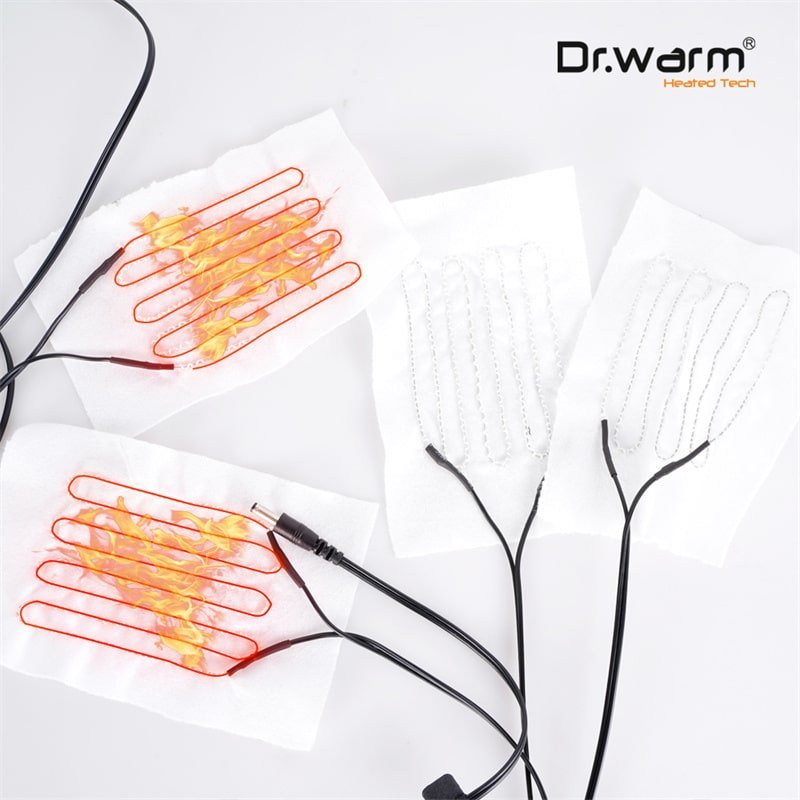
Electrical Risks Caused by Moisture Exposure
Moisture is a threat to electrical safety by a number of ways that have been well documented.
First, it allows short circuits to occur by conducting heating traces or wires together, going directly around the intended resistance, and resulting in quick overheating. Second, the damp insulation is conducting leakage current, which decreases the efficiency and creates the risk of shocks. With time, moisture causes corrosion of conductive materials; copper traces or connectors and results in resistance drift, non-uniform heating, and open circuits.
Such risks are increased in flexible systems in which mechanical stress increases damage. To understand more about these related failure modes, see our analysis of why heating elements fail in heated clothing.
Insulation Layers and Their Role in Electrical Safety
Good insulation in wearable heating elements is not only beneficial in offering primary electrical protection but it is also a barrier to environmental ingress.
Primary insulation isolates live conductors directly between one another and also to the user, and stops current flow during both normal and fault conditions. The outer layers revolve around moisture barriers, whereas secondary layers are resistant to abrasive and mechanical damages.
Real electrical insulation is not just mechanical protection dielectric strength, volume resistivity, and breakdown voltage are important parameters, and mechanical layers are much more concerned with flexibility and durability.
The concept of multi-layer insulation is professional design:
| Layer | Function |
| Primary insulation | Electrical isolation |
| Secondary insulation | Moisture barrier |
| Outer protection | Abrasion & wear resistance |
These layers are used in harmony and the materials chosen to be compatible in flexing, heat and humidity.
For core principles in this area, refer to our hub on heating element design.
Common Insulation Failure Mechanisms in Wearable Heating Elements
The most common cause of insulation failure in both heated wearables is due to recurrent mechanical and environmental pressures.
Flex cracking Flex cracking takes place as brittle coatings or films break in bending and expose conductors. Delamination during cleaning is caused by the breaking of adhesives or dissimilar thermal expansion that permits the access of water between layers. Polymer bonds are attacked by chemical degradation of detergents and the dielectric properties are reduced after many cycles.
These mechanisms emphasize the requirement of materials which are highly elongated and hydrolysis-resistant as well as materials with strong adhesion. Learn more about mechanical challenges, explore flexible heating element challenges.
Moisture Resistance Strategies Used in Heating Element Design
In the manufacture of strong shields against moisture, manufacturers make use of encapsulation techniques.
Heating traces are totally sealed with full encapsulation (e.g. potting or over-molding with flexible polymers). Terminal and joint sealing involves the use of specialized adhesives or heat-shrink tubing to avoid entry points. The permeability of controlled material is used to choose low-moisture-absorption materials such as a silicone material or polyimide, and to avoid hygroscopic insulators that might trap water internally.
Such strategies constitute a system that ensures integrity by flexing thousands of times, washing thousands of times, much more than basic surface processes.
Interaction Between Insulation, Layout, and Heat Distribution
The thickness and position of the insulation have a direct effect on the heat transfer.
The more dense layers are used to increase the dielectric strength and moisture resistance, though may inhibit thermal conduction to the user, thus perceived warmth is reduced. The layout has to be able to strike a balance between coverage of even heating and insulating over-areas in hot areas.
Optimization is done through strategic positioning of heating traces and insulation positioning by engineers. This trade-off impacts safety as well as comfort- see how heat uniformity and comfort ties into these decisions.
Validation and Testing for Moisture and Insulation Reliability
Reliability requires strict repeatable protocols of test.
Water exposure tests recreate controlled submersion or spray cycles of rain, immersion or sweat. Measurement Dielectric integrity Pre- and post-exposure Insulation resistance (with megohmmeters) is measured with high values (usually >1 M 0 cold). Electrical validation After washing Post-wash electrical validation comprises of aging simulations repeated laundry, leakage current and breakdown tests.
To consider the wash-specific,aligned with standards like IEC or UL, confirm long-term performance under realistic abuse.
For wash-specific considerations, review our guide on washable heating element design.
Conclusion — Moisture Safety Is Engineered, Not Assumed
Moisture risks are common and unavoidable in wearable heating elements and engineers have to manage this risk via integrated design.
Insulation performance is achieved through strategic decisions of materials, structure and validation and not just the use of outer fabrics or simple coatings. The system level responsibility is the guarantee of electrical safety, dependability and safety in use under rigorous applications.