In the case of heated socks, OEM implies that the brand provides the specifications of the design and the heating system, the materials and the performance goals whereas, the factory does the production work. ODM, in their turn, begins with the pre-existing design and platform made by the manufacturer, such as heating components, battery integration, and control systems, and the brand modifies it with branding, some small modifications, and packaging.
Both of the models cover the actual requirements in the wearable heating sector, yet they are used to support distinct strategic concerns. The main problem that many brands make is the belief that OEM heated sock can always achieve better outcomes merely because of increased possibilities of customization. Practically, ODM heated socks can be more effective in which the brand aims at fast entry, confirmed demand, or limited internal capabilities.
Whether to go with OEM or ODM heated socks is the right decision, which is based on the level of control over the product, the investment required in product development, and the technical differentiation needed by the brand.
What Is OEM in Heated Socks Manufacturing?
OEM is still the preferred model in cases when the brand requires ultimate control of the technical design and positioning of the heated sock.
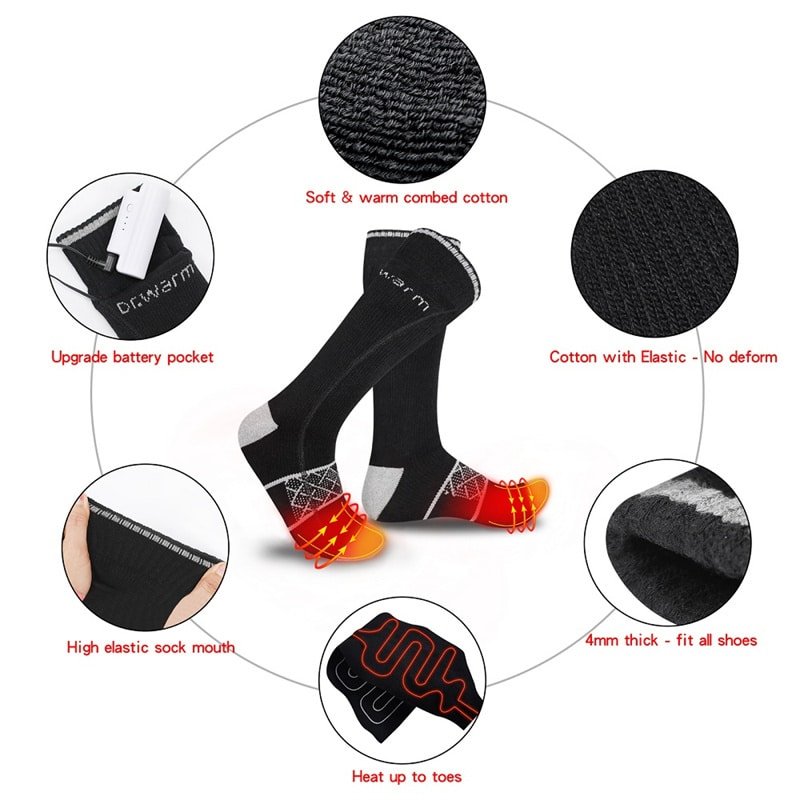
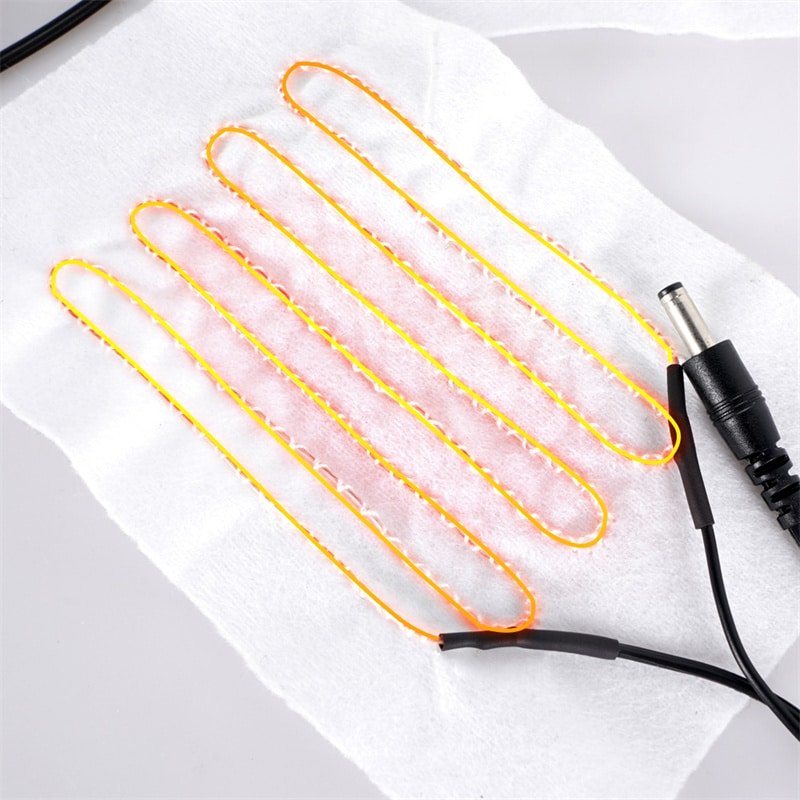
In OEM, the brand has the greatest responsibility of the product blueprint. This involves defining the type of heating element (carbon fiber film, wire layout, or hybrid), voltage platform (usually 3.7V or 7.4V between battery life and heat output) zone placement (toe, forefoot, arch), temperature range and step control logic, battery capacity and placement make sure it is not under pressure), controller ergonomics, and washability standards.
The producer compliantly manufactures as per such specifications, and makes changes to tooling, assembly conveyors, and quality measures where necessary. The brand owns the IP in design, manages the performance validation, and orchestrates third-party testing in terms of safety and endurance.
A great deal of initial engagement is required with this method: tech packs, a series of sample sessions, and extensive cooperation between engineering. It is applicable in scenarios where a competitive advantage is the differentiation by special heating profile or integration capability.
Here’s a clear breakdown:
| OEM Factor | Brand Responsibility | Manufacturer Role |
| Product Design | High (full specs and IP ownership) | Production execution |
| R&D Investment | Required (design, prototyping, testing) | Technical support and adaptation |
| Customization | Extensive (heating zones, battery, materials) | Engineering feasibility checks |
| Time to Market | Longer (depends on complexity) | Scales with approved design |
What Is ODM in Heated Socks Manufacturing?
ODM heated socks capitalize on the existing platform that has proven successful in the market, leaving brands to focus on how to fit in the market as opposed to developing everything on the ground.
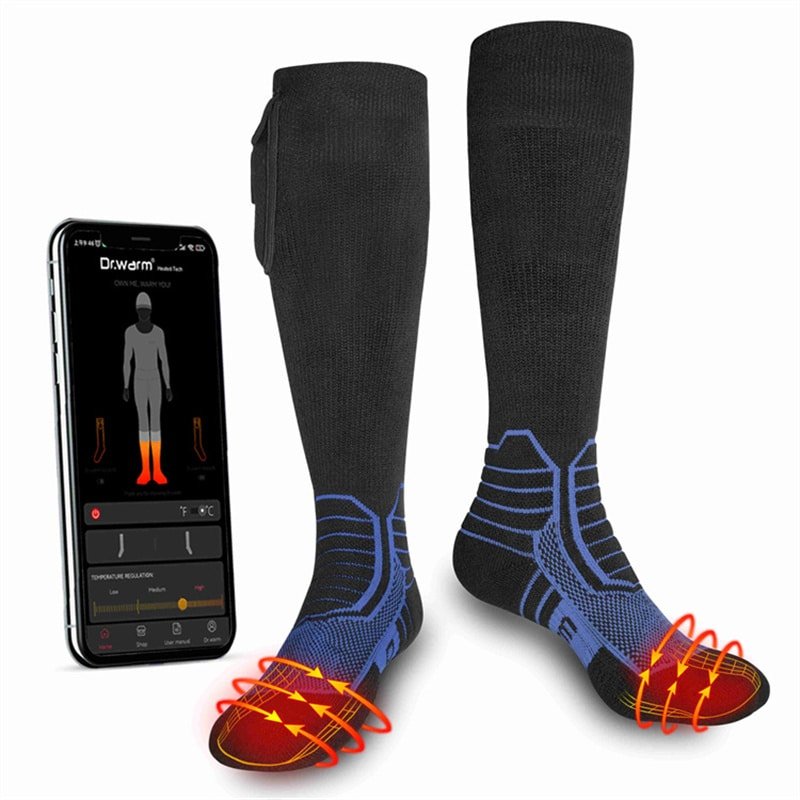
The factory has already put available R&D: improved patterns of heating films that do not form hot spots, good battery management systems (BMS) to avoid over-discharge or overheating, multi-level controllers with remote or app connectivity where possible and fabrics resistant to repeated washing without loss of conductivity.
Brands pick out choices in catalog, and ask minor modifications, e.g. changing the colorways or differently positioning the logos, or modifying the size, or putting their own branding on. The development costs remain minimal since the basic engineering, mould tools and certification preparation have been done.
This model has the benefit of being faster in launch and ensures that there is a lesser chance of technical failure but, has structural limitations on how much the final sock can deviate form the design of the base.
| ODM Factor | Brand Responsibility | Manufacturer Role |
| Product Design | Limited (selection + minor tweaks) | Pre-developed design & platform |
| Development Cost | Lower (R&D already completed) | Full R&D ownership |
| Customization | Moderate (branding, limited functional changes) | Standardized production |
| Time to Market | Faster | Ready-to-scale lines |
Strategic Differences Between OEM and ODM Heated Socks
The fundamental difference between OEM and ODM heated socks is the risk, investment and control location which directs the scalability and differentiation possibility.
Product uniqueness is high in OEM because it provides custom heating distribution, bespoke battery arrangements (e.g. larger capacity when running long in extreme cold), and unique control software. It has greater initial expenditures (tooling, sampling copies, certification per one-of-a-kind spec) and extended schedules, and enjoys better brand differentiation in high-end outdoor and ski or tactical sectors.
ODM reduces financial risk and shortens the time-to-market, which are best suited in validating category demand or venturing into adjacent markets (workwear, medical warmth). Trade offs consist of moderate uniqueness – competitors can have near identical base platforms – and less ability to take radical technical departure.
| Criteria | OEM | ODM |
| Product Uniqueness | High | Moderate |
| Cost Structure | Higher upfront (design & tooling) | Lower upfront |
| Flexibility | High | Limited |
| Speed to Launch | Slower | Faster |
| Brand Differentiation | Strong | Moderate |
Many established heated socks manufacturers offer both paths, allowing brands to begin with ODM to test waters and transition to OEM heated socks manufacturing solutions once data supports deeper investment.
When Should a Brand Choose OEM?
The existing brands with a definite goal of technical leadership must focus on the OEM heated socks.
This would be true of companies that serve the premium winter sports markets where the performance of heating has been differentiated (e.g., the asymmetry of zoning in skiers, the duration of operation in mountaineers, interconnectedness with smart apparel systems) and is worth the investment. OEM also provides control to brands that would like to have a unique battery placement to enhance ergonomics, proprietary temperature curves due to medical-grade profiles, or unique material blends.
The concept to bulk development cycles normally take 4-9 months with the close collaboration with the factory engineers on prototyping, thermal imaging test, endurance tests (10,000-+ flex cycles on heating components), and safety checks test. The outcome is that it has created an exceptionally differentiated product.
When Does ODM Make More Business Sense?
ODM heated socks provide the best ROI to the brands that are entering the category or testing it, and do not have a strong R&D budget.
First collections and e-commerce players that venture into heated apparel, distributors that add private label heated sock lines, or outdoor brands that venture into winter accessories all have the benefit of ODM speed. Market validation is quicker — typically 2–4 months after selection to packet delivery -– less risky in the event that market demand turns out to be softer than forecasted.
Collaboration with factories with existing ODM platforms also brings trust and familiarity with the processes that will facilitate a transition to the production of custom-heated socks under OEM once the scale and feedback support the transition.
How Manufacturing Capability Influences Both OEM and ODM
The technical depth of the factory is the eventual success in either of the models of heated socks.
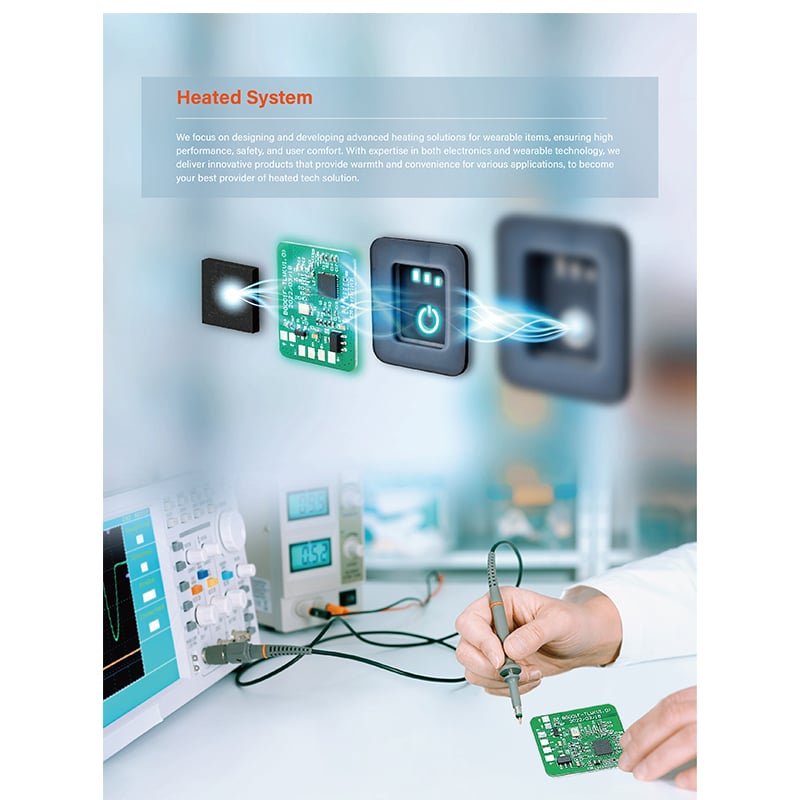
Within the OEM, an active and well developed in-house R&D, including circuit designers, specialists in heating films, and battery integration engineers ensures that feasibility feedback is realistic, that prototypes meet performance, and iterations do not get behind the schedule. The consequence of weak R&D is that it results in reworking the same product repeatedly, or incurring costs that are too high, or losing safety.
In the case of ODM, the reliability between batches is ensured by mature testing facilities (thermal cycling chambers, washability simulators, over-temperature protection validation) and extensive experience with certification (CE, RoHS, FCC, UKCA, UL). Battery know-how is especially important: inadequate BMS design may lead to field failures and sophisticated protection may increase the life span of a cycle and may be taken as a source of consumer confidence.
The direct effect of certification compliance is the following: the factories that have already set the ISO-specific systems and the frequent third-party audits minimize the import delays and liability risks.
Common Mistakes Brands Make When Choosing Between OEM and ODM
Avoidable losses faced by many brands include poorly estimating the models or capability of partners.
- The unspoken rule of OEM is that it demands high quality quality a product is simply the result of the process controls at the factory and not the model itself.
- ODM is not necessarily low-end or generic performance – underdeveloped ODM platforms by well-established manufacturers of heated socks can provide professional warmth, safety and durability.
- Missing the technical depth of the factories – selecting one based on price or size of the catalog does not take into account the potential of the partner to provide a stable battery connection, heating compatibility, or certification requirements.
- Making decisions based on first cost with no consideration of long-term scalability, revision costs, or the costs of changing vendors to an OEM.
- The ODM avoids IP and differentiation risks, which are ignored and results in the creation of products that are too similar to competitors.
- Miscalculating the resource needs of OEM- trying to enter without internal bandwidth in design or without proper tech specifications is a frustrating and time-wasting activity.
Conclusion — OEM and ODM Are Strategic Tools, Not Labels
Both OEM and ODM heated socks do not have universal superiority. It depends on how you match the model and your brand position at that point, available resources, differentiation objectives and when to enter the market.
The brands that can represent the decision as a strategic lever, balancing control and speed, investment and risk, and uniqueness and efficiency, will be in a position of achieving a sustainable growth in the competitive wearable heating market. The success of any long-term cooperation is often based on the creation of a manufacturing alliance on the basis of mutual technical knowledge and stable performance, no matter what the initial model is.
Frequently Asked Questions
Can a brand start with ODM and move to OEM later?
Yes, and many do. The platform proves the market, then a custom programme follows once volumes justify tooling. The trap is assuming the ODM tooling transfers — it usually does not, so the second stage is a new development rather than an extension of the first.
Which model gives the better margin?
Neither, on its own. ODM competes on price because competitors can buy the same platform; OEM competes on differentiation, which supports price but demands investment first. Margin follows positioning, and the model is a consequence of it.
What does OEM actually require from the brand?
A technical specification the factory can build to: element type, zone map, control type, materials, size range and performance targets, all decided and written down. A brand arriving with a mood board has not started an OEM programme yet.
How do you protect an ODM product from being copied?
Weakly, by design. The platform belongs to the factory, so exclusivity is a commercial agreement rather than a technical barrier. If differentiation matters, the customisation has to reach the element or the control logic, not just colourways and branding.