
Extreme temperatures in outdoor activities impose much more pressure on heated sock than the fun games such as skiing or hiking. Employees are regularly exposed to working in sub-zero conditions sometimes building up to 8-12 hours, moisture caused by snow, rain, or sweat, heavy steel-toe footwear that steam-packs the materials and continuous repetitive movement that is caused by walking, climbing, or lifting. The conditions pose sustained thermal and mechanical voltage on heating components, wiring, textiles, and batteries.
Most product developers wrongly believe that winter sports optimized heated sock will be effective in the industrial environment. As a matter of fact, recreational designs emphasize on intermittent heating and more light duty comfort, and on the industrial heat sock, constant-rate output, and amplified environmental defense against possible risks to worker health and efficiency to guarantee high productivity.
In the case of extreme cold outdoor work, the heated socks should have the ability to combine strong heating integration, strong textile design, and consistent battery design to allow safety and reliability throughout the longer working shifts.
Environmental Stress Factors in Industrial Outdoor Work
Industrial outdoor conditions present stress situations that cut across each other and subject the survivability and effectiveness of the heated socks to a direct test.
Extended periods of low temperatures also require heating systems which can be left to work continuously without much degradation. Liquids may be a result of melting snow or rain or body sweat that present a risk of electrical short circuiting or corrosion. The effects of heavy boots are continuous pressures on heating areas and wiring, with the long shifts necessitating predictable battery performance, not occurring unexpectedly and exhausting its power resources in a moment. Monotony in movement causes flex fatigue at circuits and seams.
The following are some of the important environmental influences and their direct influence:
| Environmental Factor | Impact on Heated Socks |
| Extended Exposure | Continuous heating demand |
| Moisture | Electrical insulation risk |
| Heavy Boots | Pressure on wiring and heating zones |
| Long Shifts | Battery endurance requirement |
| Repetitive Motion | Flex stress on circuits |
These aspects point to the inefficiency of usual recreation designs. To learn more about the specifications in such conditions, see our overview of heated socks for extreme cold applications.
Heating System Stability Under Continuous Load
The heating systems in industrial heated socks should be capable of sustaining constant thermal power through the entire work shifts and not brief bouts as is the case of recreational use.
The heating system is frequently used on and off with variable intensity in the recreational situations. The industrial applications, however, demand constant results to fight constant heat loss in sub-zero air. Good designs should have a high level of thermal control, like multi-zone NTC sensors and PWM controllers, which will never create hot spots yet still provide even distribution of the heat over the foot.
Risks of overheating become worse with extended load, and can lead to either discomfort or material degradation. Safety measures established on reliable systems are automatic temperature limiting and fail-safe cutoffs so that output can still stay within safe ranges (usually 4055 C at the skin interface) even after several hours of operation.
Battery Performance in Sub-Zero Industrial Conditions
Heated sock batteries using lithium dying batteries have visible performance decline in extreme low temperatures, insulating construction and location is an important reliability consideration in industrial performance.
Standard lithium-ion cells are operated at the temperature of around 0 C and efficiency decreases with lower temperature. The resistance to internal resistance increases, and the ion mobility decreases, and usable capacity reduces- at times well below -15degrees C.
The following is a general description of the behavior of batteries over temperature:
| Temperature Range | Expected Battery Behavior |
| 0°C | Stable |
| -5°C | Slight reduction |
| -10°C | Noticeable runtime drop |
| Below -15°C | Significant efficiency loss |
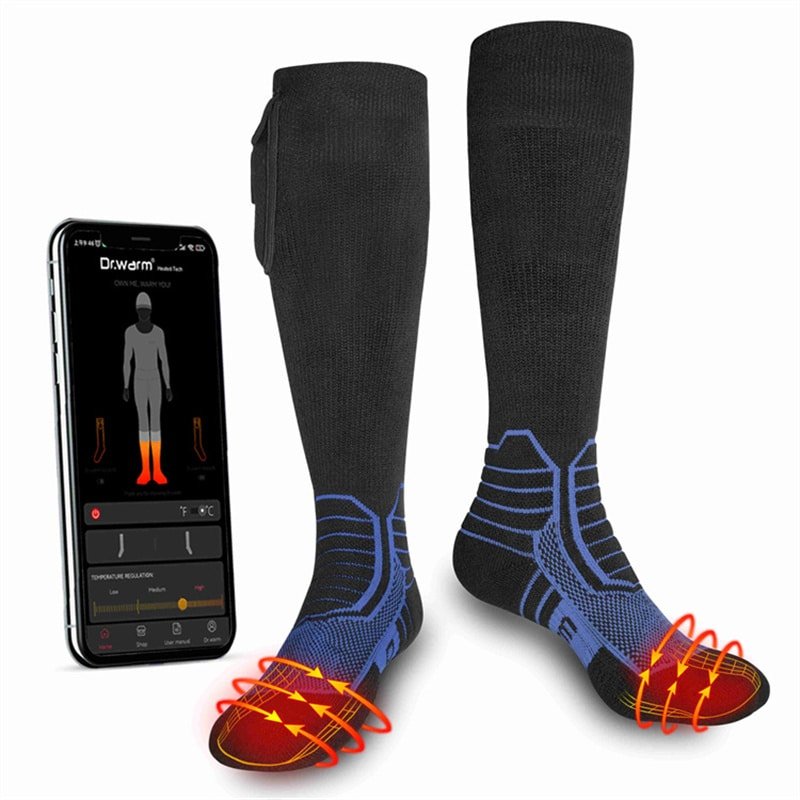
As a solution to this, battery pockets may be designed as insulated and placed outside the industrial design (e.g. on the side of the calf) so that the cold is not exposed directly. Internal plasmas may result in shorter cooling times and less operational time. It is necessary to implement runtime planning: a battery of 2200-3000mAh can be used to last 6-8 hours at low modes at moderately cold temperatures, but full shifts below -10C would demand more capacity or reserve packs.
Reinforced Textile Structure and Durability
The fabric that is used to make the heavy-duty heated socks has to be able to resist compression, abrasion and repeated flexing way beyond the recreational limits.
Reinforced areas Double-layered knitting extends into the toe, heel, and arch areas to guard heating devices against the pressure on the boots and the impact of the ground. In high-stress flex applications, long-lasting yarns are (usually nylon-polyester mixed with spandex to recover) used to ensure that the flex areas do not crack or the wire does not exhaust itself during thousands of flex cycles.
Bar-tack reinforcement or flat-lock stitching to the seams is done to keep the seam to resist tension failure. Industrial durability tests usually consist of:
- Flex cycling (e.g. 50,000+ bends) multiple.
- Simulated boot compliance testing.
- Durability of high we areas.
- Maintenance in field conditions wet endurance/ dry endurance.
These inducements make sure that the sock does not lose its structure and heating capabilities during its service life.
Moisture Resistance and Electrical Protection
Moisture control and electrical insulation constitute important safety seals in industrial heated socks when it comes to wet, snowy or sweaty environments.
Inner cloths with sweat-wicking properties (or a blend of coolmax or merino) cause perspiration to be separated further by elements which may produce short circuit eliminating or lessening this risk. Waterproof encapsulation of heating modules and wiring is commonly silicone or polyurethane coatings whereas connectors are sealed and IP-rated.
Path wiring is insulated and short-circuit protection is built-in, as well as over-current fuses, which introduce redundancy. All these characteristics help avert breakdowns that may cause inconvenience, burns or electric shocks during the extended outdoor duty.
Comfort and Fit for Long Work Shifts
Fit and comfort in the heavy industry workplace have a direct impact on worker adherence to and routine wearing of the heated socks.
Hooves that carry the weight of heavy boots will not fall because the sole has anti-slip silicone grips as well as the management of the hotspots which can lead to heat build-up in the shoe. Thickness is managed to prevent crowding within the safety footwear and battery pockets locate the slim packs to reduce the chub around the ankle or calf.
Even heat can be distributed evenly and fatigue is minimized because of the proper fit, which is important to retain the productivity and inspires full-shift donning in ultimate conditions.
Common Mistakes When Designing Heated Socks for Industrial Use
A number of common mistakes lead to low reliability in the introduction of pieces of clothing designed to be useable in the outside of the factories:
- The continuous load requirements are underestimated and fail to provide continuous load to the heating elements before fatiging occurs.
- Use of recreational heating settings with no strengthened zoning or regulation.
- Neglects cold induced battery behavior, which causes unexpected run time deficits.
- Lack of flex and compression testing, which leads to wiring breakage with time.
- Ignoring moisture insulation, augmenting short-circuit and corrosion hazards.
These issues can be solved during prototyping to avoid expensive field failures and safety concerns.
Conclusion — Reliability Defines Heated Socks for Extreme Work
Outdoor work on extreme cold temperatures requires the design of specific outdoor heating socks based on the stress conditions of the industry, where the main focus should be on the ability to maintain the heating effect constantly, the durability of the textiles, and the stability of the battery to provide the safe and predictable working results during the long time of operation.
The developers of the product undergo rigorous engineering modifications, not the consumer-friendly comforts but areas, and provide suitable resolutions that would in fact assist in worker safety and continuity of operations under the most adverse conditions.
Frequently Asked Questions
Why does a winter sports sock perform badly on a work site?
Duty cycle. A ski sock works hard for a few minutes and then rests on a lift; a work sock is asked for moderate heat for eight hours while the wearer stands, walks on grit and never warms up indoors. The element is not the problem — the thermal budget and the abrasion exposure are.
What does continuous load actually do to the system?
It removes the recovery time. In intermittent use the pack and the controller cool between bursts; under continuous load they hold temperature, which is why the protection thresholds and the thermal path matter more than the peak output. It also flattens the discharge curve, so runtime is set by the average rather than by bursts.
Where should the pack sit in sub-zero work?
Against the calf, under insulation, and away from anything that gets knocked. A cell at zero or below delivers less usable capacity and more internal resistance, so the location is a runtime decision, not a styling one. The worst place is a pocket that hangs free where the wind hits it — the pack cools, output drops, and the user blames the battery.
How should moisture and abrasion be handled?
Assume damp, not dry. Our standard sealing is IPX4 with IPX5 available as an option, and the parts that decide survival are the connector and the charge port rather than the element. Abrasion is a separate problem: reinforce the heel and the toe box interface, because that is where grit and boot seams grind through a knitted surface first.