
Thin versus thick heated sockeries are not the same due to just the fabric weight, but also have a direct influence on the insulation strength, heat retention, flexibility, and compatibility to use. During the design of heated socks, thickness determines the effectiveness with which the built-in heating components move the heat, the capacity of passive insulation structures to capture heat, and the interaction of the socket with the footwear.
It is a common belief that thicker and warmer heated socks are, yet it is the relationship between insulation and heat dispersion that in a heated sock determines heating. Thicker is not necessarily warmer and too much bulk may squeeze heating components, limit vascular circulation, or form pressure areas that inhibit perceived comfort and warmth derived with circulation. The use of thin or thick heated sock depends on usage, compatibility, and the level of insulation needed to the feet.
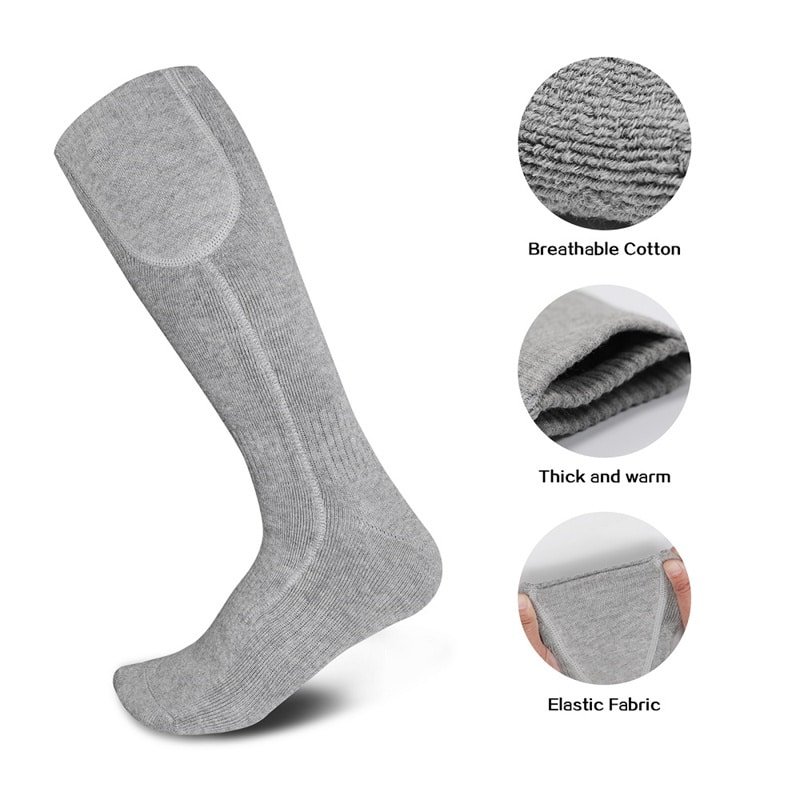
Structural Differences in Textile Construction
Knit density, layering and material composition represent the core structural variance in terms of manufacturing. Single-layer or lightweight knit constructions (usually merino blends or synthetic technical yarns) are used in thin heated sock forms, and thick constructions in multi-layer knits with added cushioning or loft are added.
Here’s a clear comparison:
| Feature | Thin Heated Socks | Thick Heated Socks |
| Fabric Layers | Single-layer or light knit | Multi-layer knit |
| Flexibility | High | Moderate |
| Compression Fit | Better for tight boots | Better for relaxed boots |
| Insulation (Passive) | Lower | Higher |
| Heating Element Integration | Closer to skin, more direct heat transfer | Elements may sit deeper in layers, relying more on trapped air |
| Typical Yarn Weight | 150–250 g/m² | 300–500+ g/m² |
The differences are based on the textile engineering decisions. Thin constructions are used in performance footwear to achieve a high level of maximum fit, but provide passive thermal resistance with thicker constructions and pockets of the connection between the insulation and the shoe. For brands developing custom solutions, thin and thick heated socks customization allows tailoring layer counts, yarn types, and heating pad placement to balance these trade-offs.
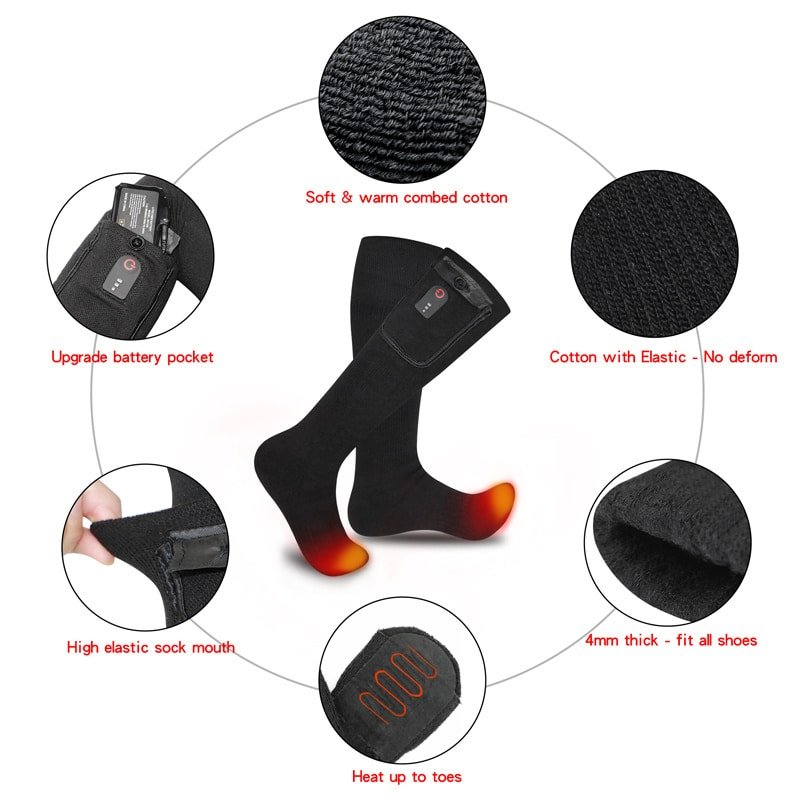
Heat Retention and Thermal Efficiency
The combinations of passive (insulated fabrics) and active (battery-powered elements) are combined in heated socks. Thin socks are faster to heat up and cool to make passive barriers of the heating wires or films closer to the skin and less material is used to interfere with the heating layer, however, they conduct heat away to the outside environment more rapidly with weaker passive heat barriers.
Thick socks are good at getting the heat generated into lofted layers or pockets of air so that overall thermal performance in very cold or low-activity situations is optimized. Nevertheless, in case the heating element is enclosed too deep, part of the heat might escape before the foot.
Comparison of efficiency (conceptual, as per typical designs):
| Aspect | Thin Heated Socks | Thick Heated Socks |
| Heat-Up Speed | Faster (direct contact) | Slower (more material to penetrate) |
| Heat Loss to Environment | Higher | Lower (better trapping) |
| Overall Thermal Efficiency in Static Cold | Moderate | Higher |
| Efficiency in Active Use (e.g., movement) | Higher (less bulk, better circulation) | Moderate (potential restriction) |
Balanced insulation has been known to perform well in practice in engineering tests when compared to maximum thickness alone.
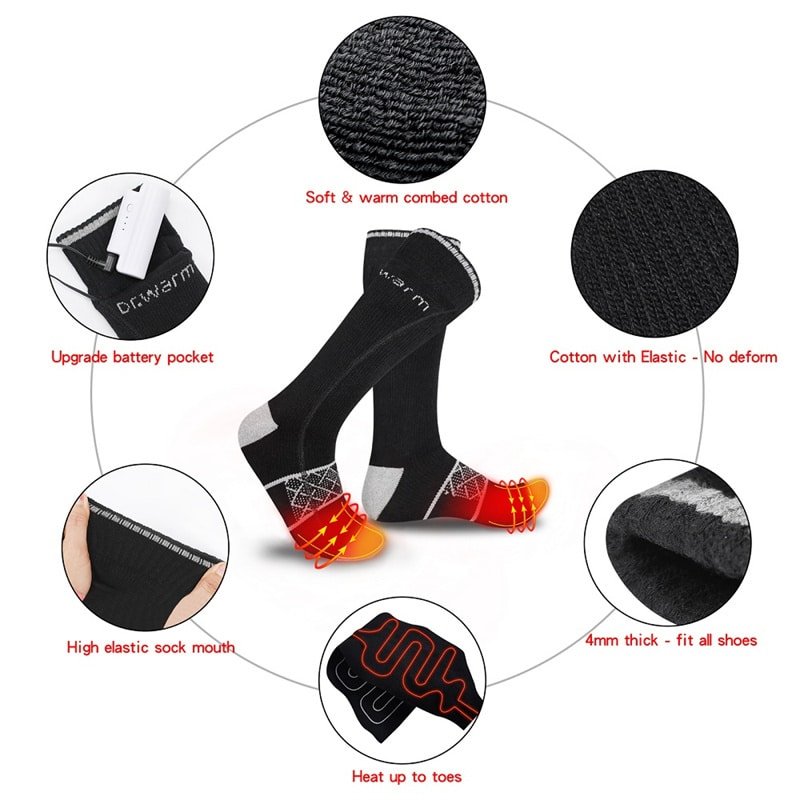
Comfort and Boot Compatibility
Boot compatibility is another important engineering factor. Snug-fitting shoes (e.g. ski or mountaineering types) require thin warm-up socks, to prevent pressure points, compromised circulation, or changed fit of the boot that may endanger performance and safety. The thick socks will either leave the feet numb or with a lower circulation, which will literally leave feet colder with the extra insulation.
Contrastingly, thick heated socks have an advantage on work boots or more casual winter shoes that are more volumetric and have additional cushioning, as the additional cushioning lessens fatigue; and on longer standing or low activity shifts, the passive insulation of the heating system is supplemented by the added warmth of stockings.
Key factors include:
- Pressure distribution Thin socks reduce hot spots on laces or buckles.
- Moisture management – Both kinds of wicks will soak up the sweat but thickser ones can hold up more unless they are designed with breathable stitchings.
- Fit stability- Thick socks will move or bunch up during high-activity exercises unless compression areas are included.
Battery Efficiency Considerations
The thickness of the insulation affects the demand of the battery. Thick socks can minimize heat dissipation, and the system can be used to keep target temperatures at lower power consumption or active fewer cycles – may run longer on the same battery capacity. To counter dissipation caused by extreme low temperatures, thin socks need more frequent or more intensive heating that can cause batteries to deplete more rapidly.
Designers tend to trade-off by matching the thin designs with effective carbon-fiber designs and intelligent controlling devices that pulse heat, whereas thick models can afford to use a slightly lower-wattage monitoring device without losing comfort.
Application-Based Recommendation
During a selection of thickness, physiological selection of the sock is done using the matching of thermal profile of the sock.
| Application | Recommended Thickness | Primary Reasoning |
| Ski Boots | Thin | Precise fit, unrestricted circulation, quick heat transfer |
| Outdoor Work | Thick | Extended static exposure, added cushioning and passive insulation |
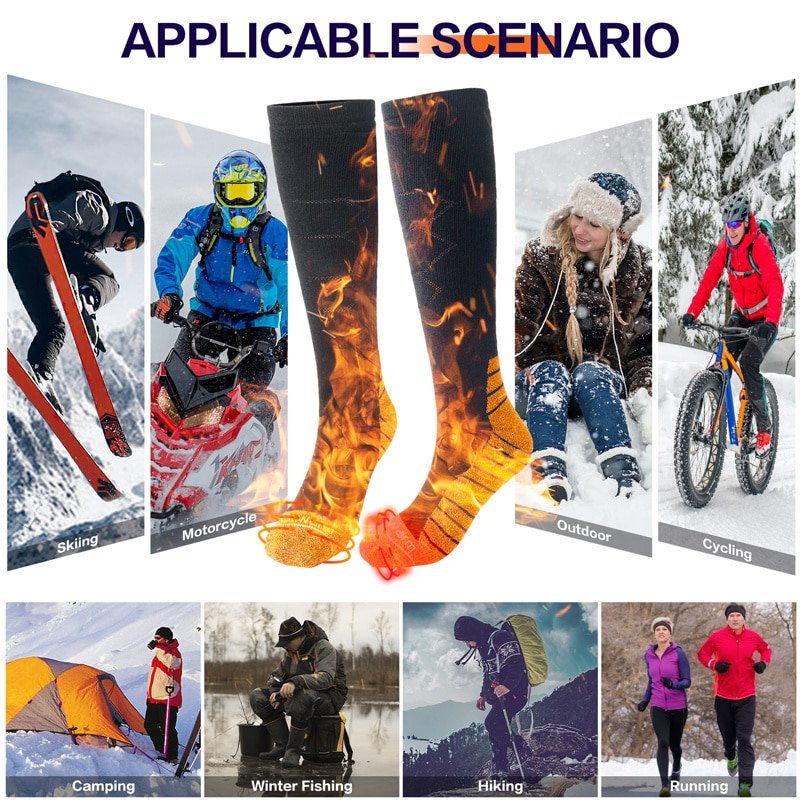
| Casual Winter Use | Thick | Comfort priority, relaxed footwear volume |
| Mountaineering | Thin | Lightweight packability, technical boot compatibility |
| Industrial Cold Storage | Thick | Long-duration low-activity warmth |
These are guidelines that enable product managers to match the configurations of products with target markets and to optimize the manufacturing feasibility.
Finally, thick and thin heated socks are examples of trade-offs in the engineering of direct heat delivery, passive retention, flexibility, and integration into footwear. The correct option is balancing active heating performance with practical use limitations instead of falling back to maximum thickness.
(Word count: 912)
SEO Title: Rechargeable Heated Socks vs Disposable Warmers
Meta Description: Compare rechargeable heated socks and disposable warmers in terms of runtime, temperature control, cost, and sustainability.
Excerpt (62 words):
Rechargeable heated socks and disposable warmers provide warmth through different technologies. This guide compares performance stability, runtime control, environmental impact, and long-term value from a product development perspective.
Rechargeable Heated Socks vs Disposable Warmers
Rechargeable heated socks are engineered wearable heating systems, while disposable warmers are short-term chemical heat solutions designed for limited use. Rechargeable versions use battery-powered elements (typically carbon fiber or wire) with adjustable controllers, delivering consistent, regulated warmth. Disposable warmers rely on exothermic chemical reactions (iron oxidation) activated by air exposure.
Many assume disposable warmers are more convenient due to no charging requirement, but long-term cost, control precision, and reliability differ significantly. The better solution depends on expected duration, temperature control requirements, and sustainability priorities.
Technology Comparison
The fundamental difference lies in the heating mechanism and lifecycle.
| Feature | Rechargeable Heated Socks | Disposable Warmers |
| Heating Source | Battery-powered electric elements | Chemical reaction (iron + air) |
| Control | Adjustable (multiple settings, often app/remote) | Fixed (single temperature curve) |
| Reusability | Yes (hundreds of cycles) | No (single use) |
| Sustainability | Higher (reusable, minimal waste) | Lower (landfill after one use) |
| Temperature Stability | Regulated output | Peaks then declines |
| Integration | Built into sock textile | Loose pack inserted in footwear |
These distinctions guide positioning: rechargeable as a durable system product, disposable as a low-commitment accessory.
For brands exploring integrated solutions, rechargeable heated socks manufacturing supports custom battery capacities, controller logic, and element placement.
Runtime and Stability
Rechargeable heated socks offer stable, adjustable output — typically 4–10+ hours depending on setting, battery size, and ambient conditions. Smart controllers maintain set temperatures via pulsing, avoiding peaks and crashes.
Disposable warmers follow a fixed curve: rapid heat-up (10–20 minutes), peak warmth (around 40–50°C), then gradual decline over 6–9 hours. Once activated, output cannot be adjusted or paused, and performance varies with air exposure and moisture.
In extended or variable conditions, rechargeable systems provide more predictable warmth.
Long-Term Cost Considerations
Upfront investment favors disposables, but per-use economics shift quickly.
Example over 50 uses (assuming average retail pricing):
| Metric | Rechargeable Heated Socks | Disposable Warmers |
| Initial Cost (pair) | $80–$150 | $1–$2 per pair (packs) |
| Cost Per Use (50 uses) | $1.60–$3.00 | $50–$100 total |
| Replacement Cycle | 1–3 years (batteries/elements) | Every use |
| Maintenance | Charging + occasional battery swap | None (discard) |
Rechargeable options break even after 30–50 uses, making them economical for frequent applications.
Environmental Impact
Disposable warmers generate significant waste: single-use packaging and non-recyclable chemical packets contribute to landfill accumulation. Each use adds plastic, iron residue, and salts that may not biodegrade cleanly.
Rechargeable heated socks produce far less waste over their lifecycle — primarily end-of-life battery recycling (lithium-ion standards apply). With proper design, components last hundreds of cycles, reducing resource consumption and emissions from repeated manufacturing.
Sustainability-focused brands increasingly favor rechargeable for circular economy alignment.
Application Scenarios
Different use cases highlight where each excels.
| Scenario | Recommended Option | Primary Reasoning |
| Short Events (festivals, games) | Disposable Warmers | No charging needed, low commitment |
| Full Work Shifts (8+ hours) | Rechargeable Heated Socks | Stable control, reusability |
| Skiing / Multi-Day Trips | Rechargeable Heated Socks | Adjustable heat, consistent performance |
| Emergency / Infrequent Use | Disposable Warmers | Shelf-stable, no maintenance |
These scenarios inform product lineup decisions.
In conclusion, rechargeable heated socks and disposable warmers serve distinct functional roles: one as a controllable, reusable system; the other as a simple, single-dose solution. The choice reflects priorities in runtime stability, cost efficiency, and environmental responsibility rather than universal superiority.
Frequently Asked Questions
Does thicker always mean warmer?
Only when the heat has somewhere to go. Loft helps once the element is producing, but an over-insulated sock traps heat near the element, which the controller reads as satisfied while the foot stays cool. Balanced construction beats maximum thickness.
Which is better for a tight-fitting boot?
Thin, almost always. A technical boot has no spare volume, so any added thickness becomes a pressure point over the instep or at the toe. The liner should deliver the warmth with minimal stack height and let the boot handle insulation.
How does knit density change heating behaviour?
It changes how fast heat moves. A dense knit conducts to the skin quickly and feels warm sooner; a lofted knit spreads it more slowly and holds it longer. Wearers experience that as responsiveness, and it is why two socks with an identical element behave differently.
Can one sock design cover both use cases?
Poorly. Thin and thick are answers to different footwear, so a compromise usually fits neither. A brand is better served by two constructions sharing one electronics platform than by one construction stretched across both.