

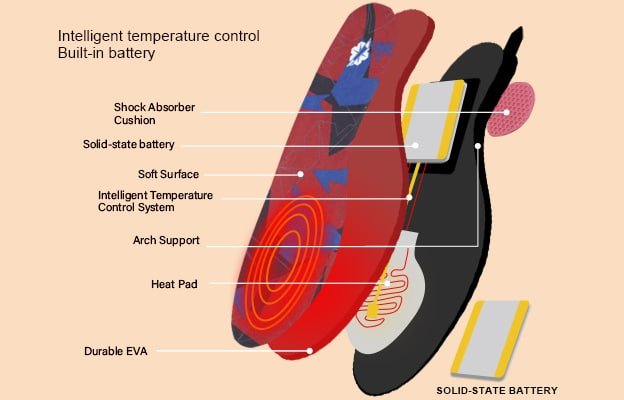
Hot insoles have heating coils that are charged by internal lithium batteries. A system of control manages temperature and eliminates the risk of overheating. The system works at low voltage to prevent accidents.
The most common belief among many users regarding the concept of heated insoles is that they warm like a pad. In fact they are made wearable heat enginings to ensure the constant distribution of heat and safety control.
Not only the generation of heat in units, but also the combination of heating units, battery modules, and temperature regulators determine performance and safety of heated insoles. It is the integration that yields real-world reliability, particularly in the demand environment, such as winter sports or the extended outdoor environment.
For those exploring custom heated insoles solutions, understanding these core engineering aspects is essential when evaluating manufacturing partners or product designs.
Core Component #1 — Heating Elements
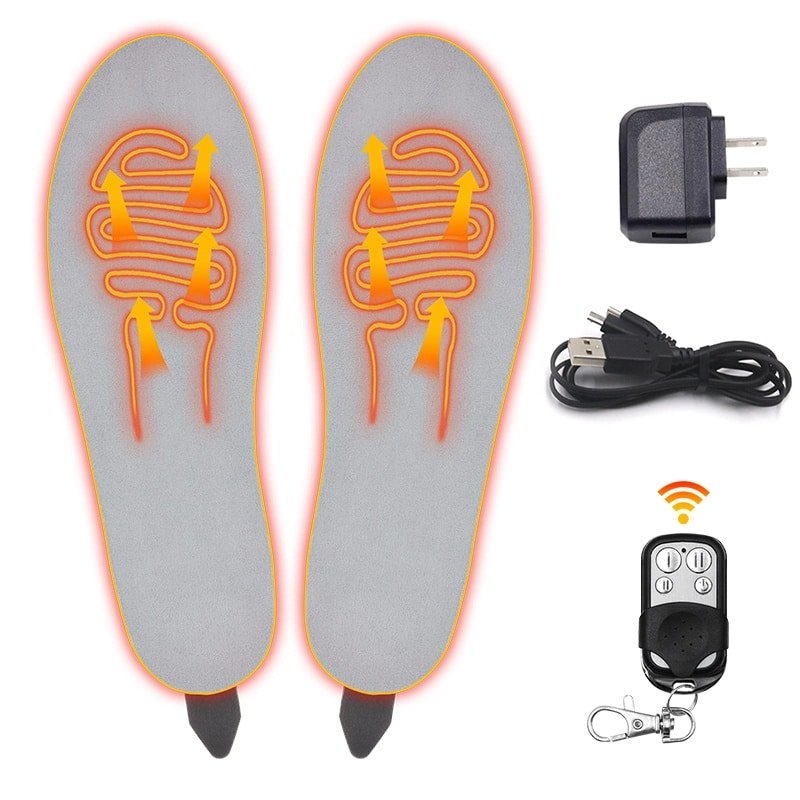
Heating element is the core of any type of a heated insole that transforms electrical energy into thermal energy by resistance.
The majority of the contemporary heated insoles are based on one of three major technologies carbon fiber heating, heating film, or conventional wire-based. Both of the methods balance heat generation, flexibility, durability, and cost.
Resistance Heating Principle Explained
Heating Heating is through Joule heating, when electric current is made to pass through a resistive material, the amount of heat generated is proportional to the square of the current and to the resistance of the material (P = I 2 R). DC power (as low as 3.7 V to 7.4 V) makes the system safe, and provides controlled warmth.
Heating Technologies Comparison.
Comparison of Heating Technologies
| Heating Technology | How It Generates Heat | Advantages | Typical Use Cases |
| Carbon fiber | Electrical resistance in carbon strands | Even distribution, fast heating, flexible, durable | Premium insoles for sports/outdoor use |
| Heating film | Conductive layered material (often carbon-based) | Thin and flexible, uniform coverage | Slim designs, full-foot coverage |
| Wire heating | Resistive metal wire loops | Cost-efficient, reliable | Budget models, basic applications |
Carbon fiber heated insoles have a superior reputation with regard to even distribution of heat and durability because of the material thermal conductivity and the ability to withstand fatigue caused by repeated bending. Similar advantages are available with heating film in thinner profiles with wire systems remaining popular due to their simplicity and reduced production cost.
Core Component #2 — Lithium Battery Power System
Stable and safe power supply is vital – the heating system cannot operate on a regular basis without a steady and reliable power supply.
Low voltage DC lithium powered batteries, which are lithium-ion or lithium-polymer batteries are used to provide a DC-based heated insoles.
Critical Battery Characteristics and Effects.
Key Battery Features and Impacts
| Battery Feature | Function | Performance Impact |
| High capacity (e.g., 2200–5000 mAh) | Stores more energy | Longer heating time, extended outdoor use |
| Protection PCB | Prevents overcharge, over-discharge, short circuits | Enhances safety, prevents battery damage |
| Quick charging | Reduces recharge time | Less downtime, improved user convenience |
| Detachable vs built-in | Allows easy replacement or swapping | Flexibility in maintenance and use |
Batteries most often work with nominal 3.7V with the packs formed in series when higher voltages are required. Capacity has a direct relationship with the runtime – higher mAh ratings, courses of increased heating on lower settings, which are typical in all-day outdoor activities. Protection We have protection circuits (PCM or BMS) that are common to control cell health and to avoid thermal problems.
Core Component #3 — Temperature Control System
Perfect thermoregulation is the difference between an effective and a simple design of heated insoles.
High temperature regulation makes the units easier to use, burn-free, and extends the battery life.
How Temperature Control Works
Pulse-width modulation (PWM) is also used by control circuits to modulate power delivery to keep the desired levels of heat without delivering full power at all times.
- Multi-level settings -Multi-level settings -Typically 34 levels (low, medium, high) with customization dependent upon circumstances.
- Sensors — Thermistors are installed in areas near heating to check real-life temperature.
- Spreading means — Move through manual buttons on the battery pack, or with a wireless control or even an app to make fine adjustments.
- Automatic shut-off – Timer or low-battery activated; others have over-temperature shuts.
This recycle system ensures a stable temperature and avoids the wastage of energy.
How Heat Is Distributed Evenly Across the Foot
Even distribution of heat eliminates heat discomfort and gives the best warmth to the areas where it is most needed.
The inadequate designs may also cause hot spots at the forefoot leaving the toes or heels cold.
Strategic Heating Zone Placement
- Forefoot-based designs are based on the toes and the ball of the foot – high areas of heat loss.
- Full-foot heating extends between forefoot and heel during complete coverage, ensuring that every area is covered, which is perfect in an addicted cold.
- Heating elements are positioned in form of patterns (loops, grids or films) to prevent concentrated heat.
- The insulation layers (foams or reflective surfaces) redirect the heat into an upward direction toward the foot and reduce the heat loss to the lower part.
Foot anatomy and thermal imaging are used to optimize the placement of the zones according to the anatomy of the foot, and provide engineers with a chance to eliminate hot spots and provide a balanced warmth.
Safety Mechanisms in Heated Insoles
Any battery powered wearable heating product cannot compromise on strong safety features.
Key Safety Mechanisms
| Safety Mechanism | Purpose | Risk Prevented |
| Temperature sensor | Monitors heat in real time | Burns, overheating |
| Overcurrent protection | Limits excessive current draw | Electrical faults, battery damage |
| Overheat / thermal cutoff | Automatically reduces or stops power | Thermal runaway, fire risk |
| Insulation layer | Contains heat, protects skin | Discomfort, localized burns |
| Aging / endurance testing | Validates long-term reliability | Early failure, degradation |
Waterproofing (so-called IP-rated components) can be used to avoid moisture in the outdoors. The battery protection has been designed to guard against overcharge, over-discharge, and short circuits, which is of crucial significance in systems based on lithium.
Why Engineering Quality Matters More Than Heating Temperature
The highest temperature boasts do not work much without uniform and dependable performance.
Stable operation at high temperature is simple; stability at high temperature and thousands of cycles is much more difficult.
Key Engineering Factors
- Stability – Assume constant temperature in battery life and ambient cases.
- Batch consistency — Production Runs that have uniform performance.
- Long term dependability– resistant to flex fatigue, moisture and thermal cycling.
- Safety in the field application Proved ability in winter sport, work, or everyday cold.
Unexpectedly, regardless of the peak temperature, poor integration may cause uneven heating, early failure or safety issues.
Conclusion — Heated Insoles Are Wearable Heating Systems, Not Simple Inserts
Heated insoles are designed by utilising the regulated contact of heating and lithium batteries, in combination with temperature regulation devices. They could not be trusted because of engineering accuracy and production discipline as opposed to mere heat production assertions.
Knowing these elements, it becomes easier to users, brands and sourcing groups to compare what is really able to provide safe and effective heat in frozen conditions, such as resistance-based heating, integration of battery management and safety.