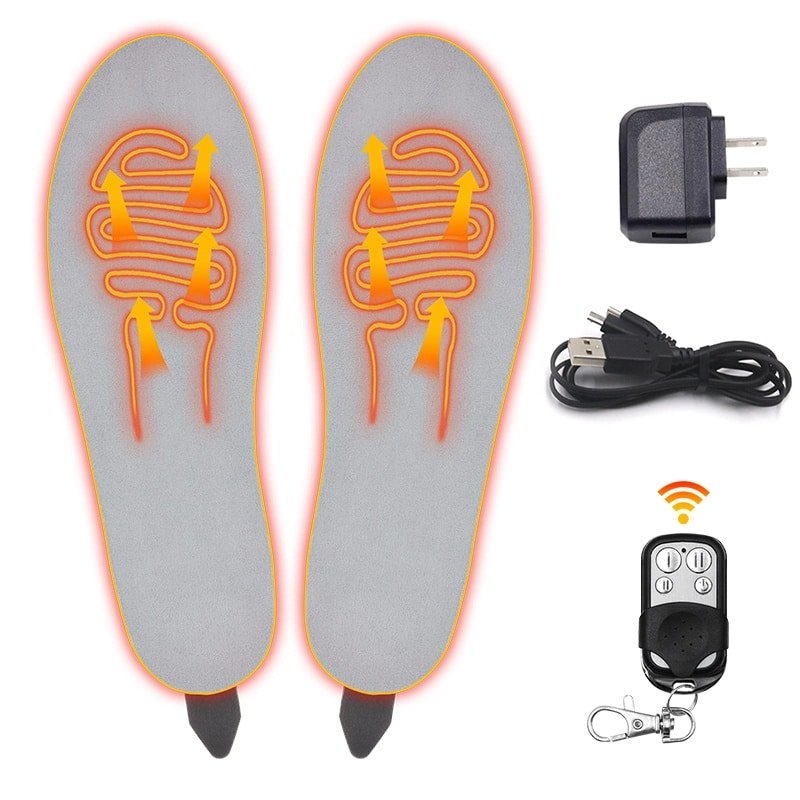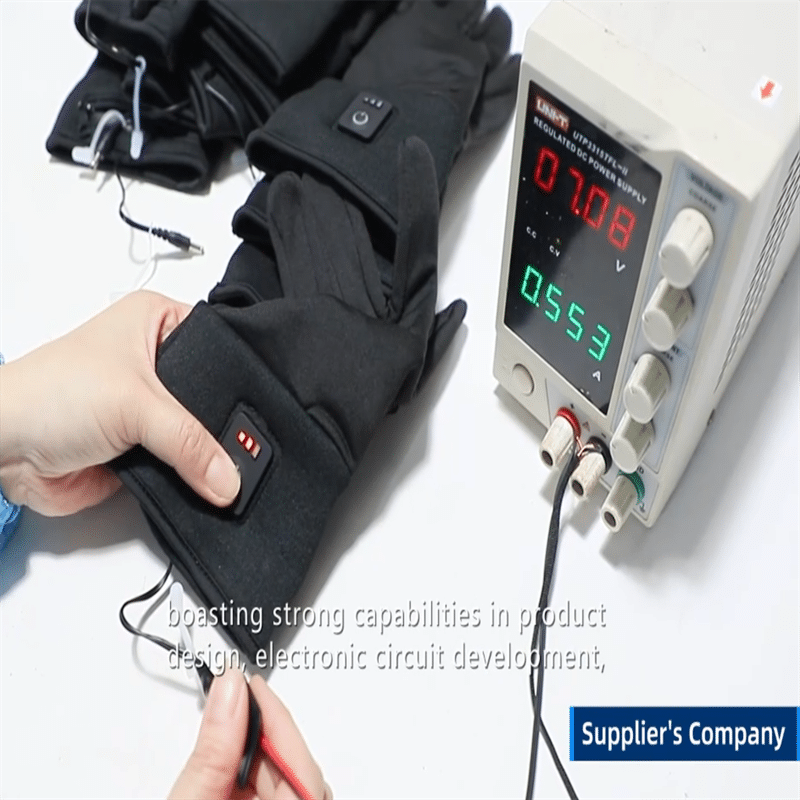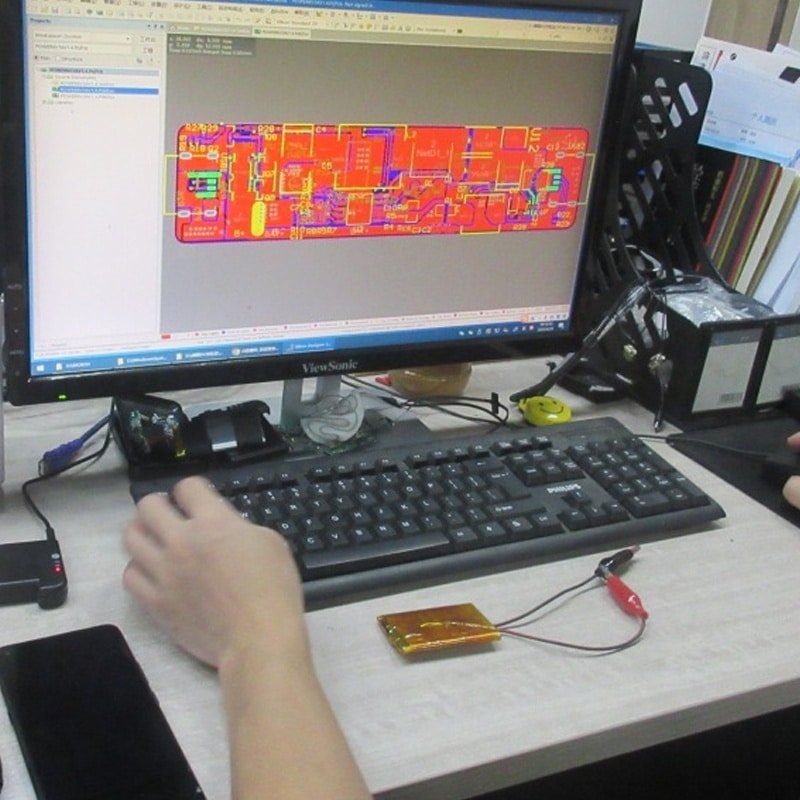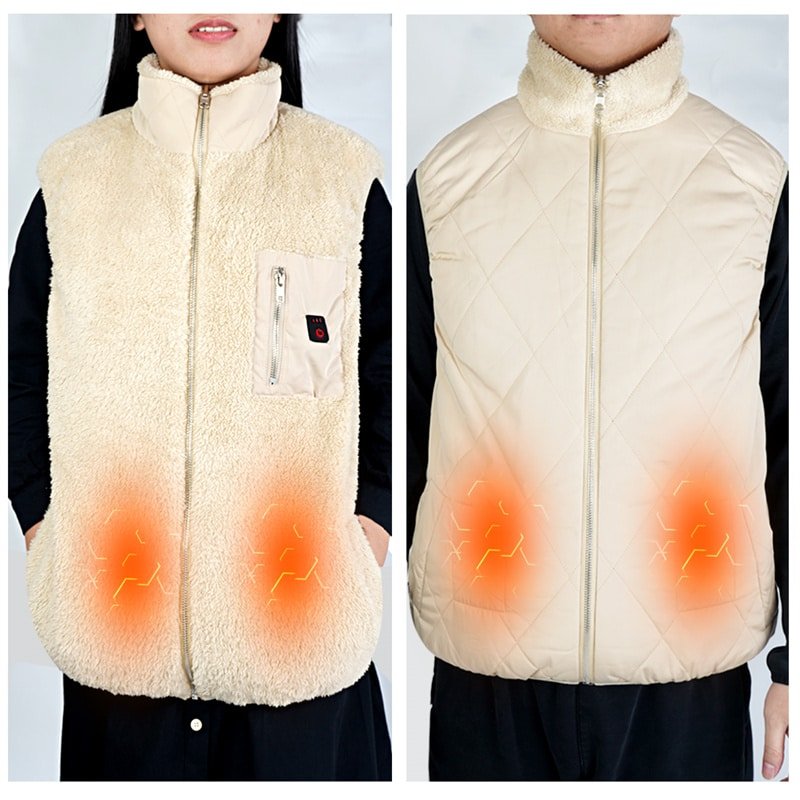

Both the Bluetooth and the remote control systems control the temperature levels in the heated insoles by wirelessly talking to the heating coils and the microcontroller of the insole. The versions of Bluetooth are usually paired with a smartphone application to allow advanced features such as digital adjustment, timers, and in certain cases temperature tracking. The systems based on the principle of remote control assume the utilization of a special handheld unit to easily operate them. Most customers hold a belief that when the name Bluetooth is mentioned it comes up with the understanding that the technology is of superior quality which is not the case since the two technology have the capacity to perform with similar reliability once engineered. This is not merely an issue of convenience: the difference between the Bluetooth and remote control version of the heated insoles indicates some discrepancy in the implementation of the firmware, circuit complexity, cost hierarchy, and long-term viability.
The decision to go with Bluetooth or remote control heated insoles must rely on factors of positioning of the product, where it will be marketed, technical complexity, and long-term durability and not simply on the perceived technological interest.
How Remote Control Heated Insoles Work
The remote control heated insoles continue to be a viable option in a wide range of applications because of their simplicity in engineering and reliability.
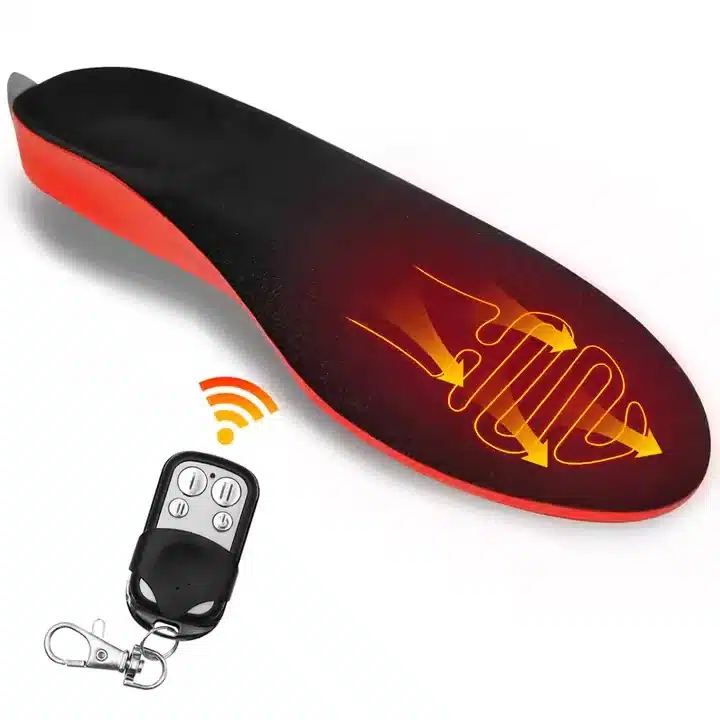
In such systems, radio frequency (RF) transmission, usually in the sub-GHz or 2.4 GHz band, conveys signals between a special handheld controller and a receiver coiled that is installed on the insole. The controller also issues orders to change the temperature levels, typically has 3 to 4 preset settings (low, medium, high, off). These signals are interpreted by the microcontroller fitted to the insole and power is adjusted to the heating components.
Key Technical Characteristics of Remote Control Systems
Remote control systems need only bare-minimum development of control code since the code is simple – receive order, adjust the proportionate PWM duty cycle to the heater, and ensure simple safety measures such as over-temperature shut-offs.
Patient-specific physical remote gives haptic response and immediate response in the absence of pairing procedures.
| Feature | Remote Control System |
| Signal type | RF transmission |
| Setup complexity | Low |
| Battery consumption | Moderate |
| Firmware requirement | Minimal |
| User interface | Physical remote |
This simplicity is translated to a simple way to debug in the production process and the number of points of failure in the field, particularly in the setting where smartphone connectivity may be inconvenience.
How Bluetooth Heated Insoles Work
Bluetooth insolating toots provide additional functionality and sophistication on control but require higher engineering standards that should be addressed carefully.
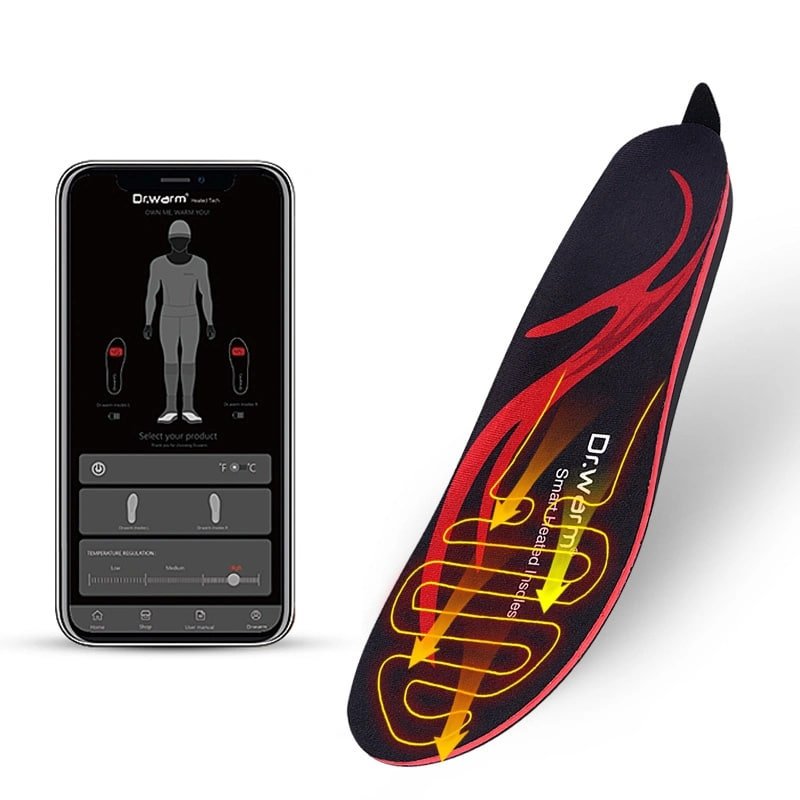
These systems are based on the Bluetooth Low Energy (BLE) modules incorporated in the PCB of the insole. This module can be paired with a smartphone application, which lets one choose temperature settings, timers, monitor battery level, and in some cases firmware updating. The microcontroller of the insole communicates through BLE and processes the command of apps and drives the heating elements with safety measures in place.
Key Technical Characteristics of Bluetooth Systems
Connection states, advertising intervals, data encryption and power-saving mode have to be controlled by the firmware to balance responsiveness and efficiency. Integration of apps is another level, as it needs compatibility between iOS and Android versions.
For brands exploring custom solutions, OEM Bluetooth heated insoles development often involves close collaboration on firmware optimization and app features to meet specific market needs.
| Feature | Bluetooth System |
| Signal type | Bluetooth Low Energy (BLE) |
| Setup complexity | Higher |
| Battery consumption | Slightly higher |
| Firmware requirement | Advanced |
| User interface | Mobile app |
Engineering Complexity and Production Impact
In terms of manufacturing, Bluetooth systems require much greater engineering capacity as compared to remote control options.
Bluetooth firmware development incorporates BLE stack development, power management functions, and strong error handling towards drop-out of connections. Antenna positioning, RF shielding provisions and isolation of sensitive analog/digital section makes PCB layout more complicated to achieve reduced interference and noise.
The testing of the production should have the BLE certification, tests assuring connection reliability between devices, and tests determining the over-the-air updates. Remote systems on the other hand, are concerned primarily with the rudimentary RF reach and response of commands.
| Factor | Remote Control | Bluetooth |
| Circuit complexity | Lower | Higher |
| Firmware development | Minimal | Significant |
| Testing requirement | Standard | Advanced validation |
| Production risk | Lower | Higher |
Such variations directly influence the development schedules as well as error rates when scaling the project.
Battery Consumption and Power Efficiency
The performance metric that is vital in heated insoles is battery life and the method used to control various functions determines standby and active energy consumption levels.
Remote control RF module is usually mod/healthy power when active but idles otherwise which results in runtime that can be predicted and is usually centered on the use of the heating elements. BLE devices also have low average power using sleep-heavy operation, however, standby current during advertising operation or during keeping connections can be cumulative particularly when advertising time is low.
Practically, there is a possibility that Bluetooth systems will decrease the overall runtime, because BLE is always-listening and therefore performs better when optimized firmware is used to minimize the difference. This trade-off can be seen when it is required to have advanced features such as real time monitoring as opposed to the need to have such features as long heating duration in remote situations.
Cost Structure Differences
The difference in costs in the two systems arises due to hardware differences as well as overheads in development.
Remote control uses RF simpler chips and few firmware, so components and assembly are moderated. BLE modules are necessary in Bluetooth, PCB real estate is needed plus a large investment in firmware/app.
| Cost Component | Remote Control | Bluetooth |
| Hardware cost | Moderate | Higher |
| Firmware cost | Low | High |
| App maintenance | None | Required |
| Production complexity | Lower | Higher |
The occurrence of post sales support on Bluetooth might rise because of lack of compatibility between the apps or certain firmware bugs and on the other hand, remote systems have fewer support tickets.
Which Control System Fits Different Brand Strategies?
Ideal control mechanism would be in tandem with positioning of a brand and the target users and internal capabilities.
Entry-level mass market products tend to prefer remote control heated insoles because of their cheaper price, simpler supply chain, and performance even in low-end cold-weather situations. High-end outdoor brands can gravitate towards Bluetooth capabilities with applications that can make them more useful in a skiing, hiking or mountaineering environment.
Technological lifestyle brands can leverage on the intelligent nature of Bluetooth which is popular among consumers who perceive connectivity and data analytics. However, remote control is more demanded in industrial or job demand because it is more robust in harsh conditions in which a smartphone might not be feasible or dependable.
There is no universal best method, it depends upon features desired according to engineering and cost constraints.
Common Misconceptions About Bluetooth Heated Insoles
Other assumptions that have been made regarding the Bluetooth control are still in place that cannot be regarded as true when they are scrutinized by technical experts.
- The heating power does not automatically go up with Bluetooth, maximum temperature is assorted to a heating element design and battery capacity, not the controlling way.
- App Control has nothing to do with saferness – the safety depends on the protection circuits and the firmware safety available on both systems at the hardware level.
- The remote systems are not obsolete, as they are very reliable and very easy in most professional and low end applications.
- Greater complexity raises engineering risk – Bluetooth presents more opportunities of failure in code and connection as well as applications.
This knowledge would enable sourcing managers to make decisions that are grounded on facts and not tendencies.
Conclusion — Smart Features Should Match Strategic Goals
Both Bluetooth and remote control heated insoles have their own advantages that are valid in relation to the purpose they would be applied to. The issue of stability engineering, production feasibility, and long-term reliability are more important than wearable heating technology novelty.
This is because its decision should not be accurate based on the perceived technological advancement itself but based on technical resources, brand positioning, and the cost tolerance as well as the production stability factors. Objectively weighing these variables, provides the ability of brands and OEM partners to chose the control system that will best support their product roadmap and customer requirements.