

Heated socks are a product that combines electronics, software and heating systems into a unified wearable platform through an app. With Bluetooth connection, users are able to remotely control temperature settings and real time performance via a smart phone application. This extends way beyond changing a physical switch, it requires co-operative interaction between hardware and software, such as reliable wireless communication, fine power control, and sensitive firmware.
It is often thought that app-controlled heated socks only replace the manual control button with mobile app control. As a matter of fact, they need strong firmware or driver controls, stable wireless connections and closely synchronized battery capacity to operate effectively in severe environments.
The operation of Bluetooth controlled socks will be based on the uninterrupted cooperation of hardware engineering, battery system, Bluetooth modules, and mobile software design.
When considering smart heated socks or evaluating and developing them, it is critical to comprehend this system level complexity when the advanced choices are considered.
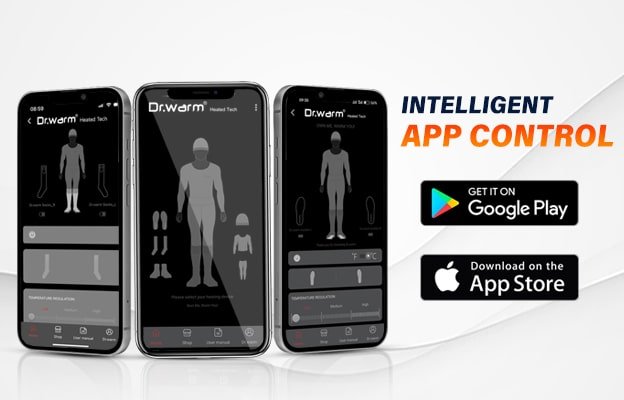
Core Architecture of App-Controlled Heated Socks
The backbone of trusted apps-based heated socks is a well-tuned system with comprehensive integration of the power provision, heat, wireless communication, and smart control.
Some of the main elements interact:
- Heating element: This part is usually carbon fiber wires or flexible heating film woven to the sock material, concentrating heat in high heat zones such as the toes and forefoot to evenly distribute heat.
- Lithium battery pack: The Democratized battery pack is a rechargeable battery pack (typically 3.7 / 7.4 V) that can be integrated into a cuff pocket or an in-basket module and supplies portable power.
- Battery Management System (BMS): Measures voltage, current, temperature, and eliminates overcharge, over-discharge or short.
- Bluetooth module: Generally Bluetooth Low Energy (BLE) to transfer wireless data in the most efficient and low power consumption output.
- Microcontroller (MCU): The main chip that reads the instructions in the app, performs temperature controls and controls power conditions.
- Mobile app interface: iOS/Android software that transmits commands and provides feedback in the shaped of battery level and actual temperature.
| System Component | Function |
| Heating Element | Generates controlled warmth via resistive heating |
| Battery Pack | Provides portable, regulated power |
| BMS | Protects battery and regulates safe output |
| Bluetooth Module | Enables low-power wireless communication |
| MCU | Executes temperature logic and system commands |
| Mobile App | User control interface for settings and monitoring |
Brands seeking to develop or source these systems often partner with manufacturers offering smart heated socks OEM solutions to ensure component compatibility and system reliability.
How Bluetooth Integration Works
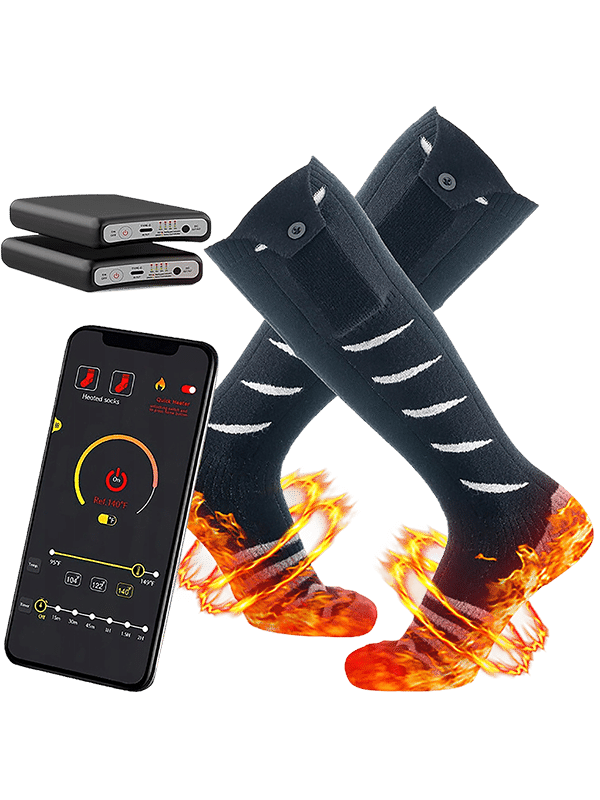
The bluetooth integration is what can make heated socks more an active gadget with an adjustable user interface, however, there are some engineering considerations required to make it sustainable and efficient.
Most contemporary Bluetooth heated socks utilize Bluetooth Low Energy (BLE) protocol (Bluetooth 4.0 or later), which puts a high value on low power usage coupled with a compromised short-range capability – optimal in the wearable device market where the battery life is paramount.
Pairing mechanism generally entails:
- Activation of socks (enablement of power and BLE module).
- Browsing through the devices with the app.
- Creation of a safe network, which can be the simplest numeric validation, or auto-connection.
After connecting the pair, the application sends the commands (e.g. change in heat level) as small packets of data to the MCU through the Bluetooth module. These instructions are processed by the MCU that changes heating output.
The considerations of signal stability have been:
- Worked on the 2.4 GHz range, which is prone to Wi-Fi or microwave or other BLE interference.
- During the movement, sweat, or even flexing matter of the fabric, one aims to remain connected, which is usually alleviated by the placement of antennas in the vicinity of the cuff.
- Automating reconnection logic on short to short connections.
Now other important factors are firmware updates. OTA can also enable manufacturers to deliver updates to enhance power efficiency, fix bugs, or introduce new features but this necessitates well-designed bootloader and secure update protocols to avoid bricking the devices.
Temperature Control Logic and Power Management
The operation of effective temperature regulation in the heated socks app control systems is based on the complexity of logic to balance the comfort of the user, safety, and battery life.
The MCU utilizes algorithms to provide multi-level heat control, such as low (usually 104f), medium (usually 122f), and high (usually 140f and higher) with some applications having a much finer granularity.
Pulse-width modulation (PWM) is commonly applied in real-time temperature control to switch power to the heating coil at a frequency below the heating element average dissimilarity to obtain hotness by means of rapid power switching, resulting in average thermoregulation with very little full power operation. The method minimizes power spikes and enhances efficiency.
Battery consumption optimization offers adaptive algorithms to throttle the output when battery voltage is low and also, upon inactivity or approaching extremely low-battery limits.
Temperature memory on the cooler will save the previous setting to have the convenience of a next time.
| Control Feature | User Benefit |
| Multi-level Heat | Personalized comfort across conditions |
| Auto Shut-Off | Enhanced safety and prevents forgotten drain |
| Real-Time Monitoring | Battery visibility and precise adjustments |
| Temperature Memory | Convenience—no need to reconfigure each time |
User Experience Factors Beyond Technology
Hardware and firmware are the basic components but the bottom side is user experience where sensors and firmware ensure adaptation in bluetooth heated socks and brand perception.
The design of the application interface should put the emphasis on simplicity: with ease of use in the form of intuitive sliders or buttons to turn the heat on and off as well as easily readable battery indicators as well as the number of steps involved in pairing should be minimal. Menus can be too complicated and allow too much control.
The truth is that ease of pairing matters much-better quality auto-connect on power-up allows users to meet the requirement and avoid some inconvenience brought about by cold outdoor conditions and gloves covering the phone.
Stability in the open air consists of the graceful handling of disconnects caused by movement, and prompt and visual/audible notification of the disconnection.
The compatibility not only across devices (iOS and Android, different OS versions) does not exclude the large user groups.
Latency in feedback: This is time taken in responding to app command, lag between command and actual heat change. It should be kept within the range of 1 to 2 seconds to be responsive.
This may result in negative reviews of the company in terms of poor experiences in any field that will affect the brand trust in the competitive markets of wearable heating technology.
Manufacturing Challenges in App-Controlled Models
The app-controlled heated socks require more accuracy than the traditionally switch-controlled model, especially in the area of electronic integration.
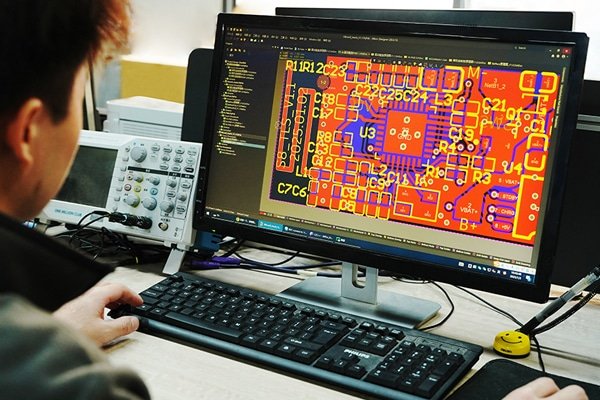
PCB assembly entails considerable tolerance to allow small and flexible board types to be installed into the sock cuff, without any damage to comfort or service life.
The test of firmware stability is performed thousands of times, with cycles simulating real-world conditions: temperature variations, movement, intermittent connectivity to unearth real-world conditions.
This is by waterproofing the electronic modules (typically to IP65 or above) against sweat, snow, and washing – with conformal coating, sealed connectors, and potting compounds.
Signal interruption prevention incorporates strategic setting-up of antennae and shielding in minimizing fabric or body attenuation.
Stress testing (thermal cycling, vibration, and long term battery cycling) and aging is done to ensure longevity prior to market release.
Battery Life Considerations in Smart Heated Socks
The performance of the battery is one of the most evaluated features of the smart heated socks, and Bluetooth introduces constant low-level drain.
Constant Bluetooth connection presents a minor yet continuous power usage (with an average of 115 mA of power usage in active scanning mode or connected mode) which collects towards the hours.
Drain at high settings is greatly accelerated, peak power can range between 4 and 6 hours, and low power can go as long as 10-14 and more depending on capacity.
When not heating, standby power usage required should be reduced by use of efficient sleep modes.
Effective firmware programs consist of optimized PWM duty cycles, adaptive algorithms, and aggressive power gating and can achieve far greater run times.
Capacity of a battery directly correlates to total duration where typical packs are 2200-8500mAh/sock.
| Factor | Impact on Battery Life |
| BLE Connection | Low but continuous draw |
| High Heat Setting | Faster drain |
| Firmware Optimization | Extends runtime through efficiency |
| Battery Capacity | Determines total duration |
Common Issues in App-Controlled Heated Socks
Even thoroughly designed systems have problems that the manufacturers must handle:
- Connection drops – Interference, distance, or low battery causes this drop; this can be countered by reconnection logic but may not counter interruption control.
- Firmware errors — Can cause unreliability of commands, scaling of temperatures inaccurately, or spontaneous shut-downs; fixed by update over the air (where available).
- Poor temperature control — The sensor drift, bad PWM calibration, or unbalanced location of heating elements.
- Battery drain issues – complaints will usually be during always-on Bluetooth or high-performance mode; users can sometimes ignore the standby influence.
- Bugs in applications — Crashes related to the version or being denied permissions or failing to pair on older devices.
All these problems show the significance of the strict testing and firmware development.
Conclusion — Smart Integration Defines Modern Heated Socks
Heated socks that can be controlled by an app are a mix of wearable heating devices and mobile applications. Their quality is backed by a disciplined engineering implementation, non- volatile firmware development, and accurate manufacturing implementation.
Achieving success in this category is a matter of balancing creativity with the strength in that the new intelligence should improve the main activity of providing uniform warmth in cold conditions as opposed to making the task challenging.