

Heat sensors in insoles The choice of the battery does not just rely on capacity in any heated insole but directly on the safety, heating stability, life, and regulatory whatsoever.
The majority of the heated insoles use rechargeable lithium-based battery, most often lithium-ion (Li-ion) or lithium-polymer (Li-Po) cells. The battery capacity that works in milliampere-hours (mAh) determines the duration of heating directly, with built-in protection systems (circuit boards, thermal sensors, etc.) required to avoid the risks of overcharge and overheating or short circuiting.
A reputable number of buyers will anticipate high battery capacity as a mean of high performance. Factually, the issue of safety engineering, the stability of discharge rates and the heat control are of equal importance. In insoles operating at 70 C, battery quality and safety circuitry are significant factors to consider than the raw capacity values, in terms of safety and long-lasting performance.
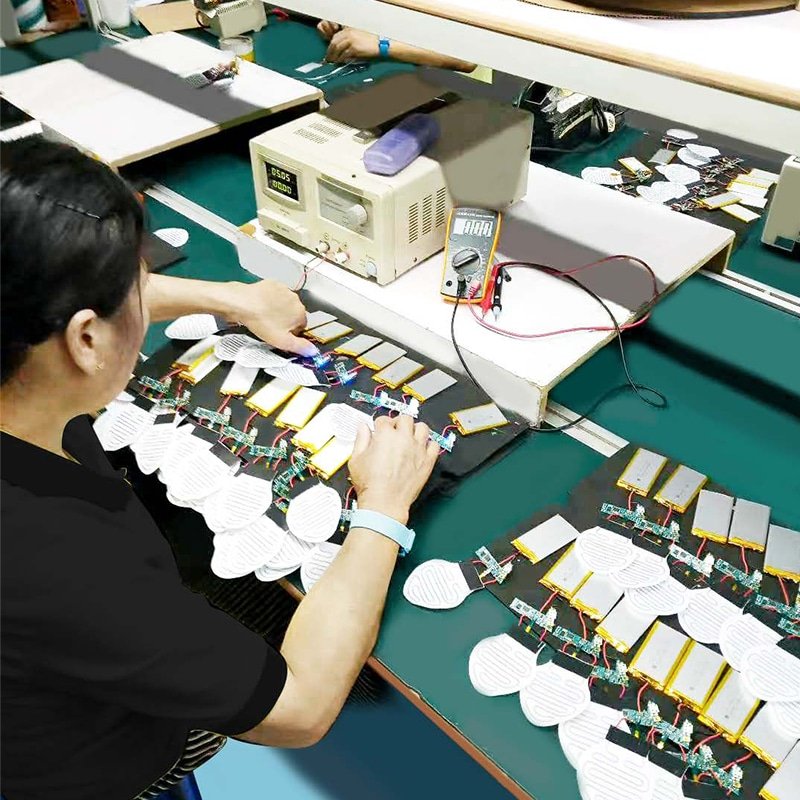
Why Lithium Batteries Are the Standard in Heated Insoles
The lithium-based batteries have been adopted as a standard in the heated insoles industry because they have a high energy density, are rechargeable, and they can provide constant power in a sizeable package.
Lithium-Ion (Li-ion) Batteries
These apply a liquid electrolyte to cylindrically or prismatically shaped cells. They provide a constant voltage output, and are usually used in removable battery pack designs of the type of solution used with heated insoles.
Lithium-Polymer (Li-Po) Batteries
Li-Po cells utilize a gel-like polymer electrolyte that is contained in a pouch that is of flexible material. This enables thinner shapes with more flexibility that blend comfortably into slim profile in soles without bulky appearance.
Key Advantages of Lithium Chemistry
Lithium batteries are high-energy with high specifications, at 150-250 Wh/kg, and thus it can be heated in a short time in a compact size. When well taken care of, they are said to support hundreds of recharge cycles hence suitable to be used by consumers and professionals in cold environments.
Older designs now seem to be phased out of use because Nickel-based systems (NiMH and NiCd) are largely replaced by a unified system. They have a reduced energy density, memory effect and weight, which reduces comfort and performance in current heated footwear.
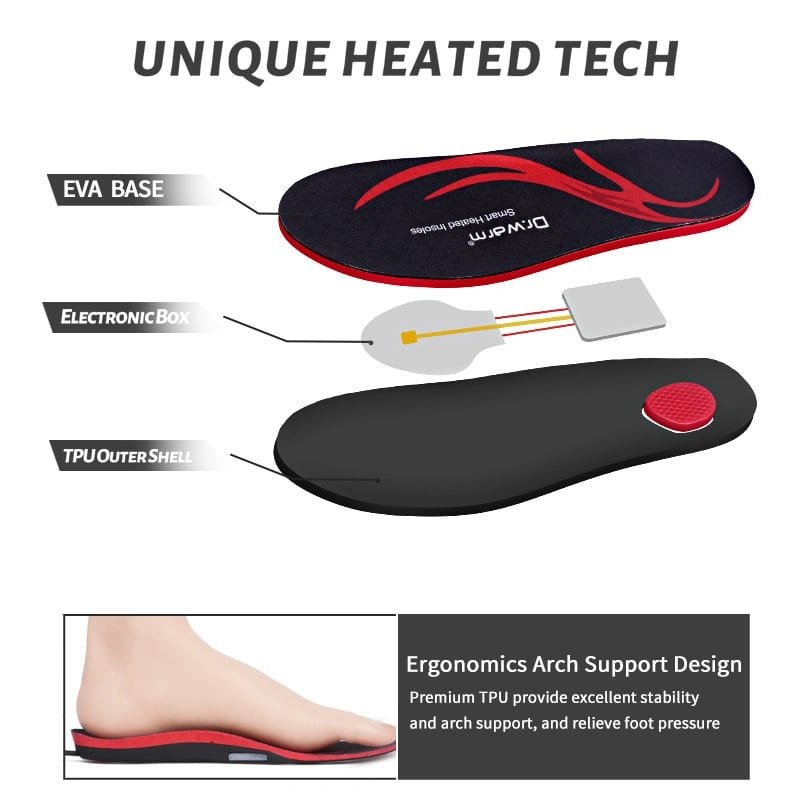
| Battery Type | Key Characteristics | Typical Use in Heated Insoles |
| Lithium-ion | Stable cylindrical cells, liquid electrolyte | Detachable battery packs |
| Lithium-polymer | Flexible pouch cells, polymer electrolyte | Slim insole designs |
| Nickel-based (rare) | Lower energy density, heavier | Outdated designs |
For manufacturers exploring custom solutions, partnering with experienced producers that understand these trade-offs ensures reliable integration — such as in heated insoles OEM manufacturing.
Battery Capacity (mAh) and Heating Duration
Battery capacity in mAh is used to tell how much charge a cell can hold but in comparing to the effect of heating a insole it is associated with heating run time when this is balanced with power draw and efficiency.
Greater capacity increases possible operating time, although the operating time in real life depends on heat intensity (low, medium, high) temperature of the ambient air, and the efficiency of the heating elements.
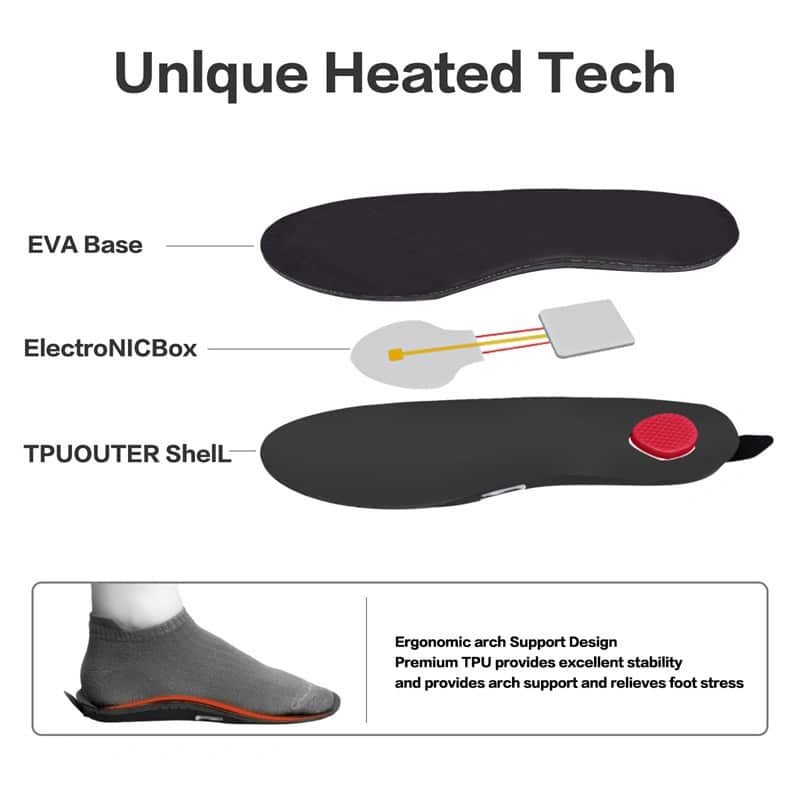
Capacity vs. Runtime Trade-Offs
The bigger the battery, the longer the heating time but more weight and bulk adding to the tight shoes, which makes them less comfortable.
| Capacity Range | Approximate Heating Duration (typical conditions) | Design Consideration |
| 1500–2000 mAh | Short to moderate (often 4–8 hours on low/medium) | Lightweight, prioritizes slim fit |
| 2000–3000 mAh | Balanced (6–12 hours depending on level) | Standard for outdoor and daily use |
| 3000 mAh+ | Extended (8+ hours, up to 12–14 on low settings) | Heavier battery pack, suited for prolonged exposure |
These are rough estimates that are founded on engineering facts; real performance will be determined by efficiency of the systems and environment. Applying exaggerated durations that have not been validated may mislead users and welcome compliance problems.
Protection Circuit Boards (PCB) and Safety Engineering
Protection circuit boards (PCBs) are not optional in rechargeable heated insoles – they are used to protect against lithium chemistry inherent to the mechanisms besides being subject to mechanical, temperature, or user error forces.
Essential Protection Features
A good PCB measures and regulates:
- Overcharge protection — disables charging before swelling or thermal runaway occurs.
- Over-discharge protection- This averts excessive drain, which destroys cells.
- Short protection Fault protection short-circus to prevent sparks or fires.
- Temperature control- involves sensors that will stop the process when the cells or heating units will be above safe temperatures.
Other characteristics such as current limiting will guarantee a stable production during changing loads.
| Protection Feature | Purpose | Risk Prevented |
| Overcharge cutoff | Prevents excessive charging | Battery swelling, fire risk |
| Short-circuit protection | Detects and isolates faults | Electrical safety, component damage |
| Thermal sensor | Monitors cell and element temperature | User burns, thermal runaway |
| Current limiter | Regulates output under load | Circuit failure, overheating |
Before the accident Precautions against electricity Electric shock Electric damage Electric disturbance Electric
Integrated vs Detachable Battery Systems
Integrated and detachable battery design has definite trade-off in usability, maintenance and lifespan.
Integrated Battery Designs
There are batteries built in the insole which produce a wireless smooth insole. They fit well in a sleek figure, but make it slow in changing and fixing in case its cells deteriorate.
Detachable Battery Modules
Outside or interchangeable packs can be changed and charged easily. They carry more and make such maintenance simpler, yet include connectors which must be waterproof and dependable.
Key Trade-Offs
Integrated systems are more comfortable and less prone to snag formation, although lower serviceability. Detachable ones enhance the lifespan with replaceable packs and easier drying but need heavy waterproofing (often IP65+ rated) to cope with sweat and snow.
Identifying the user scenarios, i.e. the outdoor work and casual use, will require that the manufacturers make decisions.
Battery Lifespan and Aging Performance
Depending on the quality of cells used and usage, battery life in insoles when heated has a range of 300-800 full charge cycles before showcasing capacity degradation.
Factors Affecting Degradation
Lithium cells become less efficient over time as a result of chemical side reactions. Full discharges favored by high temperatures enhance aging; and often overload the chemistry.
Storing (cool, half-charge) and not exposing oneself to excessive heat prolongs life.
| Factor | Impact on Lifespan |
| Charging frequency | Gradual capacity decline with cycles |
| High temperature exposure | Faster degradation |
| Poor protection circuits | Early failure from unmanaged stress |
| Proper aging test | Validates long-term quality |
Cycle and high-temperature aging tests should be done by manufacturers to ensure real-life durability.
Compliance and Transportation Considerations
Heated insoles at lithium batteries are types of products that are highly regulated by transport regulations because of thermal runaway risks.
UN38.3 test — altitude, thermal, vibration, shock, and short-circuit tests — is required to achieve safe shipping. Stability of transportation through stresses is confirmed.
Other standards are CE, FCC and RoHS, and labeling compliance on air/ground transportation. The capacity or cost (e.g. 30 percent or less in future regulations) of many airlines is limited and requires appropriate documentation.
To prevent delays at the customs or recalls, sourcing teams ought to review UN38.3 reports to prevent customs.
Common Battery Mistakes in Heated Insoles Production
The problem of production errors is frequently of the nature of focusing on short-term specification at the expense of long-term safety and reliability:
- Raising capacity and sacrificing safety – using high-mAh cells and not as well-protected.
- Assuming that protection circuitry quality does not matter – basic or inferior PCBs not overseen by thermal monitoring.
- A high load on low grade lithium cells -low separators on the cells or irregular production.
- Omission of aging tests – not testing lifecycle and decay at heat/pressure.
- Excessive claims on the duration of heating time – marketing on optimal laboratory conditions instead of practice.
Such neglects might result in field failures, safety accidents or regulatory problems.
Conclusion — Battery Engineering Defines Safety and Stability
Types of batteries in the case of heated insoles define long before the insoles can be heated. Reliability is brought about by good lithium cell choice, built-in protection circuitry and rigorous manufacturing check.
To product managers and sourcing professionals, the emphasis should be placed on safety engineering instead of raw capacity, and that will guarantee compliant products that should last the test of time and that they will be usable in the harsh conditions of the cold weather. Focusing on quality at the battery level ensures safety of the end-user and fosters a sustainable relationship with the end users based on heated footwear.