

Heated insoles provide mostly the heat at the bottom of the foot through an insole embedded in the shoes, and the heated socks offer the heat on all of the foot and sometimes the ankle through built-in components of the fabric. The more favorable option will be ultimately determined by the sort of footwear, the intended activity and the special performance demands like compatibility and durability.
Another myth is that warm feet are warmer especially when you wear warm socks because they contain more surface area. In reality, heating distribution efficiency, placement of the elements and battery configuration contributes more to the real thermal performance as compared to total coverage itself.
Structural compatibility, durability requirements and requirements based on heat distribution need to be the basis of the decision between heated insoles and heated socks as opposed to perceived coverage.
Structural Design Differences
Heated insoles and heated socks are two different ways of incorporating heating technology into footwear with strong implications on the ease of installation, replaceability and the overall system integration.
Heated insoles are portable heating insoles that are a removable insert that contains heating elements composed of either carbon fiber or flexible film technology to be placed into the inside of standard shoe or boot bottoms. Heated socks contain heating wires or conductor cloth within the fabric of the sock, so the heating aspect of the clothing is built into the garment.
This is the basic distinction that influences the interaction of each product with footwear. The flexibility of insoles is very high on a variety of pairs of shoes, whereas socks are restricted to the thickness and fit on a given volume of boots.
| Factor | Heated Insoles | Heated Socks |
| Installation | Insert into shoes | Worn as socks |
| Replaceability | Easy to swap | Limited |
| Footwear flexibility | Works with multiple shoes | Limited by sock thickness |
| Structural stability | Protected by shoe | Exposed to stretching |
For brands developing custom heated insoles for outdoor use, it can be removed and prototyped or adapted to different types of shoes without modifying the upper structure.
Heating Coverage and Distribution
Having the heat delivered efficiently relies on the specific location and efficiency of heat transfer rather than the overall amount of surface area covered.
Heated insoles focus the heat directly beneath the sole which is the major point of contact with cold surface, giving uniform warmth to the weight-bearing part of the foot. Such an underfoot attention can usually be a productive heat transfer particularly when this is combined with insulating footwear layers.
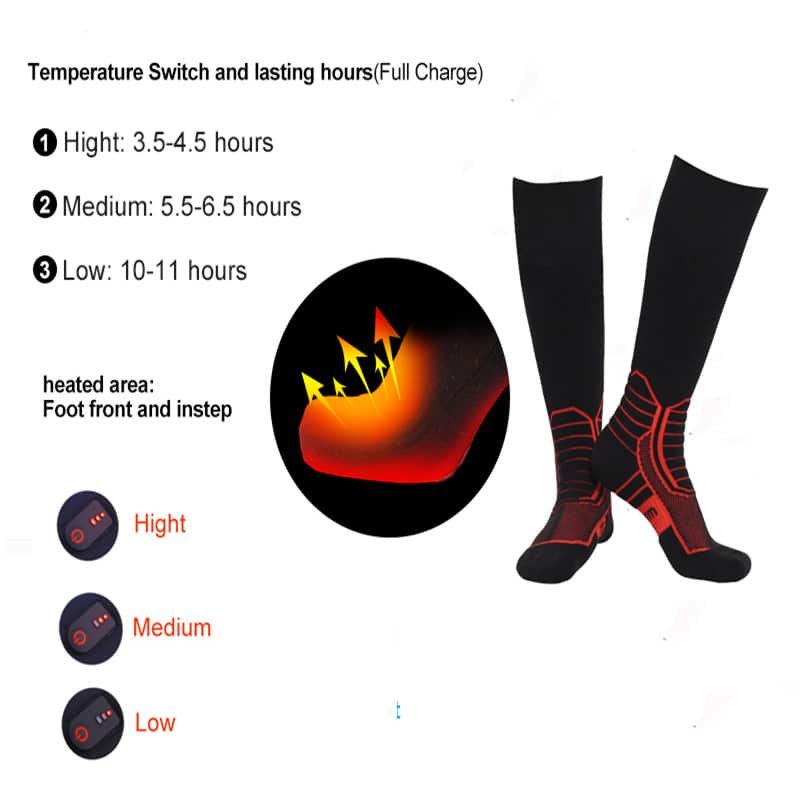
Heated socks provide warmth in the sole, upper foot, and occasionally the ankle or toes, being a more enveloping effect. This wider coverage is however subject to a slight loss of heat through layers of fabric and uniformity is highly dependent on the wiring topography and density of elements.
They both may work well when designed appropriately, though in compressive conditions, insoles are likely to provide more reliable warmth than socks, whereas in full circumferential coverage situations, socks are the ones that will work.
| Heating Feature | Heated Insoles | Heated Socks |
| Primary heat zone | Sole area | Sole + upper foot |
| Heat uniformity | Even from bottom | Depends on wiring layout |
| Battery placement | External or ankle | Often ankle or calf |
| Efficiency | Direct contact with foot | Slight heat loss through fabric |
Direct underfoot heating is commonly found to be more comfortable in use in applications such as skiing or long outdoor exposure because it has less conductivity to cold through the ground surface.
Durability and Wear Resistance
Durability is quite different as various products are subjected to various mechanical stresses in the course of usage.
The heating insoles are designed to resist compressive forces, shear forces, and bending under body weight in the protective footwear. Quality designs incorporate the use of reinforced heating elements and protective layers that help to withstand fatigue thus they are applicable in the high-impact or long-duration activity.
Heated socks encounter other issues: they tend to stretch out, they can be washed, they can snag on boot lining, etc. Fatigue can also occur to heating wires or conductive threads due to heating with time, and laundering (even machine-washable) may hastily wear it unless it is under careful management.
The frequency of replacement is usually reduced in the insole in a demanding environment whereas socks can demand higher frequency of replacement depending on their intensity of use and care routines.
Battery Placement and User Comfort
The position of the battery determines distribution of weight, ease of accessibility and overall user experience in a practical situation.
External battery modules are used with heated insoles, usually to be clipped to the shoe tongue, ankle, or even the belt, and wires are threaded to the heel. This type of construction ensures that the weight is not applied to the footbed area, the interior of the shoe is low profile and can be easily removed to charge or change.
Most battery-operated heated socks have built-in pouches of battery packs – typically around the calf or the ankle – with small lithium-ion batteries pressed against the leg. Although it does away with external wires in certain designs, it may add a bit of bulk or movement when moving, and charging may entail removing the pack, which must be attached in one place.
| Battery Factor | Heated Insoles | Heated Socks |
| Battery location | External module | Integrated pocket |
| Charging convenience | Detachable | Often fixed |
| Weight distribution | Stable | May shift |
| Maintenance | Easier replacement | Limited repair options |
The maintaining and flexibility of external placement in insoles usually have benefits, particularly to technical users who favor fast changes.
Best Applications for Each Option
The best fitting solution is the one that fits the requirements of the activity in terms of the demands of the activity in terms of fitness, mobility and being exposed to the environment.
Heated insoles are usually useful in situations where they need a high level of durability and interchangeability with footwear, like heavy boot usage in a heavy outdoor setting, construction in cold-storage areas, and hiking where the user changes shoes regularly. Their thin shape leaves them in the tight-fitting boots without making them bulky.
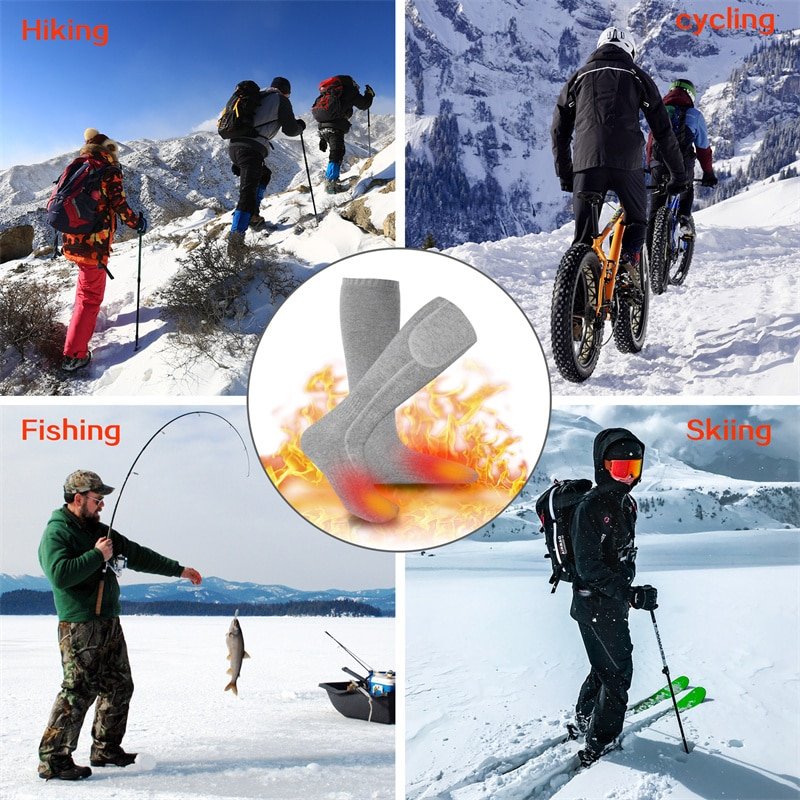
Heated socks are usually worn in situations where warmth of feet and ankle is of paramount importance, such as in skiing, snowboarding or even in static outdoor activities such as hunting or ice fishing. They also fit well into layered systems though they might need boot volume to be adjusted to prevent a fit problem.
Both are not always superior, the choice depends on the availability of footwear and performance considerations.
Common Misconceptions When Comparing the Two
The assumptions that may result in the incompatibility of the heated foot solution choices are several.
- Greater coverage is better a guarantee of greater warmth and the issue of actual warmth is that it relies on the level of the efficiency of the transfer of heat and the positioning of the elements and not the size of the coverage; specific underfoot heating can be superior to extensive coverage that is less focused.
- Socks are always better; Comfort depends on the fit of the boot; additional sock cushion results in a pressure point or poor circulation in tight shoes, whereas insoles retain the preference of original socks.
- Insoles do not warm upper foot — Although primary attention is paid to the underfoot area, the fact that conductive warmth can be efficiently distributed with the help of good insulation and shoe design.
- The position of the battery has no influence on usability: External vs. internal position has an influence on the weight feel, the ease of charging, and convenience of the battery in longer usage.
By making these points clear, technical buyers can be able to make choices based on engineering facts and not the assumptions they have.
Which Option Is More Suitable for Brands and OEM Development?
In the manufacturing and product development sense, the idea of the heated insoles tends to be more scalable and flexible to the brands.
The insoles have less complex integration, that is, heating systems are stored in a separate unit, which means that the area of temperature control, amount of battery capacity, and the choice of materials can much easier be adjusted without having to redesign clothing. The ease of replacement is an advantage to after-sales support because warranty has a lower complexity.
Heated socks are more complicated to manufacture, such as tough integration of conductive threads or wires within stretchable fabrics, precise placement to prevent failure locations during flexing or washing, and testability in alignment to different sizes of socks. This adds to the time and possible quality control issues.
To sourcing managers and developers of the own-label solution specializing in winter heated foot solutions, insoles can offer a more effective entry route with fewer structural integration challenges.
Conclusion — Choose Based on Application and Design Strategy
Both heated insoles and heated socks have their unique benefits relative to usage, shoe fit and wear life issues. Knowledge of structural design, heating distribution variations enables brands and users to choose what solution fits their particular cold-weather requirements.
Considering such aspects as the method of heat delivery, resistance to mechanical stress, design of the battery, and the purpose of the product, i.e. whether it will be used in skiing, outdoor work, or in everyday life, the decision-makers can consider the matching of the product choice with actual performance goals instead of baseless assumptions.