

Hunting and fishing are conditions that require prolonged stationary warmth instead of the great mobility experienced in winter activities such as skiing. These activities, unlike lively ones where one is constantly in motion and generates a lot of body heat and can make necessary adjustments after a short time, have long durations of immobility as one sits on a blind or stands in a stream or waits on a treestand with cold ground, dew, rain or wading water and in the cold wind. Climate constant low level heat is critical to avoid numbing and keep blood circulation active without causing discomfort or distraction.
People think that the heated sock types used in hunting are the same as the ones ski styles, however, in hunting and fishing, long periods of inactivity, noise-free operation and resistance to moisture are required. To be used in hunting and fishing, some of the requirements of heat socks include a steady low intensity heat, long life cycle and waterproof clothing to ensure that the products remain functional when exposed to harsh outdoor conditions over extended periods.
The essence of positioning does not get lost: Heated socks in hunting and fishing should have the ability of balancing silent functionality, constant heating output, waterproofness, and extended battery life to work well in hunting drawings that require prolonged stagnation and stay inside the cold outdoors.
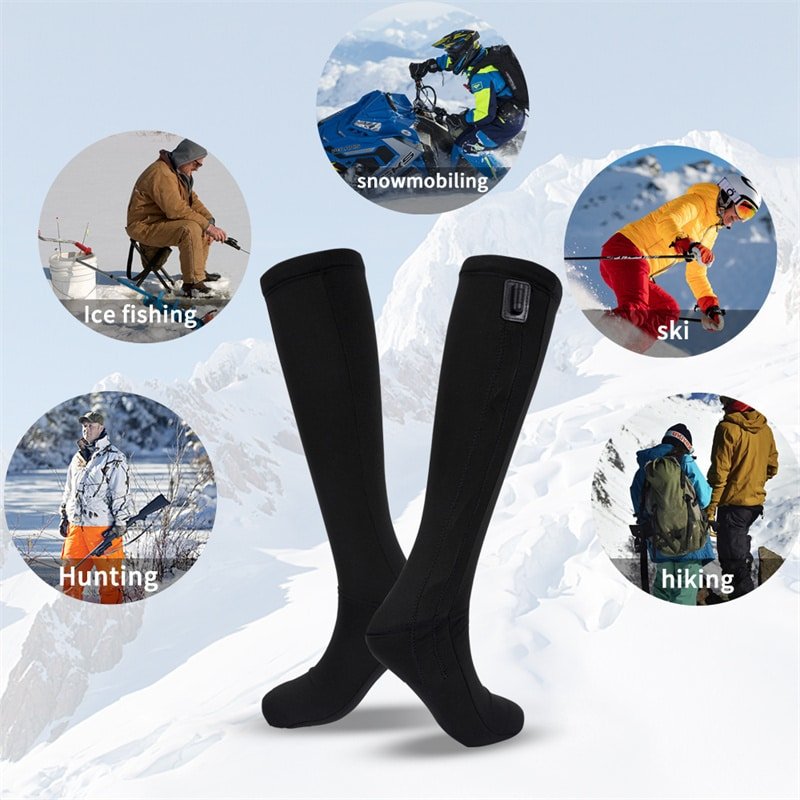
Environmental Conditions in Hunting & Fishing
Hunting and fishing require socks that are heated to provide extended confinement in cold and unpredictable environments as opposed to temporary activity.
Common situations would be sitting or standing hours without much movement, direct contact with frozen or wet ground, being in water during wading, rain, melting snow or high humidity, wind increasing heat loss and distant areas where no convenient access to charging is available during multi-day trips. These influence design towards durability, defense as well as elegance rather than peak power production.
| Environmental Factor | Design Implication |
| Static Exposure | Stable low-level heating |
| Cold Ground | Reinforced toe heating |
| Moisture | Insulated wiring |
| Wind Chill | Thermal retention focus |
| Limited Charging | Extended battery capacity |
For brands developing outdoor heated socks customization customization is critical to meet the demands in those particular fields and make the product match the actual field requirements instead of being a no-specific cold-weather product.
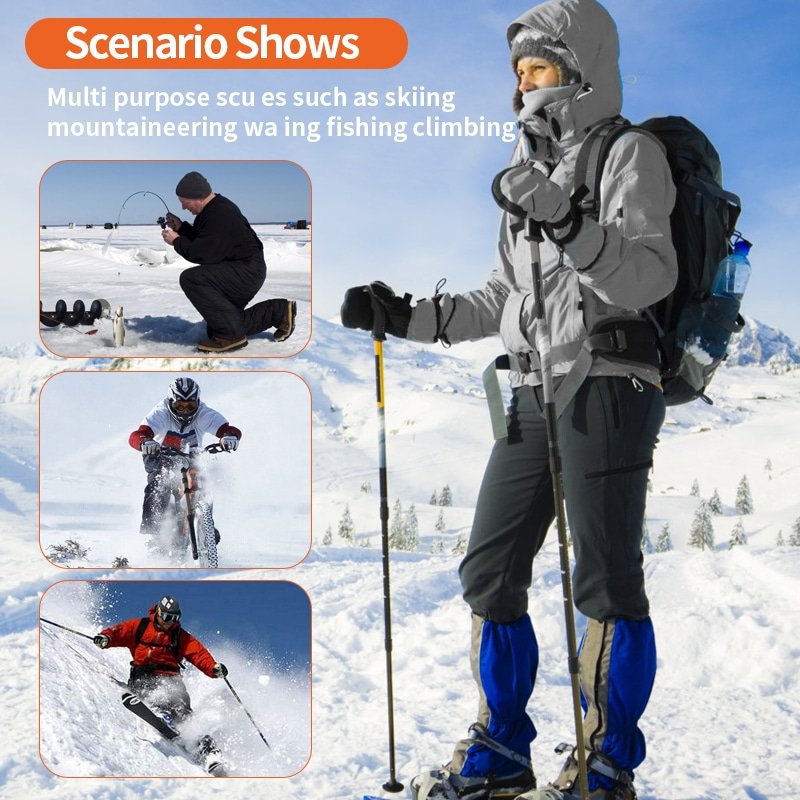
Heating System Requirements for Field Use
Hunting and fishing heated socks are designed to favor warmness at low intensity rather than high bursts of high intensity performance common in high-movement sports.
Even heating should be directed especially in the toe box where circulation decreases the most in the resting posture. Carbon fiber or elastic film components can be used in these applications, and they can be covered uniformly without hot spots that can be uncomfortable in the long run. Bulk should be kept to the minimum possible to form pressure points within the insulated boots or the waders, and the wiring designs must be flexible so that natural foot actions are not impeded.
Most importantly, it has to be quiet – no clicking of mechanical switches and a relays as even the slightest sound will frighten game or spell concentrated thoughts in silent field conditions. Sir, soft-touch, cellular controls (electronic) or controlled through remote or app also eradicate this problem but also enable finely-adjustable control.
Battery Endurance for Extended Outdoor Sessions
One of the most significant types of differentiation of heated socks are battery life with hunting and fishing because sessions are often more than 812 hours long and have no chance to recharge the battery.
The practical warmth required in the case of a static position is provided in low to medium settings which does not consume much energy compared to high settings which are to be used in a quick recovery mode of active sports. Pulse-width modulation (PWM) control in itself is highly efficient since it removes the constant power draw but instead it cyclic draws, giving a significant amount of usable time. Batteries with a bigger capacity (e.g. 4000–6000mAh per side or more) become the norm, with possibly dual battery configurations that can be swapped as required.
The time taken depends on ambient temperature, wind, and personal metabolism, however, probable expectations encompass:
| Heat Setting | Estimated Runtime |
| High | 3–4 hours |
| Medium | 6–8 hours |
| Low | 8–10+ hours |
Low setting used in heavy wind conditions at sub-freezing temperatures may be warm enough, and may give the most all-day performance to long time heated sock in harsh outdoor activities.
Moisture Resistance and Electrical Protection
The biggest risk of reliability of the heated socks in the hunting and fishing area is moisture where because it is always wet, damp, or wet due to the rain, sweat or wading of boots.
Best designs would use insulated sealed, sealed, and insulated wiring and connectors to avoid short circuits and corrosion. Waterproof encapsulation should be used on heating elements and solder joints should be reinforced with conformal coating or heat-shrink tubing. Battery pouches require waterproof zippers or flaps, and these should be placed in such a way that they are not directly into the water.
Poor moisture shielding, results in frequent failures intermittent heating, total shutdown, or safety risk on exposed conductors. Internal moisture reduction via moisture-wicking inner layers (merino blends or synthetics) is an efficient way of sweating, but it is the interaction with the exterior boots that is the weak point- fishing sweat socks and hunting sweat socks should not be affected in any way by splash, dew, or condensation into boots.
Comfort and Fit in Outdoor Boots
The concept of coziness when hunting and fishing in heated socks depends on the fact that these insulated warmer socks should be worn in close relation to heavy, insulated shoes, and not to athletic footwear that is lightweight.
The thickness should remain limited – usually mid-weight instead of bulky, so as not to cramp-up tight waders or boots in case of long wears. Seam placement eliminates areas of stress particularly in the toe and heel where the boots put pressure. The sole or cuff has anti-slip silicone grips to prevent bunching or rotating during slippery liners.
Free routing of wires with flex dumb is in line with that of natural foots, without the inflexible sections potentially resulting in hotspots or fatigue. In the course of hours of non-activity, these details will make or break the sock an endurance-enhancing feature or a distraction.
Durability and Field Testing Considerations
Hunting and fishing heated sock testing should be carried out using durability tests that mimic natural field abuse in excess of laboratory tests.
The flex testing must be more than 100,000 cycles to simulate the repetitive use of boot entries/exits and movement of feet in small spaces. At -20 o C or colder, cold chamber tests determine the conduct of the battery, balanced heating, and brittle nature of the material. Multi-day wear simulations- multi-day wear, moisture exposure wear, boot compression wear simulation and ground contact abrasion wear simulation.
The aging tests increase exposure to the temperature variations, humidity and flex in order to forecast the long term reliability. Field testing, e.g. real multi-hour field work or fishing, would show aspects that lab tests may not, including connector strain or unexpected battery drain when in wind. Manufacturers of battery heated socks in hunting can only be sure that the hunting batteries will remain against seasons when the products are strictly and application-specifically checked.
Common Development Mistakes for Hunting Heated Socks
Most development projects fail because of the application of ski or active-sport assumptions to unchanging outdoor use.
- The intake of ski-oriented heating patterns, with high-output areas in the forefoot rather than toe-priority heating distribution of that area, during long periods of immobility.
- It is important to choose overheating to high settings, as this burns batteries fast, and has minimal payoff when one is not actively doing anything.
- Poor estimation of moisture exposure, resulting in a lack of sealing and a high rate of field failures.
- Even contrary to silent operation requirements, carrying noisy switches that are stealth-busters.
- Ignoring actual battery capacity planning, which leads to the creation of products that do not have the capability to handle full-day sessions.
Such lapses produce products which perform dismally where reliability is the most important issue.
Conclusion — Field Performance Defines Hunting Heated Socks
Hunting and game fishing must have heated socks with high aims of extended operational life, constant low temperature heating, waterproofness, and field performance in order to provide reliable warmth during extended outdoor conditions of cold weather.
Customized engineering – Custom engineering – Custom engineering deals with stagnant needs, environmental risk, subtle functioning. Brands that want to spend the money on these details design equipment that literally allows one to spend longer hours on the field, where foot warmth is a direct factor in performance and safety.