

The conditions of skiing pose some unusual stresses to the use of heated socks which are way beyond the normal winter conditions. Extremely low temperatures coupled with tight compression of the ski boots, high frequency and impact ankle flexion, ingress of snow and prolonged duration when the ski boot is used such as 6-8 hours or even longer on the mountain are the contributing factors to the condition. The following aspects require heating design to accommodate and ensure uniform performance without jeopardizing the fits of boots, circulation and safety.
People seemingly think that skiing heated socks can be used in place of winter heated socks. In practice, the structural life of the ski environment is to be increased by a large margin, in specific location of heating to combat boot pressure points, and additional protection against moisture and mechanical force.
The process of making heated skiing socks involves a lot of attention to heating technology, moisture control, insulation design, and battery storage to makes sure the skiing experience is stable all through the slope.
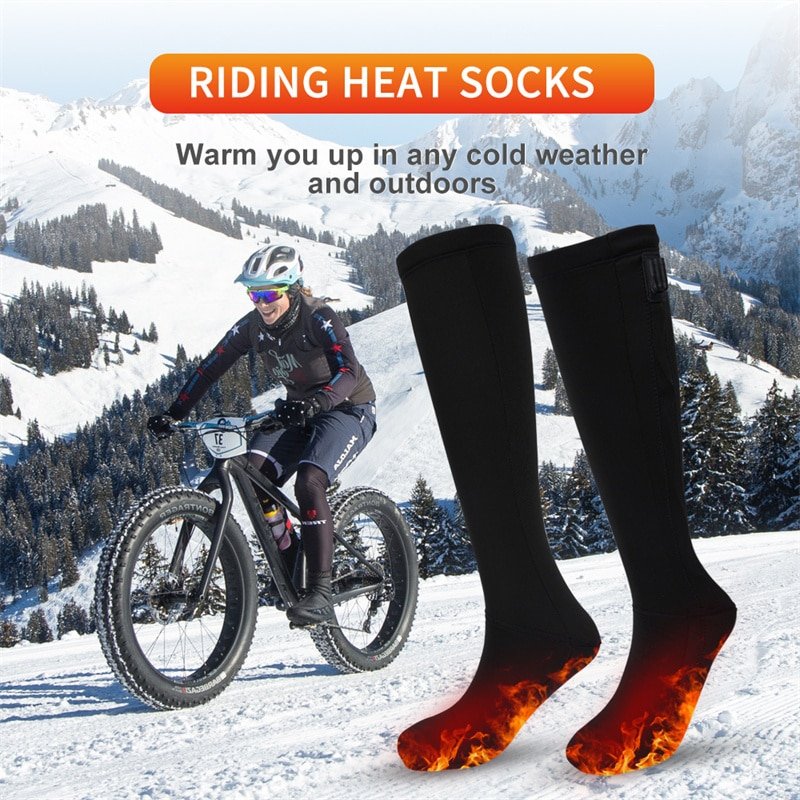
Why Skiing Creates Unique Performance Demands
The challenges of such great environmental conditions and the active physical loads make skiing extremely demanding in the terms of the use of the heated socks.
Putting up with low temperatures causes more heat via the feet, and tight ski boots place focal strain which compressed heating parts and blocks the flow of blood. Turns and traverses with high ankle flexion strains wiring and connections, snow and wet further pose short circuit or corrosion threats, and extended continuous working hours put the batterie to capacity during real-use load.
The circumstances explain the typical failure of generic design of heated socks when used in skiing.
| Environmental Factor | Impact on Heated Socks |
| Sub-zero Temperatures | Increased heat demand and faster heat loss |
| Boot Compression | Pressure on heating zones, potential hotspots |
| Constant Movement | Wiring stress, flex fatigue, connection failure |
| Moisture Exposure | Electrical protection risk, short-circuit potential |
| Long Wear Duration | Battery endurance requirement, thermal regulation |
In the case of the brand that is directed to ski market, these interlinked stresses need to be filled. Brands exploring specialized solutions may benefit from custom heated socks for skiing brands to meet these alpine-specific needs.
Optimal Heating Zone Placement for Ski Applications
The process of heating zones on ski heated socks is led by the need to provide warmth to the body parts most vulnerable to the cold and reduce the bulk and point of friction to components that fit loosely.
Care should mainly be given to the area of toes, as it is in forward-leaning ski postures when they are the ones that lose the most heat and are the most susceptible to boot-constriction. Forefoot integration gives it an added warmer layer without being overly layered, and heel bulk does not create any problem when he skies on his heels. Compression of the heat balance is good to provide even distribution of heat rather than the occurrence of cold spots during the tightening of the boots.
Inefficient location, like hoarding elements to only the single or excessive wiring of high-pressure areas, may decrease comfort, cause hotspots or limit circulation which results in accelerated fatigability or numbness.
| Heating Zone | Ski-Specific Consideration |
| Toe Area | Primary cold exposure; wrap-around or cap design preferred |
| Forefoot | Pressure from boots; thin, distributed elements |
| Heel | Avoid thick wiring to prevent lift interference |
| Arch | Optional for extended warmth; minimal if boot fit is priority |
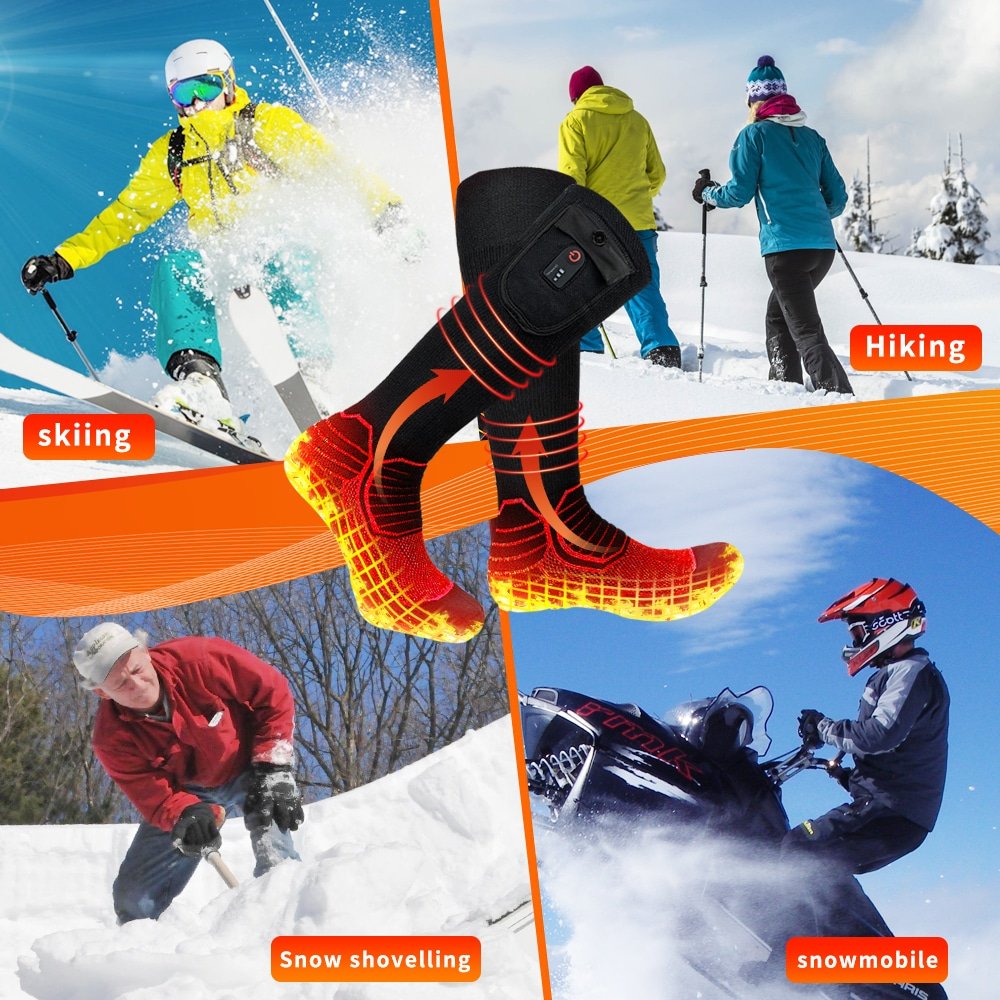
Insulation and Breathability Balance
Insulation and breathability: Insulation vs. Breathability in ski heated socks So far, to ensure that the ski heated socks are not overheated and retain thermal presence in all changing alpine climates, a balancing between insulation and breathability is vital.
Merino wool blends are still a standard because of their inherent ability to wick moisture, offensive odors, and even temperature. Implementation of synthetic moisture-wicking fibers to ensure high-output activity maximizes evaporation and thereby decreases the accumulation of sweat to cause chilling. Though, the aim is thermal retention enough to supplement active heating without retaining excessive heat, which will cause cooling of the body upon leaving the activity.
Excessive insulation leads to a greater moisture problem in closed ski boots and insufficient insulation causes the heat system to strain batteries, resulting in depleted batteries. Different densities of the knit zones are used, where the loft is greater in the toes/forefoot and the compression is less in the other regions to allow the passage of air and help in avoiding overheating at one of the areas.
Battery Performance in Cold Conditions
Depending on the ambient temperature (low) the performance of the battery in cold condition of the common lithium-ion cell decreases significantly; therefore, insulated design and location placement of ski heated socks are vital.
Slower chemical generation in lithium batteries decrease capacity and voltage output below the freezing temperature. Under -10 o C or colder, performance could be reduced by 30-50 percent of the room temperature, depending on discharge rate and cell quality.
Externally attached battery pockets (usually on the calf) are used to ensure constant working temperature, whereas internal location can cause compression damage or heat loss. The outer designs are also beneficial in enhancing the accessibility in changing during extended days.
| Temperature Range | Runtime Impact |
| 0°C | Minimal |
| -5°C | Moderate |
| -10°C or lower | Noticeable reduction (up to 50%) |
This requires testing in real-world conditions, simulated or on snow, to prove the runtime assertions since at higher temperatures lab figure tends to over-project the ability to withstand colder temperatures.
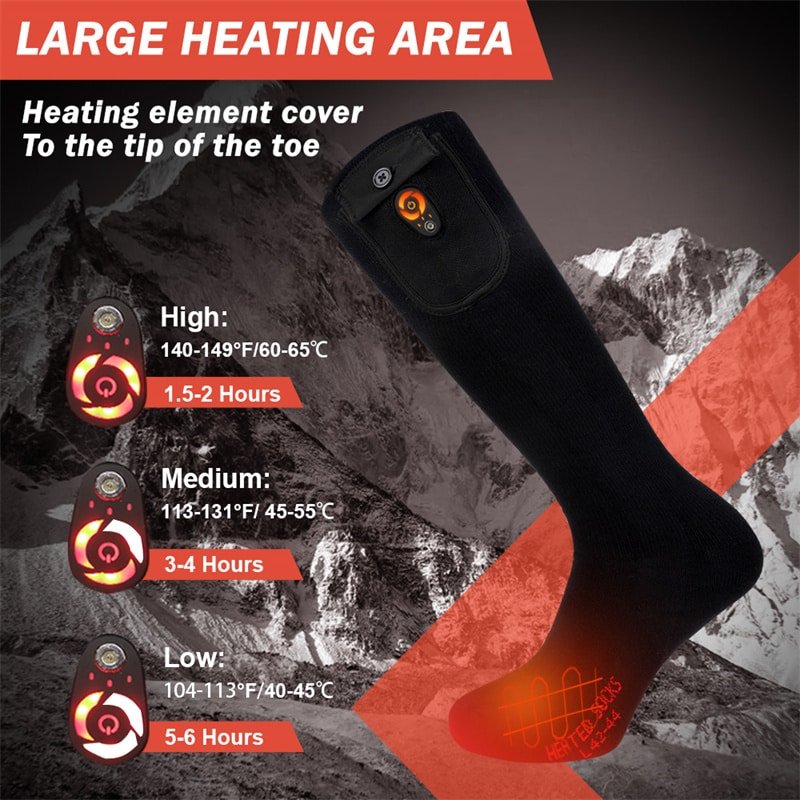
Durability Under High Movement
The long-term reliability in ski heated sock is durability against high movement because ankle flex and shear forces challenge all the components several times.
Turns and moguls involve flexion of the ankle to impose cyclic stress on wiring routes and it requires reinforced conductors, flexible heat transfer films or carbon-based elements, and strain relief to connections. The stress point must be reinforced with stitching, and protection with channeling around the cuff, arch, and toe to avoid the movement or fracture of wires.
Durability during wash is also a key consideration- socks should not deteriorate as a result of repeated washing in terms of heating capabilities or electrical conductivity. Flex testing (thousands of cycles with emulated ski motion) and accelerated aging tests are used to determine weak areas at an early stage of development.and accelerated aging protocols help identify weak points early in development.
Comfort and Fit Considerations for Ski Boots
It is important that comfort and fit in ski boots are based on compatibility of compression where any slight added thickness will distort the proper functioning of a boot.
The heated socks should be of low profile to prevent the presence of pressure point or limited circulation in tight ski boots. The location to pad seams must avoid high friction points such as Achilles or instep and free thickness (preferably the same as high quality non-heated ski socks) maintains the flex and responsiveness of the boot.
To minimize the bunching of hotspots, anti-slip silicone grips are used in the areas of the sock that are structured with knits, or, anti-slip zones to prevent rotation of the socks during violent moves. The prototypes put in real skii boots of various sizes should be tested to provide the consistency of fit and performance implications such as the ability to maintain the edges control and reduction of fatigue.
Common Development Mistakes in Ski Heated Socks
High cost of revision and low performance can be avoided through the avoidance of common pitfalls during development.
- Excessive heat use: Lack of effective temperatures causes sweat and consequential chilling.
- Large placement of battery The thicker packs used internally or due to bulk become uncomfortable and do not fit in tight boots.
- Lack of moisture control: This causes the condensation or sweat to damage the heating units in poor wicking.
- Lack of flex testing: Wiring loses strength during ankle repetition.
- Disregard cold behavior of batteries: Extravagant run-time performance leads to mid-day power decay.
These are well covered through comprehensive prototyping and field validation.
Conclusion — Performance Engineering Defines Ski Heated Socks
Skiing heated socks should be designed to operate under alpine temperatures and strike a balance between heating capability, durability, and dehydration with battery stability in order to provide predictable defense when operating under cold conditions in the long term.Efficient development combines textile organization with heating system architecture at an early stage and puts more emphasis on ski-specific stresses than on generic use in the winter. This is a performance-based strategy that provides the products with the high standards of winter sports brands and on-mountain end-users.