

Both socks and insoles are heated and they are not universal because the right option can be determined by covering the heating areas, structural aspects of integration, comfort factors and positioning of the product.
Most people in the business believe that the idea of heated insoles is a watered-down or cheaper alternative to heated socks. In practice, when used in a real life context, these two systems greatly diverge in their similarities in terms of distribution of heating, structural integration and comfort dynamics. The sock variant is fully heated using textile-integrated components and the insoles type specifically heats the sole.
It is necessary to decide between heated socks or heated insoles considering their heating coverage, the level of comfort they are used to, the compatibility with the choice of footwear, and the complexity of their manufacturing. Engineering wise, all the methods come at a certain trade-off in thermal behaviour, integration issues and reliability over time.
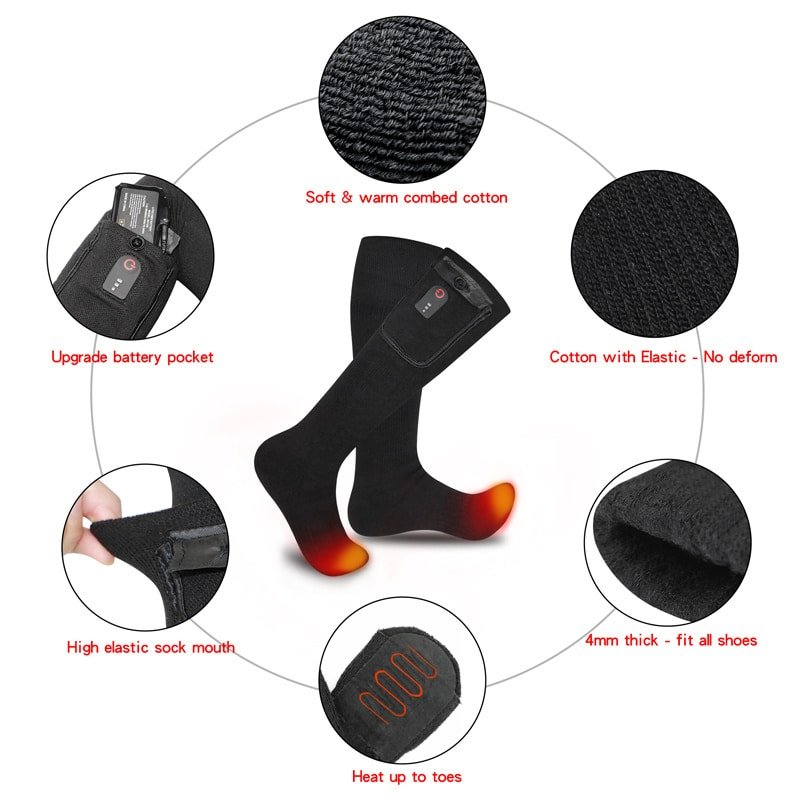
Core Structural Differences
The basic difference between the heating socks and the heating insoles is in the manner in which they are made and installed to become a part of the footwear system.
Novel thermal knits Heated socks are socks in which directly incorporated heating elements are heating carbon fiber wire (or flexible heating film) wire or heating film layers directly into the textile construction of the sock. This is a textile-based method that enables the heating to fit well in the contours of the feet.
Conversely, heated insoles incorporate heating units within a hard or semi-hard footbed insert typically installed beneath a cushion area. Routing of power is frequently performed on external cables that are formed as either heel or side of the insole.
The implications of such differences in design are different in terms of power delivery, flexibility and the overall system life.
| Feature | Heated Socks | Heated Insoles |
| Heating Coverage | Toe + forefoot + midfoot | Sole-focused (primarily arch/toe/heel) |
| Structure | Textile-based | Footbed insert |
| Battery Placement | Ankle or calf (integrated routing) | External cable or side-mounted |
| Flexibility | High (conforms to movement) | Moderate (limited by insert rigidity) |
For brands exploring custom solutions, a heated socks OEM manufacturer can provide tailored textile integration that aligns with specific performance targets in demanding applications.
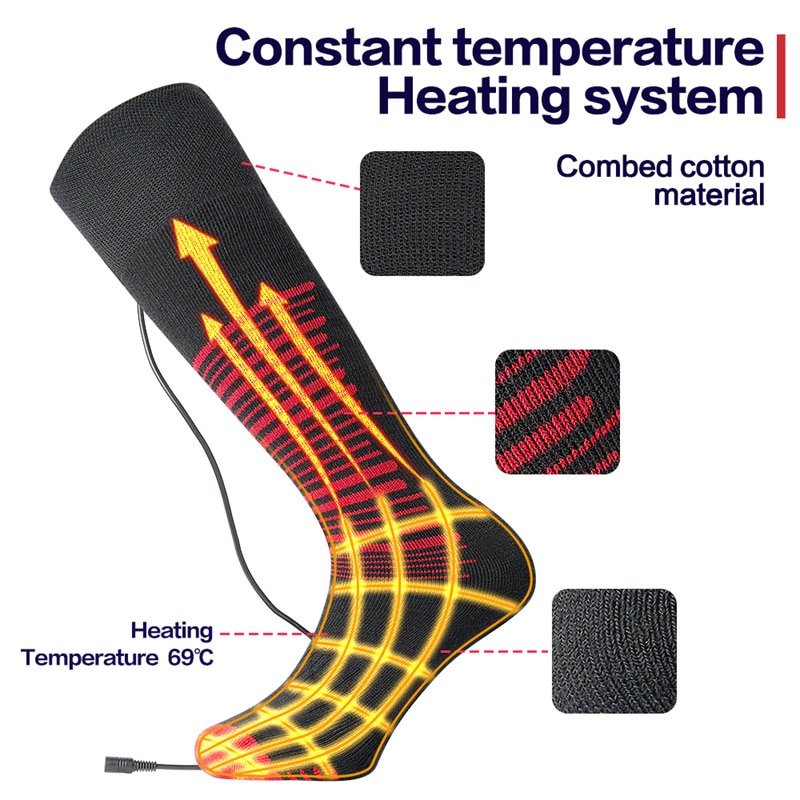
Heating Coverage and Thermal Efficiency
In general, the heated insoles give more focused heat to areas of high pressure, whereas heated socks have a wider thermal protection.
Heated socks also provide warmth to a greater portion of the bodies such as toes, forefoot and sometimes portions of the midfoot and side. This extended coverage helps enhance flatter heat distribution and increased thermal retention in general with insulated footwear.
By design, heated insoles make energy to concentrate on the shear surface (sole), producing quicker heat up in the region of foot grip, but leaving the upper part of the foot and toes to rely on conductive heat.
Heated socks, particularly when used in insulated boots, can be viewed as more effective in keeping the feet warm, because in such a case the sock performs the supplementary thermal insulation. The insoles require the insulation of the boot and its fitting to eliminate the heat loss upwards.
| Heating Aspect | Heated Socks | Heated Insoles |
| Coverage | Broad (full foot envelope) | Concentrated (sole only) |
| Heat Distribution | Even across surfaces | Localized to bottom |
| Warm-Up Speed | Moderate | Faster in sole area |
| Retention | Higher in insulated sock | Depends on footwear insulation |
On product development, full coverage would fit in situations where the warmth is needed all the way through the foot whereas localized heating is suited when the sore needs are in need of immediate warming.
Comfort and Fit Considerations
The differences cause comfort and they are mainly due to the mode of interaction between each type of system and the foot and boot with the movement.
Heated socks are not very bulky because the heating parts are woven or laminated in to thin and flexible materials. They keep natural foot flexion, pressure distribution, but thicker heating zones may cause slight changes in what is perceived as a good fit in very tight boots.
Heated insoles add more volume – usually 3-5 mm of thickness and wiring – that may shrink the capacity of performance-oriented or tatacted footwear. This introduced bulk periodically moves pressure points or necessitates sizing changes.
Also movement dynamics takes its toll since socks travel with the foot reducing the hotspots, whilst the insoles stay stationary which may cause an uneven pressure of the foot during long periods of activity or aggressive movements.
High-performance winter each/performance oriented brand Brands specializing in high performance winter sports often prefer socks due to their flexibility to fit dynamic needs, but insoles may better find use in more fixed or industrialized sports with less volume constraint in the boot.
Battery Placement and Runtime
The location of batteries will result in differences in real-world use and power consumption.
Hot socks will typically include power conduits in the form of smooth textile tubes leading to batteries in the ankle area or the calf which keeps the wiring insulated and reduce contact. This combined method eliminates the chances of snags and enhances the insulation around connection points.
External cables sometimes to batteries attached to the leg or belt are used by heated insoles, either leaving the heel or the side. External wiring would be more exposed to cold and mechanical forces of movement.
Runtimes are mostly determined by battery capacity, and not necessarily the heating system itself, whereas socks would have additional insulation on parts, which might save itself in very cold conditions.
| Factor | Heated Socks | Heated Insoles |
| Battery Integration | Seamless textile routing | External wiring |
| Runtime | Similar (capacity-based) | Similar (capacity-based) |
| Cold Exposure | Better insulation | More exposed components |
Battery systems should be specified by balancing the routing complexity with environmental durability by engineering teams.
Durability and Maintenance
The effects of exposure to washing, flex cycle, and environmental stress significantly result in durability.
Warm socks are washed in the machine frequently, requiring more requirement of water-tightness of heating systems and attachments. The sealed carbon fiber or film elements used in modern designs are shown to be good with regard to longevity, but flexing at the joints may cause stress to the wiring with tens of thousands of repetitions.
Foot insoles heated have reduced rate of washing, but constant compression, shear forces very close to each other, and foot sweat moisture. Replacement is easier – replace the insert without interfering with the sock – but inserts may be damaged through repeated pressure or delamination.
In more intensive applications, insoles usually have a lower service life in the field than socks, which must be subjected to more rigorous launder procedures to guarantee long service lifetime.
Application Scenarios
The ideal option would be close to the target use and shoe setting.
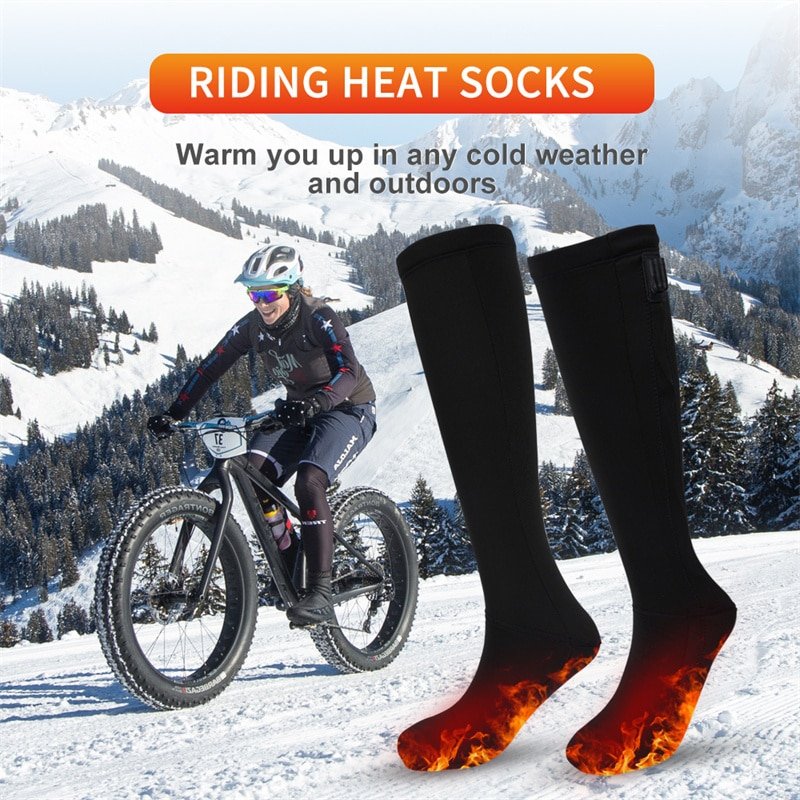
In sports where dynamic movement of the high-performance insulated boots are used, like skiing or snowboarding, the heat-socketed socks are much better at covering the entire foot and maintaining the same level of fit.
Heated insoles are easier to integrate, and have increased multi-footwear capability in heavy industrial boots or where a worker changes shoe frequently, such as construction work or working in a warehouse.
Multi-shoe users usually prefer the convenience of changing insoles (e.g., by swapping in different insoles every several hours) and long-duration immobile activities (e.g., a hunting stand) are favored by activities that require an even distribution of heat to all other areas of the body.
| Application | Recommended Option | Key Rationale |
| Skiing | Heated Socks | Full coverage + dynamic fit |
| Industrial Boots | Heated Insoles | Easy integration + durability |
| Long Static Use | Heated Socks | Even heat retention |
| Multi-Shoe Use | Heated Insoles | Transferable across footwear |
Common Misunderstandings
There are a number of misconceptions in the product evaluations:
- Insoles are more affordable, so it has a better value, and differences in costs may not be about performance itself: more comprehensive literaly-covered socks can provide better thermal performance in most cases but will be perceived as expensive.
- Hot socks are bulkier always, though the thickness introduced by the textile and integrated design can add little to it in comparison with older generations, and frequently can be less invasive than the insole bulk of a tight boot.
- Both products perform the same way- Heating distribution, thermal transfer, and integration effects bring about appreciably different user experiences.
- Fitting any footwear a blind eye: If the precision is important to the boots, Insoles can spoil the fit, and socks should be assessed in terms of combination and dampness.
Conclusion — The Better Option Depends on Use Case
Heated socks: Thermostatic insoles are used to heat the feet of an individual. The more appropriate one will be based on heating coverage needs, footwear compatibility, comfort expectations, and the priority of engineering integration.
Brands and product managers ought to position target applications in respect of the next trade-offs: focus on full-foot thermal performance, dynamic comfort and socks or focus on localized warming, integration ease and multi-use capability with insoles. Both systems are not universal in their performance best practises – alignment of the solution by particular performance consideration and state of use decides the best tool.