

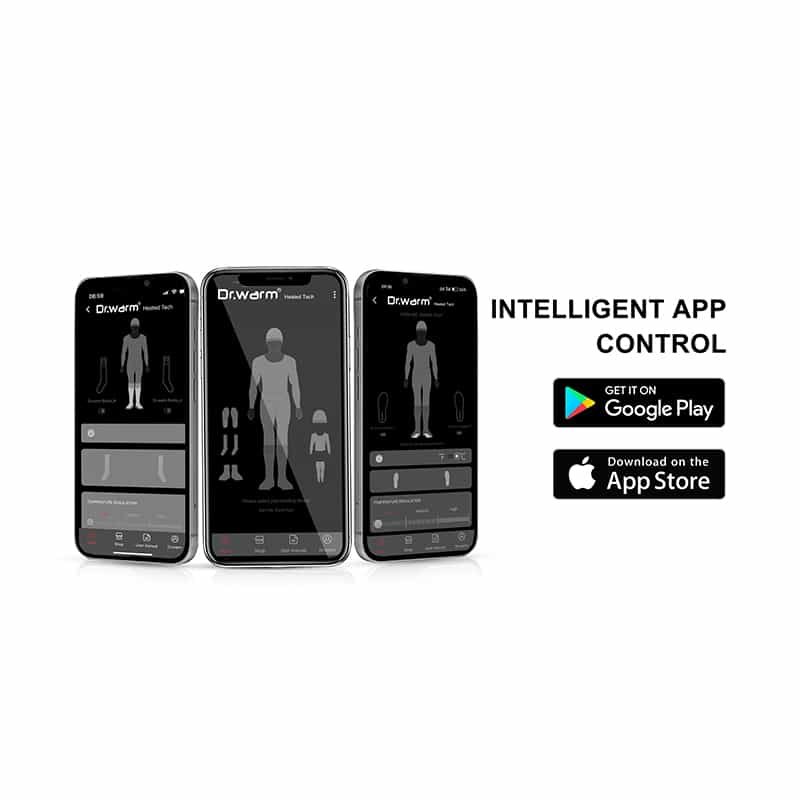
In sports and outdoor environments, feet face constant changes: intense exertion during downhill skiing, prolonged static postures in backcountry hiking, rapid shifts from rest to high-intensity movement, combined with sweat buildup, variable ambient temperatures, and boot compression. Fixed-level heating systems often fall short here, delivering either too much heat during activity (leading to discomfort and faster battery drain) or too little during breaks (allowing cold spots to develop). App control changes this by enabling precise, real-time temperature adjustment directly from a smartphone, without needing to stop, remove layers, or fumble with buttons under gloves.
In heated socks designed for sports and outdoor use, app control enhances performance by enabling precise temperature adjustment, energy optimization, and adaptive heating logic during movement. This adaptability proves far more valuable than simply pushing for maximum heating output. Many assume higher wattage equals better performance, but in endurance activities—where sessions can last 6–10 hours—adaptive heating logic preserves battery life, maintains consistent comfort, and prevents issues like overheating or moisture trapping that reduce overall effectiveness.
Architecture of App-Controlled Heated Socks
Sports-grade heated socks demand a compact, motion-resilient electronic architecture that withstands repeated flexing, impact, and vibration without compromising signal integrity or safety.
The core components integrate in a way that prioritizes low profile and balanced weight distribution. Heating elements concentrate primarily in the toe and forefoot zones, where circulation is most vulnerable in cold conditions. The controller miniaturizes to fit discreetly near the ankle or calf, while the battery—typically a slim lithium-polymer pack—sits higher on the calf to avoid pressure points inside the boot. Bluetooth modules use low-energy protocols optimized for stable pairing even during aggressive movement or in sub-zero interference environments.
For deeper insight into system-level design considerations, explore our app-controlled heating features for heated socks.
| Component | Integration Focus |
| Heating element | Toe-centered warmth |
| Controller | Miniaturized stability |
| Battery | Lightweight balance |
| Bluetooth module | Stable signal during motion |
This layout ensures the system remains unobtrusive inside tight ski boots or hiking footwear while delivering reliable connectivity.
Thermal Mapping for Sports Performance
Toe-focused thermal mapping is non-negotiable in sports heated socks because peripheral circulation drops fastest in the extremities during cold exposure and exertion.
The design prioritizes heat delivery to the toes—especially the big toe and surrounding areas—to maintain blood flow and prevent numbness. During high-activity phases like carving turns or uphill traverses, the system must avoid excessive heat buildup that could cause sweating, as trapped moisture accelerates heat loss once activity slows. App control allows quick scaling back of output when exertion increases core temperature and foot blood flow naturally rises.
Sweat management becomes critical: poor thermal distribution can create hot spots that promote perspiration in one zone while leaving others cold. Effective mapping distributes warmth evenly across key areas without overloading any single region.
| Zone | Performance Objective |
| Toes | Maintain circulation |
| Forefoot | Even warmth |
| Arch | Comfort support |
| Calf (optional) | Circulation stability |
Control Logic and Adaptive Heating
Dynamic temperature scaling through intelligent firmware is what separates basic Bluetooth heated socks from true sports-grade wearable foot heating systems.
Rather than static on/off or fixed levels, advanced control logic monitors user inputs, activity patterns (via manual presets or potential sensor integration), and environmental feedback to adjust output in real time. Preset modes let users select activity-specific profiles—such as “ski descent” for bursty high heat followed by lower sustain, or “hiking endurance” for steady low-to-medium output. Overheat protection algorithms prevent temperature spikes during intense movement when boots trap heat.
Signal smoothing filters out momentary Bluetooth drops caused by arm swing or body positioning, ensuring consistent control.
| Firmware Function | Sports Benefit |
| Adaptive scaling | Comfort during activity |
| Preset modes | Quick adjustment |
| Overheat protection | Safety |
| Energy optimization | Extended runtime |
Battery Management and Endurance Optimization
Battery runtime defines real-world usability in outdoor sports, where recharging mid-activity isn’t feasible.
Designers balance voltage, capacity, and current draw: higher voltage supports intense heating bursts but drains faster, while efficient current regulation extends life on lower settings. For skiing or long hikes, realistic expectations range from 4–6 hours on medium heat to 10+ hours on low, depending on temperature and activity intensity. Lightweight batteries (often 2000–5000mAh per sock) minimize fatigue without sacrificing output.
App interfaces provide precise battery status visibility, allowing users to conserve power proactively.
| Power Parameter | Outdoor Impact |
| Capacity | Activity duration |
| Voltage | Heating intensity |
| Current control | Efficiency |
| Weight | Comfort during movement |
User Experience in Outdoor Conditions
Practical usability separates engineered systems from prototypes: app control must remain accessible when hands are gloved, temperatures are low, and movement is constant.
Reliable Bluetooth pairing in cold weather avoids dropouts during chairlift rides or trail transitions. Preset modes enable one-tap switches between “warm-up,” “cruise,” and “max” without menu diving. Real-time battery percentage and estimated remaining time help users plan—critical when a full day on the mountain is the goal.
Testing Requirements for Sports-Grade Heated Socks
Production stability demands rigorous validation beyond lab benches.
Cold-environment endurance testing simulates multi-hour exposure at -10°C to -20°C with intermittent high-activity cycles. Movement simulation rigs replicate skiing flex, hiking strides, and impact to verify no wire fatigue or connection failures. Moisture resistance checks ensure sweat or snow ingress doesn’t short circuits or degrade heating elements. Signal stability validation confirms Bluetooth holds under vibration and body shielding.
These protocols ensure consistent performance across batches.
Common Design Mistakes in Sports Heated Socks
- Excessive heating concentration in one zone, leading to hot spots, sweating, and rapid battery drain during activity.
- Heavy battery placement low on the ankle, causing pressure points, discomfort in tight boots, or shifting during movement.
- Inadequate moisture management, where non-breathable materials or poor wicking trap perspiration and reduce effective warmth.
- Firmware not tuned for movement, resulting in unstable Bluetooth connections, erratic temperature swings, or false overheat triggers.
Conclusion — Adaptive Control Defines Outdoor Performance
Raw heating power matters far less than intelligent adaptability in demanding sports and outdoor scenarios. App control enhances heated socks by enabling adaptive heating, energy optimization, and ergonomic stability—all critical factors in sports and outdoor performance environments. When firmware coordinates precisely with thoughtful thermal mapping and robust battery management, the result is reliable comfort, extended runtime, and maintained circulation without unnecessary bulk or compromise. For engineers and brands developing smart heated socks, heated socks for skiing, or adaptive heating socks, prioritizing dynamic logic over maximum output delivers measurable gains in real-world use.