

In practice, on hot socks, battery life can be between 3-10 hours per charge, depending on the desired level of heat generation, ambient temperature, the design of the sock and the efficiency of the full system. In moderate conditions, the low settings may exceed 8 -10 hours of run time with the maximum temperature in the freezing environment restricting the run time to 3 -5 hours or even less.
Most users believe that heated sock runtime is an absolute figure that is stamped on the pack. Practically, real performance is widely differentiated on the basis of the intensity of heating, environmental requirements, and efficiency of the whole chain of power delivery.
The reason behind battery life of heated sock is balanced power management, efficiency of heating element, and battery engineering and not just battery size.
To set realistic expectations, especially when this is important to you, and to provide true performance comparisons, which rechargeable heated socks brands and product managers should analyze when making their choices,
For brands and product managers evaluating options, understanding these interacting variables is essential to setting realistic expectations and comparing rechargeable heated socks performance accurately.
Key Factors That Determine Battery Life
The performance of battery can be displayed as a resultant power of the interplay of energy supply, energy consumption, and environment needs and not as a result of a single element.
The primary factors include:
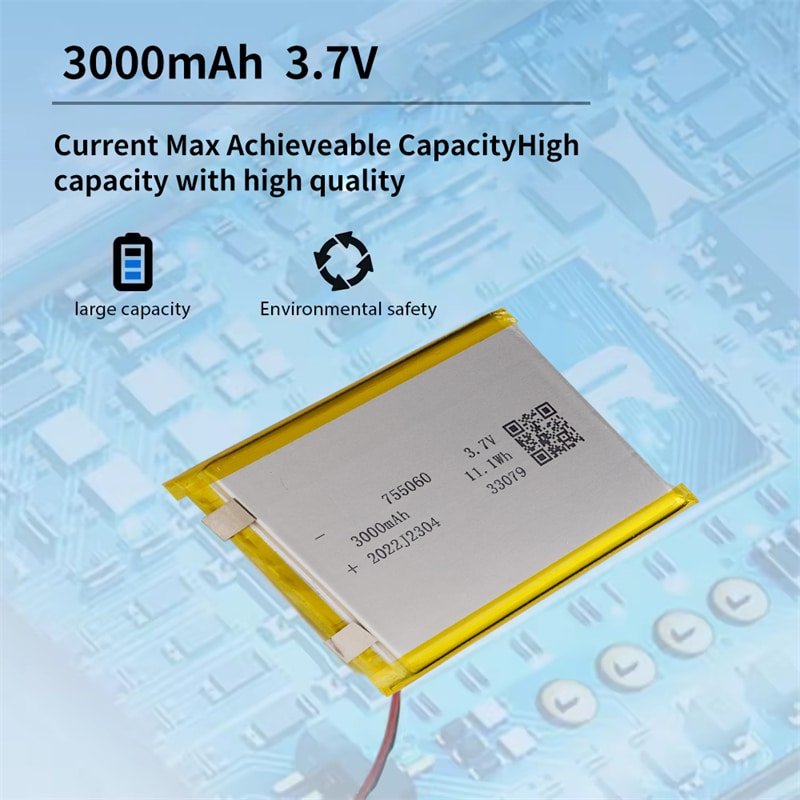
- Battery capacity (measured in mAh or Wh): This is the individual measure of the amount of total energy a battery can store before being drained.
- Resistance of the heating element: The smaller the resistance, the more current will pass through it and the quicker the heating will commence, and it will consume more energy.
- Selected temperature level: Greater settings are much more power demanding.
- Ambient temperature: In cold weather the heating system needs to labiller more to keep your feet warm which draws more.
- Insulation: The higher the thermal retention in the sock, the less power is required to maintain comfortable temperatures.
| Factor | Impact on Runtime |
| Battery Capacity | Directly affects total energy available |
| High Heat Setting | Faster energy consumption |
| Low Heat Setting | Extended runtime |
| Cold Environment | Increased power demand |
| Insulated Sock Design | Improves efficiency by reducing heat loss |
Understanding Battery Capacity vs Runtime
The specifications of capacity are deceptive based on context alone – a pair of batteries with the same mAh rating would produce very different run time based on voltage, efficiency losses, and system design.
mAh gauges the ability of the battery to provide charge (the amount of milliamp-hours), yet the cumulative energy is measured as watt-hours (wh = voltage ×ah). The energy stored in a 7.4V battery of 2200 mAh is higher compared to a 3.7V battery of the same mAh rating.
The causes of efficiency losses include: voltage conversion, wiring resistance, BMS overhead, and heating elements conversion of electrical energy to heat.
| Battery Spec | Meaning |
| mAh | Current capacity (charge quantity) |
| Voltage | Determines total power and energy calculation |
| Wh | Total energy capacity (most meaningful metric) |
| Cycle Life | Long-term durability (number of full charges) |
Batteries that have a higher energy density and lower internal resistance tend to have a higher run time of heated socks in the real world, despite a similar value of mAh being quoted.
How Heating Levels Affect Energy Consumption
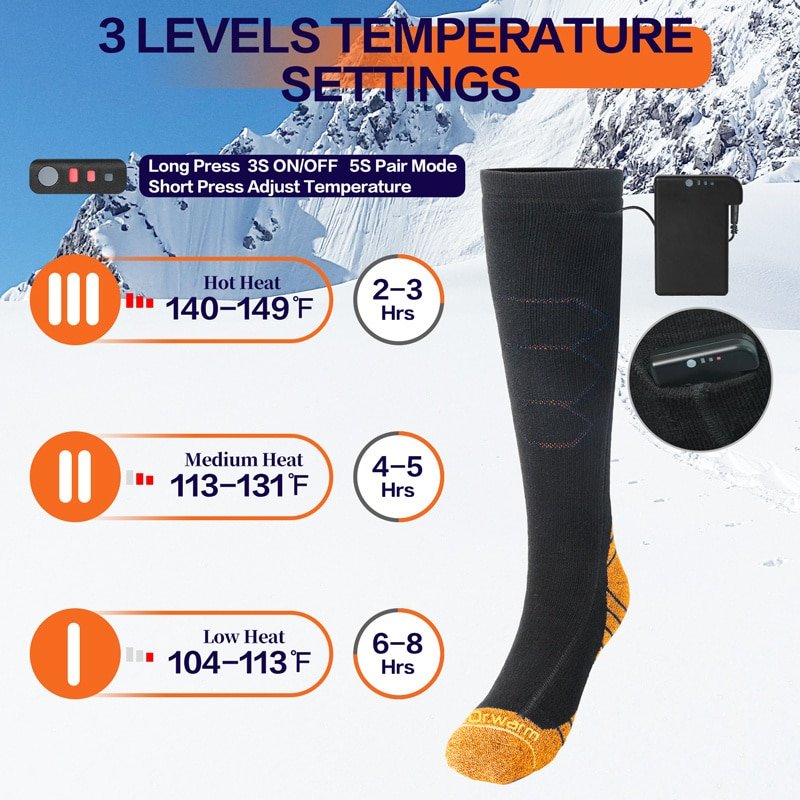
The majority of heated socks have 3-level heat sensors (low, medium, high) where the power consumption is nonlinearly proportional to the setting.
Manufacturers often use pulse-width modulation (PWM) to control the power input: the heating element is being powered with full power in intermittent bursts instead of full lower voltage. This provides better efficiency and enables finer control but run time also reduces sharply at high duty cycles.
The battery is emptied quickest when in continuous high output (akin to 100% duty cycle) and much longer when used with a regulated low setting.
Energy management Real time thermal management (as available) may also be optimized by decreasing power after reaching target temperature.
| Heat Level | Estimated Runtime (typical 4400–5200 mAh pack) |
| High | 3–4 hours |
| Medium | 5–7 hours |
| Low | 7–10 hours |
These figures are based on moderate circumstances (approximately, 0 10 C ambient) and proper insulation. The real performance is dependent on design considerations and natural conditions.
Battery Lifespan vs Single-Charge Runtime
Single charge runtime is a measure of hours that a device can be used in one full charge and battery lifespan is a measure of the number of usable cycles a device will have before a substantial reduction in capacity.
Heat socks using lithium-ion cells normally have lifespan of 300 to 500 complete charge cycles before the capability reduces to 80 percent of initial. Degradation increases when a deep discharge is made, when charging in high-temperature, or when full-to-empty cycles are frequent.
Effective charging methods, such as, not charging the battery to a full extent, charging at moderate temperatures, and use of good chargers, prolong cycle life to the deeper end of the range.
These two metrics are important to distinguish: at first a sock can provide 8 hours of operation on single charge, but after 400 cycles the actual performance of the given operation can be dropped to 20–30 percent unless capacity degradation is kept on a minimum through decent BMS design and choice of cells.
Manufacturing Factors That Influence Battery Performance
Reliable battery operation and extended life are particularly linked with precision in the manufacture of several steps.
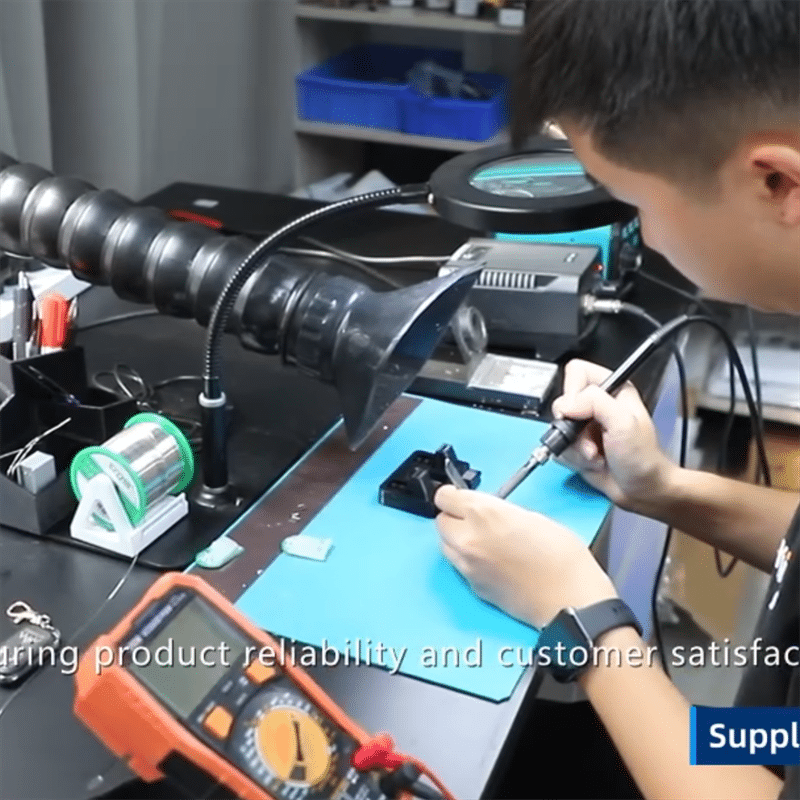
Good Battery Management Systems (BMS) will possess good voltage/current control, balanced charging, over-temperature, and the low quiescent current use in standby.
Accurate soldering and low resistance wire reduce volt drops and heat generation in the circuit.
The thermal insulation of the battery pack minimizes self-heating and controls losses in cell efficiency due to cold.
Constant quality control – such as inbound cell checking, assembly cleanliness, and end:of-test tests provide consistency between batches and diminishes early failures.
Lack of good performance in either of these aspects may result in reduced run time, untimely lack of capacity, or health concerns.
Common Misunderstandings About Heated Socks Battery Life
The number of common assumptions that result in discrepant expectations is several:
- The more mAh the more runtime, at least. That cannot be true when the voltage is lower, when efficiency is poor, or when there is excessive internal resistance that causes large losses.
- “Lasts 8 hours all heated socks — Advertisement figures are generally based on ideal conditions in the laboratory; actual, full high-heat use under conditions is generally much lower.
- Temperature of the environment is not considered- Lower temperatures require increase in average power consumption to keep warm.
- Ignoring insulation designing – Thin or badly insulated sockets dissipate quicker, and necessitate constant step up in power input.
The knowledge of such variables enables brands and users to perceive claims in a more realistic manner.
How Brands Should Evaluate Battery Claims
Structured due diligence avoids surprises during evaluation of the suppliers of heated sock or prototypes:
- Ask to provide reports of run-time tests at standard conditions (e.g. at certain ambient temperatures, at certain levels of heat).
- Request actual temperature data logs with power-draw and stability with time.
- Record documentation of battery discharge life and after 300 + cycles, review degradation-curve.
- Check specifications on BMS, its characteristics of protective elements, and quiescence current.
- Determine precise assumptions of usage in terms of advertized run times (heat level, ambient temperature, socket insulation).
This data is supplied by the transparent suppliers, uncertain or excessively optimistic claims are usually a sign of the engineering shortcuts or testing.
Conclusion — Battery Life Reflects System Engineering
The life of the batteries in the heated sock is the expression of integrated engineering, to strike the balance between battery capacity, heating performance, power management, and manufacturing accuracy through providing consistency and predictability of the performance.
The long-term durability and runtime per charge are dependent on a well designed system level design, not the individual high capacity cell. Being realistic with test data that can be checked by anyone will bring everyone the gains of the supply chain, and eventually lead to the effective product decision-making in cold-weather applications.