

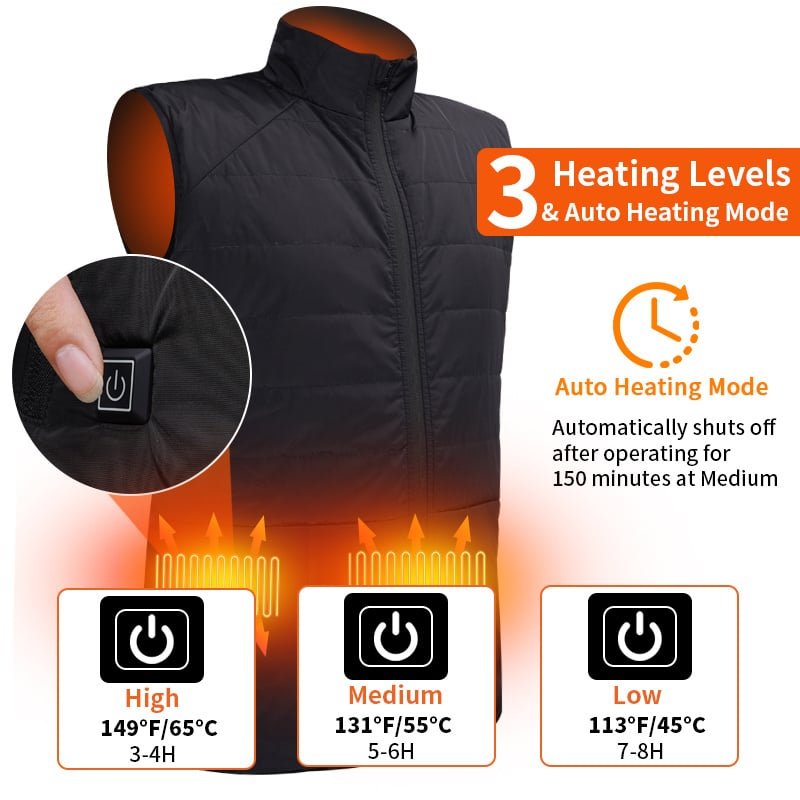
Mobile applications manage heat in heated garments by sending formatted instructions interpreted by the electronic controllers to manage electrical energy transmitted to heating components within prescribed safety and system boundaries. Notably, these applications do not read or produce heat directly, rather they fulfill the control of temperature indirectly by controlling power. It is a common myth that an app setting can immediately adjust the temperature but in fact, temperature reaction is determined by hardware thresholds and thermal inertia. Mobile applications regulate temperature in warm garments by communicating electronic control logic, but not by directly controlling the production of heat.
This basic knowledge makes a distinction between electrical and thermal dynamics and the app-based interfaces. The app is in practice a user-facing command interface, converting inputs into signals which cause predefined behavior in the hardware. In the absence of this coordination, the temperature control would not be adjustable by the user, but the application is still limited to the physical capabilities of the system.
What “Temperature Control” Means in App-Controlled Heated Clothing
App managed temperature control in heated clothing is the indirect modification of electrical power as opposed to the direct thermal control. Fundamentally, what users define as the temperature control is often just a proxy of modifying the power supply to heating components, which, in turn, has an effect on the thermal output with time. Most consumer-grade heated wearables do not have apps that connect to real-time fabric temperature sensors due to cost, complexity and battery concerns. They instead plot user-selected levels on electrical behaviours that are approximate desired warmth.
This difference is important since the gap between a temperature setting and real temperature is caused by an environmental variation, material properties, and system delays. An example is that a high setting may be the maximum allowable current, but the heat experienced by the user will be based on insulation, ambient conditions and body heat. As an alternative to temperature, which demands continuous sensor feedback, Apps regulate power levels in order to be safe and efficient.
To clarify key concepts:
| Term | Actual Meaning |
| Temperature Level | Minor power output range. |
| Heat Output | Delivered electrical energy. |
| Perceived Warmth | Result of heat + insulation |
| App Control | Command interface |
This table shows how the operation of temperature control in heated clothing using the app is based on the principle of layered abstractions, where the input of the app is a single component of a broader electric-thermal chain.
System Flow From App Input to Temperature Change
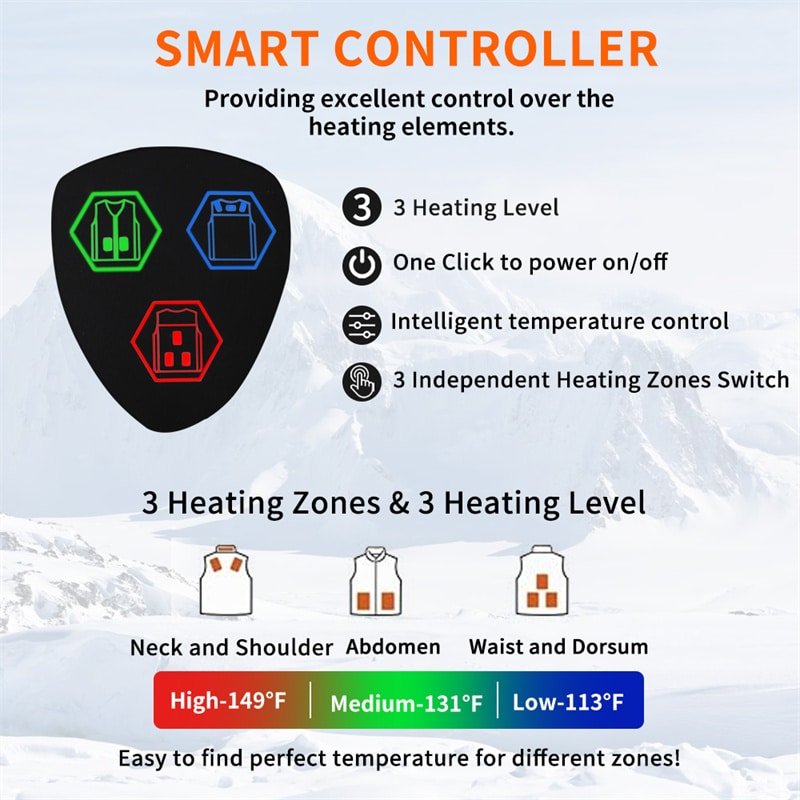
The sequence of electrical and thermal sequences between the input of an app and the real temperature drop in warm garments is the consequence of embedded logic. Beginning with user interaction, the system then converts abstract commands into quantifiable physical results, although each stage poses hardware dependencies.
Within the context of app design in heated wearables, this flow is based on established communication standards such as the Bluetooth Low Energy (BLE), and guarantees the sound transfer of signals without a plentiful consumption. The process does not involve manipulation of heat directly rather controlled power modulation to produce consistent results.
The step wise system flow is as follows:
| Step | System Action |
| App Input | User selects heat level |
| Signal Transfer | Bluetooth command sent |
| Controller Logic | Power limit applied |
| Electrical Output | Current adjusted |
| Thermal Response | Changes in temperature occur slowly. |
This series highlights the fact that there will always be delays of several seconds to several minutes between the generation of electrical energy and heat, as heating materials need to transform electrical energy into heat and overcome the capacitance of materials.
Signal Encoding and Transmission
App commands are usually coded as binary packets, which contain information about the target zone (e.g. chest or sleeves in a jacket) and how much power should be applied. These are transmitted to the controller through BLE, verified against rules in the firmware and then executed.
Hardware Dependencies in Flow
The thermal response step can also be changed by the environmental factors, including wind chill, where the system must continue with power output longer to stabilize it.
How Controllers Translate App Commands Into Power Regulation
Electronic controllers provide interpretation between app commands and power control, and impose hardware limits to ensure not to run the hardware into a dangerous state. The microcontroller unit (MCU) is located in the Printed Circuit Board Assembly (PCBA) and interprets incoming signals and converts them to pulse-width modulation (PWM) or direct current changes in the heating elements.
Firmware programs make sure that no matter how much heat an application requests, the controller will limit output by battery voltage and current-draw limits and thermal limits. This translation eliminates the possibility of overcurrent that may ruin the components or may even burn them. To take a closer look at the integration, see how app control works in heated wearables.
Firmware Logic Breakdown
In more complex systems, firmware may make use of proportional-integral-derivative (PID) principles, whereas less complex applications of the concept of heated clothing could be based on threshold logic. An example of this is when a command is issued to maintain heat at medium it may initiate 50% PWM duty cycle, which will change the voltage applied to carbon fiber or wire elements.
Role of Calibration
At the manufacturing stage, the controllers are adjusted to match the app level to the desired power output, taking into consideration differences in the resistance of the heating elements.
Fixed Levels vs Dynamic Temperature Control
Fixed-level systems prevail in heated clothing because they are simple and reliable compared to the more complicated techniques of dynamics that need more sensors. In fixed-level designs, applications provide discrete choices (e.g. low, medium, high) that are associated with fixed power percentage control, offering predictable but not-adaptive control.
Simple feedback may also be included in semi-dynamic systems such as battery temperature control to maneuver within predetermined parameters. Close-loop feedback loops with skin or fabric sensors, unlike wearables, are used infrequently due to the weight, cost, and power size. Bounded control has become the most commonly used technique in most heated clothing to trade usability with engineering feasibility.
Comparison of control types:
| Control Type | Characteristics |
| Fixed Level | Simple, predictable |
| Semi-Dynamic | Adjusts within limits |
| Full Feedback | Rare in wearables |
This confined methodology makes sure that temperature regulation control in hot wearables focuses on safety and not on accuracy.
Advantages of Fixed Systems
Constant limits help minimize computer load on the controller, increasing battery duration without altering user expectations.
Challenges in Dynamic Implementation
Active control requires the strong sensor integration that can embed the points of failure in the flexible clothing conditions.
Why Temperature Stability Depends on Hardware, Not the App
Hardware properties, including thermal inertia and characteristics of the material, are the cause of temperature stability of heated clothing and not the app software itself. The time delay in heat accumulation and heat loss through fabrics and elements is known as thermal inertia, that is, the app commands command the changes but do not determine the stability of the instant.
Materials such as polyester or down have an insulation effect which also contributes to the amount of heat retained which tends to give a change in the perceived temperature even with a constant power input. Another layer is heating element response delays as a result of resistance and capacitance, in which apps can only request changes, rather than violate physical principles. To get background information,refer to what is an app-controlled heating system in heated clothing.
Impact of Environmental Variables
Uncontrolled environmental conditions such as ambient temperature and humidity may cause instability and need hardware designs with compensatory logic in the controller.
Material-Specific Considerations
The stability of the thicker insulations can be obtained faster under lower power, whereas the thin materials will require more outputs and higher variability.
Battery Constraints in App-Based Temperature Control
The practicality of application-based tempering is determined by battery limits since the higher the heating, the faster the battery will wear out due to the additional consumption of current. Battery protection circuits in hot wearables like lithium-ion batteries will ensure that maximum output is restricted to prevent deep-discharge or overheating, and will override app requests when needed.
Apps have to connect to this logic reporting the real-time battery status and throttling options when the voltage becomes lower than thresholds. This guarantees the long life, but limits the practical time of the high temperature settings. Explore how heating apps affect battery life in heated wearables for more on this interplay.
Discharge Curve Implications
In high settings, discharge may be 2 times, which shortens the runtime of a few hours to minutes, imposed by the firmware of a controller.
Protection Mechanisms
There are battery management systems (BMS) that combine undervoltage lockouts, whereby apps cannot overcharge to unsafe levels.
Safety Limits Embedded in App-Controlled Temperature Systems
The controllers are programmed with safety limits in the app-controlled temperature systems, which can never be overcome to avoid hazards. The over-temperature cutoffs are triggered when the temperature of the elements surpasses the preset limits (usually 50-60 o C ) by breaking the power stream no matter whether the user is present or absent.
Fail-safe behavior is like automatic shutoff in fault detection, e.g. short, or low battery, and puts the user safety above functionality. These boundaries are based on such regulatory standards as UL and guarantee system integrity. Information on over-temperature protection in app-controlled heated wearables elaborate on these mechanisms.
Threshold Implementation
The firmware would monitor thermistors on the elements and send interrupts when they are neared.
Regulatory Compliance
These built-in protective mechanisms are required by the compliance with CE and RoHS, regardless of the update of app software.
Why Temperature Control Accuracy Is Often Misunderstood
The issue with temperature control in heated clothing is often misinterpreted since people think that the capabilities of app settings correlate with strict thermal performance, disregarding hardware differences. Actually, temperature within these systems is a guiding principle because the elasticity of clothing makes it difficult to warm the clothing with uniformity, and hence, hotspots or unevenness develop.
Precision is also complicated by the user motion, overlay, and external factors in which the apps give control interfaces but do not have guarantee of lab precision. Some implementation pitfalls to avoid include; see common app design mistakes in heated wearables for engineering insights.
Consumer vs. Engineering Perspectives
Users demand the ability to control their temperature with the degree of precision of a thermostat, yet engineering practicalities prefer strong, crude control.
Variability Sources
Factors such as placement of elements and stretch of fabric are some of the aspects that make it seem inaccurate.
Conclusion — Temperature Control Is a Coordinated System Outcome
Mobile applications can control temperature in thermal garments by controlling the electrical behavior of a given system by a set of system logic. Actual temperature readings rely on co-ordinated hardware feedback, temperature limits and thermal states – not interfaces in apps. This integration allows dependability in a real world, where regulation is carried out by the heavy lifting of it by controllers and elements. With this kind of interdependency, engineers and product managers will be able to implement systems that offer a balance between user control and the physical realities and not over-depend on software to provide thermal accuracy.