
The MOQ, lead time and customization requests in the production of OEM heated socks are not arbitrary numbers since they are directly related to the sourcing of materials, baking system engineering, battery combination and the efficiency of the production process. Most brands believe that these numbers can be negotiated, but in fact, they are the reflection of the realities of the level of raw material procurement, specialized component batches, knitting machine configurations and stringent testing procedures to ensure safety and performance in wearable heaters.
To establish a long-term relationship based on stability with an OEM manufacturer of heated socks, one has to understand MOQ, lead time, and customization capacity. Poor initial expectations are usually the cause of delays, cost inflation, or compromise on the quality of the product that would otherwise have been prevented in a realistic planning.
What Determines MOQ in OEM Heated Socks Production?
OEM heating socks MOQ is influenced by the practical manufacturing factors and not the preference of the supplier only.
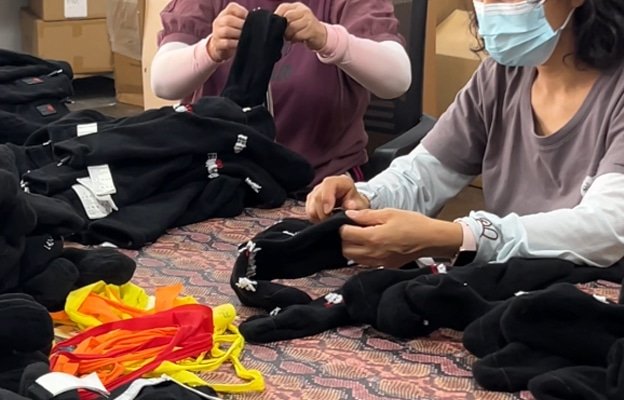
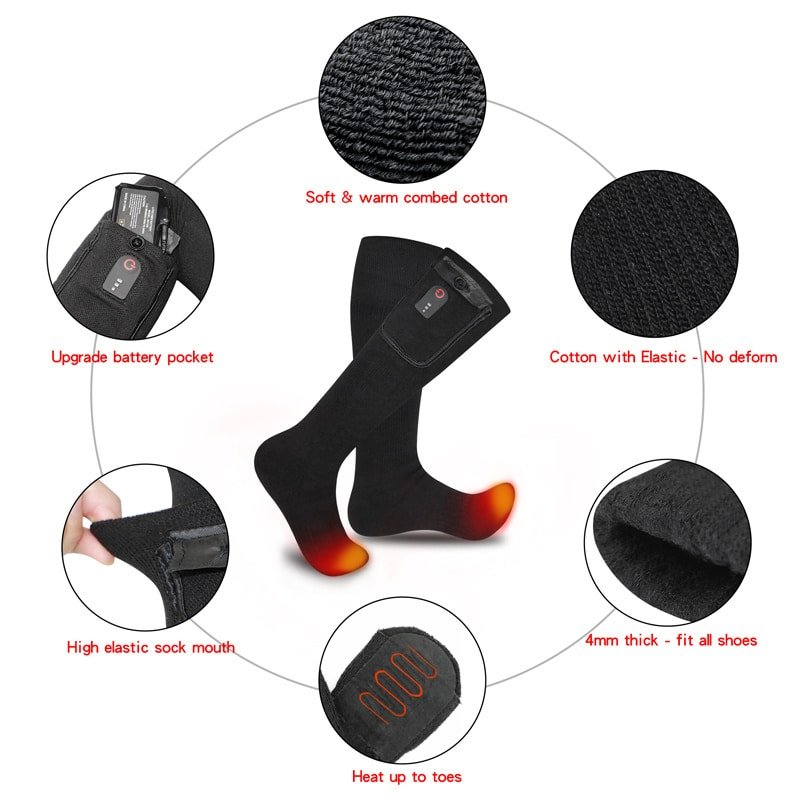
Special components Heated socks consist of more specialized parts than a typical sock: the base knitted fabric, heaters (usually carbon fiber or flexible film), chargeable lithium batteries, control modules, and wiring harnesses. Each component has its own procurement and set up thresholds.
The key threshold is in raw material procurement. Thermal insulations and moisture-wicking yarns (like merinos or synthetic technical fibers) are usually sold in dye lots or yarn cones, which suppliers cannot cut down to a minimum size. The heating components need to be batch-produced to ensure consistent resistance and durability, whereas the batteries must be obtained in batches that meet supplier safety standards and the minimum purchase agreements.
Another layer is added by knitting machine setup. The time spent during re-threading, testing of the design, and adjusting tension to avoid defects is quite lengthy and needs large amounts of downtime to switch between designs, types of yarns, or gauge. This setup time and cost is raised by complex patterns or reinforced areas where heating pads should be located.
Quantities are further affected by color and complexity of size. Multi-color dyeing requires the minimum batch sizes to produce consistent results and small-run across sizes wastes efficiency on assembly lines.
Here is a breakdown of key MOQ drivers:
| MOQ Driver | Why It Affects Quantity |
| Fabric Dyeing | Minimum dye batch size to ensure color consistency and avoid waste |
| Heating Elements | Batch production efficiency for consistent resistance and endurance |
| Battery Packs | Supplier procurement volume tied to certification and safety standards |
| Packaging | Print run economics for custom labels, boxes, or inserts |
| Assembly Line Setup | Changeover efficiency between designs or component integrations |
To put it in context, in an OEM case, typical MOQs of custom heated socks could be a number of several hundred to a number of several thousand pairs per design/color/size combination depending on the degree of technical integration. Working with an experienced OEM heated socks factory helps clarify these thresholds early based on your specific requirements.
Typical Lead Time Structure in OEM Heated Socks Manufacturing
OEM heated sock manufacturing lead time is based on a systematic order of stages with each stage being affected by engineering, supply chain, and the validation of quality requirement.
The overall duration of the process of initial inquiry to delivery usually takes 6-12 weeks when dealing with a standard order, however heavy customization or problems with the supply chain may prolong the process.
- Sample development – Developing and testing prototypes to test fit, heating performance and integration.
- Material confirmation — After approval of sample, locking of yarns, heating films, batteries and controllers.
- Mass production – Knitting, embroidering heating elements, assembling, and wiring.
- Testing and aging Electrical safety tests, thermal testing, over-temperature protection testing, endurance testing.
- Preparation of packaging and shipment Custom labeling, final inspection of quality, and coordination of logistics.
Here is an overview of typical time frames:
| Stage | Typical Time Frame | Influencing Factors |
| Sampling | 7–20 days | Custom complexity, number of revisions |
| Material Sourcing | 5–15 days | Fabric & battery lead time, supplier availability |
| Production | 20–35 days | Order size, production scheduling |
| Testing & Aging | 3–7 days | Safety standards, certification requirements |
| Packaging | 5–10 days | Custom packaging needs |
Simple logo OEM orders (heated socks with their own label with a few minor modifications) are typically faster than structural personalization, where new heating zone patterns or increased battery capacities would necessitate further engineering verification and testing.
How Customization Affects MOQ and Lead Time
In the production of heated socks in OEM, the level of customization is directly proportional to MOQ and lead time because every upgrade is accompanied by a new engineering, testing, or sourcing variable.
Simple modifications such as printing logos do not require much overheads whereas radical modifications such as the heating system or building plan require a lot of resources.
Levels include:
- Just logo printing – Standard heat transfer or embroidery.
- Color changes -Yarn dyes or sock body shade changes.
- Redesign of structures sock- The modification of cuff height, arch support, or padding areas.
- Reconfiguring the heating element- Repositioning the pads, altering the wattage zones, or type of the material.
- Battery capacity adjustment -Changing mAh capacity or run time.
- App or controller integration Custom firmware, Bluetooth pairing or temperature algorithms.
Impact summary:
| Customization Level | MOQ Impact | Lead Time Impact |
| Logo | Low | Minimal |
| Color | Moderate | Dyeing delay |
| Structure | High | Engineering time |
| Heating System | High | Testing required |
| Battery Upgrade | Moderate | Supplier coordination |
The increased customization tends to increase the MOQ upwards in order to recover the development costs and the production drives are maintained in an efficient manner.
Balancing Cost, Speed, and Flexibility
To lower MOQ often leads to increased unit costs since constant setup costs (machine changeovers, testing requirements, material minimums) are apportioned over fewer pairs.
Urgent lead times tend to reduce the extent of customization, since expedited time slots will provide less time to perform iterative engineering or elaborate supply chain co-ordination.
For offering the optimal balance, long-term planning offers a chance to make repeat orders or staged rollouts: manufacturers can streamline scheduling, get better prices on materials, and lower per-unit costs as time passes. Instead of reactive ordering is strategic forecasting to reduce pressure on both ends and facilitate consistent quality in wearable heating OEM production.
Questions Brands Should Ask Before Confirming MOQ
Before committing any MOQ, make sure to clarify these details of operations to prevent future surprises:
- What specifically is the reason behind your MOQ of this design (e.g. sourcing of batteries, batches of heating elements, knitting setup)?
- Is it possible to divide the MOQ by color or size or do they have to be the same per style?
- What impact will the suggested level of customization have on the necessary testing periods and certifying schedules?
- How long is the realistic lead time of repeat orders after the first run has been fixed?
- What is the stability of your battery and component supply chain and what is the contingency in the case of disruption?
These questions will show the depth of manufacturing the partner has and will bring the expectations close.
Common Misunderstandings About OEM Heated Socks Production
There are a number of myths between brands that are new to sourcing heated apparel:
- Thinking that MOQ is arbitrary and can be agreed upon over and over again, without compromising quality or schedule.
- Asking to have the heavy structural or heating system customized (heavy system) in less than 4 to 6 weeks.
- Not considering the time that would be used in certification testing, particularly the over-temperature protection and battery safety validation against international standards.
- Reworking design specifications after the sampling step that re-establishes much of the engineering and material validation effort.
These early are dealt with beforehand avoiding friction and facilitating a smoother running of the project.
Conclusion — Manufacturing Planning Determines Flexibility
MOQ and lead time in the OEM heated sock production process are indicators of fundamental manufacturing rationality – between component batch efficiencies and engineering workload and safety validation concerns.OEM heated sock projects that work are based on these goals: the flexibility and cost control of production are associated with long-term scalability and success. Early articulation and planning allow brands to have high-performance and consistent production and viable economics.