
Most heated gear projects that fail do not fail in the market — they fail at factory selection: a supplier that quotes fast but cannot show a test lab, battery cells without shipment-ready certification, or a “30-day” lead time that quietly becomes 90. This 9-point checklist gives you what to ask, what a straight answer sounds like, and the red flags that should end the conversation. Every benchmark below comes from our own plant in Dongguan, so you can compare any supplier — including us — against real numbers.
1. Production Capacity You Can Verify
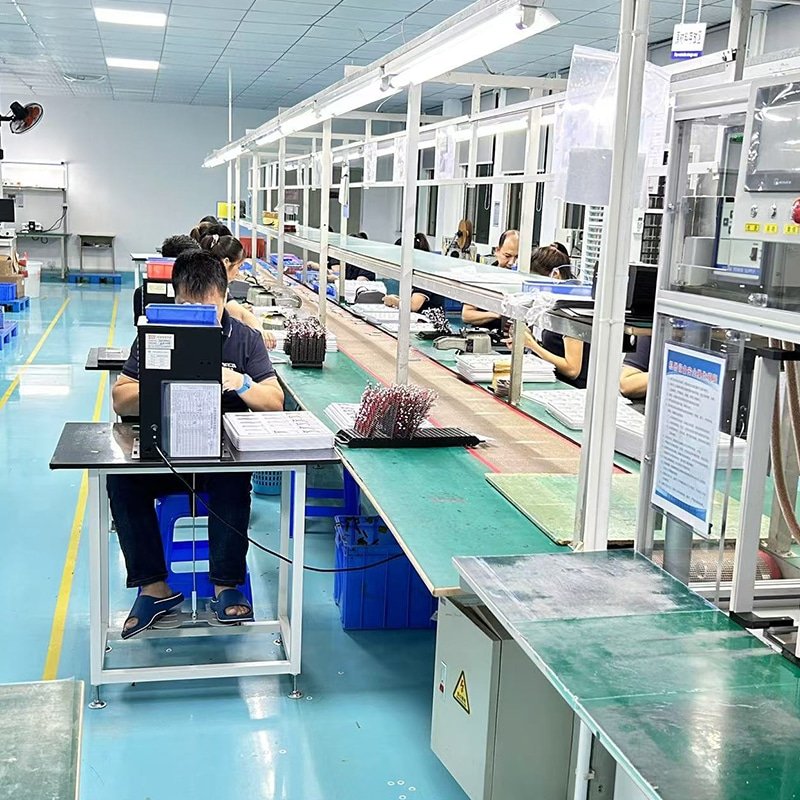
A serious manufacturer publishes capacity by category, not one vague “daily output” figure. Ask for: factory floor area, number of production lines, and monthly output for the exact category you are buying.
Our benchmark: 6,000 m² main plant plus a 2,074 m² electronics assembly workshop, 3 production lines, and published monthly capacity for every category — for example 40,000 pairs of insoles per month (60,000 in peak season) and 200,000 battery packs (350,000 peak). See the full factory and capacity breakdown.
Red flag: capacity quoted only in “workers per day”, or numbers that change between the first email and the sample stage.
2. Certifications Tied to Your Destination Market
Match marks to the market you ship to: CE and UKCA for the EU and UK, FCC for the US, RoHS for materials, ISO 9001 for the quality system behind it all. Then go one step further — ask for the certificate number and verify it on the issuing body’s website. A supplier who hesitates at this step is telling you something.
Our benchmark: a 20-item certification archive covering quality systems, North American and European marks, and battery transport. We publish the core list — including numbers you can verify online — on our certifications page.
Red flag: certificate photos with the number cropped out, or a PDF that names a different legal entity than the factory in the quotation.
3. An In-House Testing Lab, Not Just a Supplier Report
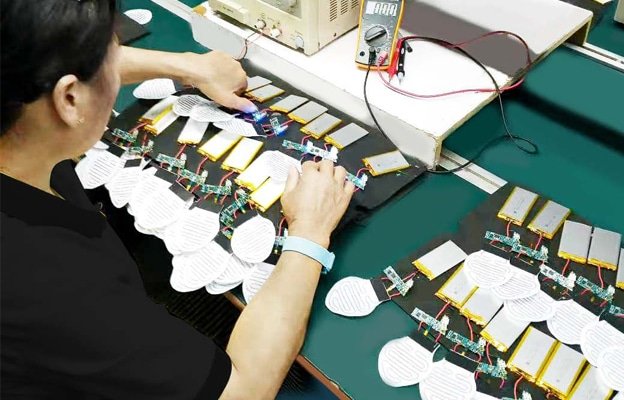
Third-party reports prove a batch passed once. An in-house lab proves every batch gets checked. Ask which tests run in-house: heating uniformity across the garment, temperature stability at each setting, wash-cycle endurance, and battery charge-discharge cycling.
Our benchmark: every unit passes 100% QC inspection before packing, backed by in-house tests for temperature rise, element endurance and battery cycling. How element wash-cycle testing works.
Red flag: “quality is guaranteed” with no test items named, or a single lab report dated years before your order.
4. Prototyping That De-Risks Your Design
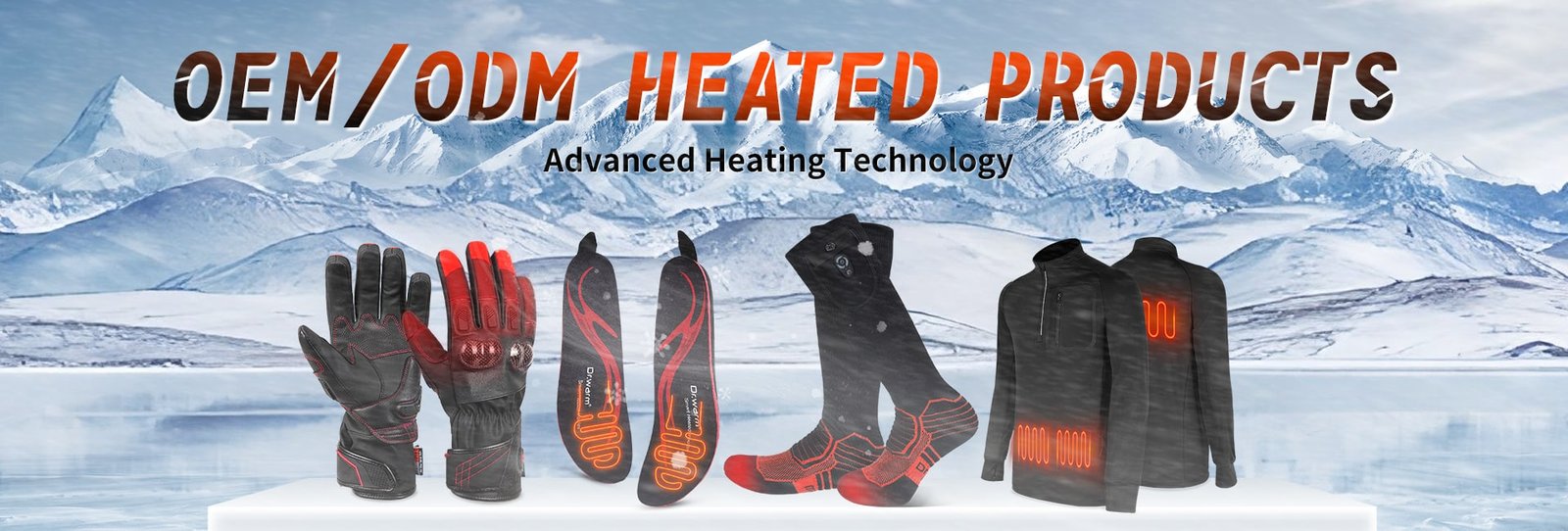
Sampling is where heated products are actually engineered: element placement, wiring routes, thermal cutoffs, battery fit. Ask how many sampling rounds are included, how long each takes, and whether the sampling fee is credited against bulk production.
Our benchmark: sampling in 7–30 days depending on complexity, with the sample fee deductible from the bulk order. See our full OEM/ODM process.
Red flag: “we’ll copy your sample exactly” — a factory that cannot improve the thermal design is not an engineering partner.
5. Battery Compliance Beyond the Export Baseline
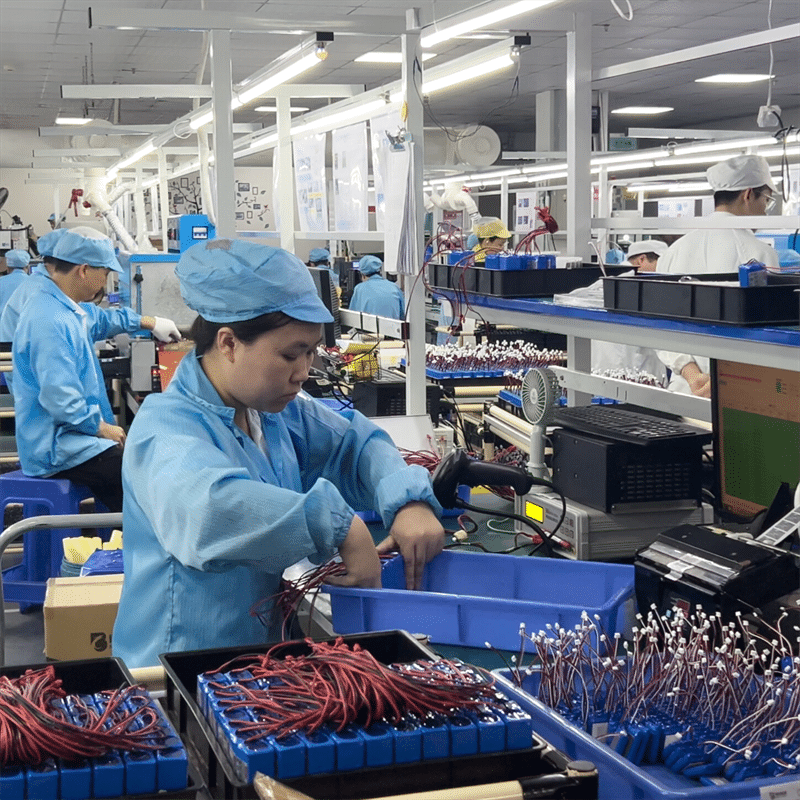
The battery is where heated products carry the most regulatory risk. Beyond UN 38.3 for lithium transport, ask what the cells and packs are certified to in the factory’s home market — a manufacturer that meets China’s CCC requirement and GB 47372-2026 for heating appliances is building to a standard stricter than many export baselines.
Our benchmark: self-produced battery packs built to GB 47372-2026 with CCC, plus UN 38.3 for transport. Our battery solution.
Red flag: cells bought on the open market with no pack-level certification, or “certificates available upon request” that never arrive.
6. MOQ and Lead Times Stated Up Front
Ask three numbers and write them into the RFQ: minimum order quantity, sampling time, and bulk lead time — and ask what happens to that lead time in Q3/Q4 peak season, when every heated products factory is full.
Our benchmark: MOQ from 500 units for ODM projects, 100 units for OEM, and 1 unit for in-stock items; OEM production in 20–25 days, ODM development in 50–60 days. MOQ, cost and timeline explained, and what actually drives unit cost.
Red flag: a lead time with no peak-season answer, or an MOQ that appears only after you have paid for samples.
7. Engineering Support Behind the Sales Reply
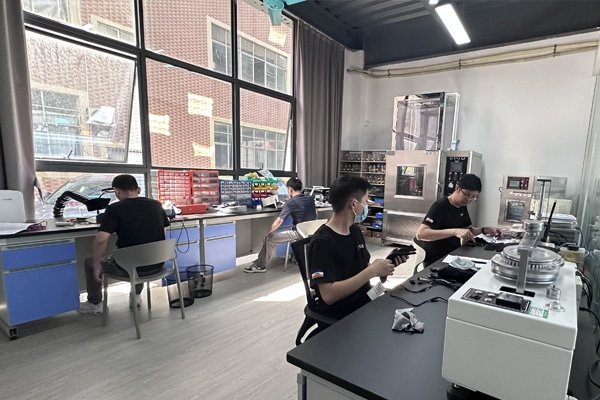
A quick reply is customer service; a technically grounded reply is engineering. Ask who answers your questions — a trading company salesperson or the factory’s own R&D team — and request one concrete example of a design problem they solved for a client.
Our benchmark: in-house R&D covering heating element design, control systems and app development — the same team that builds our custom heating elements.
Red flag: every technical question answered with “yes, no problem” and no follow-up drawing, spec sheet or test data.
8. A Track Record You Can Check
Look for breadth (how many categories they actually manufacture, not resell), depth (how long they have made them), and honesty about common failure modes. A factory that openly documents the pitfalls of this industry is more convincing than one that claims none exist.
Our benchmark: manufacturing heated products since 2013 across 5 categories with 336 models, for markets where North America accounts for about 45% of shipments. Common pitfalls when working with heated clothing factories.
Red flag: a “factory” whose product photos all carry other brands’ watermarks.
9. After-Sales Terms in Writing
Warranty, spare parts, failure-rate handling and firmware/app support should be in the contract, not in a WeChat promise. Ask what happens when a carton fails in the field six months after delivery.
Our benchmark: 12-month warranty on all products, with battery troubleshooting and after-sales documentation maintained for every model we ship. How we handle battery failures.
Red flag: “warranty: yes” with no duration, scope or replacement mechanism.
The 9-Point Supplier Scorecard
Copy this table into your evaluation sheet and score each supplier from 1–5. Any supplier below 3 on two or more rows is not worth a sampling fee.
| # | What to evaluate | Ask the supplier | Instant red flag |
|---|---|---|---|
| 1 | Production capacity | Floor area, lines, and monthly output for my category — with peak-season figures | One vague “daily capacity” number |
| 2 | Certifications | Certificate numbers for my destination market, verifiable on the issuing body’s site | Numbers cropped out of certificate photos |
| 3 | Testing lab | Which tests run in-house, on every batch | Only third-party reports, no in-house process |
| 4 | Prototyping | Rounds, lead time per round, and whether the fee is credited to bulk | Sampling fee never mentioned until invoiced |
| 5 | Battery compliance | Cell origin, pack-level certification, UN 38.3, and home-market standards | Open-market cells with no pack certification |
| 6 | MOQ & lead time | MOQ, sampling time, bulk lead time — and the peak-season answer | No peak-season answer |
| 7 | Engineering support | Who answers technical questions; one solved design problem as proof | “Yes, no problem” with zero documentation |
| 8 | Track record | Categories, models, years in the exact product line | Photos watermarked with other brands |
| 9 | After-sales | Warranty duration, scope, and field-failure mechanism, in writing | Warranty with no duration or scope |
Frequently Asked Questions
What is a realistic MOQ for custom heated products?
For a fully custom ODM project, expect around 500 units. For OEM production based on an existing platform with your branding, around 100 units. For in-stock items, a serious factory will sell a single unit so you can test the product first. Beware of quotations that hide the MOQ until after sampling fees are paid.
How long do sampling and bulk production take?
Sampling takes 7–30 days depending on design complexity. OEM production of an existing platform typically runs 20–25 days; a full ODM development cycle runs 50–60 days. Always ask for the peak-season figure — Q3 and Q4 capacity in this industry is booked months ahead.
Which certifications should a heated products manufacturer have?
At minimum: ISO 9001 for the quality system; destination-market marks such as CE/UKCA for Europe, FCC for the US, and RoHS for materials; UN 38.3 for lithium battery transport. Stronger suppliers also meet China’s CCC and GB 47372-2026 for heating appliances, which exceed many export baselines. Ask for certificate numbers and verify them with the issuing body — see the full certification guide.
For category-specific selection guides, see how to choose a custom heated socks manufacturer, heated jacket manufacturer and heated insoles manufacturer.