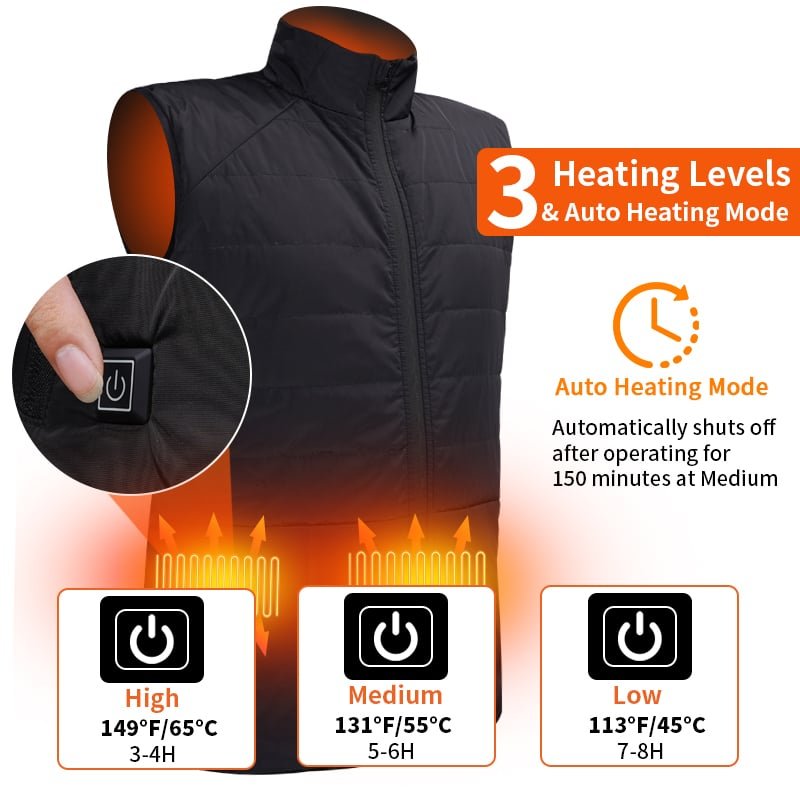

Ask five suppliers how long a heated jacket battery lasts and you will get five different numbers, each defensible. The honest answer is a range: about two hours on high in a hard wind, or a full shift on low with a larger pack. What separates a useful answer from a marketing one is whether the seller can name the pack, the heat setting and the conditions.
How Long Do Heated Clothing Batteries Last?
Across the packs we build, expect 2 to 10 hours per charge. Capacity is usually written in milliamp-hours (mAh), but mAh only compares packs at the same voltage. Watt-hours (Wh) is the figure that travels across systems, and the one worth asking for in a quote:
| Pack | Nominal energy | Where it is normally used |
|---|---|---|
| 3.7V 2200mAh | 8.1 Wh | Gloves and insoles, short sessions |
| 3.7V 3200mAh | 11.8 Wh | Gloves and socks, half a day |
| 7.4V 2200mAh | 16.3 Wh | Gloves on a dual-cell system |
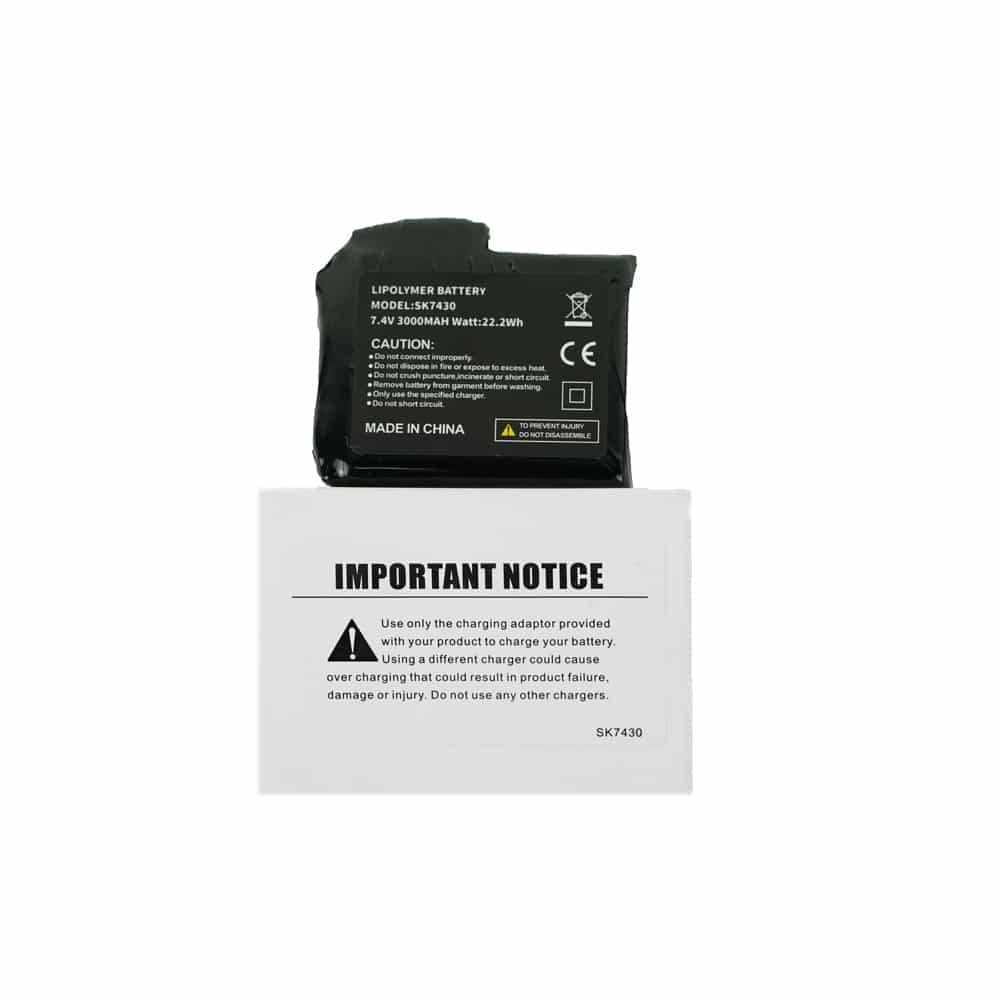
| 7.4V 3000mAh | 22.2 Wh | Vests, light jackets, heated pants |
| 7.4V 4000mAh | 28.1 Wh | Jackets and pants, a working day on medium |
| 5V 10000mAh | 50 Wh | 5V jackets and vests, all day on low |
| 12V 5000mAh | 60 Wh | Full jackets, multi-zone heating |
One of our own 7.4V packs, labelled as it leaves the line:
The table settles a common argument. A 3.7V 3200mAh pack carries 11.8 Wh; a 7.4V 2200mAh pack carries 16.3 Wh despite the smaller mAh figure. Comparing capacity without the voltage column compares nothing, which is how two suppliers both tell the truth and still disagree by a factor of three.
A sanity check you can run before ordering: Wh divided by draw in watts gives hours. A 7.4V 3000mAh pack holds 22.2 Wh, so a garment pulling 10W on medium runs roughly two hours, and the same pack on a 5W low setting runs roughly four. If a quoted runtime does not survive that division, the quote is a wish rather than a specification.
What Actually Decides Runtime
Capacity sets the ceiling. Three variables decide where inside that ceiling a garment lands on a real day.
Heat setting is the biggest lever
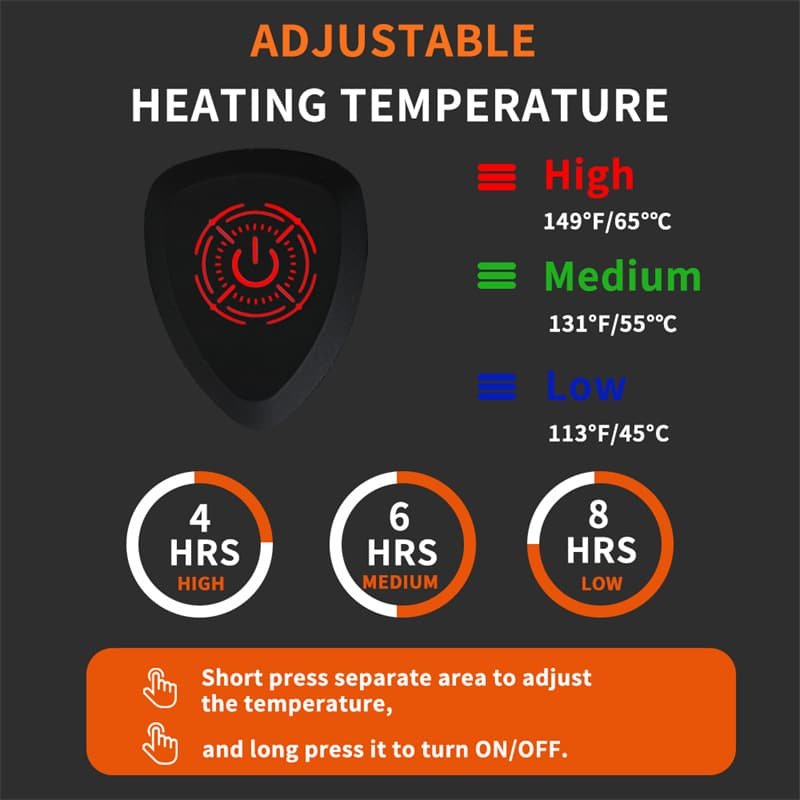
Think dimmer, not on/off. A heated glove may draw 3W on low and 8W on high – closer to two and a half times the consumption than to a 30 percent difference. Most garments give their best balance of warmth and endurance on medium, and most complaints about short runtime come from running on high out of habit.
Heating element type
Carbon fibre spreads heat across a wider area with less resistance than older wire elements, so more of the pack becomes warmth and less becomes a local hot spot. Heating film is thinner and more flexible, which is why it suits socks and insoles where a wire would be felt through the lining.
Outside temperature, wind and battery age
Two effects stack in the cold: a lithium cell delivers less usable capacity, and the garment draws more power to hold the same skin temperature because the gap to the outside air is larger. Wind multiplies the second by stripping heat off the shell faster than the element replaces it. Below 0°C with wind, a pack that gives a full day indoors may give a few hours, and neither figure is wrong. Age compounds it – a pack in its third winter is not the pack that shipped.
Runtime by Garment Type
Ranges we quote for typical winter conditions, with a matched pack and a garment in good repair. Treat them as planning numbers, not as guarantees for a specific mountain.
| Garment | Common pack | Low | Medium | High |
|---|---|---|---|---|
| Heated gloves | 3.7V 2200-3200mAh | 4-6 h | 3-4 h | 1.5-2 h |
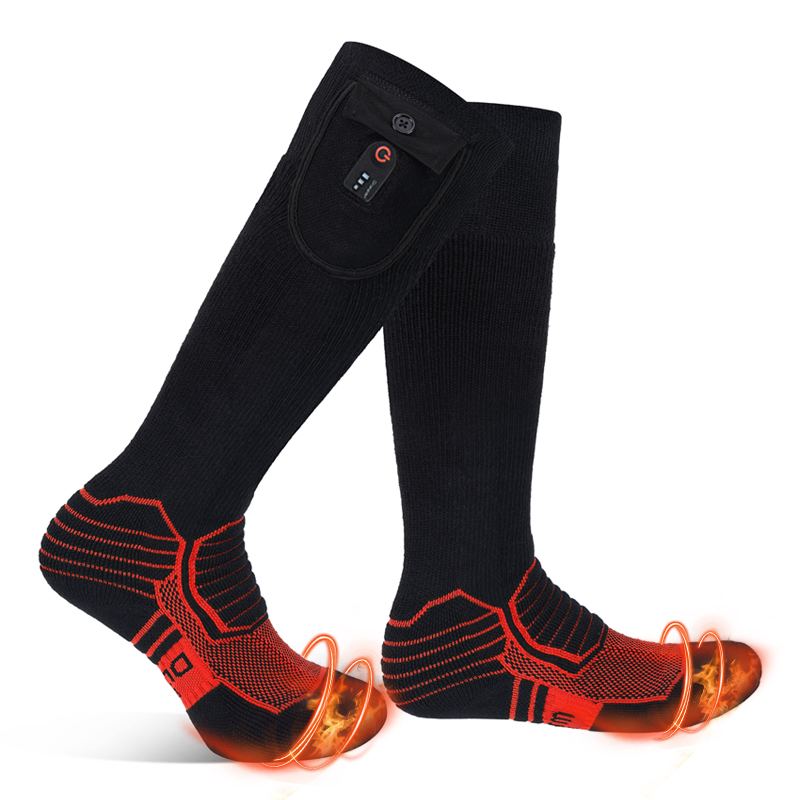
| Heated socks | 3.7V 2200mAh | 5-7 h | 3-4 h | 2-3 h |
| Heated insoles | 3.7V 2200mAh | 5-7 h | 3-4 h | 2-3 h |
| Heated vest | 7.4V 3000mAh | 4-5 h | 2.5-3.5 h | 1.5-2 h |
| Heated jacket | 12V 5000mAh | 8-9 h | 5-6 h | 3-4 h |
| Heated pants | 7.4V 4000mAh | 5-6 h | 3.5-4.5 h | 2-3 h |
If your own numbers come in below the table, three things explain it before the pack does: a pack in its second or third season, a charger from a different system that never quite filled it, and timing that starts when the garment is switched on rather than when the fabric feels warm.
For the glove and sock cases in more detail, see custom heated gloves and custom heated socks. Jackets follow the same arithmetic with a larger pack, covered under custom heated jacket.
How Long Does a Pack Last Before Capacity Drops?
A quality lithium pack holds roughly 300 to 500 full cycles before usable capacity falls to about 80 percent, which in seasonal use is several winters. Partial charges count proportionally, so topping up after a short outing costs less life than running flat every time. Heavy commercial use accelerates it: a 5000mAh pack cycled daily may read closer to 4000mAh of usable capacity after a year. Swelling, a pack that runs hot while charging, or runtime halving are signals to replace rather than to nurse along.
Are Heated Clothing Batteries Safe?
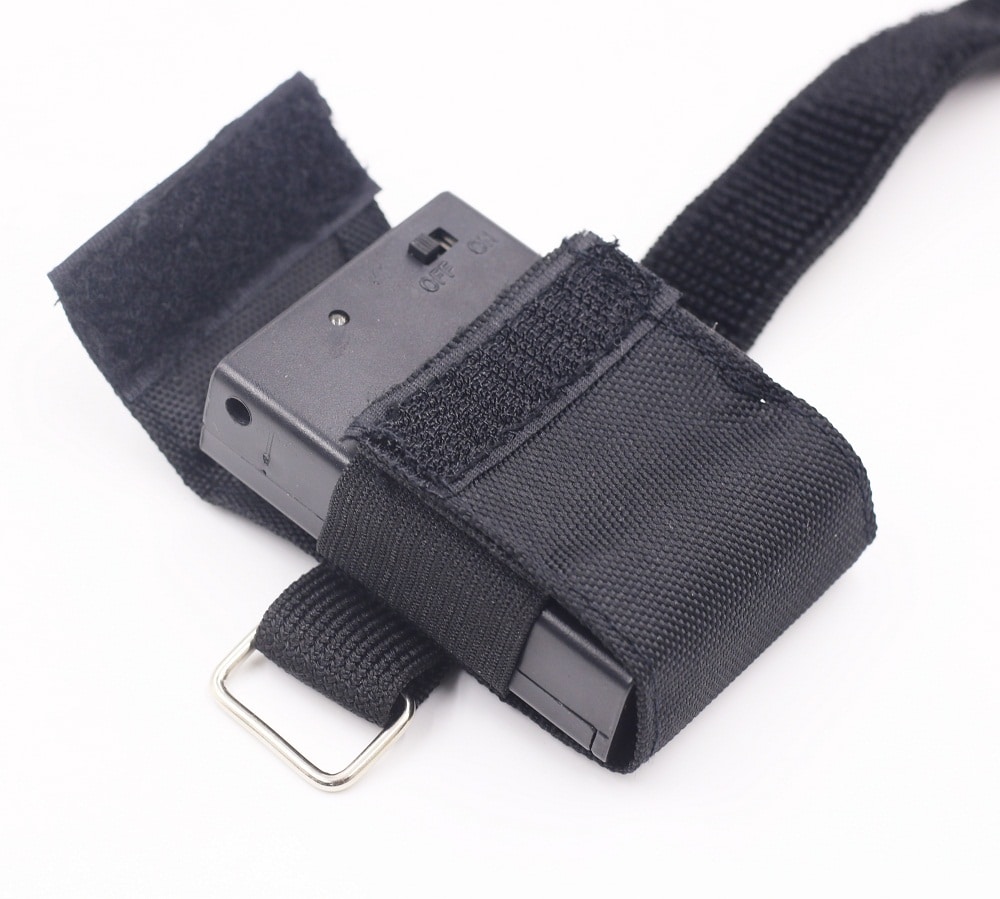
A pack built to standard is safe; failures that reach the news are almost always uncertified cells with no protection board. Three layers do the work: a protection circuit against overcharge, over-discharge and short circuit; a cell that has passed transport testing; and a charger matched to the pack voltage rather than whatever plug fits.
On documentation, the packs we supply carry CE, UKCA, UL, FCC, RoHS, Reach, UN 38.3, DOE, ISO 9001 and GB 47372-2026 with CCC, with TÜV testing on top. Two numbers worth keeping on file: TÜV US 72504115 and ISO 9001 11724QU0181-09R1S. The certificate holder is Dongguan S-KING Limited while production runs at Dongguan Ditewang – if a supplier cannot name both the holder and the plant, the paperwork deserves a second look. The datasheet shipped with each pack is an SDS, which is a transport document rather than a certificate in itself. The full set sits on our battery solutions page, with the manufacturing side under OEM/ODM services.
How to Get More Hours Out of One Charge
- Start low and step up only when the cold demands it. The largest runtime gain costs nothing.
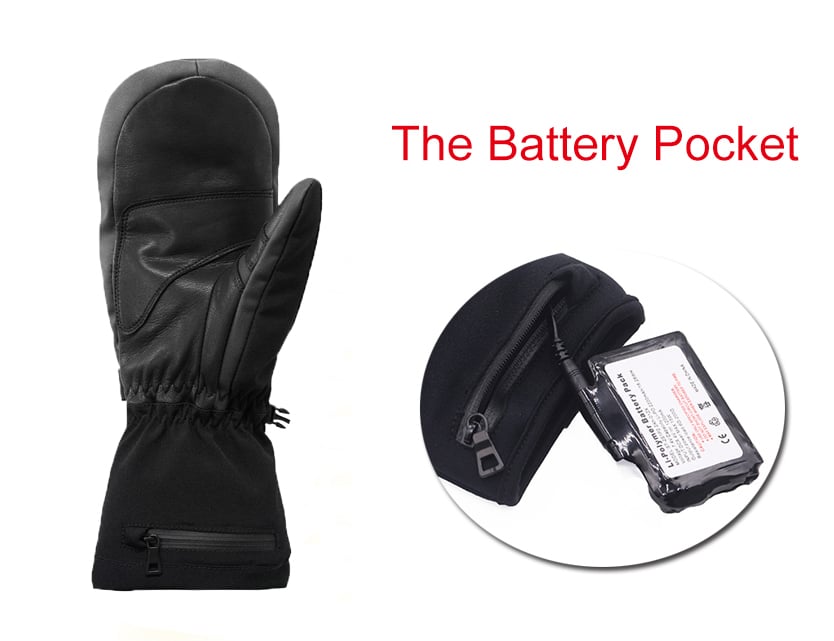
- Carry the pack in an inside pocket. A warm cell delivers more of its rated capacity than a cold one.
- Store at around half charge in a cool dry place, not full and not flat.
- Charge with the matched charger: 5V/2A for 3.7V packs, 8.4V/1.5A for 7.4V, 5V/3A for 12V. Charge time follows pack size, from about 3.5 to 4 hours on a 7.4V 2200mAh pack up to 18 to 19 hours on a 12V 5000mAh pack.
- Check the connector and cable once a season. Most dead-battery reports are a worn plug, not a worn cell.
Final Recommendation
If you are specifying rather than buying retail, work backwards from the shift you need to cover. A glove programme that has to survive a four-hour ski lesson wants a 3.7V 3200mAh pack, not a 2200mAh pack and an apology. A jacket programme for site work wants 12V 5000mAh or a 5V 10000mAh pack, and a spare, because packs get swapped at lunch rather than charged on a wall. Then check the two things that decide whether the number holds in year three: the cycle rating of the cell, and whether the same part number will still exist when the first batch wears out.
Frequently Asked Questions
How long does it take to fully charge?
Charge time tracks pack size and charger: a 7.4V 2200mAh pack on its matched 8.4V/1.5A charger takes about 3.5 to 4 hours, while a 12V 5000mAh pack can take 18 to 19 hours. Quick-charge circuits shorten that but add heat along the way, so the slower charger is the gentler default for pack life. A pack still reading low after twice its expected charge time usually has a cable or port problem, not a capacity problem.
How many charges before the pack noticeably weakens?
Expect roughly 300 to 500 full cycles before usable capacity falls to about 80 percent. Partial charges count proportionally, so topping up after a short outing costs less life than a full discharge. In seasonal use that is several winters, which is why a spare pack bought early is usually a better buy than a bigger one. For charging and storage habits that slow capacity loss, see how to extend battery life in heated apparel.
Why does it drain so much faster outdoors?
Two effects stack. The cell chemistry delivers less usable capacity when cold, and the garment demands more power to hold the same temperature because the temperature difference to the air is larger. A pack that gives a full day indoors may give a few hours at minus ten on high, and neither figure is wrong.
Should I leave it on the charger between uses?
No. Leaving a pack at full charge, especially somewhere warm, ages it faster than cycling it does. Charge it the night before use, and for storage keep it around half charge in a cool dry place. A pack stored flat for a whole summer may not recover when the season starts, and that failure is self-inflicted.
Can I use a power bank instead?
Only when the voltages match. A 5V power bank of 10000 to 20000mAh is the normal pack for 5V jackets and vests, and a sensible spare for that system. It will not run a 7.4V or 12V garment, and forcing it through a converter gives 10 to 20 percent less runtime because the heating circuit was not tuned around it. It also rarely sits in the pocket as well as a purpose-built pack.
Can I take it on a plane?
Yes. Packs rated at or below 100Wh are allowed in carry-on under IATA rules, and every standard heated-clothing pack falls inside that limit, including a 5V 20000mAh pack at exactly 100Wh. Spare packs must travel in the cabin rather than checked baggage, with the terminals taped or bagged.
Can a worn-out pack be replaced on its own?
Only if the model is still supported and the connector and voltage match. This is the specification most worth asking about at purchase: how long will this pack be available, and is there a current part number for it. A garment with a five-year shell and an orphaned pack has a one-season life, whatever the label says.