
Most heated apparel buyers start with a product question and end up with a supplier question: the samples look right, the price looks right, and then six weeks later the certification documents arrive in somebody else’s company name. That gap is usually not a quality problem. It is a supplier-type problem.
This guide covers the four kinds of supplier you will meet when sourcing heated clothing, the seven checks that separate a factory from a reseller, and what the difference actually changes on your project. If you already have a shortlist and want to qualify one supplier in detail, use our 9-point supplier checklist instead.

Why the factory-or-trader question matters more in heated apparel
In ordinary apparel, a trading company can be a perfectly good partner. Fabric, cut and sew, trims, packing: the work is visible and a good agent adds logistics value.
Heated apparel carries three things that a reseller cannot fake for long:
- The heating system. Element layout, wattage per zone, wiring routing and the controller firmware all interact. When a buyer asks for a change on zone three, someone has to know why it was built that way. A trader has to forward the question; a factory answers it.
- The battery and its paperwork. Lithium packs travel under UN 38.3, and the test summary is tied to the cell and pack configuration. Change the capacity or the housing and the document has to be reissued. Whoever holds that file controls your shipping schedule.
- Certification ownership. CE, UKCA, FCC, RoHS, Reach, DOE and UN 38.3 reports name a legal entity. If the certificate holder is not the party you are buying from, an audit or a marketplace compliance check will surface it, and the explanation is always awkward.
None of this means traders are dishonest. It means the questions you would ask of any clothing supplier are not sufficient here.
The four supplier types you will actually meet
1. Direct manufacturer
Owns the plant, the production lines and usually the electronics assembly. Holds its own certifications. Designs and builds samples in-house. Typical MOQ sits in the 100 to 500 piece range for custom work, with sample lead time of two to four weeks and bulk production of four to six weeks after approval.
2. Factory-trader hybrid
Manufactures part of the range and sources the rest, often because one category needs a specialist line. Legitimate and common in heated apparel, where a glove factory may not run an insole line. The risk is silence about which is which: ask for a written statement per SKU.
3. Trading company
Sells without owning production. Can be efficient for small mixed orders and for buyers who want one invoice across several factories. Adds a margin, adds a communication layer, and depends entirely on how well it controls its suppliers.
4. Brand or marketplace reseller
Sells finished branded goods with light logo changes. Fastest route to a shipping carton, weakest route to a differentiated product, and normally no access to the tooling or the certification file.
Four-type comparison
| Dimension | Direct manufacturer | Factory-trader hybrid | Trading company | Brand reseller |
|---|---|---|---|---|
| Who owns the design | You, built on their platform | Split by SKU, needs stating | Usually the factory behind them | The brand |
| MOQ for custom work | Typically 100 to 500 pcs | Varies per category | Often negotiable in small volumes | Stock quantities only |
| Sample lead time | 2 to 4 weeks, built in-house | 2 to 4 weeks for own lines | Adds forwarding time | Samples are finished goods |
| Bulk lead time | 4 to 6 weeks after approval | Mixed depending on line | Adds coordination time | Stock dependent |
| Certificate holder | The manufacturer, verifiable | Mixed, ask per SKU | Usually a third party | The brand |
| Changing a heating zone | Engineering review, then sample | Possible on own lines | Forwarded, then quoted | Not possible |
| Who answers technical questions | The engineer who built it | Case by case | An account manager | A catalogue |
| Responsibility if a batch fails testing | Clear, in writing | Needs contract clarity | Split and often disputed | Replacement at best |
Typical ranges above reflect what buyers commonly see in public sourcing guides for this category. Your own numbers depend on the design, the fabric and the destination market.
The seven checks that separate a factory from a reseller
Each check below can be completed before you place a deposit, and none of them require a site visit.
Check 1: The business licence and the production address
Ask for the licence and read the registered scope. It should include manufacturing of the product you are buying, and the production address should match where your goods are actually made. A licence covering sales or import-export only, with production “arranged”, tells you what you are dealing with.
Check 2: Whose name is on the certificate
Request one certificate file and look at the holder line, not the logo. The holder should be the entity you are contracting with, or an entity you can trace to it in writing. This single check removes most of the ambiguity in a supplier conversation.
Check 3: Who builds the sample
Send a technical question with the sample request: why the element is routed a particular way, or what happens to the controller at low voltage. A factory replies with a reason and often a suggestion. A reseller replies with a promise to check.
Check 4: Lines and equipment you can name
A factory can tell you how many lines it runs, how many main machines it operates and what the daily output is per line. Vague answers about “our partner factory” are an answer in themselves.
Check 5: The battery file
Ask which cell and pack configuration the UN 38.3 summary covers, and what happens if you change capacity. A factory that assembles packs will explain the re-test trigger. A reseller will repeat your question back to you.
Check 6: A quality system with a number
ISO 9001 is not proof of good products, but it is proof of a documented process, and the certificate number can be verified. Ask for the number and the audit scope, then check it.
Check 7: How the price is built
Ask for the price structure: shell fabric, lining, heating element, controller, battery, labour, packing, testing. A factory can break this down because it buys and builds these inputs. A reseller usually returns a single landed number.
What buying from a factory actually changes
- Change requests stay cheap while the design is open. Moving a heating zone or swapping a controller is a sample revision, not a new supplier conversation.
- The accountability chain is one link long. If a batch fails a safety test, there is no third party to blame and no margin to argue over.
- Certification documents arrive in the right name. That matters at customs, at marketplace compliance review, and at your own retailer audits.
- You can see where the money goes. A broken-down price is negotiable on the parts that matter to you, instead of a single number you either accept or refuse.
- Small runs are possible but bounded. Factories set MOQ by changeover cost, so expect custom work to start at a few hundred units rather than a few dozen.
Red flags worth pausing on
- Certificate scans with the holder name blurred out.
- A sample that arrives with a different controller than the one quoted.
- No answer to “which cell is in this pack”.
- Lead times quoted before the design is agreed.
- A price that is 30 percent below every other quote on identical specifications.
- Reluctance to name a production address.
Where Dr. Warm sits
We are a direct manufacturer, not a trader. Dr. Warm has been producing heated products Since 2013 from Dongguan, China, with a 6,000 m² main production plant and a separate 2,074 m² electronics assembly workshop, 3 production lines, 12 main machines and a team of 56 including 8 R&D engineers. Annual capacity runs above 1,000,000 pieces.
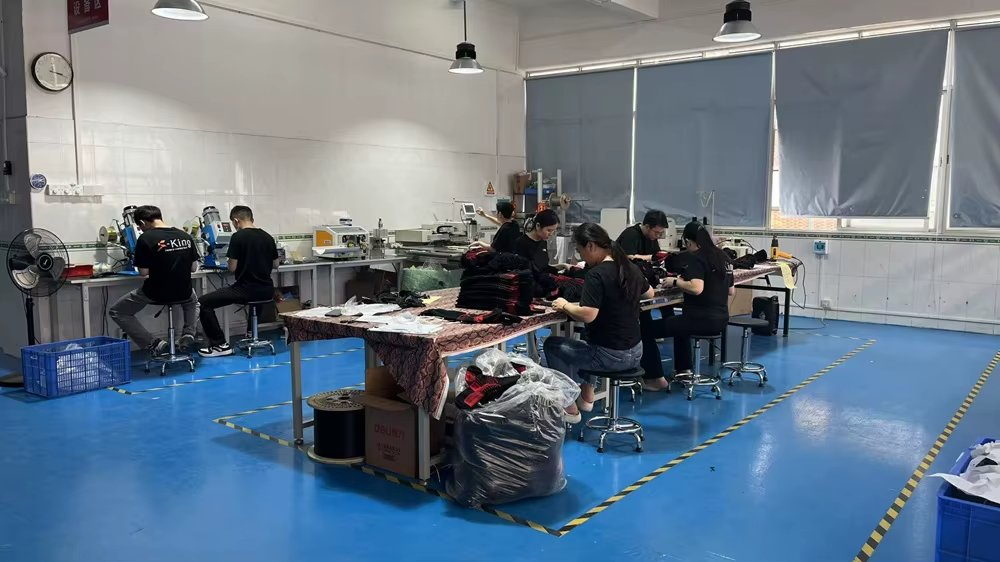
The range covers heated insoles, socks, gloves, vests, jackets, underwear and accessories, which means a buyer can build a full heated line without stitching together three suppliers. Our OEM/ODM services run at MOQ 100 pieces for OEM and 500 for ODM, with sampling in 7 to 30 days, OEM production in 20 to 25 days, ODM in 50 to 60 days and bulk orders completed within 45 days. Warranty is 12 months.
Certification is held by Dongguan S-KING Limited, the certificate holder for the CE, UKCA, UL, FCC, RoHS, Reach, UN 38.3, DOE, ISO 9001 and GB 47372-2026 with CCC certifications, plus a TUV report. Documents and their numbers are available on request. See certifications for the current list, our factory for the production setup, and battery solutions for how packs are specified per project.
If you are sourcing a specific category, the heated gloves manufacturer page is the closest thing we have to a line-by-line capability statement, and the same logic applies across socks, insoles and vests.
Frequently Asked Questions
How can I tell if a heated apparel supplier is a real factory?
Ask three questions before any deposit: who holds the certification files, who builds the sample, and how the price is structured. A factory answers all three with specifics and can name its production address, line count and main equipment. A reseller forwards the questions or answers in general terms.
What MOQ should I expect from a heated apparel factory?
For custom heated apparel, 100 to 500 pieces per style is the common range, because MOQ follows changeover cost rather than order value. Stock items and simple logo work can go lower. Our own terms are 100 pieces for OEM and 500 for ODM.
Who should hold the CE and UN 38.3 certificates?
The legal entity that manufactures and exports your goods should be the certificate holder, so the documents match the commercial invoice and the shipping paperwork. If a third party holds them, get a written explanation of the relationship before production starts.
Is a trading company always a bad choice?
No. A good trading company is useful for small mixed orders, for buyers without a sourcing team, and for consolidating several factories into one shipment. The mistake is paying factory-direct expectations while buying through a reseller, or assuming the certificates belong to the company that quoted you.
Request a quote
Send us your category, target market, estimated quantity and any reference sample. We will reply with a feasible specification, the certification path for your destination, a sample timeline and a price breakdown rather than a single number.