
How to Source Heated Scarves for Your Winter Range: OEM Guide
Heated scarves are one of the fastest additions to a winter accessory range — but the category is easy to source badly. Unlike a heated glove, a scarf sits against the neck and face, so battery placement, heat distribution and fabric feel decide whether customers keep wearing it. This guide covers what to specify before you place a private-label order with a heated apparel manufacturer.
Why heated scarves are a different engineering problem
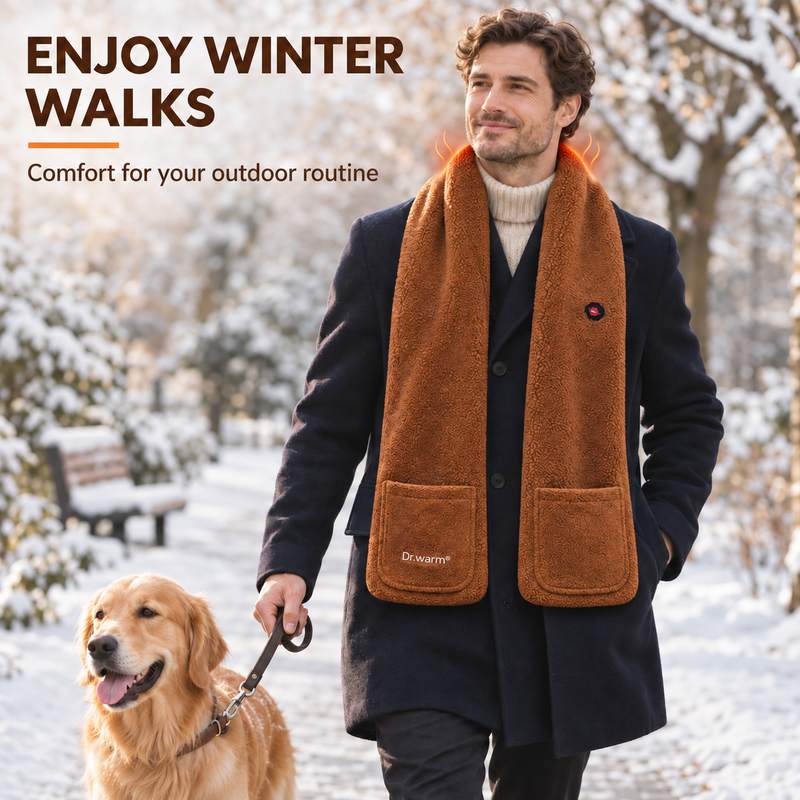
A scarf has no pocket to hide a battery pack, so the power source has to be built into the garment without pressing against the neck. In our OEM programmes, the pack is seam-sealed into a rear panel or a dedicated pocket at the back of the neck, with the wiring routed away from the face. Heating elements are distributed across the length of the scarf rather than concentrated in one spot, because the neck loses heat along its whole circumference.
The result should feel like a normal fleece scarf with a warm layer inside — not a piece of electronics wrapped around your neck. If a supplier cannot explain where the battery sits and how the heat is spread, ask for a sample before discussing price.
Five specifications to fix before you request a quote
The five decisions that shape a heated scarf programme are heat zones, battery placement, fabric, control method and washability. Fix these at the start; changing any of them after sampling costs time and tooling.
- Heating zones. Most scarves use two to four zones along the length. More zones give even warmth but need more wiring and a larger battery.
- Battery placement. The pack should sit at the back, flat against the upper back rather than the side of the neck. Ask to see a worn sample, not a table-top photo.
- Fabric and lining. Fleece and soft-shell outer fabrics with a thin insulating lining keep the heating layer close to the body without bulk.
- Control method. A button on the scarf is simplest; app and remote control are possible where the product sits in a connected range.
- Washability. Confirm the care instructions at sample stage, including how the battery and controller are removed before washing.
OEM versus an existing platform
If you are entering the category, start from an existing heated scarf platform and change the branding, colour and packaging; develop a new structure only when you have a specific reason. An existing platform has validated heating patterns and a tested battery layout, so samples arrive in 7 to 30 days. A fully custom ODM project — new shape, new heating layout, new control system — takes 50 to 60 days of development before mass production.
MOQ reflects that difference: OEM projects start from 100 units, fully custom ODM projects from 500. Stock samples are available for evaluation before you commit. For the full distinction between the two paths, see our OEM/ODM page.
What the battery configuration should cover
Battery capacity for a heated scarf is configured to the order, not taken from a fixed catalogue value. The deciding factors are the number of heating zones, the target heat levels and how long the product needs to run between charges. Standard voltage platforms are 3.7V, 5V, 7.4V and 12V, with 24V available as a custom build.
Ask your supplier to state the capacity in your quotation and to confirm that the pack, controller and heating elements were tested as one system. A pack that works in a glove is not automatically right for a scarf with a different zone layout. More on our approach is on the battery solution page.
Certification and documentation for your market
The certification file must match the scarf configuration and the destination market, not just the factory in general. Dongguan S-KING Limited holds CE, UKCA, UL, FCC, RoHS, REACH, UN38.3, DOE, ISO 9001, GB 47372-2026 with CCC documentation, and ISO 13485. Lithium packs ship with UN38.3 test summaries and an SDS for freight documentation.
Ask for the test file covering your model and battery configuration. A generic company certificate is not enough when a retailer or customs broker checks the paperwork. Our certifications page sets out which documents belong to which market.
Three sourcing mistakes to avoid
The three most common mistakes are approving a table-top sample without wearing it, changing the battery after sample approval, and treating certification as a factory-level rather than model-level question. All three surface after production starts, when changes are most expensive.
Wear the sample for at least twenty minutes. Check that the heating is even along the length, that the pack does not press on the neck, and that the controller is reachable. Then lock the battery and packaging specification before the production slot is reserved.
Fabric and comfort: what to check in a worn sample
The fabric decision affects whether the scarf feels like winter equipment or like electronics — and it changes how the heat reaches the body. A fleece outer with a thin insulating lining is the most common starting point because it holds the heating layer close without adding bulk. Softer knitted fabrics feel better against the neck but need a more carefully routed element to avoid a visible ridge.
When you evaluate a sample, wear it for at least twenty minutes rather than judging it on a table. Check three things: whether the heat is even along the whole length, whether the battery panel presses on the neck, and whether the controller can be reached without taking the scarf off. A design that passes a visual inspection but fails any of these three will generate returns once it reaches customers.
Ask also how the fabric behaves after washing. A lining that shrinks or a fleece that pills can move the heating element away from the body, reducing warmth even though the electrical system still works. Your supplier should be able to state the care procedure for the exact fabric used in your order.
How to verify quality before a bulk order
Quality verification for a heated scarf should cover the electrical system and the garment together — a fabric inspection alone misses the faults that matter. Request three records before you approve production: the heating uniformity check, the battery protection test and a batch record from a comparable run.
- Heating uniformity. The elements should produce even warmth along the scarf, with no cold segment and no local hot spot.
- Battery protection. Over-current, over-temperature and short-circuit protection should be tested on the pack used in your configuration.
- Batch traceability. A batch record should connect materials, operators and test results so a later claim can be checked against the actual run.
If a supplier can show you a production line but cannot produce a batch record, treat the stated capacity as unverified. The factory site visit is useful for seeing the process; the records are what prove it runs consistently when nobody is watching.
Seasonal planning for a new accessory line
A heated scarf added to a winter range needs to be in sampling during spring if it is to ship before the autumn selling season. Accessories are often planned later than gloves and jackets, which puts them at the back of the production queue just when every line is full.
Work backwards from the shelf date. Allow 7 to 30 days for sampling on an existing platform, 20 to 25 days for OEM production, and add time for shipping documentation when lithium batteries are involved. Confirming the battery and packaging at sample approval is worth more than compressing the schedule later.
Frequently asked questions
Can a heated scarf carry our own brand?
Yes. Logo placement, colourways, woven labels and retail packaging are customised as part of OEM and ODM programmes, starting from 100 units for an existing platform.
How long does sampling take for a heated scarf?
Samples take 7 to 30 days depending on how much of the platform changes. Branding and colour changes on an existing scarf are at the faster end; a new heating layout takes longer.
Can the battery capacity be specified for our market?
Yes. Capacity is configured per order, and the voltage platform is chosen with the heating layout. Tell us the target runtime and market and we will propose a matched configuration.
Which certifications apply to a heated scarf?
Dongguan S-KING Limited holds CE, UKCA, UL, FCC, RoHS, REACH, UN38.3, DOE, ISO 9001 and GB 47372-2026 with CCC documentation. The exact scope depends on the model and destination market.