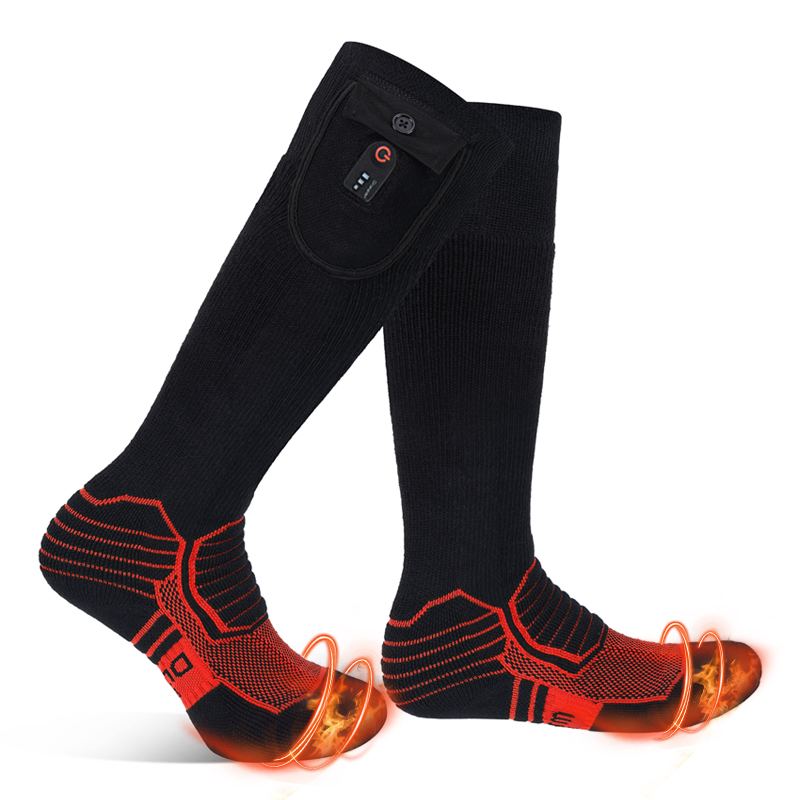
Yes — battery powered heated socks suit both skiing and winter hunting. The useful question is a different one: can the same sock do both? Mostly it cannot, and the reason is not marketing. Four parameters get pulled in opposite directions, and one of them — thickness — cannot be averaged at all.
The ski boot is a rigid shell, so thickness is a clearance
A ski boot is a plastic shell wrapped around a moulded foam liner. The liner was heat-fitted to a foot wearing a thin sock, and the buckles close on that stack. Anything added between foot and liner compresses the foam, and the boot stops behaving like the boot that was fitted.

What that looks like in practice: a bunched sock at the instep becomes a pressure point within half an hour, the pressure point becomes a cold or numb toe, and the skier concludes the boot is wrong. It is almost never the boot. The rule that survives a season is simple — the heated sock must be no thicker than the liner sock the boot was fitted in, which is why the layer stack in the figure above matters more than the pile height of the knit.
The second ski-specific fact is that the shell does not breathe. A ski day alternates between a few minutes of hard work and ten minutes standing on a lift in wind; the inside of the boot goes from dry to damp by the third run and stays damp. So the material job in a ski sock is moving moisture away from the skin, not trapping more heat. That is the same balance the ski-specific heated sock brief turns on, and it is the opposite of what a hunting product is optimised for.
Third: inside a rigid shell, only the toe and forefoot zone does any work. Heating further up the foot is pressed against plastic and does nothing except create a lump. A ski sock can therefore carry a shorter heating zone than a hunting sock and lose nothing.
Hunting is the opposite load: hours of stillness in a roomy boot
A hunting boot has volume. It has a thick liner, often a rubber or neoprene lower, and the wearer may well be in a spare sock. Nothing is compressing the sock, so thinness buys nothing — and a sock built to ski-boot tolerances will feel under-insulated and under-heated in a boot this big, which is the single most common complaint when a brand tries to sell one model into both channels.
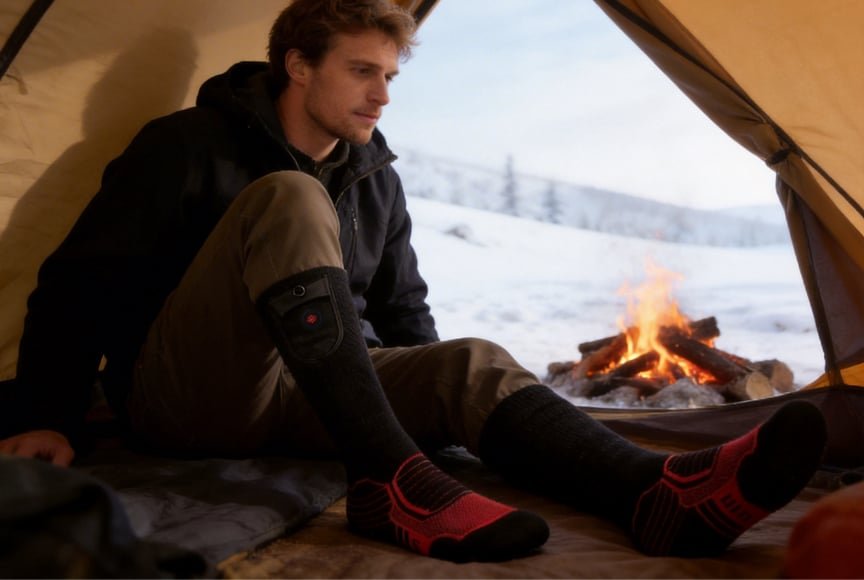
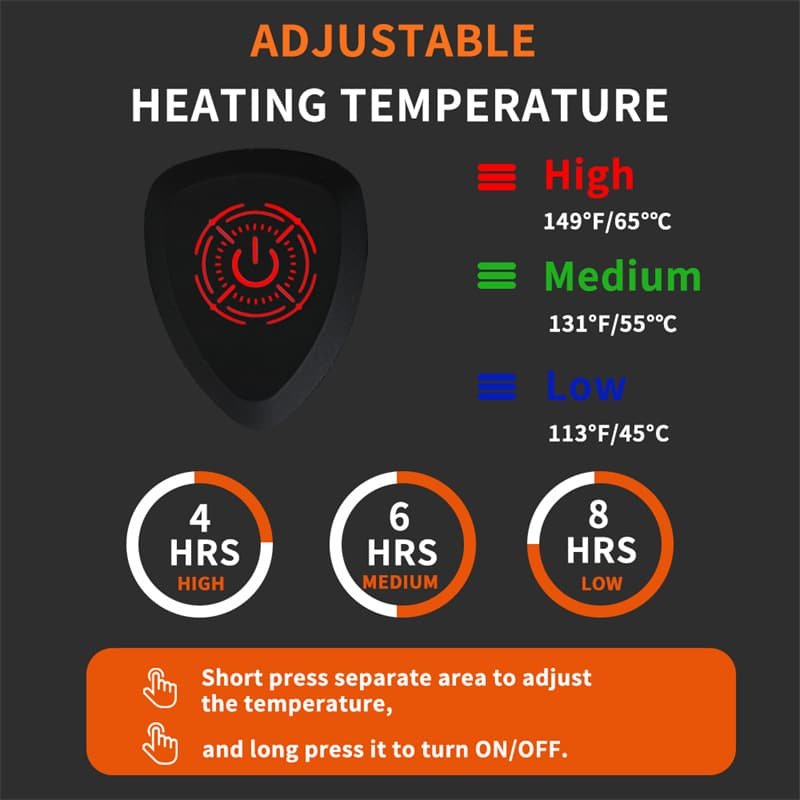
The demand is not peak heat. It is hours at a stable low output, because a body at rest produces very little and the ground pulls heat out through the sole faster than the body replaces it. A thousand small decisions follow from that: keep the low setting genuinely low, make the switch reachable without standing up, and accept that the pack will be pressed against a tree, a seat or the ground for most of the day.
Two field constraints almost never make it onto a specification sheet. The first is noise: a hook-and-loop pocket flap opened at twenty metres ends a stalk, so hunting builds use silent closures instead of rip tape. The second is kneeling — a calf-mounted pack gets pressed between the leg and the ground every time the wearer kneels or crawls, which is a load case a ski sock never sees. Both are cheap to design in and expensive to retrofit.
| Parameter | Skiing asks for | Hunting asks for | One product? |
|---|---|---|---|
| Sock thickness | At or below the liner sock; clearance is fixed | Cushioned, with room for a spare sock | No — this is the parameter that cannot be averaged |
| Output profile | Quick warm-up, high for a run, idle on the lift | Low and flat for five or six hours | Firmware and controller yes; tuning differs |
| Pocket and closure | Secure under a shell and a trouser leg | Silent, and survives kneeling | No — closure acoustics are a real specification |
| Control access | Gloves on, hands on poles, pack buried | Seated, gloves on, pack under trousers | Yes — remote or app solves both |
| Heating zone | Toes and forefoot only; more is pressed by plastic | Toes, forefoot and a wider warm footprint | Partly — same element, different extent |
What can be shared, and what cannot
The shareable part is everything electrical: battery platform, PCBA and firmware, heating element type, the toe zone pattern, the charger, and — the expensive one — a single certification file. Certifying a battery and a controller is the slow, costly step in a programme, and it is paid once per platform, not once per knit. That is the argument for one platform and two builds.
The unshareable part is textile: cushioning and thickness, sock height (a ski sock can stop where the shell starts, a hunting sock should keep going), pocket closure, and colourway. These are cheap to differentiate at sampling and impossible to fix later.
Which is why the answer to the original question matters commercially. A brand that ships the ski build into the hunting channel gets returns for “not warm enough”; a brand that ships the hunting build into ski boots gets returns for “boot no longer fits”. Both are thickness complaints wearing different clothes.
Runtime is a profile, not a number
Skiing switches the sock on and off: a few minutes of run, ten minutes of lift, and a long lunch. The pack is not the constraint for most of the day, so the mistake that actually costs a skier their warmth is starting with a cold pack — a battery that has spent the night in a car or a boot bag delivers less than its rating, and the calf pocket is a better home for it than a rucksack.
Hunting runs the pack flat out at low output for the whole sit, so capacity decides the day and the numbers are worth running properly. Nominal energy is voltage times capacity: 3.7V at 3,200mAh is about 11.8Wh, 7.4V at 3,000mAh is 22.2Wh, 7.4V at 4,000mAh about 29.6Wh. A five-hour sit at low output is a different draw from a two-hour ski session at high, which is why how many hours heated socks work in freezing conditions has no single answer.
Charging is the last shared resource and the one most often underestimated on a trip: packs recover in roughly 3.5 to 19 hours depending on model and capacity, and a 7.4V pack will not charge from a 5V lead. For a ski week that means one charger per person and a plan for two packs; for a hunting trip with no mains power it means a power bank and a platform that accepts one.
None of this makes a dual-purpose product impossible — it makes it a platform decision rather than a product decision. Build the electronics once, build the textile twice, and let each channel have the sock its boot actually needs. The full specification checklist for either build sits in our heated socks buying guide.
Custom heated socks for ski and hunting brands
Dr. Warm develops both builds on one platform: 3.7V, 7.4V and 12V battery options, carbon-fibre or graphene elements, toe and forefoot zones, button, wireless remote or Bluetooth app control, silent pocket closures for field use, and private-label packaging. OEM from 100 pairs, ODM from 500 pairs, and single pairs from stock for evaluation in your own boots.
Frequently Asked Questions
Can you wear heated socks in ski boots?
Yes, as long as the sock is no thicker than the liner sock the boot was fitted with. A ski boot is a rigid shell around a moulded foam liner, so extra thickness compresses the liner and becomes a pressure point within half an hour. Toe and forefoot heating is the part that survives inside a shell.
Are heated socks worth it for hunting?
For a sit, yes. A body at rest produces very little heat and the ground takes what it does produce, so hours of stable low output is exactly what a thermal sock cannot deliver. Two details matter more than the headline specification: a silent pocket closure and a control the wearer can reach without standing up.
How long do heated socks last on a ski day?
Usually longer than the cold part of the day. A ski day is runs of a few minutes and lifts of ten, so the sock is switched on for a fraction of it, and the limit is more often a pack that started the day cold. Carry the spare inside a jacket rather than a rucksack.
Can one heated sock work for skiing and hunting?
Usually as a compromise rather than an optimum. The battery, controller and toe zone can be shared, but thickness, pocket closure and sock height cannot be averaged, and thickness is the one the ski shell will not forgive. The practical route is one platform with two textile builds.