Heated socks sit in the hardest place a heated product can sit: inside a boot, against the skin, and under constant flex and moisture. That is why two socks built to the same headline specification can feel completely different after an hour on a ski lift or a full shift outdoors.
This guide is written for two readers at once: buyers who want to choose well, and the brands, distributors and importers who need to write a heated sock specification a factory can build. Each section maps to a line you can put in a tech pack or a supplier brief.
What Is Inside a Heated Sock
A heated sock is a knitted sock with four extra systems worked into it, and comparing them separately is the fastest way to tell apart offers that look identical on a product page.
- Heating element. A carbon fiber, graphene or metal-fiber yarn or film integrated into the knit. The material decides how evenly heat spreads and how well the sock tolerates being stretched over a calf and folded into a boot. For the trade-offs between the two common formats, see our comparison of heating film and carbon fiber in heated socks.
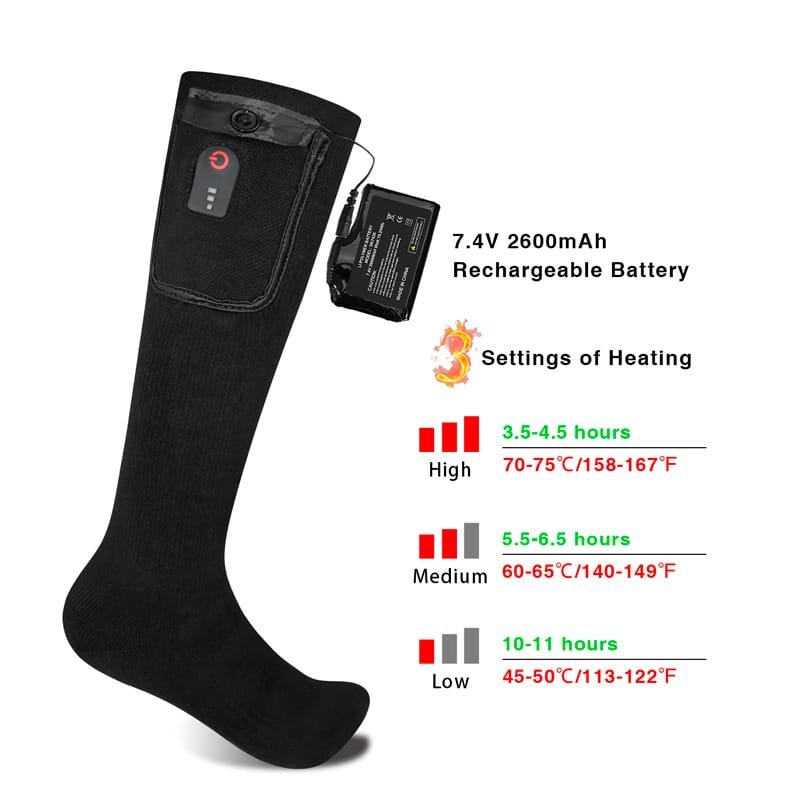
- Battery and pocket. A small pack carried near the upper calf. Cuff weight and pocket security matter more here than on any other heated product, because the pack moves with every step.
- Controller. A button on the battery, a wireless remote or a Bluetooth app. Because the pack sits under a trouser leg or inside a boot, remote and app control are usually worth the extra cost.
- Knit and lining. The yarn blend, the inner surface and the seam placement decide whether the wearer feels the wiring at all. Blind-stitched integration keeps the element flat and the seams out of the way.
The principle behind all four is the same: an element converts electrical energy into heat and the knit holds it close to the foot. Our explainer on how heated socks work covers that in more detail.
Key Specs to Compare: Voltage, Battery, Warmth and Waterproofing
The comparison narrows to a short specification list. The table below shows the values we build to at Dr. Warm: if a supplier cannot state these clearly for a heated sock, that is already an answer.
| Voltage options | 3.7V / 5V USB / 7.4V / 12V / 24V (customizable) |
|---|---|
| Battery capacity | 2200 / 2600 / 4000 / 5000mAh and above (customizable) |
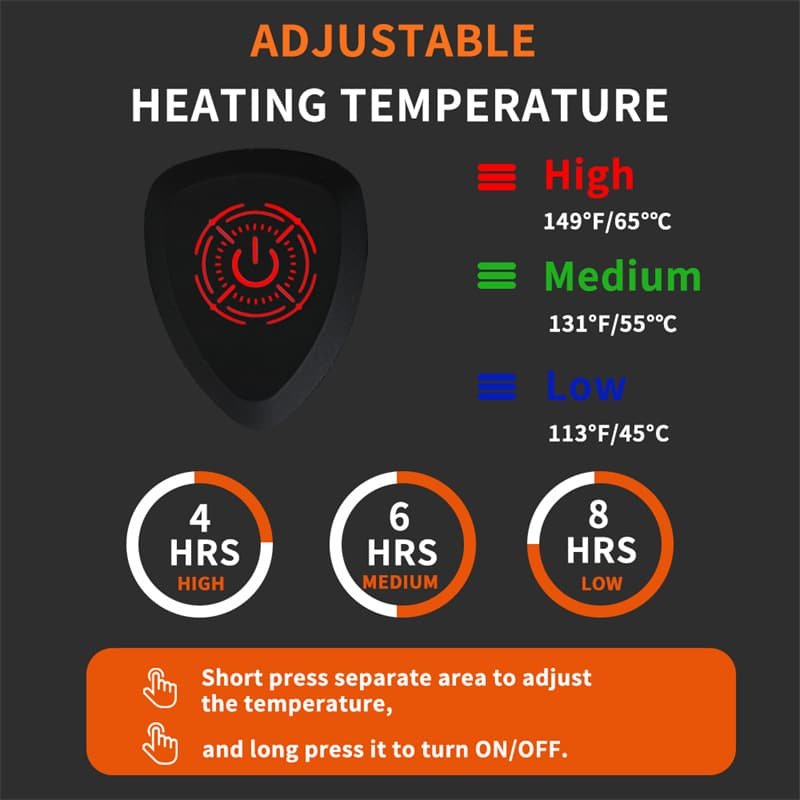
| Heat levels | 3-level adjustable |
| Heating element | Carbon fiber / graphene / metal fiber (model dependent) |
| Heating zones | Toe / forefoot / sole / extended full-foot (customizable) |
| Working temperature | 40–70°C, model specific (see product spec sheet) |
| Waterproof rating | IPX4 standard / IPX5 optional (where applicable) |
| Charging | Magnetic / USB / DC (model dependent) |
| Warranty | 12 months |
| Certification | CE / RoHS / FCC / UKCA / UL1642 / UN38.3 / IEC60335 / CCC / TUV / ETL |
Voltage is the line buyers misread most often. A lower-voltage and a higher-voltage system can both produce comfortable warmth, because the element resistance and the controller do the rest of the work; voltage describes the architecture of the pack more than it describes warmth. What it changes in practice is cuff weight, how fast the sock warms up and how much coverage the system can sustain. Our notes on battery capacity for heated socks cover how capacity and voltage work together.
Heating zones and waterproof rating are the other two lines worth fixing early. Toe and forefoot heating is the most common layout because toes feel cold first, and it draws less power than a sole or full-foot design; broader coverage warms more of the foot but asks more of the battery and adds cuff weight. Waterproof rating describes the electronics and the battery pocket, not the knit, and a supplier who blurs that line is likely to blur others.
Heated Socks or Ordinary Thermal Socks?
Buyers usually ask whether the electronics are worth it at all, so it is worth answering plainly.
Ordinary thermal socks rely on insulation — wool, fleece blends or synthetic yarns — and trap heat the foot already produces. They are light, inexpensive, need no charging and wash without ceremony, but they cannot add warmth: if the feet are already cold, or the wearer is standing still in freezing air, an insulating sock only slows the loss.
Rechargeable heated socks add a battery, a heating element and a controller. They generate warmth on demand, hold a set temperature and target the toes where it matters most, in exchange for charging, a little extra cuff weight and more specific care.
The choice comes down to exposure time and how much the wearer moves. For short walks in moderate cold, thermal socks are the sensible answer. For skiing, winter hunting, motorcycling, camping, outdoor work and long shifts — wherever the wearer is stationary or exposed for hours — active heating is the difference between finishing the day outside and leaving early. Many brands carry both and position them by scenario rather than by price; for the full comparison instead of this summary, see heated socks versus regular thermal socks.
How Long the Heat Lasts in Freezing Conditions
Runtime is the number buyers ask about first and the hardest to state honestly, because it depends on how the socks are used rather than on the pack alone.
- Heat level. The lowest setting always runs longest; a wearer who warms up on high and drops to low gets far more hours than one who stays on high all day.
- Heating coverage. A toe-only zone draws less power than extended full-foot heating from the same pack.
- Ambient temperature. Cold reduces the usable capacity of any lithium pack, so an indoor bench test tells a buyer nothing about a morning at minus fifteen.
- Sock and boot insulation. Good insulation holds the generated warmth and lets the socks run at a lower setting; a thinly insulated boot forces a higher setting and shortens the shift.
- Battery weight against capacity. A bigger pack adds hours and cuff weight at the same time, so the ceiling is set by comfort as much as by energy.
Wearers can stretch a pack without changing the specification: charge both cells fully before going out, warm the boots before stepping outside, drop to a lower level once the feet are comfortable, switch off indoors and keep the battery pockets closed. For long shifts a matched spare set beats a larger pack, because it can be swapped without changing how the sock fits.
For sourcing decisions, ask for runtime measured at every heat setting, with the battery voltage and capacity, the zone size and the ambient test temperature stated alongside — a short request whose answer tells you a great deal about the supplier.
Fit, Materials and Comfort Inside a Boot
Fit is the specification most often left to the last minute, and the one that generates the most returns.
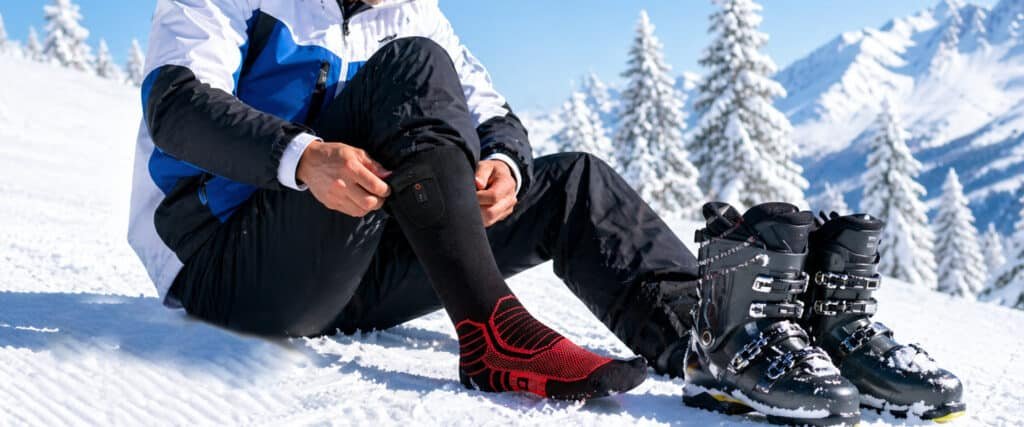
Size and pressure. A heated sock has to fit closely without compressing the toes or squeezing the calf. One that is too small stretches the internal wiring and crowds the foot inside the boot; one that is too large folds and puts repeated pressure on the same part of the element. Smooth the sock before putting footwear on, because wrinkles become pressure points.
Thickness inside fitted boots. Thicker is not automatically warmer. In a fitted ski boot or a riding boot, an over-thick sock can compress the foot and cut circulation, which makes feet colder rather than warmer. Slim constructions usually outperform thick ones wherever boot volume is tight.
Yarn and moisture. Wool, cotton, polyester, nylon, spandex and custom blends are all used, and the right choice depends on warmth, moisture management, stretch and product positioning. Moisture management matters more in a heated sock than in an ordinary one, because a wet foot loses heat faster and the element has to work harder to compensate.
Battery pocket comfort. The pocket should hold the pack against the calf without pressing on the ankle or sitting inside the boot, and the closure should stay shut through a full day of walking. Carrying the sock by the battery wire is the fastest way to damage the connector.
Which Model Suits Which Use Case
Heated socks sell across buyer groups with very different priorities, and the specification that wins one group can lose another.
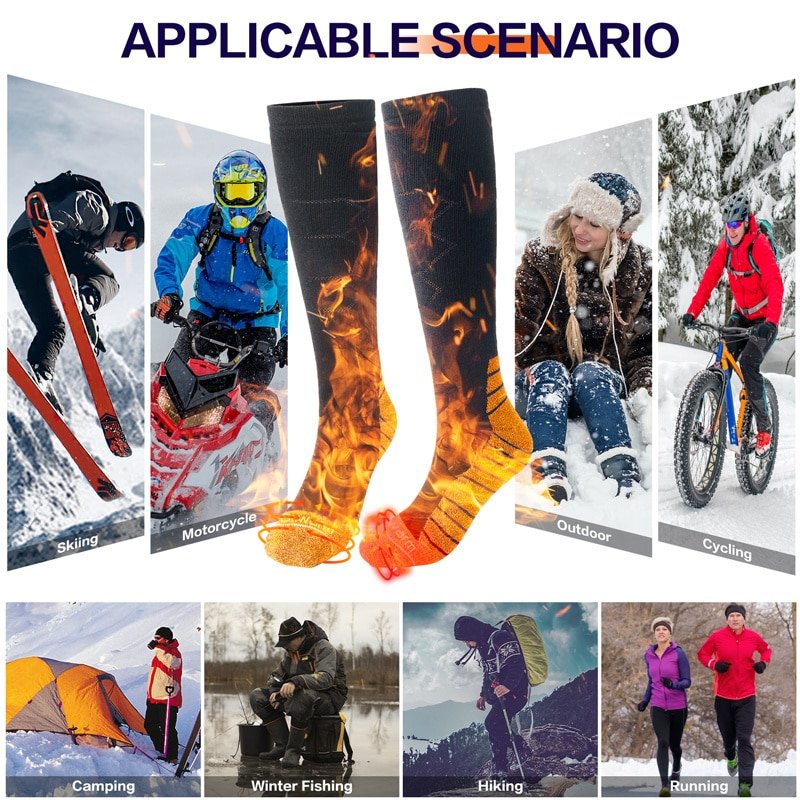
- Skiing. Slim elements, moisture-managing yarns, secure battery pockets and minimal internal seams, with a close but non-restrictive fit for a rigid boot. Peak temperature matters less than steady warmth through a long day on the lifts.
- Winter hunting. Long sessions standing still with little body heat. Long runtime on the low and medium settings, quiet materials, low-profile packs and a remote that can be used without opening a boot.
- Motorcycling. Rapid heat loss from wind, especially at the toes. Stable medium and high heat, a tall construction, slim elements and packs small enough not to interfere with riding boots or trousers.
- Camping and everyday winter use. Adjustable warmth, comfortable insulation and simple controls. Everyday models should stay light, use neutral colours and work with ordinary winter footwear rather than only with technical boots.
There is no single best model for every activity: the strongest product is designed around one clearly defined scenario, and a range is built by varying heating zone, sock height, battery and control rather than by chasing a headline temperature. The heated sock collection we manufacture shows how those variations come together.
Waterproofing, Washing and Care
Care instructions decide whether the second winter is as good as the first, and heated socks are washed far more often than any other heated product.
First, a word on waterproofing. Not all heated socks are fully waterproof. Most use moisture-managing yarns and water-resistant battery pockets rather than a sealed construction, so product copy should distinguish clearly between moisture-wicking, water-resistant, splash-resistant and waterproof. The battery, connectors and controller need protection even when the knit tolerates moisture.
- Remove the power first. Switch off, disconnect both batteries, remove any detachable controller, close the pockets and check the connectors for damage. Never put a battery or a charger in water.
- Follow the care label. Some models take a gentle machine wash inside a laundry bag and others are hand wash only; the method depends on the yarn, the wiring and the connector construction.
- Avoid bleach, strong solvents, aggressive brushing, hot water, dry cleaning and hard wringing. Press excess water out gently instead of twisting the sock.
- Air dry completely in a ventilated spot, away from radiators, open flames and heated drying cabinets, and do not reconnect the power until the sock and the connector are fully dry.
- Store correctly between seasons. Clean and dry, batteries removed, no sharp folds, connectors kept away from metal objects, and the pack left at partial charge.
Safety and Avoiding Discomfort
A heated sock is a low-voltage product, and the safety rules are simple enough to print on the care card.
- Choose the correct size and wear the sock smooth, without folds or bunches.
- Insert the battery fully into its pocket and secure the closure; the pack should not press on the ankle, sit inside the boot or hang on the connector wire.
- Start on the lowest setting and move up only if needed; heat tolerance varies widely between wearers.
- Use footwear with enough room for the sock. A thick sock in a tight boot is uncomfortable even when the system is working perfectly.
- Use only the battery and charger supplied with the sock, and keep the connector and charging port dry.
- Stop using the socks if you notice a single hot point, a chemical smell, a swollen pack, a melted connector, intermittent heating or exposed wiring.
For brands, the safety case is a design case: over-temperature protection, short-circuit protection, over-charge and over-discharge protection, stable controller output, heating-uniformity testing, connector durability and flexing and aging tests are the items to confirm before the first order rather than after the first return.
Troubleshooting: When They Fail to Heat Up
Most dead-sock complaints turn out to be one of a handful of causes, and a support script that works through them in order resolves the majority without a return.
- The batteries are not fully charged. Charge both cells on the specified charger. If one sock works and the other does not, swap the left and right batteries: if the fault follows the pack, the pack is the problem.
- The connector is loose. Movement around the calf works plugs loose over time. Check that the plug is fully inserted, that the connector is clean and dry and that the battery pocket is properly closed, and never force a plug that does not match.
- The pack is in protection mode. A battery-management system stops output when it detects abnormal voltage, current or temperature. Disconnect it, let it rest and reconnect according to the instructions.
- The sock or the connector is wet. Moisture interrupts electrical operation. Remove the packs and air dry completely; do not test, charge or reconnect a damp system.
- The element is damaged. Sharp folding, over-stretching or aggressive washing can break internal connections. One warm patch, heat that stops when the foot moves, or a large left-right difference all point to element damage.
- The wrong charger is in use. A plug that fits may still carry the wrong voltage, current or polarity.
Designing for fewer failures is the better answer, and it is mostly a matter of element integration, blind stitching, sealed connectors and a wiring route that survives flexing — a manufacturing decision rather than an after-sales one. See how we build and test on our factory page.
OEM, ODM and Private-Label Options
For brands and distributors the decision usually ends with a custom programme rather than a catalogue order, and the parts that can be specified are broader than most first-time buyers expect.
- Heating system. Toe, forefoot, sole or extended coverage, the element material, output levels and the temperature-control logic.
- Construction. Cotton, wool, polyester, nylon, spandex or custom yarn blends, sock height, size range and reinforced heel and toe structures.
- Battery and control. Capacity, pack shape, pocket position, charging interface, and button, remote or app control with custom controller programming.
- Branding and packaging. Knitted or printed logos, labels, instruction sheets, battery markings, colour boxes, carry bags and gift packaging.
Our standard terms are straightforward: stock from 1 unit, OEM from 100 units and ODM from 500 units, sampling in 7 to 30 days and mass production within 45 days, and a standard manufacturer warranty. A useful enquiry states the target country, the intended activity, the estimated quantity, the required heating areas and runtime target, the preferred control method, the materials and sizes, the logo files, the packaging requirements, the compliance documents needed and the target delivery date. Battery development and certification support are handled in house — see the battery solution page — and the full service scope starts with OEM and ODM services.
Frequently Asked Questions
Can heated socks be worn directly against the skin?
They can, and many wearers do, but a thin liner sock underneath usually gives a better result. The liner absorbs the moisture that a heated yarn cannot, keeps the skin away from any seam edge and means the heated sock itself needs washing less often. Wearers who prefer the sock against the skin should look for a smooth inner surface and flat seams, and should start one level lower than they would over a liner.
Can the battery in heated socks be replaced?
On most rechargeable designs the pack is detachable and can be replaced on its own, which is why spare pairs are a common add-on for workwear and long outdoor use. A built-in pack is more discreet but takes the whole sock out of service when the pack reaches end of life. Replacement packs must match the voltage, connector and controller of the original, so it is worth confirming that the part will stay available before committing to a range.
Can heated socks be worn in normal shoes and trainers?
Yes, provided the sock is slim enough not to crowd the shoe. Everyday models are built for this, with low-profile packs, soft yarns and a modest heating zone; technical ski and hunting socks are usually too bulky for a trainer. The battery has to sit outside the shoe, which is why everyday designs favour a small pack on a low cuff or a clip that sits above the ankle.
Do heated socks work with a partly charged battery?
They will run, but output and runtime both fall as the pack discharges, so a partly charged pair is not a reliable way to judge how warm the socks get. It also matters when testing: two socks on different charge levels will not heat evenly, and a left-right difference in warmth is far more often a charging difference than a fault.
Can heated socks be repaired if the heating element stops working?
A damaged element or internal wiring is not a user-serviceable repair, because the knit has to be opened, so it should be inspected by the supplier or a qualified technician. Batteries and connectors are different: a worn pack or a damaged cable can usually be replaced without touching the sock, which is one practical reason to choose a design with a detachable pack and a replaceable cable.
How do I keep heated socks from slipping down inside a boot?
Start with the right size, because a sock that is too large will always work its way down. Beyond that, look for a graduated cuff, a wide elastic band above the calf rather than a narrow one, and a battery pocket set high enough to anchor the top of the sock. Smooth the sock before putting the boot on, and never pull it up by the battery wire, which both loosens the cuff and stresses the connector.
Heated socks are judged inside the boot rather than on the shelf, so the discipline is simple: define the scenario, fix the heating zone and the pack, test inside the footwear your customers actually wear, and publish care and safety rules that a wearer will follow. If a specification review would help before your next order, our engineering team can work from your tech pack or from scratch.