
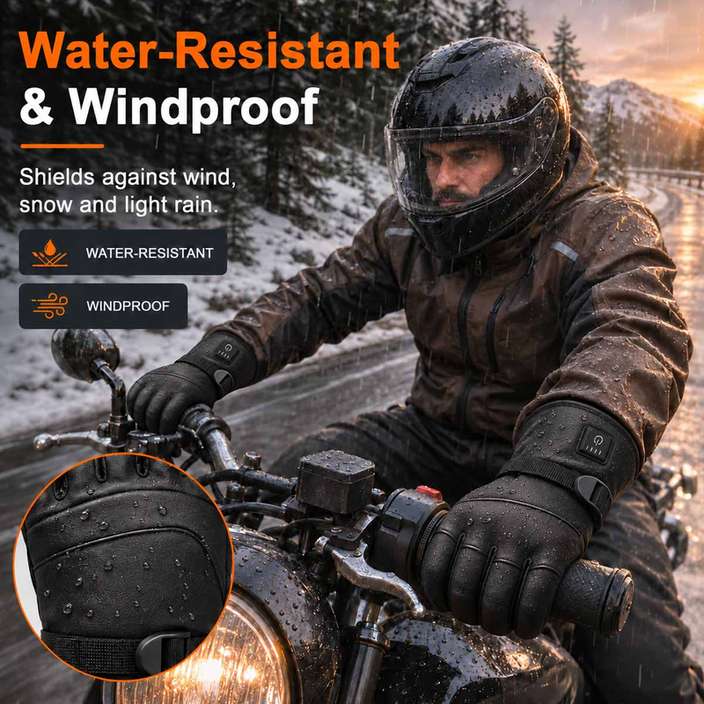
Quick answer: Heated gloves are water-resistant, not waterproof in the submersible sense. IPX4 is standard and IPX5 is optional. To keep the heating elements working, remove the batteries before cleaning, never wring or twist the gloves, air-dry them fully, keep the charging port dry and store them with the lead unstressed.
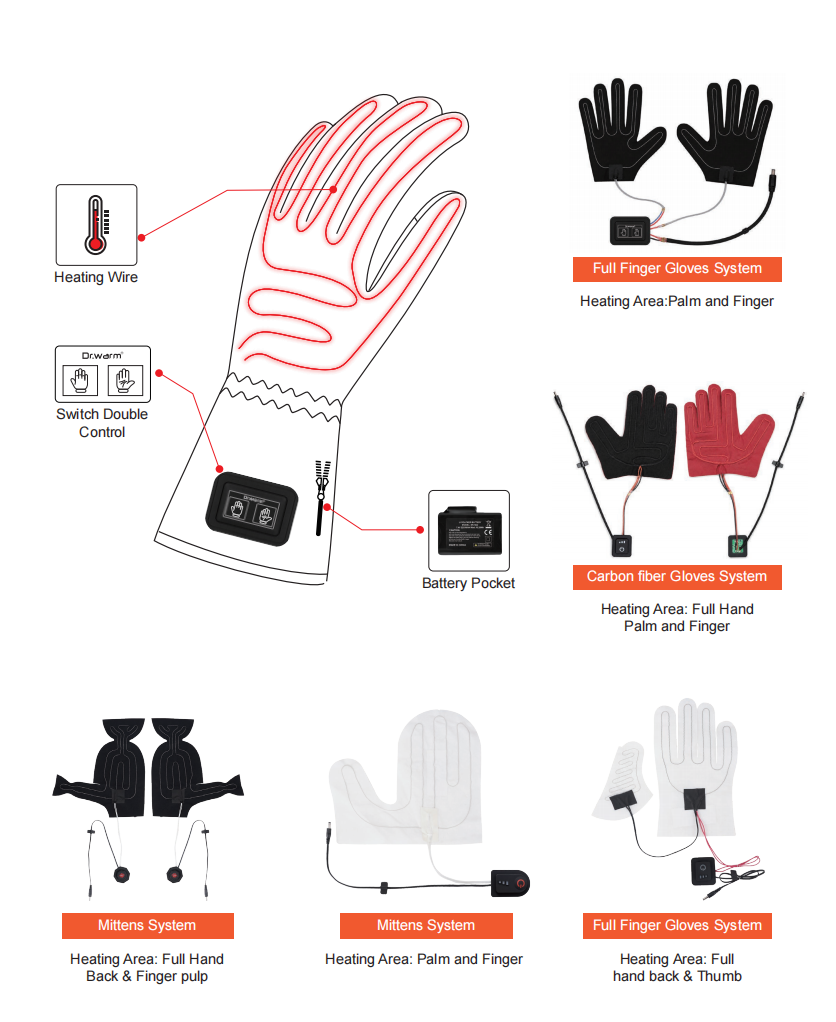
The element in a glove runs through the fingers, so the two things that shorten its life are repeated bending at the knuckles and moisture reaching the connector. This guide covers the care routine and the construction details that make it easier. For fault diagnosis, see why heated gloves stop heating.
What “Waterproof” Means on a Heated Glove
The shell fabric and membrane resist rain and snow; the electrical system does not tolerate immersion. IPX4 covers splashing water from any direction, while IPX5 covers low-pressure water jets. Neither rating covers connecting power while the port is wet, and neither means the glove can be soaked in a sink. Snow melting into the cuff is a far more common real-world problem than heavy rain.
When evaluating a sample, check where the battery lead exits the cuff, whether the connector has a cover, and how the wire is sealed where it enters the fabric. Those three points decide how the glove behaves after a season of use.
It is worth separating the shell from the system when writing a product listing. “Water-resistant shell” is accurate for an IPX4 or IPX5 garment; “waterproof” implies immersion that no charging port can tolerate. Retailers who use the precise wording see fewer returns after wet-weather use, because buyers understand from the start that the connector needs to stay dry.
| Rating | What the test covers | What it does not cover |
|---|---|---|
| IPX4 (standard) | Splashing water from any direction | Immersion, or connecting power with a wet port |
| IPX5 (optional) | Low-pressure water jets | Soaking, machine washing with batteries fitted |
| Care label | The cleaning method approved for that exact model | A different model in the same range |
Cleaning Routine That Protects the Elements
| Step | What to do | Why |
|---|---|---|
| 1. Power down | Switch off and remove the batteries | Prevents any current while moisture is present |
| 2. Protect the connector | Close the port cover or seal it as the care label instructs | Keeps water out of the contact area |
| 3. Clean gently | Wipe with a damp cloth or hand-wash following the label; no bleach, no soaking | Avoids stressing bonded elements and adhesives |
| 4. Never wring | Press water out with a towel instead of twisting | Twisting is what breaks a wire at a knuckle |
| 5. Air-dry fully | Dry at room temperature, away from direct heat | No machine dryer; heat and tumbling damage the wiring |
| 6. Reconnect last | Only power up once the port and fabric are completely dry | Prevents protection-mode shutdown and corrosion |
Never machine-dry a heated glove. The combination of heat and tumbling is harder on the element than an entire season of wear. Care instructions should be printed in the manual and on the care label in your market’s language — this is one of the most common return categories that clear guidance prevents.

Drying, Storage and Inspection
- Store the gloves flat or loosely rolled; do not fold them sharply at the fingers.
- Leave the battery lead unstressed and the connector capped during the off-season.
- Keep batteries separate, and do not store them fully discharged for long periods.
- Inspect the finger zones for a hard lump, a displaced element or exposed wiring before each season.
- Check the control button and the port for corrosion after any wet outing.
Warranty on finished products is 12 months and cells are rated for 500+ charge cycles. If you notice a swollen battery, a burning odour, a melted connector or a sudden change in heat output, stop using the gloves and do not recharge them. The overheating safety guide lists the full set of warning signs.
Why Construction Matters More Than a Care Label
For retailers, wash-related returns are usually a design outcome. Ask for strain relief at the cuff, sealed wire entry, connector retention testing, flex testing at the finger joints after repeated wash cycles, heating-uniformity testing and IPX4 or IPX5 verification. Overcharge, over-discharge and short-circuit protection, over-temperature cutoff, battery and charger compatibility and final aging inspection complete the checklist.
Most gloves use a 7.4V platform with an 8.4V / 1.5A charger; compact accessories use 3.7V with 5V / 2A. Battery capacity is configured to the order, not fixed. UN38.3 documentation is required for lithium battery transport, and the SDS is a shipping document, not a certification. For OEM programmes the MOQ is 100 pieces, full ODM 500 pieces, sampling 7-30 days and OEM production 20-25 days; see bulk glove OEM and USB vs 7.4V platforms.
Frequently Asked Questions
Are heated gloves waterproof?
Heated gloves are water-resistant, not submersible. IPX4 is the standard rating and IPX5 is available as an option. The shell resists rain and snow, but the charging port must be dry before connecting power, and the gloves should never be soaked or machine-washed with the batteries installed.
How do I clean heated gloves?
Remove the batteries first, close or protect the connector, wipe or hand-wash gently following the care label, and never wring or twist the gloves. Allow them to air-dry completely before reconnecting power.
How do I extend the life of the heating elements?
Avoid twisting or crushing the gloves when wet, store them flat or loosely rolled with the lead unstressed, keep the connector clean and dry, and inspect the finger zones and cuff lead regularly for damage.
What should a bulk buyer check about water resistance?
Ask for the IPX4 or IPX5 verification method, connector protection details, flex testing at the finger joints after wash cycles, and evidence that the element and wiring are sealed from moisture ingress.
Writing a care guide for your glove line? Ask us for the model-specific instructions to put in your manuals.