
Quick answer: Gloves fail differently from jackets. The heating wire runs through fingers that bend thousands of times a day, the battery lead exits at a cuff that gets pulled during every wear, and the whole product lives with snow, sweat and friction. When a heated glove stops heating, check the cuff lead and connector first, then moisture, then the finger-joint wiring — before assuming the battery is dead.
This guide focuses on those glove-specific failure points. For general electrical behaviour see our heating system guide; for safe operation see the overheating safety guide.
1. The Cuff Lead and Connector Come Loose First
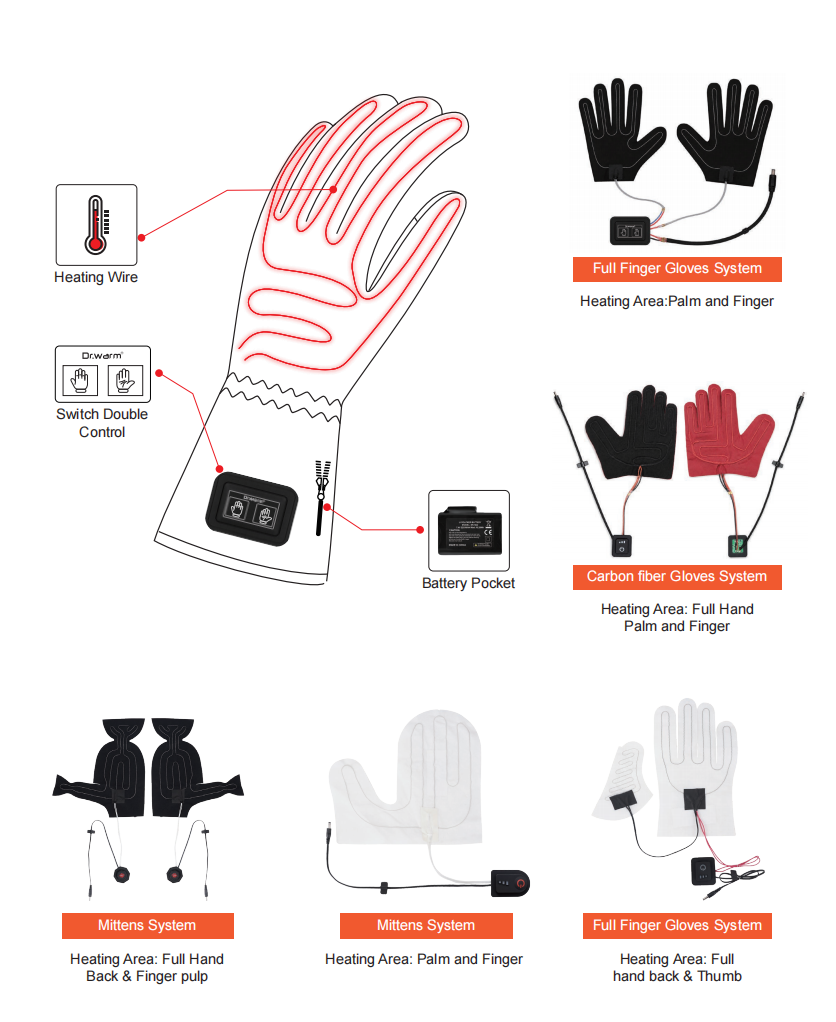
Every time a glove is pulled on, the cable from the battery pocket to the element is tugged. Over a season that can work a connector partly out of its seat or fatigue a wire at the strain-relief point. Symptoms are intermittent heat, one glove cutting out when the wrist bends, or no heat until the cuff is squeezed.
- Switch off, remove the battery and reseat the connector firmly.
- Inspect the lead where it exits the cuff for a kink or a hard bend.
- Look for corrosion, a bent pin or moisture in the port.
- Do not charge or power the glove while any moisture is present.
2. Moisture and the Charging Port
IPX4 is the standard water-resistance rating for heated gloves, with IPX5 available as an option. Neither rating covers connecting power while the port is wet. Snow melts into the cuff, condensation forms inside a glove stored in a car, and a damp port can push the controller into protection mode or stop output altogether. Let the gloves and connector area dry completely before charging, and never charge wet gloves.
3. Controller Protection Mode and the Battery
If the glove is damp or a short is detected, the controller may shut down output until power is cycled. Switch off, disconnect the battery, let everything dry, then reconnect. If there is still no heat, check the battery with the matched charger — most gloves use 7.4V with an 8.4V / 1.5A charger, while compact accessories use 3.7V with 5V / 2A. Using the wrong charger can cause underheating or unstable output.
| Platform | Typical glove use | Charger output |
|---|---|---|
| 7.4V | Most full-finger heated gloves and liners | 8.4V / 1.5A |
| 3.7V | Compact heated accessories | 5V / 2A |
| 5V USB | Power-bank based accessories | 5V / 2A or 5V / 3A |
Battery capacity is configured to the order rather than fixed, so a replacement pack must match the original specification. A swollen battery, a burning odour or a melted connector means stop using the product — do not recharge it.
4. Heating-Wire Fatigue at the Finger Joints
Unlike a vest or jacket, a glove element flexes at every knuckle. A break here usually shows as one cold finger, a cold thumb, or heat on the back of the hand but not in the fingers. There is no safe field repair: opening the element or splicing a wire changes the resistance and the safety behaviour of the circuit. The glove should be inspected or replaced under the 12-month warranty.

Glove-Specific Diagnostic Order
| Symptom | Most likely glove-specific cause | First check |
|---|---|---|
| One glove cold, the other fine | That glove’s lead, connector or element | Swap the battery/lead between gloves to isolate |
| One finger or thumb cold | Wire fatigue at a knuckle | Stop use; inspect or replace under warranty |
| Heat cuts out when the wrist bends | Loose cuff lead or failing strain relief | Reseat connector, inspect the cable exit |
| No heat after snow or washing | Moisture in the port; protection mode | Dry fully, cycle power, then recharge |
| Heat weaker than last season | Wrong charger, degraded cell, or high setting in mild weather | Check charger spec and heat level |
How Manufacturers Reduce These Failures
For retailers and brand owners, the return rate is decided at the design stage. Ask the factory for flex testing at the finger joints, connector retention testing, strain-relief detail at the cuff, IPX4 or IPX5 ingress verification, heating-uniformity testing, overcharge/over-discharge/short-circuit protection, over-temperature cutoff, battery and charger compatibility and final aging inspection. UN38.3 documentation is required for lithium battery transport; the SDS is a shipping document, not a certification.
Buyers commonly request CE, UKCA, UL, FCC, RoHS, Reach, DOE and ISO 9001, plus GB 47372-2026 with CCC on the battery; see what each covers. Certificate holder is Dongguan S-KING Limited and production is by Dongguan Ditewang Intelligent Technology Co., Ltd. For OEM enquiries the MOQ is 100 pieces (500 for full ODM), sampling takes 7-30 days and OEM production 20-25 days — see bulk glove OEM.

Frequently Asked Questions
Why did my heated gloves stop heating?
Start with the glove-specific causes: a battery lead pulled loose at the cuff, a bent or corroded connector, moisture in the charging port, or a heating wire that has fatigued at a finger joint. Check the battery charge and the controller mode next, then inspect the wiring route through the fingers.
Why is only one glove heating?
On a two-glove system, a single-side failure usually points to that glove’s lead, connector or element rather than the battery. Swap the battery or lead between gloves to isolate the fault; if the problem follows the glove, the element or wiring needs inspection.
Can I repair heated gloves myself?
You can clean and reseat connectors, dry the port fully and check for a loose lead. Do not open the element, splice a wire or bypass the controller — the circuit should be inspected or the glove replaced under warranty.
How can a bulk order reduce these failures?
Specify strain relief at the cuff, flex testing at the finger joints, connector retention, IPX4 or IPX5 ingress protection, battery and charger compatibility and final aging inspection. Ask for these test results before sample approval.
Seeing repeat failures in a retail batch? Send us the symptom and model and we will share the relevant test checklist.