

Most factory audit guides are written for clothing. They tell you to check fire exits, overtime records and stitch density. Those checks matter — but they will not tell you whether the factory can build a heated garment that survives two winters, because the components that decide that are not on the sewing floor.
A heated apparel audit has to answer a different question from a standard garment audit: can this factory build, test and control the electrical side? That is where first orders go wrong, and it is what this guide covers.
Why a Standard Clothing Audit Is Not Enough
A heated garment is a garment plus an electrical system. Roughly, the bill of materials splits into three parts: the textile (shell, insulation, lining), the heating system (elements, wiring, connectors) and the power system (battery pack, BMS, charger).
A conventional audit evaluates the first part thoroughly. On the other two, a general auditor has neither the checklist nor the instruments to form a view — so the audit passes, the order ships, and the failure appears six months later in the field as a dead zone, a swollen pack or a garment that stopped heating after the third wash.
The audit that catches those outcomes looks at four things a clothing audit does not:
- Whether the electrical work is genuinely in-house or subcontracted without disclosure.
- Whether there is a laboratory, and what it can actually measure.
- Whether test records exist as documents rather than as claims.
- Whether the battery supply chain is traceable.
Before the Audit: Preparation That Saves a Wasted Trip
An audit without a defined decision is a factory tour. Before you travel, settle three things.
Decide what the audit is for. Are you confirming a supplier you have already selected, or choosing between two? A confirmation audit can be focused; a selection audit needs comparable data across candidates, which means the same checklist applied the same way.
Define the product scope precisely. “Heated jacket” is not enough. Element type, heating zone layout, system voltage, pack capacity and waterproofing requirement all determine which production lines and test equipment are relevant. A factory set up for 7.4V gloves is not automatically set up for a 12V jacket with four heating zones.
Request documents in advance — and verify them independently. Ask for these before you visit, so you can check them against public registries while you still have time to act:
- Business licence and registration, with the legal entity name matching the name on the quotation, the contract and the bank account
- Quality management certification with certificate numbers you can verify at the issuing body
- Product certifications relevant to your target market, with scope covering your product category
- Test reports for the materials and components you intend to order
The single most useful early check is a mismatch hunt. If the legal entity on the licence, the entity on the quotation and the entity receiving payment are three different names, you are dealing with a trading company or an intermediary — which is not automatically a problem, but it is a problem if it was presented as a factory.
On the Floor: What to Look At
Walk the floor with the electrical process in mind, and ask to see specific stations rather than following a prepared route.
The battery assembly area
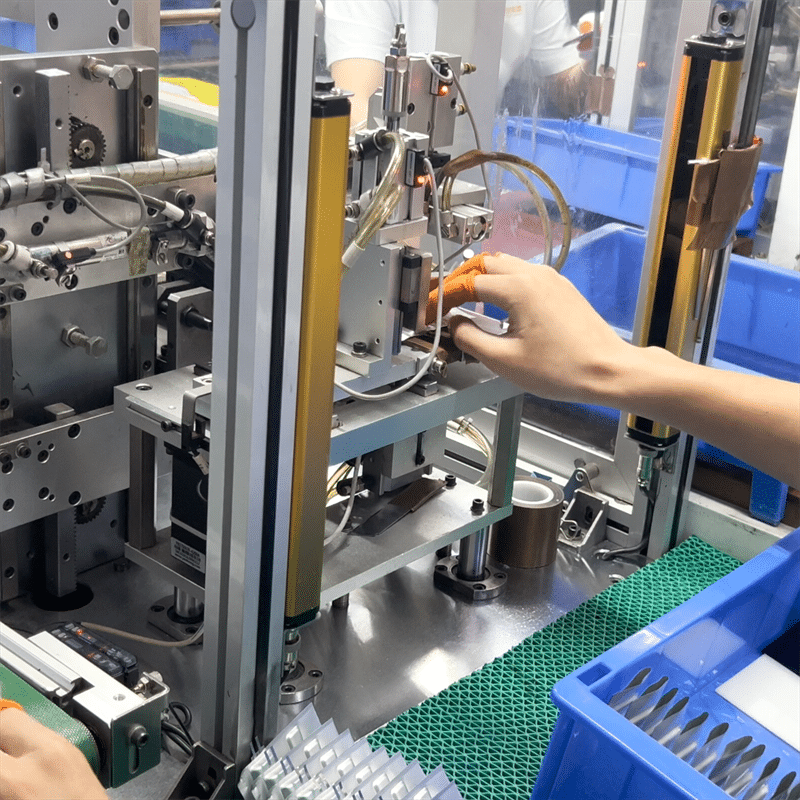
This is the first station a clothing auditor has no reason to visit, and the most informative one. What to look for:
- Spot welding or soldering of cells into packs, done as a defined operation rather than improvised. Cell-to-cell connection consistency is one of the main differences between a pack that performs as specified and one that drifts.
- BMS boards being installed as a standard step, not added on request. Ask how the board is matched to the pack and who specifies it.
- Separation from the general production floor. Battery assembly has different fire-risk and handling requirements from sewing; a factory that treats it as one more bench is telling you something.
- Traceability at pack level. Can a finished pack be traced back to a cell batch? If not, a field failure cannot be investigated, only replaced.
The heating element area
Ask how elements are cut, positioned and fixed into the lining. The relevant question is not whether the element is carbon fiber or wire — both are standard — but how the factory controls placement and protects flex points. Elements fail at bends, at connection points and where the element meets the connector, so those are the three places to look.
In-line electrical testing
Look for a test station between assembly and packing where every unit is powered and checked. A factory that tests by sampling finished goods rather than testing every unit electrically is accepting that a proportion of defects will reach your customers.
In the Laboratory: Testing Capability
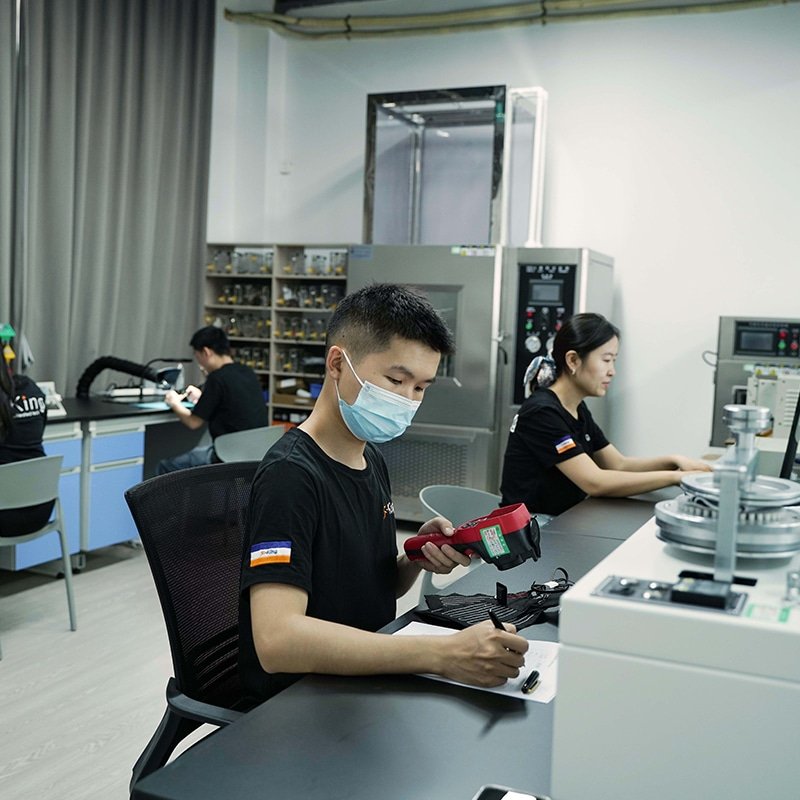
This is the part of the audit where heated apparel diverges most sharply from general garment auditing, because it requires instruments most clothing factories do not own.
| Capability | What it validates | What to ask for |
| Battery aging test | Capacity retention over charge/discharge cycles | Cycle test records, not just the machine |
| High/low temperature chamber | Performance and safety at operating extremes | Test parameters and results for your product type |
| Waterproof testing (IPX) | Seal integrity of elements, wiring and connectors | Rating held for your product — IPX4 as standard, IPX5 available |
| Wire bending test | Element and conductor survival under repeated flexing | Cycles tested and failure criteria |
| Thermal imaging | Heat distribution across the zones; detection of hot spots | Images from production units, not a demo sample |
| Battery and BMS design | Whether protection logic is specified in-house or inherited | Who defines the protection thresholds |
Two notes on reading this table. First, ask to see output, not equipment. A machine in the corner proves a purchase, not a practice; a set of dated test records with your product category in them proves a process.
Second, check the waterproofing claim carefully. A factory that quotes a broad rating range for everything it makes is not describing a product specification — it is describing a chamber’s capability. The product rating is what matters: for our own heated apparel, that is IPX4 as standard with IPX5 available on request. Anything wider should be treated as unverified until it appears on a test report for the product you are buying.
If you want to see how these map to market requirements, our certifications page lists the standards we build to and the markets they cover.
Documents and Records: The Paper Trail
Testing capability without records is unverifiable. Request these and check that they exist as actual files:
Component and material test reports for the specific items in your order — not a generic report for the product family.
Cell and pack documentation covering the cells used, the pack configuration and the protection design.
Certification documents with numbers, verifiable at the issuing body. A logo on a website is not a document.
Test records per production batch, showing what was tested and what the results were. This is where you find out whether testing happens routinely or was arranged for your visit.
Corrective action records. Every factory has defects. A factory with no defect records either has no defects, which is unlikely, or no system for recording them, which is worse.
The Audit Report: What to Write Down
Structure the report so a colleague who was not there can act on it. Four sections work:
1. Facts. What you observed, at which station, with photos or video. Keep interpretation out of this section.
2. Gaps against your specification. Not “the lab is small” but “the lab has no thermal imaging, so heat distribution claims for our zone layout cannot be verified in-house.” A gap is only meaningful relative to what you asked for.
3. Verified vs unverified claims. List every claim the factory made, and mark whether you confirmed it. This is the section that prevents a smooth presentation from becoming an unexamined assumption.
4. Decision and conditions. What you will do next, and what has to be true first — documents received, a second sample produced, a specific process changed.
If you cannot visit, the same structure works on a live video audit, provided the call is live and you direct where the camera goes. Ask for the battery assembly area, the test station and the lab, and ask them to open a record file rather than describing it. A prepared walkthrough along a set route tells you less than an unscripted request to go somewhere specific.
Manufacturer Insight
We are on the other side of these audits, and the pattern is consistent: the buyers who get the fewest surprises are not the ones who ask the most questions. They are the ones who ask for documents that can be checked, and then check them.
Two practical observations from our own operation.
The battery is where the audit has the most leverage, and where it is most often skipped. In our own production, battery packs are assembled and the BMS is designed in-house, which is why we can show protection thresholds rather than describe them. When a supplier cannot show you the protection design, it is usually because the design belongs to a third party — which means the supplier cannot change it when your market’s requirements change either.
Lab equipment is only as good as its output. Battery aging tests, high/low temperature cycling, waterproof testing and thermal imaging all exist to produce records. Ask for the records before you ask for the tour. You can read more about how we work in About Us.
Frequently Asked Questions
Can a heated apparel factory audit be done remotely? Yes, and for a first-order evaluation a live video audit covers more than most buyers expect — provided it is live rather than a prepared film, and you direct where the camera goes. Ask to see the battery assembly area, the electrical test station and the laboratory, and ask them to open a physical test record rather than describe it. What a video audit cannot verify is machine condition, stock levels or how the floor behaves when it is under production pressure, which is why an on-site visit is still worth the trip for larger first orders.
What is the single most important thing to check? The battery and its protection design. It is the component with the highest failure consequence and the one a general garment auditor is least equipped to assess. If a factory can show you the protection thresholds it designs to and the pack-level traceability that lets a field failure be investigated, most of the remaining risks are ordinary manufacturing risks that a conventional audit already covers.
Do I need a third-party audit for a first order? Not necessarily, but the decision should be deliberate. A third-party audit buys you a standardised report, a trained auditor and comparability across candidates. A self-conducted audit buys you direct observation of the specifics that matter for heated apparel — if you know what to look at. For a first order in a category you have not sourced before, the effective combination is usually your own visit focused on the electrical process, plus independent verification of documents at the source registries.
How long does an audit take? A focused on-site audit of the electrical process — battery assembly, element placement, test station, laboratory and document review — typically fits into one working day. Video audits usually run 60 to 90 minutes. What takes longer than the audit itself is the document verification before it, because that is where the discrepancies are found and where you still have time to act on them.
What if the factory refuses a visit or a live video call? Treat it as an answer. Factories genuinely producing heated apparel encounter these requests routinely and have a process for them. A consistent reluctance to show the floor, or a video call that is filmed rather than live, is one of the clearest signals available before money changes hands — and it is far cheaper to act on that signal now than after the deposit.
The Short Version
Audit the electrical side as deliberately as you audit the sewing floor. Prepare documents in advance and verify them independently, look at battery assembly and element placement rather than the showroom, ask for test output rather than test equipment, and write the report around verified versus unverified claims.
If you are still at the stage of narrowing down candidates, start with our nine checks before you sign with a heated apparel manufacturer — it covers the screening questions that come before an audit, so that the visit you book is with a candidate worth travelling to.