Battery life is one of the first things a buyer asks about and one of the last things a product team controls once a design is frozen. The runtime a user experiences is decided long before the pack reaches the customer: by the cell chosen, by the capacity built into the pack, by how the BMS handles cutoff, and by the heat output the element demands. After that, a short list of habits decides whether the pack delivers its rated capacity for two winters or five. This article is written for brands and product teams who want to know where the real levers are.
What Actually Ages a Lithium Pack
Lithium-ion cells do not fail suddenly. Their usable capacity fades gradually, through a combination of the following factors, and understanding which one is dominant tells you where to act.
Cycle count. Every full charge and discharge consumes part of the cell capacity. Shallow cycles are gentler than deep ones, which is why a habit of topping up between and after use is kinder than running the pack flat every time.
Calendar ageing. A cell loses capacity simply by existing, and it loses it faster when it is held at a high charge level in a warm place. A pack stored at a full charge in a hot warehouse over summer will arrive in winter weaker than one stored at a moderate level in the cool.
Temperature. Chronic heat is the single biggest accelerator of fade. Heat generated by the pack itself during use adds to ambient heat, which is why ventilation around the pack matters in the garment design, not just in the charger.
Voltage extremes. Resting at a very low voltage damages the cell and can leave it unrecoverable. This is the reason a BMS cutoff exists, and the reason a pack left flat for months may never come back.
Physical stress. Mechanical shock, a swollen cell, or water ingress shorten life and, in the worst case, create a safety problem rather than a runtime one.
Charging Habits That Add Cycles
The habits below are worth passing on to end users as part of your care instruction, because they cost nothing and change the outcome.
Charge before the pack is empty. Treat the low-battery warning as a prompt to charge, not an invitation to keep going. Habitual deep discharge is the fastest way to lose capacity.
Use the charger the product came with. A pack designed for one charge profile and fed by another is being managed outside its spec, and the on-board protection can only do so much.
Do not leave it on the charger indefinitely. Most packs stop charging when they reach full, but leaving them connected at a high state of charge for long periods still accelerates ageing.
Charge at room temperature. Charging a cold pack, or one that has just come off the snow, is hard on the cell. Let it come back to room temperature first.
Keep the contacts clean and dry. A poor connection can look like a healthy battery that is simply not delivering, and it is often the real answer to a runtime co
This image shows oscilloscope testing of a PCBA circuit used in heated gloves and heated apparel. The waveform measurement verifies signal stability, temperature control accuracy, and battery management performance. It highlights advanced OEM engineering validation processes for smart heating systems, ensuring reliable, safe, and efficient operation in heated clothing products.
laint.
Storage: Charge Level, Temperature and Time
For a seasonal product, storage is where a large share of the total capacity loss happens. Three variables decide it.
Charge level. Store somewhere in the middle of the range — around half charge is the usual recommendation. A pack left at one hundred percent sits at maximum electrochemical stress, while one left empty risks dropping below the point of recovery.
Temperature. Cool and dry, away from direct sun, radiators and unheated extremes. A stable indoor temperature is better than a garage that swings between below freezing and warm.
Time and check-in. Capacity falls slowly during storage, so a pack put away at half charge in spring benefits from a top-up back to about half every few months. This single habit is what separates a battery that works on the first cold morning from one that goes back for replacement.
A practical storage specification to give your customers is therefore straightforward: remove the pack, charge or discharge to roughly half, keep it dry at room temperature, and recharge it back to around half every few months during the off season.
How Product Design and Use Affect Runtime
Not all shortened runtime is the battery. Much of it is decided by the product itself, and these are the levers a brand or product team can actually pull.
Lever
Effect on runtime
Element power draw
A higher-output element runs shorter on the same pack; matching output to the intended use matters more than maximising it
Heat level behaviour
The number of levels and the way the highest one is used decides real-world runtime far more than the pack alone
Pack capacity
The most direct lever — capacity is customisable, so the pack is sized to the runtime target rather than the other way around
BMS efficiency
A well-designed protection and control board wastes less energy as heat before it reaches the element
Thermal insulation of the garment
Better insulation means the same heat output feels warmer, which lets the user run at a lower level
Ambient temperature
Cold reduces available capacity as well as increasing the demand for heat, which compounds the effect outdoors
The practical conclusion is that runtime should be treated as a design input, agreed at the specification stage, rather than discovered in field testing. If a product needs to run for a working shift at a given heat level, that is a pack sizing exercise backed by a temperature test, not a marketing claim.
Maintenance Guidance to Pass On to End Users
A short, clear care note in the box prevents most avoidable battery complaints, and it belongs in the product documentation rather than a website FAQ alone.
Remove the pack before washing or storing the garment, every time.
Charge to about half before putting it away for the season, and top it up periodically.
Keep the pack out of direct sun, off radiators and away from damp basements and sheds.
Never charge a visibly swollen, damaged or water-exposed pack; replace it.
Use the original charger and check that the plug and contacts are clean.
How We Design and Test for Battery Life
Because the pack is designed in-house, runtime can be built into the product rather than assumed. Dr. Warm has manufactured heated wearables since 2013, and our battery packs are developed alongside the heating element and the control board, so the capacity, the cutoff behaviour and the element output are matched to each other.
Capacity is customisable rather than fixed: common configurations run from around 2,200, 2,600, 4,000 and 5,000 mAh and above, and some garments, such as jackets and vests, can be specified to work with a 10,000 to 20,000 mAh USB power bank for extended runtime. Voltage is similarly configurable, from 3.7V and 5V USB packs through to 7.4V, 12V and 24V systems, and every pack is built with its own protection board and tested in our lab — battery ageing, temperature cycling and water resistance included. For the safety standards that sit behind this, see our overview of battery safety standards, and for the testing itself, how we test heated clothing.
Need a runtime target rather than a catalogue part? Tell us the product, the heat level and the hours required, and we will size the pack to match. Start from our heated apparel battery packs page,
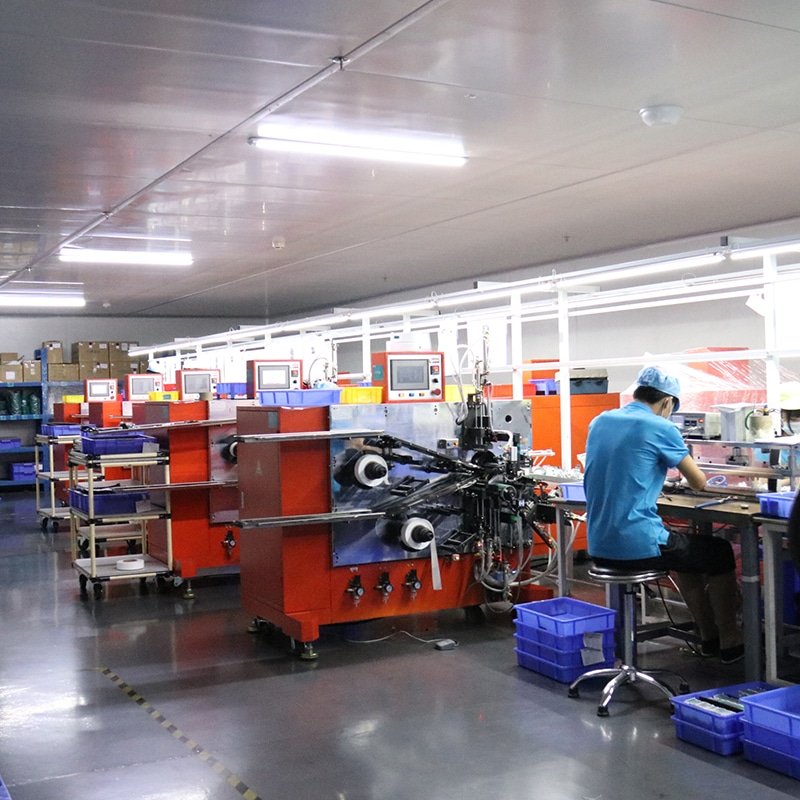
Automated production line manufacturing heating elements and electronic components used in heated apparel systems. The facility supports large-scale production of heated clothing electronics including heated jackets, heated gloves, heated socks, and heated insoles, integrating PCBA controllers, heating elements, and battery-powered heating technology for reliable wearable heating performance.
r send the brief through our OEM and ODM services.
Frequently Asked Questions
How long should a heated apparel battery last?
Runtime depends on the pack capacity, the heat level and the ambient temperature, so there is no single figure across a product range. The useful approach is to treat runtime as a design target: decide the hours required at a given heat level, then size the pack to deliver it, and verify it with a cold chamber test rather than an optimistic estimate.
What is the best charge level for storing a heated apparel battery?
Around half charge is the usual recommendation. A full pack sits under maximum electrochemical stress, while an empty one risks dropping to a voltage that the cell cannot recover from. Store it cool, dry and away from direct sun, and recharge it back to about half every few months while it is out of season.
Do heated apparel batteries lose capacity over time?
Yes, gradually, through both cycle use and calendar ageing. Shallow, regular charges are gentler than deep discharges, and avoiding chronic heat slows the fade most of all. A pack stored at a moderate charge in a cool, dry place, and topped up periodically, will hold its capacity noticeably better than one left full, flat or hot.