
Heated vests have become one of the fastest-moving categories in heated workwear and winter outerwear, and also the one buyers get wrong most often. A product listing can say “five heating zones” and “high-capacity battery” without telling you whether the vest will still be warm after four hours on a loading dock, or whether it can be worn under a shell without turning the wearer into a bulky layer.
This guide is written for two audiences at once: buyers who want to choose well, and the brands, distributors and importers who need to write a heated vest specification that a factory can actually build. Each section below maps to a line you can put in a tech pack or a supplier brief.
What Is Inside a Heated Vest
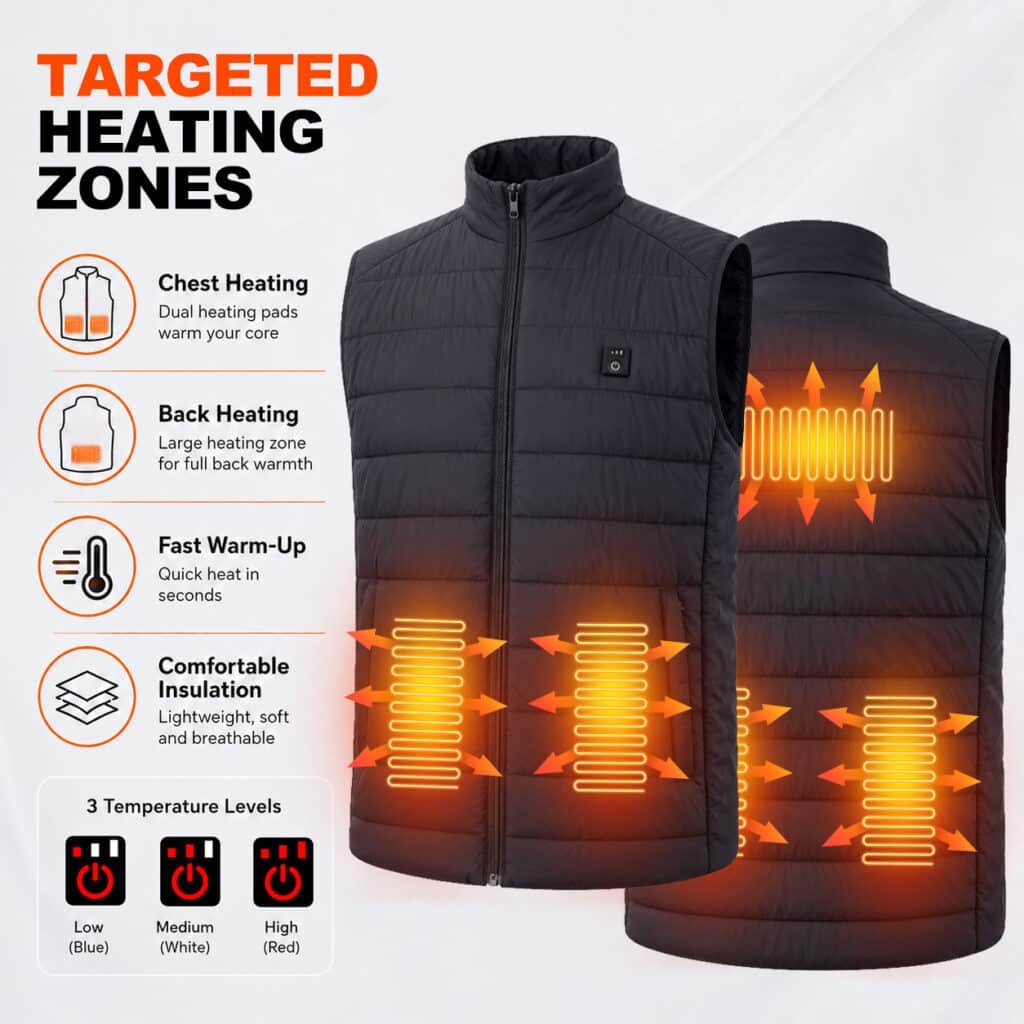
Every heated vest, whatever the branding, is built from four systems. Looking at them separately is the fastest way to compare offers that look identical on a catalogue page.
- Heating element. A flexible film or wire grid laminated behind a lining. Carbon fiber and graphene films are the two common formats; the choice changes how evenly heat spreads, how fast the vest reaches temperature and how well it tolerates folding.
- Wiring and connectors. The element has to reach the battery, and the connector is where most winter failures start. Sealed, strain-relieved connections survive repeated plugging far better than open ones.
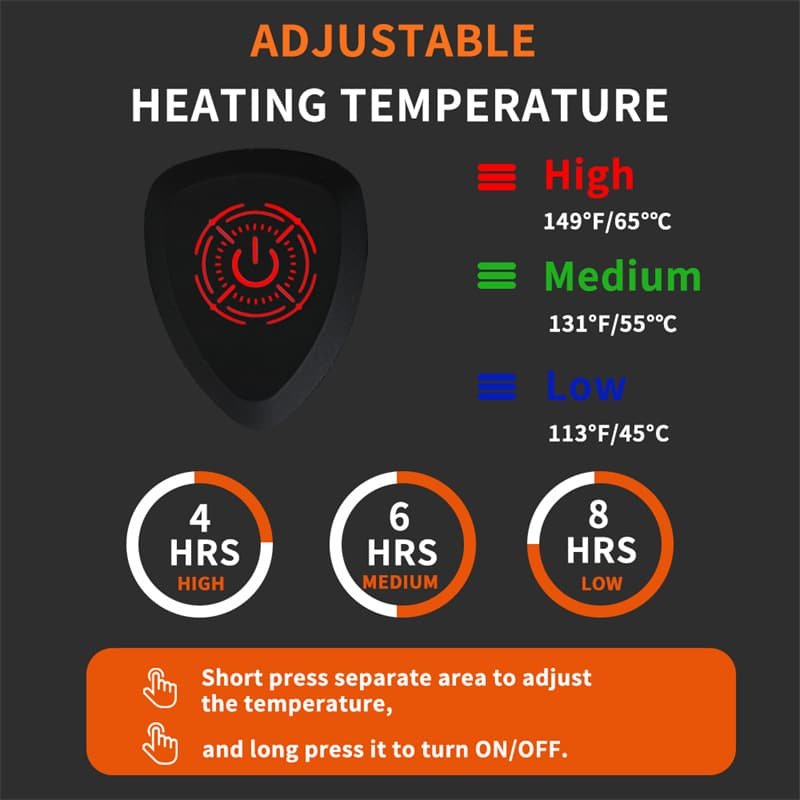
- Controller. A button controller on the chest or cuff is the simplest option; a remote or app controller adds convenience for wearers who keep the vest under a coat.
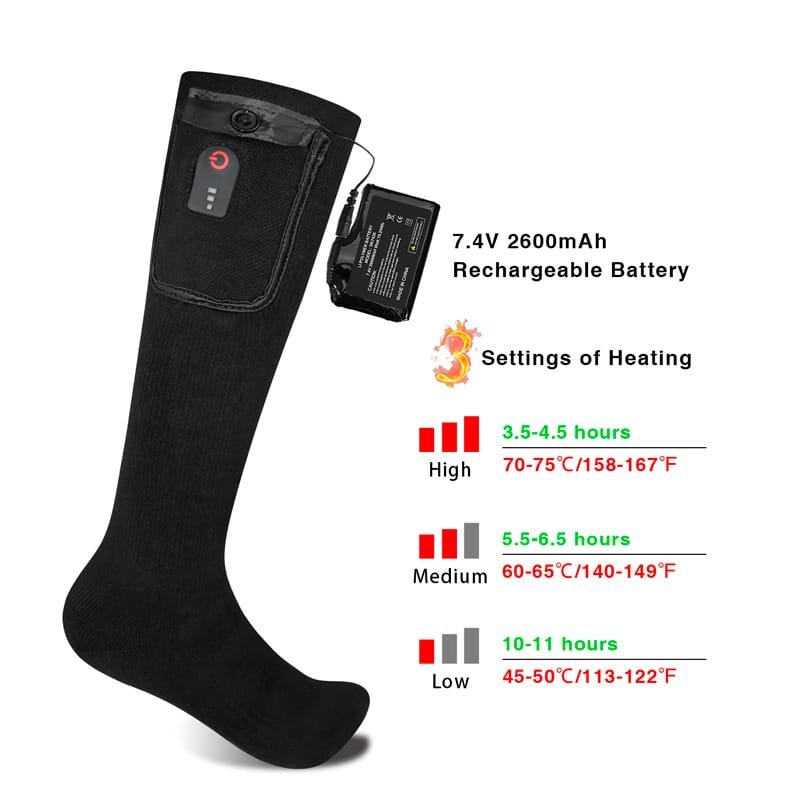
- Battery and mounting. A battery pack carried in an internal pocket keeps the cell warm, and a warm cell performs better in cold weather than one exposed on a belt.
Most heated vest faults trace back to the connector and the cable route rather than the heating film itself, which is why construction detail matters more than a headline wattage number. For a deeper look at the two element types, see our comparison of carbon fiber and heating film.
Key Specs to Compare: Voltage, Battery, Heat Levels and Waterproofing
Once you know what is inside, the comparison narrows to a short specification list. The table below shows the values we build to at Dr. Warm. Treat it as a reference line: if a supplier cannot state these values clearly, that is already an answer.
| Voltage options | 3.7V / 5V USB / 7.4V / 12V / 24V (customizable) |
|---|---|
| Battery capacity | 2200 / 2600 / 4000 / 5000mAh and above (customizable); a 10,000–20,000mAh USB power bank can also be used across our heated clothing range |
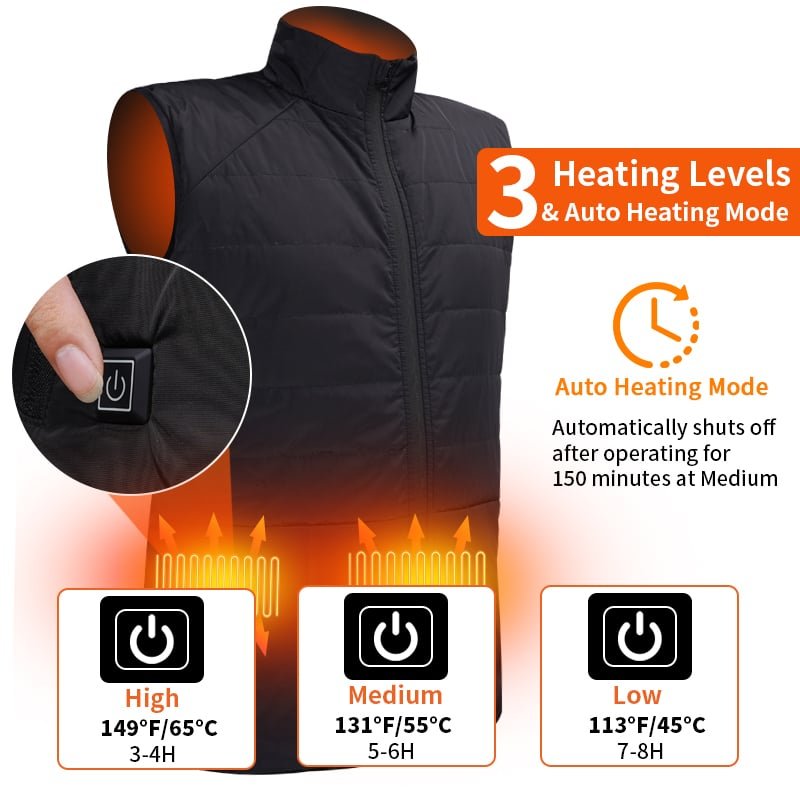
| Heat levels | 3-level adjustable |
| Heating element | Carbon fiber / graphene (model dependent) |
| Working temperature | 40–70°C, model specific (see product spec sheet) |
| Waterproof rating | IPX4 standard / IPX5 optional (where applicable) |
| Charging | Magnetic / USB / DC (model dependent) |
| Warranty | 12 months |
| Certification | CE / RoHS / FCC / UKCA / UL1642 / UN38.3 / IEC60335 / CCC / TUV / ETL |
Two of these lines deserve a note. Voltage describes the pack architecture rather than the amount of warmth: a lower voltage system and a higher voltage system can produce similar heat if the element and controller are designed for it, but they behave differently in size, weight and charging routine. Waterproof rating describes the electronics, not the shell — a vest rated for splashes is not a rain jacket, and a factory that blurs that line is a factory that will blur other lines too.
How Long the Heat Lasts in Subzero Conditions
Runtime is the number buyers ask about first and the hardest to state honestly, because it depends on how the vest is used rather than on the pack alone.
- Heat level. The lowest setting always runs longest. A wearer who keeps the vest on low will get far more hours than one who rides the highest setting all day.
- Ambient temperature and wind. Cold reduces the usable capacity of any lithium pack, and wind pulls heat out of the shell faster than still air does.
- Where the pack sits. An internal, body-warmed pocket keeps the cell closer to its comfortable operating range; an external pouch leaves it exposed.
- Layering. A vest that is already trapping body heat asks less of the battery, because the element only has to top up warmth rather than create it from cold.
Wearers can also stretch a pack further without changing the specification. Keeping the vest on the middle setting rather than the highest, carrying a spare pack for long outdoor shifts, and letting a cold pack return to room temperature before charging all make a visible difference in daily use, and they are the points worth putting in a customer-facing guide.
For sourcing decisions, the practical advice is to stop comparing room-temperature claims and ask instead for a cold-chamber test at the temperature the product will actually meet. A bench test at 20°C tells a buyer nothing about a ski lift at minus fifteen. Our notes on real battery runtime cover the same method for jackets and apply directly here.
Which Model Suits Which Use Case
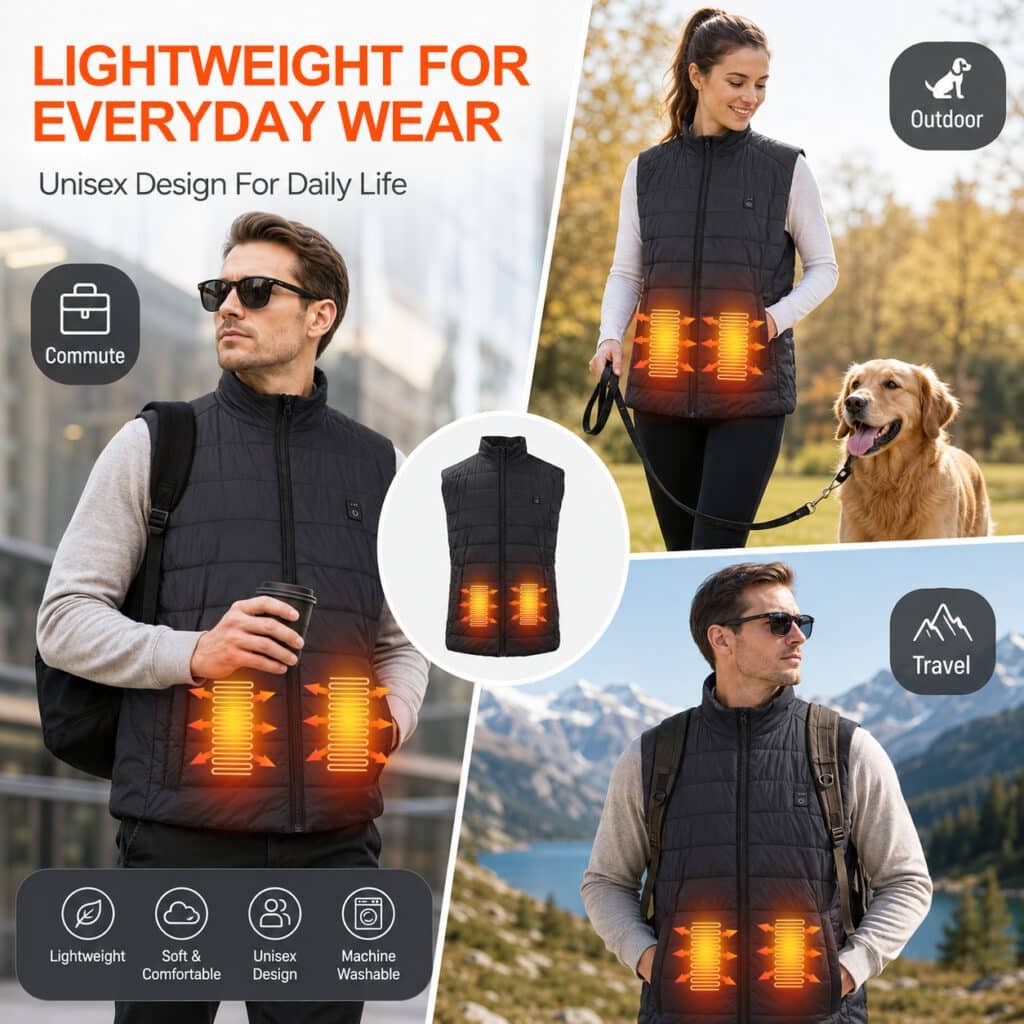
Heated vests sell across very different buyer groups, and the specification that wins one group can lose another.
- Hunting and fishing. Quiet outer fabric, low bulk and long runtime on the low setting matter most; wearers sit still for hours, so insulation quality carries as much weight as the element.
- Commuting. A slim cut that disappears under a coat, a discreet controller and simple charging routine. This is the group that benefits most from a remote or app controller.
- Construction and cold storage. A durable shell, high-visibility options, quick battery swaps between shifts and a washable outer layer. Buyers here often order spare packs with the first order.
- Skiing and cycling. Flexibility and an unrestricted arm range, with the vest sized to sit under a shell without restricting movement.
Most brands do not pick a single model. A practical range pairs a slim vest for commuting and layering with a heavier vest for outdoor work, and holds the battery format constant across both so that spares, chargers and instruction sheets do not multiply across the line.
If a buyer is choosing between a vest and a jacket rather than between two vests, our article on heated jackets versus heated vests sets out the trade-offs for brands building a range, and app-controlled heating explains what the connected option adds.
Fit, Comfort and Layering
Fit is the specification most often left to the last minute, and the one that generates the most returns.
Slim or loose. A slim vest keeps the element close to the body, heats faster and layers neatly, but leaves no room for a thick midlayer and can feel restrictive across the shoulders. A loose vest is more comfortable over a shirt and easier to size across a broad population, but needs slightly more heat to feel warm because of the air gap. Many brands carry both and position them for different end uses.
Layering. A heated vest works best as a mid-layer: close enough to the body to move heat into the torso, covered enough to hold it. Worn over a thick fleece, most of the heat is absorbed by the layer underneath; worn as an outer layer in strong wind, it is lost. Telling buyers how to wear the product is as useful as telling them how to charge it.
Sizing for a range. Men and women patterns need separate grading rather than a simple size shift, because shoulder width, torso length and bust shaping all change where the element sits. For brands building a full range, the same logic applies across every heated category in the heated vest collection we manufacture.
Safety and Overheating
A heated vest is a low-voltage garment, and the safety rules are simple enough to print on the care label.
- Use only the battery and charger supplied with the vest. A mismatched charger is the most common cause of pack damage.
- Choose the correct size. A vest that is too tight concentrates heat in one area.
- Start on the lowest setting and move up only if needed; heat tolerance varies widely between wearers.
- Avoid prolonged pressure on a single heating zone, for example a heavy tool belt or a tight harness over the chest panel.
- Keep the battery, connector and controller dry, and never charge a wet vest.
- Stop using the vest if the shell discolours, the pack swells, or the connector becomes hot to the touch.
These points are not marketing language. A brand that publishes them, and a factory that designs to them, reduces both returns and liability exposure in North American and European markets.
Washing, Storage and Maintenance
Care instructions decide whether the second winter is as good as the first.
- Remove the battery first. This is the single step that prevents most wash-related damage.
- Follow the care label. Hand washing or a gentle cold cycle with the vest closed and connectors secured is normal for most models.
- Do not machine dry. Heat and tumbling both stress the element and the lining.
- Air dry completely before reconnecting power or folding the vest for storage.
- Store flat and dry. Keep the pack at partial charge rather than empty, and keep both away from damp basements between seasons.
Troubleshooting: When It Stops Heating
Most “dead vest” complaints turn out to be one of five things, and a support script that works through them in order resolves the majority without a return.
- The battery is not fully charged. Charge to full and retest before diagnosing anything else.
- The battery is incompatible. A pack from another model may fit the connector and still not drive the controller correctly.
- The connector is loose. Re-seat it, check for debris or damp, and check the strain relief at the entry point.
- The controller is in protection mode. Some controllers lock out after a fault; cycling power restores normal operation.
- One zone does not work. If only one area stays cold, the element or its branch wire is damaged and the garment needs service.
Designing for fewer failures is the better answer, and it is mostly a matter of sealed connectors, sensible cable routing and a controller that tolerates real-world handling. That is a manufacturing decision, not an after-sales one — see how we build and test on our factory page.
OEM, ODM and Private-Label Options
For brands and distributors, the buying decision usually ends with a custom programme rather than a catalogue order. The parts that can be specified are broader than most first-time buyers expect.
- Shell and fabric. Outer fabric, colourways, panel layout and branding.
- Heating zones. Which areas are heated, how they are grouped, and whether zones run together or independently.
- Battery and control. Pack format, mounting position, charging interface and whether control is on-garment, remote or app based.
- Packaging and labelling. Private-label branding, hangtags, retail packaging and instruction sheets.
Our standard terms are straightforward: stock from 1 unit, OEM from 100 units and ODM from 500 units, sampling in 7 to 30 days and mass production within 45 days, and a standard manufacturer warranty. Battery development and certification support are handled in house, which is what the battery solution page covers. For the full service scope, start with OEM and ODM services.
Frequently Asked Questions
How long does a heated vest take to charge?
Most rechargeable heated vest packs reach full charge in three to five hours on the supplied charger. Larger packs take longer, and a partially discharged pack charges faster than an empty one. Charging a cold pack straight from outdoors takes longer than charging at room temperature, so it is worth letting the pack warm up first.
How many charge cycles does a heated vest battery last?
A well-made lithium pack is normally rated for several hundred full charge cycles before noticeable capacity loss. Two habits extend that life considerably: avoid leaving the pack fully discharged for long periods, and avoid charging it hot, straight after a full day of use.
The storage side of the same problem – charge level, temperature and length of storage between winters – is covered in the guide to extending battery life in heated apparel.
Can I take a heated vest battery on a plane?
Lithium packs used in heated apparel are built to UN38.3 and are generally treated as portable electronic devices, which means they usually travel in carry-on baggage rather than checked luggage. Airline rules vary and are updated regularly, so always confirm with the carrier before travelling.
What is the difference between a built-in battery and a detachable battery in a heated vest?
A built-in pack is more discreet and harder to lose, but the whole garment has to be taken out of service when the pack reaches end of life. A detachable pack can be swapped mid-day for a second one and replaced later on its own, which suits workwear and long outdoor sessions better.
What drives the cost of a custom heated vest order?
The main cost drivers are the heating element and zone count, the battery pack, the controller type, the shell fabric quality and the size of the run. Small changes in zone layout or fabric grade often move the unit cost more than the volume discount does, so it is worth fixing the specification before discussing quantity.
Can a heated vest be worn without the battery?
Yes. With the pack removed, a heated vest still works as an insulated vest, and many wearers use it that way in milder conditions. The heating element and wiring add very little weight, so the garment remains comfortable as a normal layer.
Whether you are specifying a first heated vest range or tightening an existing one, the checklist is the same: know what is inside, fix the specification, test in real cold, and publish the care and safety rules. If you would like a specification review before your next order, our engineering team can work from your tech pack or from scratch.