Heated jackets are the product most buyers picture when they think about heated apparel, and they are also the easiest to get wrong. A jacket has to warm a large surface, carry a heavier pack than a glove or a sock, and sit over other layers, so the garment and the electronics have to be engineered as one unit rather than assembled side by side.
This guide is written for two readers at once: buyers who want to choose well, and the brands, distributors and retailers who need to write a heated jacket specification a factory can build. Each section maps to a line you can put in a tech pack or a supplier brief.
What Is Inside a Heated Jacket
A heated jacket is a garment with four extra systems built into it, and comparing them one by one is the fastest way to tell apart offers that look identical on a product page.
- Heating element. A carbon fiber, graphene or film element laminated between the shell and the lining. The material and the layout decide how evenly heat spreads across the core and how well the panel survives being folded and compressed. For the trade-offs between the two common formats, see our comparison of carbon fiber and heating film in heated jackets.
- Battery and pocket. A pack carried in an inside or lower pocket. A jacket has more room for a pack than any other heated product, which is an advantage — but the weight also pulls at the hem, so pocket position and support matter.
- Controller. A button on the chest, a wireless remote or a Bluetooth app. On a jacket the controller is usually reachable, so a button is a perfectly good answer; the choice is really about how many channels the wearer wants to adjust independently.
- Shell, insulation and lining. The outer fabric, the membrane, the insulation and the lining together decide wind resistance, moisture handling and how much warmth the garment keeps on its own. Good insulation is not a substitute for heating, and heating is not a substitute for good insulation.
The principle behind all four is the same: an element converts electrical energy into heat and the garment holds it against the body. Everything else in this guide is about how well each part is matched to the others.
Key Specs to Compare: Voltage, Battery, Warmth and Weather Protection
The comparison narrows to a short specification list. The table below shows the values we build to at Dr. Warm: if a supplier cannot state these clearly for a heated jacket, that is already an answer.
| Voltage options | 3.7V / 5V USB / 7.4V / 12V / 24V (customizable) |
|---|---|
| Battery capacity | 2200 / 2600 / 4000 / 5000mAh and above (customizable); a 10,000–20,000mAh USB power bank can also be used across our heated clothing range |
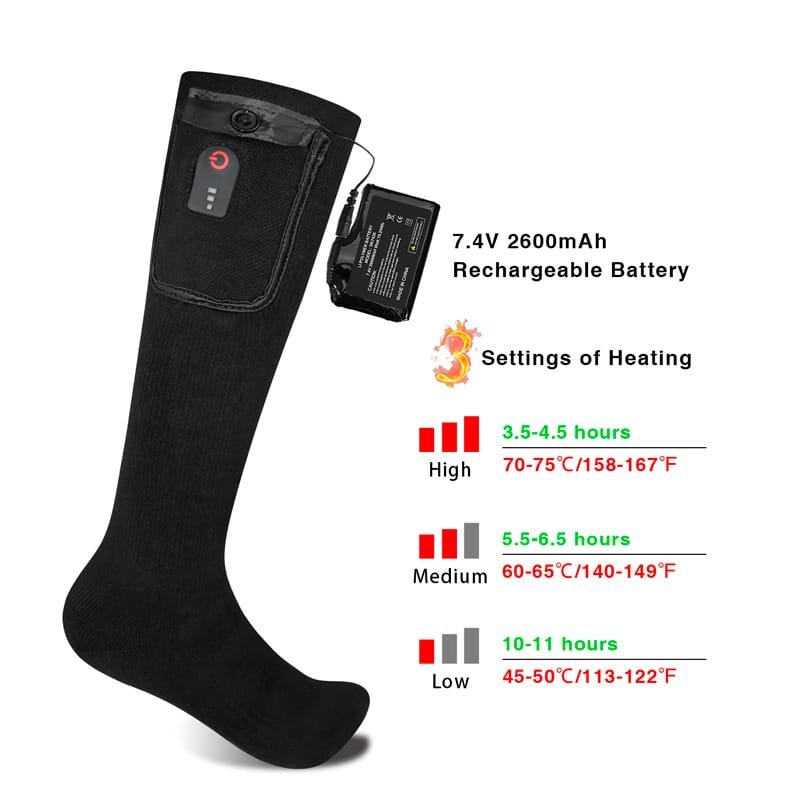
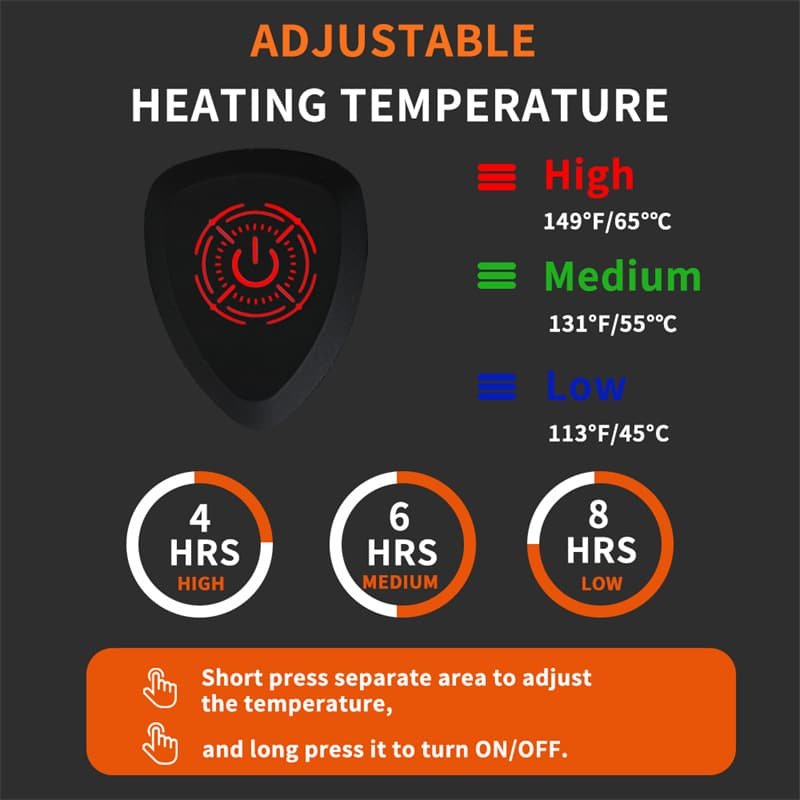
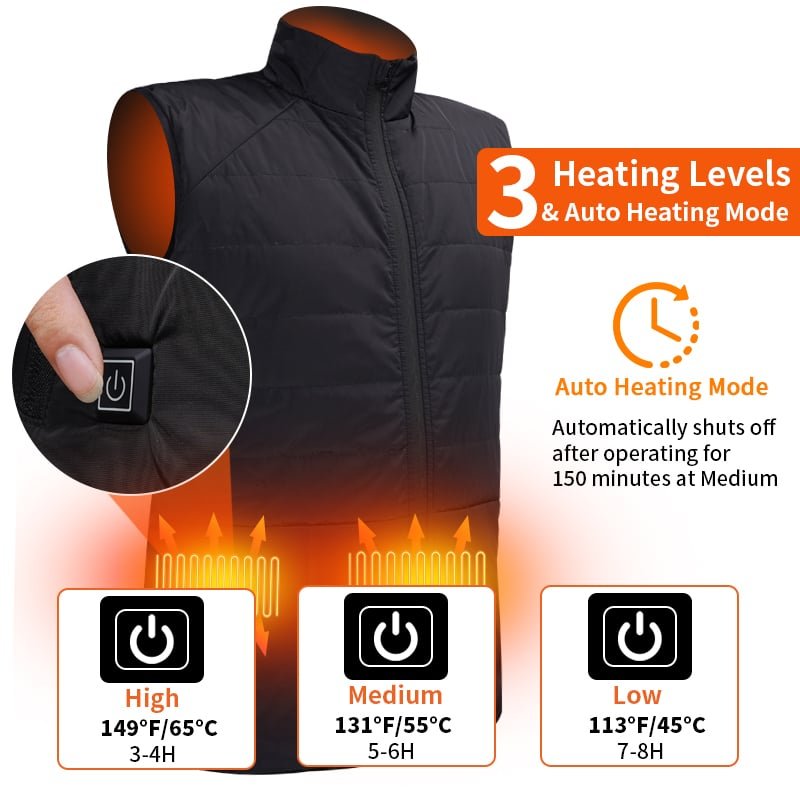
| Heat levels | 3-level adjustable |
| Heating element | Carbon fiber / graphene / heating film (model dependent) |
| Heating zones | Chest / upper back / lower back / abdomen / collar / pockets (customizable) |
| Working temperature | 40–70°C, model specific (see product spec sheet) |
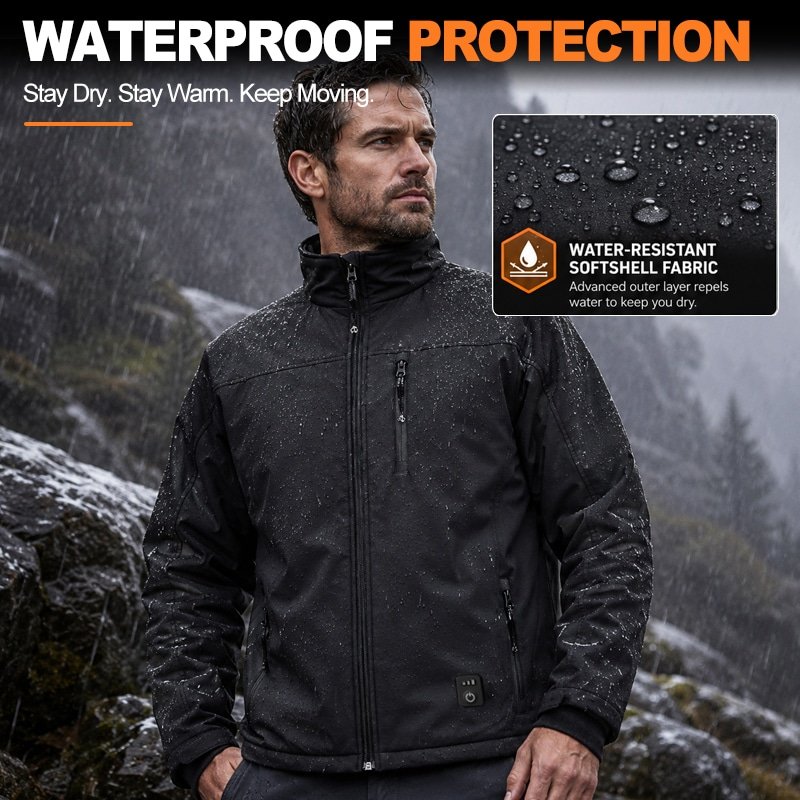
| Waterproof rating | IPX4 standard / IPX5 optional (where applicable) |
| Charging | Magnetic / USB / DC (model dependent) |
| Warranty | 12 months |
| Certification | CE / RoHS / FCC / UKCA / UL1642 / UN38.3 / IEC60335 / CCC / TUV / ETL |
Voltage is the line buyers misread most often. A USB system and a dedicated higher-voltage pack can both produce comfortable warmth, because element resistance, wattage and controller programming do most of the work; voltage describes the architecture of the power system more than it describes warmth. What it changes in practice is warm-up speed, how large a heated area the jacket can sustain and how much weight sits in the pocket.
Capacity should be read together with voltage rather than on its own, because the two together define the energy a pack actually carries. A supplier who quotes milliamp-hours without stating the voltage, the number of heating zones or the test conditions is quoting a number, not a specification. Our notes on how long a heated jacket battery lasts cover how capacity, zones and heat level interact.
Heating zones and weather protection are the other two lines worth fixing early. Chest and upper back panels warm the core, which is what a wearer actually feels; larger coverage warms more of the body but draws more power from the same pack. Waterproof rating describes the whole structure — membrane, seams, zipper, hood, cuff and battery pocket — not just the outer fabric, and a supplier who blurs that line is likely to blur others.
Heated Jackets or Ordinary Winter Jackets?
Buyers usually ask whether the electronics are worth it at all, so it is worth answering plainly.
Ordinary winter jackets rely on insulation — down, synthetic loft or fleece — and trap the heat the body already produces. They are light, need no charging and wash without ceremony, but they cannot add warmth: once the wearer is cold, an insulating jacket only slows the loss.
Rechargeable heated jackets add a battery, heating panels and a controller. They generate warmth on demand, hold a set temperature and target the chest and back, in exchange for charging, a little extra weight and more specific care.
The choice comes down to exposure time and how much the wearer moves. For short trips in moderate cold, an ordinary jacket is the sensible answer. For skiing, winter commuting, motorcycle riding, outdoor work and long shifts — wherever the wearer is stationary, exposed or working in wind — active heating changes how long the day can last. Many brands carry both and position them by scenario rather than by price.
How Long the Heat Lasts on a Full Charge
Runtime is the number buyers ask about first and the hardest to state honestly, because it depends on how the jacket is used rather than on the pack alone.
- Heat level. The lowest setting always runs longest; a wearer who warms up on high and drops to low gets far more hours than one who stays on high all day.
- Number and size of heating zones. Large chest, back, collar and pocket panels draw more energy than a basic three-zone layout, and the coverage has to be balanced against battery weight and target runtime.
- Ambient temperature. Cold reduces the usable capacity of any lithium pack, so an indoor bench test tells a buyer nothing about a morning well below freezing.
- Garment insulation. Good insulation holds the generated warmth and lets the jacket run at a lower setting; a thinly insulated shell forces a higher setting and shortens the shift.
- Wind and moisture. Wind strips heat from the surface of the jacket, especially on a motorcycle, and damp insulation loses much of its value.
- Battery weight against capacity. A bigger pack adds hours and pocket weight at the same time, so the ceiling is set by comfort as much as by energy.
Wearers can stretch a pack without changing the specification: charge the pack fully before going out, warm up on high and then drop a level, add a windproof outer layer in exposed conditions, switch off indoors and carry a matched spare pack for long days rather than a heavier one.
For sourcing decisions, ask for runtime measured at every heat setting, with the battery voltage and capacity, the heating-zone layout, the ambient test temperature and the new-versus-aged battery figures stated alongside — a short request whose answer tells you a great deal about the supplier.
Heat Control: Buttons, Zones and App Control
The controller is where a jacket range is usually differentiated, and the options sit on a clear ladder from simple to sophisticated.
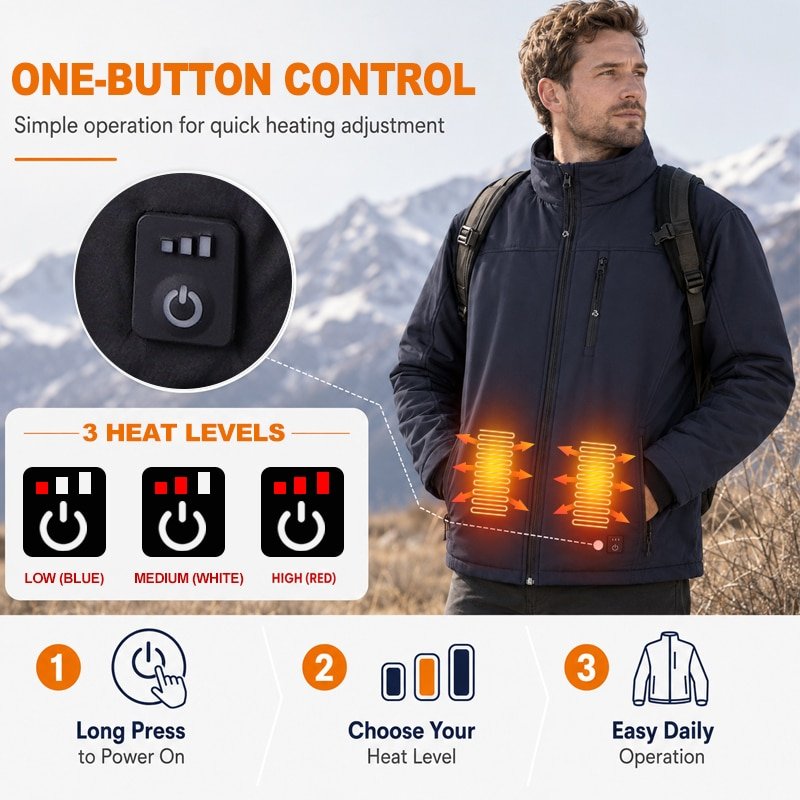
Three-level button control. The most common system, and the most robust. The wearer connects the pack, holds the power button to switch on, presses it to change level and holds it again to switch off, with an LED colour showing the selected setting. It is economical, needs no phone and cannot be broken by an app update.
Independent zone control. The heating system is split into two or more channels — front and back, upper and lower body, main body and collar, or left and right pockets. Independent control lets the wearer heat only the areas that need it, which also helps manage battery consumption.
App control. An app-controlled jacket carries a controller inside the garment and communicates over Bluetooth. Typical functions include heat-level selection, independent-zone control, a timer and auto-off, battery-status display and customised temperature profiles. For brands, an app is also a branding surface, and it can be localised for a target market. Our comparison of app-controlled and button-controlled heated jackets covers when the extra cost is justified.
Automatic regulation. Advanced systems use sensors and closed-loop control to compare the actual temperature with the target and adjust power accordingly, which reduces fluctuation and makes a jacket feel steadier rather than hotter.
Whichever control is chosen, the practical rule is the same: start on high to warm up, then drop to low or medium once the jacket is comfortable, and use high only for wind or short exposure to severe cold. Whichever system is fitted, the controller, battery and heating elements have to be developed as one matched set.
Fit, Sizing and Men and Women Patterns
Fit is the specification most often left to the last minute, and the one that generates the most returns. A heated jacket has to sit close enough for the panels to be felt without compressing the wearer or restricting movement.
Pattern and proportion. Men and women styles can share the same core battery and heating technology, but the garment patterns, proportions, panel positioning and size grading usually differ. Typical differences sit in shoulder width, waist shaping, torso and sleeve length, armhole size and bust or hip proportions. These are design tendencies rather than rules, and brands should test each size range separately rather than relabelling a single unisex pattern.
Slim fit or loose fit. A closer fit puts the heating panels nearer the body and makes the warmth feel more direct. A looser jacket leaves room for sweaters, workwear layers or protective equipment and allows more arm movement, but it takes longer to feel warm. The jacket should never be so tight that it restricts circulation, compresses the pack or causes excessive sweating.
Heating-panel alignment. Panels should line up with the chest, back and abdomen without crossing seams or body curves, and a layout designed for a straight unisex jacket often needs adjusting when it is used in a fitted pattern. Battery-pocket placement has to be checked per size as well, because a pocket that sits well on a medium can dig into the hip on a small.
For OEM buyers the useful checklist is short: men, women or unisex sizing; the target market and its regional size standards; the intended base-layer thickness; chest, waist and hip proportions; sleeve and torso lengths; heating-panel dimensions; battery-pocket placement; and the required size range.
Waterproofing and Weather Protection for Riding and Snow
Waterproofing is the specification most often claimed and least often explained. On a heated jacket the word describes the complete construction, not the surface fabric.
Protection depends on the outer shell, the membrane behind it, the seam construction, the zipper and its storm flap, the hood and cuff design, the battery-pocket protection, the breathable lining and insulation that keeps working when it is damp. A jacket that is water-resistant on the outside but open at the cuffs will still lose its advantage in driving snow.
- Motorcycle riding. Continuous wind exposure makes the air feel far colder than the thermometer suggests. A suitable heated riding jacket needs wind-resistant fabric, chest and back heating, secure cuffs and collar, a slim build that layers under protective gear, stable output and protected wiring. The battery pocket must not create a pressure point against the seat or the armour, and the controls have to be usable with a gloved hand.
- Snow, ski and general winter use. Here the priorities shift towards waterproofing, insulation and moisture management: a membrane that keeps working, sealed seams, a protected zipper, a snow-shedding hood and an insulated lining that does not collapse when it gets damp.
- Outdoor work. Durable fabrics, reinforced seams and a pack that stays put through lifting and reaching matter more than peak temperature, and the jacket has to survive being worn over a harness or tool belt.
Because riding and snow work pull the specification in different directions, the strongest approach is to design around one clearly defined scenario and then vary membrane, insulation, heating layout and pack rather than trying to satisfy every use with one garment.
Washing, Drying and Care
Care instructions decide whether the second winter is as good as the first, and a heated jacket is washed far less often than a base layer — which is exactly why owners forget the rules between seasons.
- Before washing. Switch the jacket off, disconnect and remove the pack, tuck the power cable into the battery pocket, close every zipper and pocket, and inspect the connector and the fabric for damage. Never wash or submerge the battery or the charger.
- Hand wash or machine wash. Hand washing in cool water is the gentlest option. Some jackets accept a delicate machine cycle inside a mesh laundry bag, but only when the care label specifically permits it. Use cool or lukewarm water and a mild liquid detergent, and avoid bleach, dry cleaning, hot water, strong spinning, fabric softeners where prohibited, and twisting or wringing.
- Drying. Air dry the jacket in a ventilated area, away from high-temperature tumble drying, radiators, open flames, hot-air guns and irons over the heating panels. Do not reconnect the pack until the jacket, the connector and the battery pocket are completely dry.
- Storing the pack. Keep it in a cool, dry place for long-term storage, avoid leaving it fully empty or continuously full, and follow the instructions supplied with the pack rather than topping it up out of habit.
Maintenance begins with the original design, which is why we treat membrane bonding, sealed connectors, protected battery pockets and flex-tested wiring as manufacturing decisions rather than after-sales ones. See how we build and test on our factory page.
Safety and Troubleshooting: When It Will Not Heat
A heated jacket is a low-voltage product, and the safety rules are simple enough to print on the care card.
- Use only the specified battery and charger. A general power bank can display a full charge and still fail to deliver the voltage or continuous current the jacket needs, which shows up as weak heat or an automatic shutdown.
- Check the connector and the activation method. Reconnect the plug securely, confirm that it is dry, and remember that many controllers need the power button held for several seconds before heating begins.
- Do not fight the protection circuit. Over-current, abnormal voltage or excess temperature makes the controller or battery-management system cut output. Disconnect briefly and reconnect according to the instructions; repeated shutdowns should be inspected professionally rather than reset again and again.
- Treat a single-zone failure as a fault. If only one channel heats, the likely causes are a broken wire, a damaged panel, a loose internal connector, a controller-channel fault or damage from washing or sharp folding. Internal wiring is not a user-serviceable repair.
- Never power a jacket while it is folded or packed. Pressure traps heat and prevents normal dissipation, and a garment that is powered on inside a bag or a sealed container is a real risk.
- Stop using it immediately if you notice a swollen pack, burning or chemical odours, a melted connector, exposed wiring, unusual localised heat or heat that changes when the jacket moves.
For brands, the safety case is a design case: over-temperature protection, short-circuit protection, over-charge and over-discharge protection, stable controller output, heating-uniformity testing and connector durability tests are the items to confirm before the first order rather than after the first return. Our heated jacket safety guide covers the field-level checks in more detail.
Which Model Suits Which Use Case
Heated jackets sell across buyer groups with very different priorities, and the specification that wins one group can lose another.
- Commuting. Lightweight construction that layers easily, simple controls, modest heating coverage and a pack that can be removed when the wearer steps indoors.
- Skiing and snow sports. Stronger insulation, a working membrane, chest and back heating and enough arm movement to hold a pole, with steady warmth across a full day on the lifts rather than a short peak.
- Motorcycle riding. Wind resistance, a secure collar and cuffs, a slim build that fits under protective gear and a pack positioned so it never presses against the seat or the armour.
- Outdoor work. Durable fabrics, reinforced seams, weather protection and a build that survives being worn over a harness or tool belt for a full shift.
- Everyday winter wear. Neutral colours, comfortable insulation and controls a first-time user can operate without reading the manual, plus a weight that a wearer will not notice in a car or on a train.
There is no single best model for every activity: the strongest product is designed around one clearly defined scenario, and a range is built by varying heating layout, insulation, shell, battery and control rather than by chasing a headline temperature. The heated jacket collection we manufacture shows how those variations come together.
OEM, ODM and Private-Label Options
For brands, distributors and retailers the decision usually ends with a custom programme rather than a catalogue order, and the parts that can be specified are broader than most first-time buyers expect.
- Jacket structure. Softshell, puffer, parka, heated hoodie, work jacket, motorcycle jacket or ski and outdoor jacket, in men, women or unisex patterns.
- Fabrics and trims. Membranes, insulated linings, breathable fabrics, reflective materials, reinforced panels, branded zippers, pocket placement, and hood and cuff construction.
- Heating system. Chest, abdomen, upper back, lower back, collar, shoulder or pocket coverage, the number of temperature levels, independent channels and the position of the control button.
- Battery and control. Voltage and capacity, pack shape, custom protection boards, controller matching, ergonomic housings, and button, remote or branded app control.
- Branding and packaging. Printed or embroidered logos, woven and care labels, custom zipper pulls, battery branding, instruction manuals, retail boxes, carrying bags and barcode labels.
Our standard terms are straightforward: stock from 1 unit, OEM from 100 units and ODM from 500 units, sampling in 7 to 30 days and mass production within 45 days, and a standard manufacturer warranty. A useful enquiry states the target country, the jacket type, the estimated quantity, the heating zones, the battery and runtime target, the size range, the logo files, the packaging requirements, the compliance documents needed and the target delivery date — see how the sampling, testing and mass-production stages fit together. Battery development and certification support are handled in house — see the battery solution page — and the full service scope starts with OEM and ODM services.
Frequently Asked Questions
What is the difference between a heated jacket and a heated vest?
A heated vest is built for core warmth with the arms free, which makes it the better choice for layering under a shell or a work jacket and for wearers who move a lot indoors and outdoors. A heated jacket adds sleeves, which means real insulation on the arms, a larger heated area and more weather protection — at the cost of more weight, more bulk and a higher price. In practice many brands carry both: the vest for a three-season layer and the jacket for deep winter and exposed outdoor work.
Can a heated jacket be worn as a mid-layer under a shell?
Yes, and it is one of the most effective ways to wear one. A heated mid-layer under a windproof and waterproof shell traps the generated warmth and lets the jacket run at a lower setting, which extends runtime noticeably. What matters is that the jacket is slim enough not to bunch under the shell, that the battery pocket stays reachable, and that the wearer can still adjust the controls without opening the outer layer. A jacket sized for use on its own may be too bulky to layer well, which is worth confirming before committing to a size range.
Can a heated jacket be worn with a backpack or a work harness?
It can, but the fit has to be planned for it. A loaded backpack or a harness presses the heating panels against the body, which both concentrates the warmth and adds wear at the contact points, and a heavy load can also pull the jacket and move the battery pocket. For workwear and travel use, the better answers are a heating layout that keeps the main panels clear of the shoulder-strap line, a battery pocket positioned away from the load, and enough reinforcement at the shoulders to survive constant abrasion.
Is a heated jacket available for plus-size and tall customers?
Yes, though it takes a deliberate decision rather than a stretched size run. Adding girth without changing panel positions leaves the heating zones in the wrong places, and merely lengthening a sleeve moves the cuff and the battery pocket. A proper extended range adjusts chest, waist and hip proportions, panel dimensions and pocket placement per size, and it is tested on the body shapes the market actually serves. Buyers should confirm the available size range and the grading logic before placing a private-label order.
How should a heated jacket be stored between seasons?
Clean and fully dry first, because storage is where damp and salt from a winter of use do their damage. Remove the pack, tuck the cable into its pocket, close the zippers, and hang or fold the jacket without sharp creases across the heating panels. Keep the pack in a cool, dry place at partial charge rather than fully empty or continuously full, and store it away from sharp metal objects. Checking the connector, the cable and the seams before the next season starts is cheaper than discovering the fault in the first cold week.
How do I choose between a softshell, puffer and parka heated jacket?
The shell decides what the jacket is for before the heating system does. A softshell is flexible and breathable, which suits commuting, riding and active use where wind resistance matters more than insulation. A puffer traps the most warmth for its weight and suits cold, dry conditions and general winter wear. A parka adds length and weather protection and is the right answer for snow, standing outdoor work and long exposure. The heating layout should then be matched to the shell, because the same panel set behaves differently under a breathable softshell and a heavily insulated parka.
Heated jackets are judged on the body and in the weather rather than on a specification sheet, so the discipline is simple: define the scenario, fix the heating layout and the power system, test the jacket over the layers your customers actually wear, and publish care and safety rules that an owner will follow. If a specification review would help before your next order, our engineering team can work from your tech pack or from scratch.