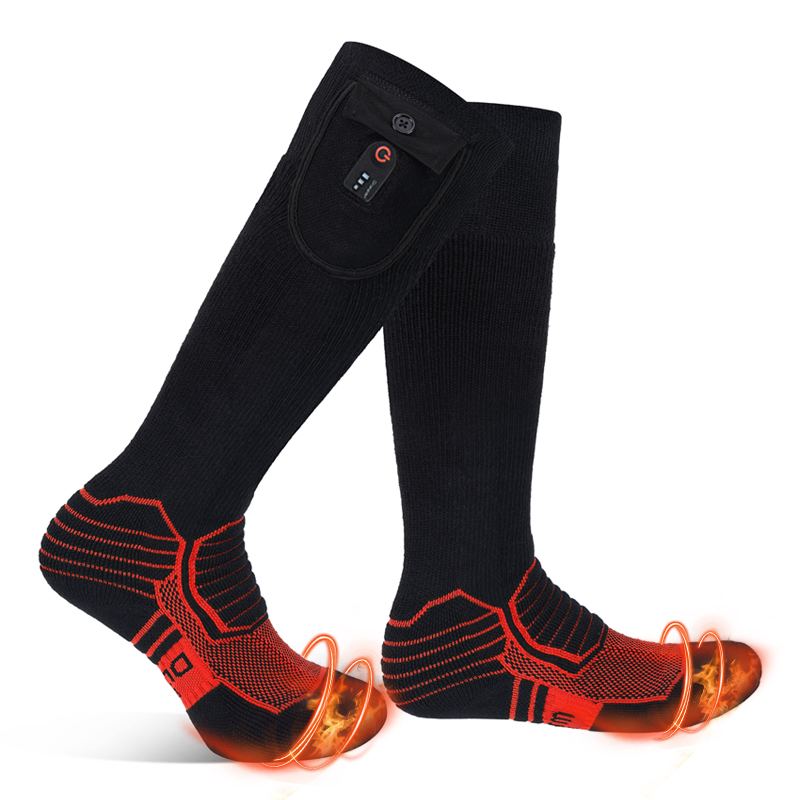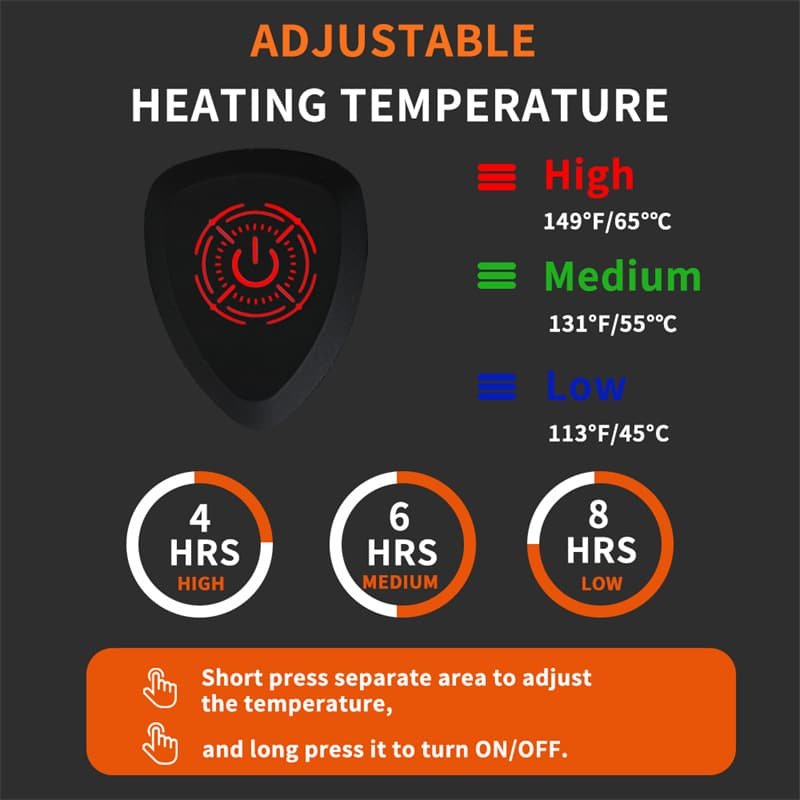

If a heated sock is producing heat and still feels wrong, the cause is almost always mechanical. Four failures account for nearly all discomfort — a fold, a boot that is too tight, a setting chosen by feel rather than by use, and a pack or plug that is not seated properly — and each one has its own signature. Reading the signature is the whole skill; acting on the wrong one is what turns a two-minute adjustment into a return.
Read the symptom before changing anything
The list below works because the cause and the feeling are specific to each other. A single hot spot the size of a coin and a whole foot that is too hot are not the same problem at different strengths; they have different causes and different fixes.
| What the wearer reports | What it usually is | What to change | What it is not |
|---|---|---|---|
| One hot spot the size of a coin, rest of the foot fine | Element pressed against the skin by a fold, a seam or a boot crease | Smooth the sock from toe to cuff, refit, recheck boot volume | Not a controller fault, and not too much heat |
| Whole foot hot and damp | Setting too high for the activity; sweat has nowhere to go | Drop one level and leave it there | Not a defective element |
| Toes go numb or tingle while the sock is clearly warm | Volume: sock plus boot is compressing the foot | Remove thickness or relace the boot | Not “the heat is too weak” |
| One sock warm, the other cool | Different level, a pack at lower charge, or a plug not fully seated | Swap the packs over and watch which foot changes | Not two different elements |
| Stinging on the ankle or shin | The pack pressing on bone, or the plug pulled tight by a trouser leg | Move the pocket higher and give the lead some slack | Not a damaged wire |
| Heat cutting in and out as the wearer walks | Connector partly out of its socket | Re-seat the plug square; if it repeats, stop using it | Not normal behaviour |
Dress in this order — it prevents most of it
- Sock on first, smoothed from toe to cuff with a flat hand. No fold at the heel, none across the instep, none at the toes.
- Foot into the boot, heel to the back, laces closed from the bottom up.
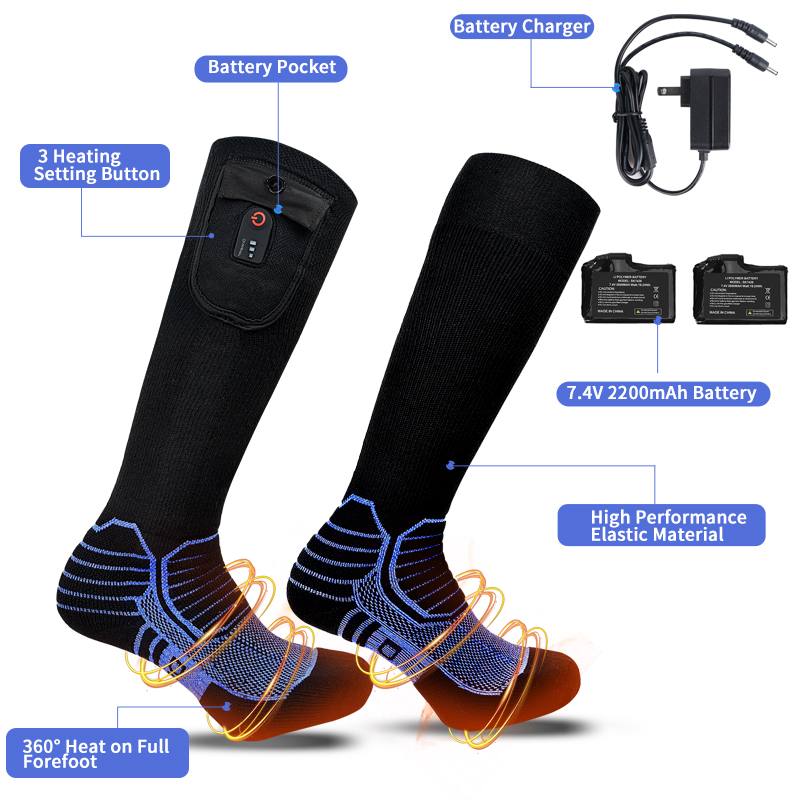
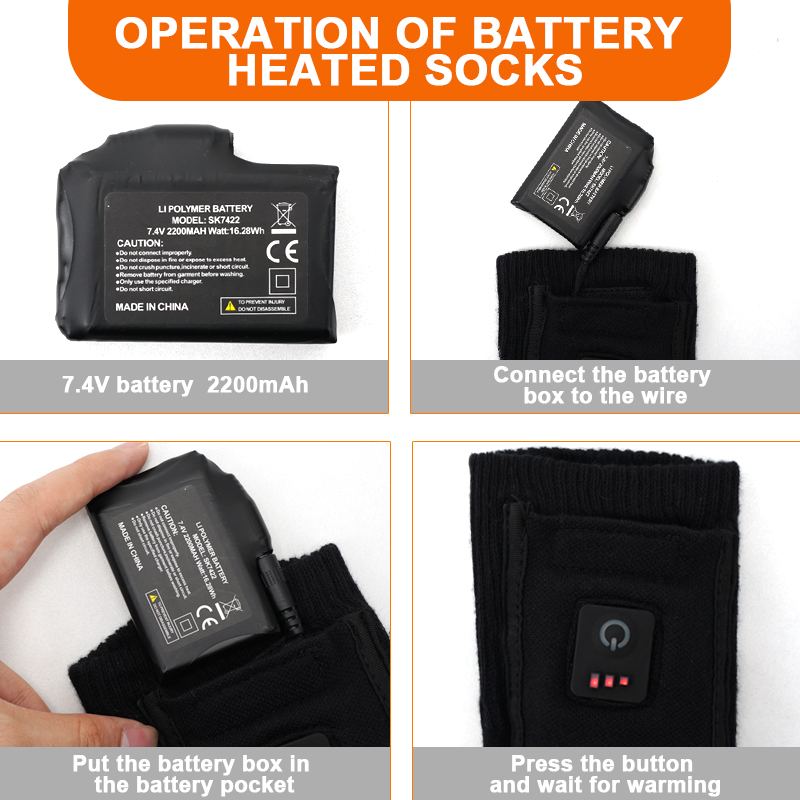
- Pack into the pocket only after the boot is on. The boot is what pulls a connected lead.
- Plug in last, and check the plug is square and fully seated rather than pushed in at an angle.
- Power on at the lowest level, walk for five minutes, then set the level the day actually needs.
The order matters more than it looks. Almost all connector damage happens in the few seconds when a boot is forced on over an already-connected lead, and almost all “it stopped working” reports trace back to that moment. Dressing in this sequence removes it, and it costs nothing to write on a hangtag or a box panel.
The fold is the real enemy
A fold is not just a lump. Inside a boot with a couple of millimetres of clearance, a fold becomes a pressure point within about twenty minutes, and the same crease bends the element in the same place on every step. That repeated bend in one spot is the load case that ends elements early — the failure mode that separates film, carbon-fibre and wire constructions in the first place, as set out in heating film versus carbon fibre.
Folds also have addresses, and each address produces a different symptom — which is what makes “the sock is uncomfortable” too little information to act on.
| Where the fold sits | What the wearer feels | Why it happens | Fix |
|---|---|---|---|
| At the heel | Pressure low on the Achilles, worse going uphill | Sock pulled too far up before the boot went on | Sit the heel seam on the heel bone, then smooth upwards |
| Across the instep | A band of pressure over the top of the foot, laces feel tighter than usual | Sock too long for the foot, or excess fabric pushed forward | Go down a size rather than relacing tighter |
| At the toe | Pressure on the nail, or a hot spot on one toe | Sock too short, or the foot slid forward in a loose boot | Larger size, and lock the heel down with the lacing |
| Under the arch or sole | A lump under the foot that gets worse through the day | Sock rotated on the foot, or an insole pushed over it | Re-position with the heating zone flat under the forefoot |
This is also why the size chart matters more than the temperature chart. A sock that fits leaves the element flat and the boot as it was fitted; a sock that does not fit turns both into variables the wearer cannot see.
Heat is not a thermostat, and numbness is not a temperature reading
Skin is poor at absolute temperature and very good at detecting change. That is why starting on high and turning down feels hotter than starting low and staying there, even when the element ends up at the same output. It is also why “turn it up” is the wrong reflex when the toes go numb: numbness is a pressure or blood-flow effect, not a message that the element is too weak, and adding heat on top of it hides the cause instead of fixing it.
The setting that works is the one chosen with the boot on and the wearer moving — not the one that felt good in the first two minutes while sitting indoors. For a long day, pick the lowest level that stays comfortable once the feet are warm, and leave it: the wearer stops noticing the difference after a few minutes anyway, but the pack does not.
For wearers who cannot feel the heat reliably
Some people do not get a reliable warning from their feet, for reasons that are medical rather than technical. We do not give medical advice and a heated sock is not a medical device — anyone in that position should follow their clinician’s guidance first, and treat the product as subject to it rather than as a substitute for it.
What the product can do is remove the need for judgement. Keep to the lowest setting. Check the outside of the sock with a hand before it goes on, because a hand feels what a foot may not. Keep sessions shorter and look at the skin when the sock comes off. And choose a sock with a hardware over-temperature cut-out, so the protection does not depend on the wearer noticing anything.
When to stop using the sock
- A burning or chemical smell, at any setting.
- A pack that has swollen, or a plug that is melted, discoloured or hot to the touch.
- One hot point that does not change when the setting is lowered.
- Heat that cuts out and returns repeatedly while walking.
- Visible damage to the element or to the knit over it.
Stop, remove the pack, and do not open or repair it yourself. A pack that has been opened is not a pack that can be inspected, and the failures above are the ones that matter. The non-electrical version of the same list — a sock that produces no heat at all — is in why heated socks fail to heat up.
What brands should specify so this does not happen
Most discomfort returns are decided at the specification stage, not in the field. The list worth putting in a brief: a hardware over-temperature cut-out, short-circuit and over-charge protection, a charger matched to the pack, a uniformity test (a single hot point is a manufacturing defect, not a user error), connector durability under pull, flex and ageing tests, and IPX4 electronics as standard with IPX5 available on request.
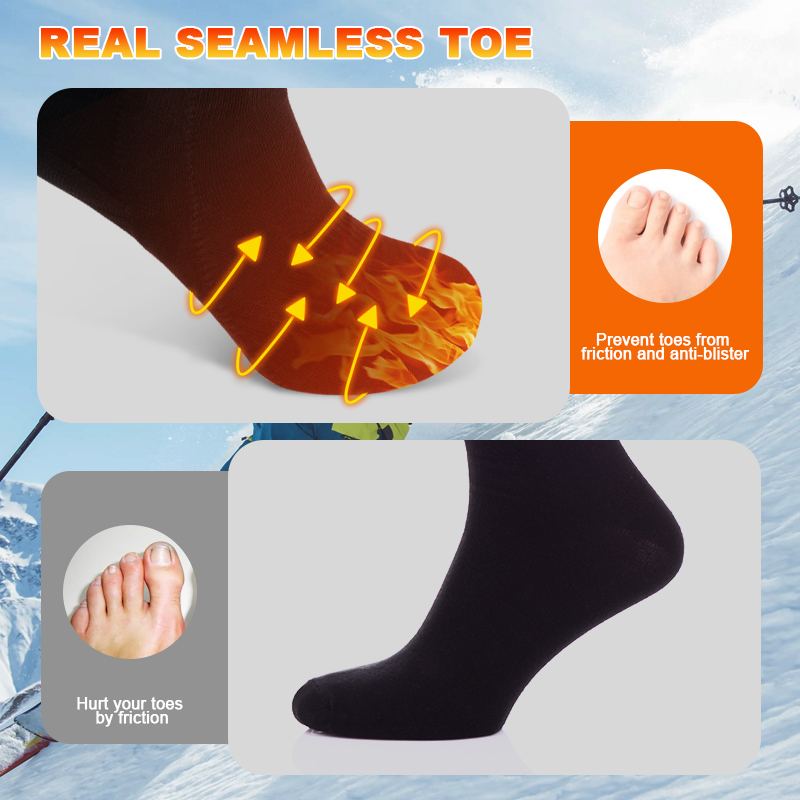
The compliance side is separate and worth naming explicitly: CE and UKCA marking, IEC 62133 for the cells, UN38.3 for air freight, RoHS and REACH for materials, and GB 47372-2026 with CCC alongside them for the Chinese market. Two construction lines prevent more returns than any of that: a seam-free toe, and a pocket that holds the plug square under load. Both are cheap at sampling and impossible to retrofit.
Develop custom heated socks with Dr. Warm
Dr. Warm develops heated socks with the element, PCBA, battery and textile engineered together: carbon-fibre or graphene elements, blind-stitched seam-free toes, matched chargers, hardware cut-outs and compliance-ready documentation. OEM from 100 pairs, ODM from 500 pairs, or single pairs from stock for evaluation. Wearing and care guidance for waterproof builds is in our waterproof heated sock care guide.
Frequently Asked Questions
How should heated socks be worn?
Smooth the sock from toe to cuff, put the boot on before the pack is connected, plug in last and start on the lowest setting. Most discomfort comes from a fold, a tight boot or a plug pulled by the boot going on, rather than from the heating system.
Can heated socks burn your feet?
A correctly worn sock with a working cut-out should not, but the risk is not zero for someone who cannot feel heat reliably. Use the lowest setting, check the outside of the sock with a hand before wearing, and stop if the skin is marked when the sock comes off.
Why is one sock warmer than the other?
Usually because the two packs are at different charge or a plug is not fully seated. Swap the packs between feet: if the warm side follows the pack it is the battery, and if the warmth stays on the same foot, look at the plug and the element.
Should heated socks be worn over or under another sock?
Closest to the skin, or over a thin liner. Worn over a thick sock the element sits further from the foot, and the boot ends up with volume it was never fitted for.