Short answer: work through it in the order the product is assembled. Charge both packs and confirm the plug is fully seated, then swap the two packs between left and right. If the fault follows the pack it is a power problem; if it stays with the same sock it is a sock problem. Only after that is it worth looking at the element, and by then the symptom will already tell you which part of it.
Most troubleshooting pages list possible causes. That is not much use in the moment, because a wearer standing in a car park cannot test five hypotheses. What follows is a diagnosis: each step removes half of the remaining possibilities, and each symptom maps to one part of the build.
Why socks fail more often than any other heated product
Three things make a heated sock the hardest garment in the range to keep working, and all three are structural rather than a matter of build quality.
- It is the only heated product worn against bare skin every day, which means it is also the only one that gets washed every week. Washing is the single largest source of non-warranty failures across the whole category.
- The element carries weight. A vest panel hangs on a torso. A sock element is under a foot, inside a boot, compressed with every step, at exactly the point where the sole flexes.
- The connector moves. The pack sits at the calf, and the calf muscle changes shape with every step, so the plug is being nudged thousands of times a day — the same fatigue story as a glove knuckle, in a softer place.
That order is also the diagnostic order. Rule out the wash and the wear first, then the power, then the element.
1. Start with the four-step check, then swap the packs
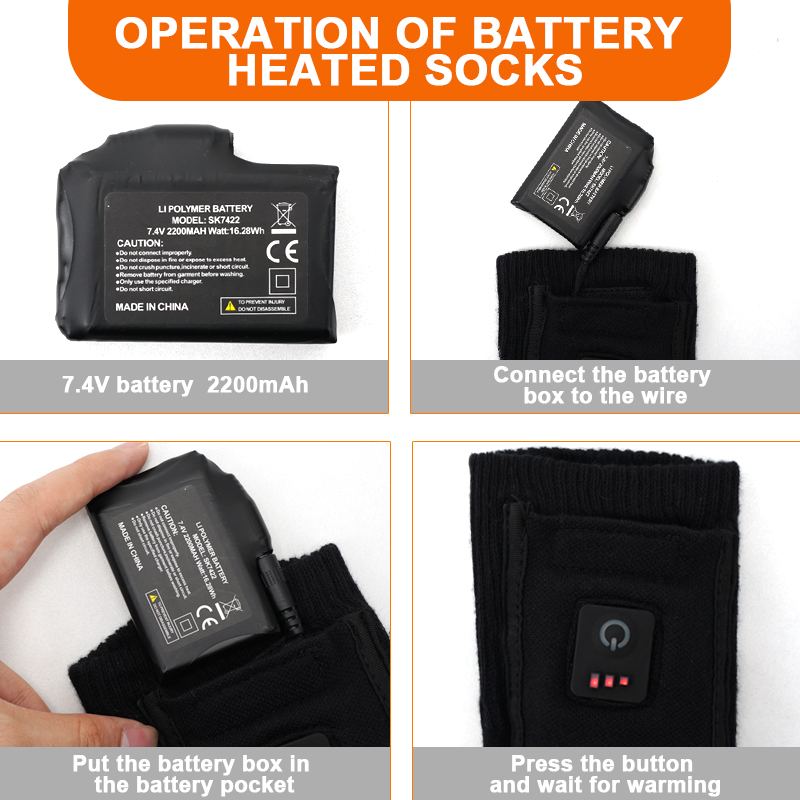
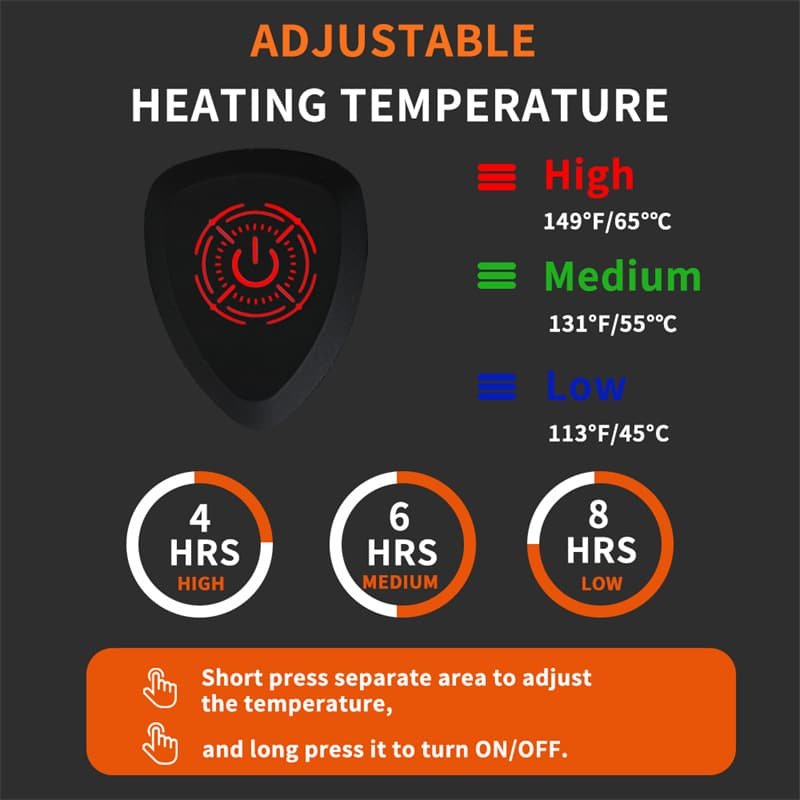
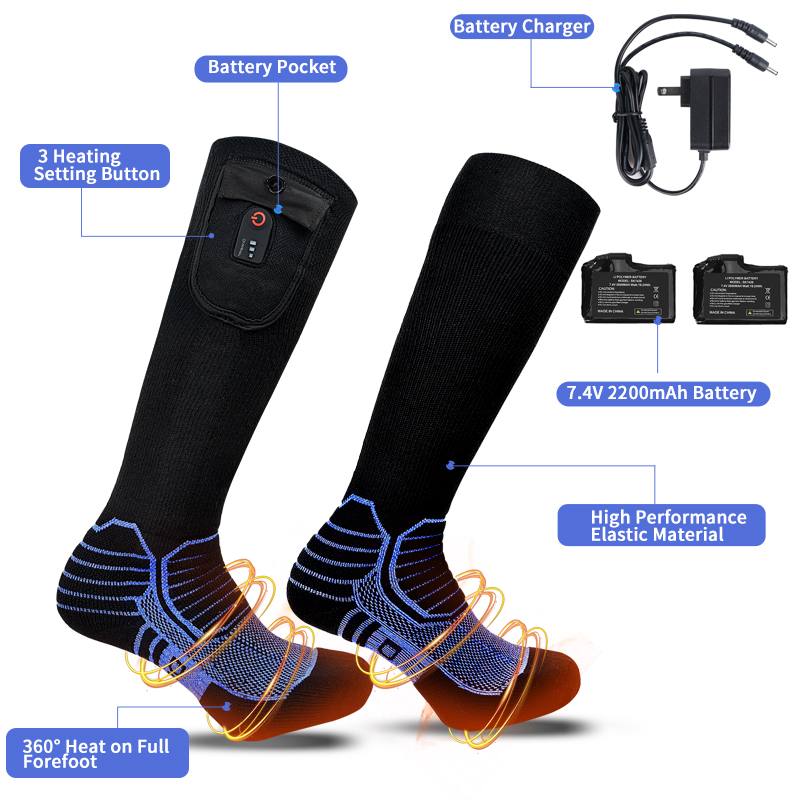
Charge the pack with the specified charger — 8.4V 1.5A on a 7.4V platform, 5V 2A on a 3.7V one — and charge it until the charger indicates completion rather than for an hour. Seat the plug fully, put the pack in its pocket, close the flap, then hold the button for a few seconds. Many controllers require a long press rather than a tap, and a tap that produces nothing is read as a dead sock.
If one sock still does not heat, exchange the two packs between left and right and try again. This one action splits every remaining possibility into two groups:
- The fault follows the pack. The sock is fine. The problem is the pack, its protection board or the charger — treat it as a power problem and stop looking inside the garment.
- The fault stays with the same sock. Both packs are fine. The problem is the plug, the wire or the element in that sock.
2. Read the symptom, not the cause list
| What the wearer sees | Most likely cause | Can it be fixed without returning the sock |
|---|---|---|
| Neither sock heats | Both packs flat, wrong charger, or the button was tapped rather than held | Yes — re-charge with the specified charger and long-press |
| One sock heats, one does not | That sock’s pack, plug or element | Yes for the pack; no for the plug or element |
| Warm at the toes but not across the foot, or the reverse | A break in one branch of the element, usually at the toe where it is thinnest | No — internal wiring is not user-serviceable |
| Warm at the calf but cold under the sole | Usually not a fault — check where the element is meant to cover before assuming a break | Yes, by checking the layout on the product page |
| Starts warm, drops after one to two hours | A cold pack at the calf giving up usable capacity, or the controller stepping down to protect it | Partly — keep the spare pack warm inside a jacket |
| Cuts out on high within minutes | Protection circuit acting on current or temperature | No — repeated shutdowns need inspection, not a reset |
| Worked before the wash, dead after | Water reached the heating layer, or the plug was left connected | No — this is the case to report rather than retry |
3. The heating area is smaller than most owners expect
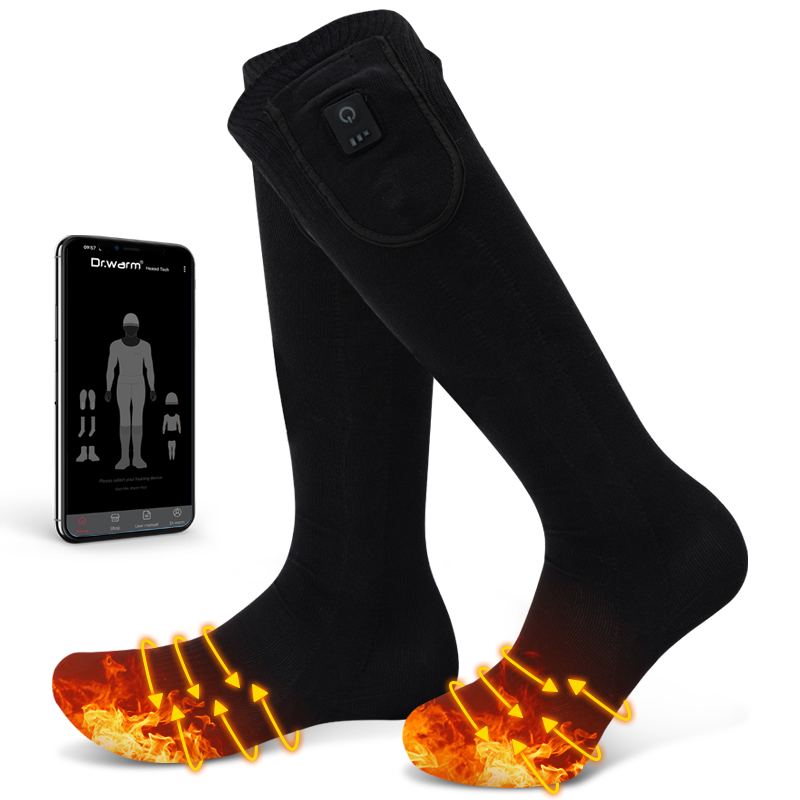
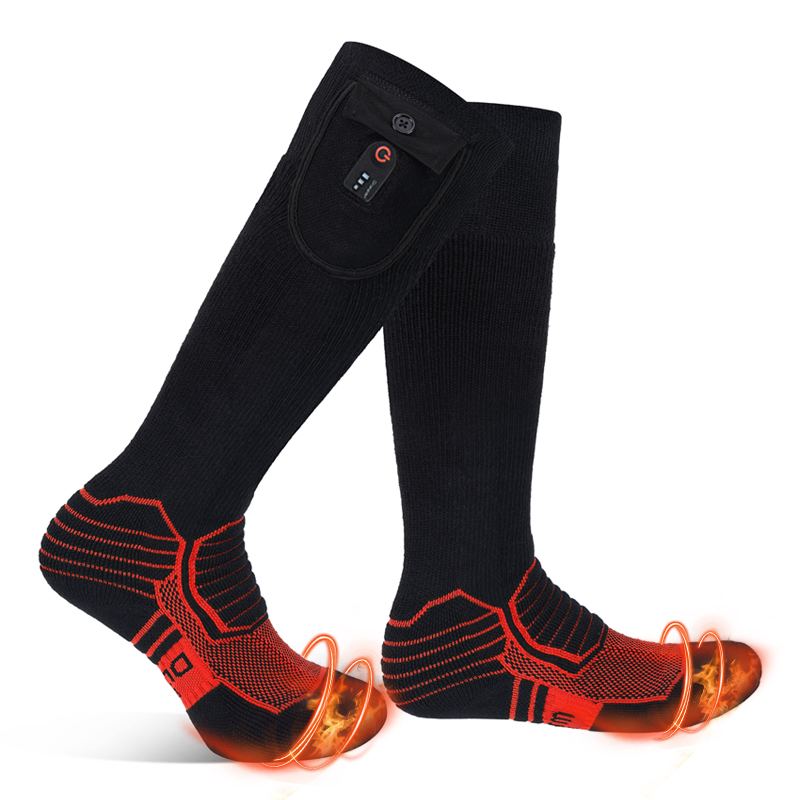
A share of “faulty” socks are simply being measured against the wrong expectation. The heated area runs from the toe box back across the forefoot, where the cold and the ground contact are; it does not run up the calf or over the instep. A wearer who reaches into the sock under the arch and finds it cool has not found a fault.
The other structural fact is that the two socks are separate products electrically. Each has its own pack, its own button and its own circuit, so one failing never takes the other down — which is reassuring in use and useful in diagnosis, because a working sock beside a cold one proves the charger and the method are sound.
4. Washing fault or manufacturing fault
Most sock returns happen in the first eight weeks of a winter, and they split into two groups that need different answers. The report from the wearer is identical in both; the timing is what separates them.
| When it appears | What points to a washing fault | What points to a build fault |
|---|---|---|
| First days | Nothing — too early for washing damage | A dead branch from new, an intermittent plug, uneven heat left to right |
| First wash | Stopped working immediately after, pack left connected or dried on a radiator | Rare — a first-wash failure on a correctly washed sock is a sealing issue |
| A few weeks in | Gradual loss of heat at the toe, sock washed often and tumble dried | Progressive loss without washing, or a plug that fails only when the calf flexes |
The distinction matters commercially, because the second column is a warranty conversation and the first is a care-label conversation. Either way the answer is not “try it again tomorrow”: a sock that has taken water into the heating layer will keep working intermittently for a while and then stop for good, and repeated resets simply postpone the return.
5. When the boot is the fault, not the sock
A meaningful share of cold-foot complaints have a working sock in them. Four situations produce the same report and none of them is an electrical fault.
- Two pairs of socks. A cotton or wool sock worn under the heated one puts an insulator between the element and the skin, and the foot is coldest exactly where the wearer thinks the heat should be. Heated socks are designed to be the layer next to the foot.
- A boot that is too tight. Compression does two things at once: it presses the element flat and it restricts blood flow, so the toes go cold even while the sock is drawing full power. If the boot was snug before, it is too small with a heated sock in it.
- The sock sliding down inside the boot. The element bunches, the heated area migrates towards the heel, and the warmth ends up in the wrong place. It looks like a partial failure because it feels like one.
- A rigid insole over the element. A thick or stiff insole spreads the load but also holds the element against the sole with no air gap, which makes the heat feel local and the foot feel cold everywhere else.
All four are worth ruling out before any return is raised, because they are cheap to test and expensive to get wrong: a customer who is told the sock is fine and finds out it was the boot does not come back for a second winter.
6. What to send the supplier so the answer is useful
Five items turn a complaint into a diagnosis, and they are the same five whether the buyer is a distributor handling an end customer or a brand handling a retailer.
- Which sock, which side, which level. “Left sock, medium, dead from new” is a diagnosis; “the socks do not work” is not.
- The result of the pack swap. This single line tells the supplier whether to ship a pack or a garment.
- Where the heat stops. Toe only, forefoot only, or nothing at all — the boundary is the location of the break.
- Wash history. How many times, at what temperature, and how it was dried. Most care-related failures become obvious here.
- Age and batch. A date and a batch code let the supplier check whether the rest of that run is affected.
Dr. Warm builds rechargeable heated socks for brands, distributors and retailers on 3.7V and 7.4V platforms, with element layout, pack position, calf pocket, control method and testing developed as one specification. The compliance file behind a sock order covers CE, UKCA, UL, FCC, RoHS, Reach, UN38.3, DOE, ISO 9001 and GB 47372-2026 with CCC. Standard cover is a 12-month manufacturer warranty, and the fault data from returns is fed back into the next build rather than filed — if you are specifying socks and want the failure modes designed out, our OEM and ODM service starts from your market and use case. The finished range is on our heated sock category page.
Frequently Asked Questions
Why does only one of my heated socks work?
Each sock has its own pack, button and circuit, so one failing never affects the other. Swap the two packs between left and right before anything else: if the fault moves with the pack it is a power problem, and if it stays with the same sock it is the plug or the element in that sock. A working sock beside a dead one also proves the charger and the switch method are fine.
My heated socks are warm at the toe but cold under the arch. Is that a fault?
Usually not. The heated area runs from the toe box back across the forefoot, where the cold and the ground contact are; it is not designed to heat the arch, the instep or the calf. Check the layout on the product page before treating it as a failure. A cold band inside the heated area itself is a break, a cold arch is the design.
Can heated socks be repaired if the element stops working?
No. The element is laminated inside the sock between the insulation and the comfort layer, and opening the garment destroys both the seal and the wiring. A sock with a dead branch is a replacement, not a repair, and any inspection should be done by the supplier rather than by cutting into the sock.
Do heated socks stop working after washing?
They should not, provided the pack is removed, the plug is left unconnected, the wash is cool and the sock is air dried away from radiators and tumble dryers. Water reaching the heating layer is the failure that matters, and it usually shows up as intermittent heat that fades over a few weeks rather than as an immediate death on the first wash.
Related Reading
- How to Wear Heated Socks Without Discomfort
- Heated Socks Buying Guide: Specs, Warmth, Control and Care
- How Long Do Heated Socks Last? Battery Life Explained
- Waterproof Heated Socks Care Guide: How to Protect Heating Components
- 3.7V vs 7.4V Heated Socks: Which Battery Version Matches Your Scenarios
- our heated sock range