
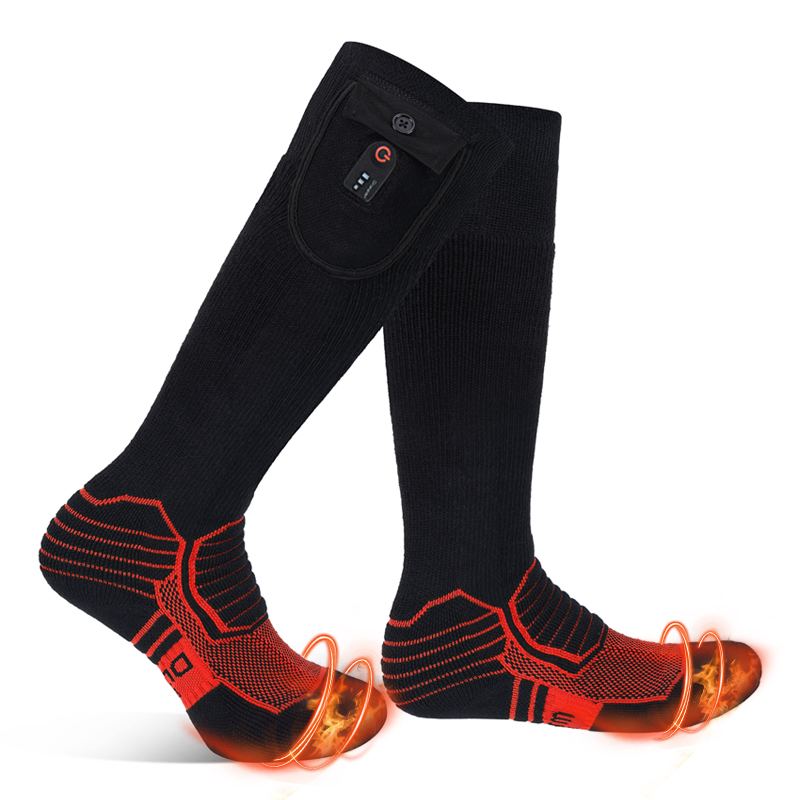
Short answer: 3.7V is the sensible platform for socks worn in normal footwear — cycling, commuting, everyday winter use — because the pack stays small enough to sit on the calf without the sock pulling down. 7.4V is for ski boots, long days in the cold, and buyers who want the heated area to cover the whole forefoot rather than the toes alone.
A heated sock has one constraint no other heated product has: the battery rides on the wearer’s calf, above the boot, on a garment that is stretchy by design. That single fact drives more of the specification than voltage does. This guide covers what each system really delivers, where 7.4V earns the extra bulk, and what to fix before tooling.
What 3.7V heated socks are
A 3.7V sock runs from a single-cell pack — 2,200mAh to 5,000mAh in our standard range, or 8.1Wh to 18.5Wh. The cell is light enough that a thin sock can carry it in a calf pocket without the cuff migrating south during a walk, and it charges from a 5V 2A adapter like any other 3.7V pack in the range.
This is the platform most everyday heated socks are built on, and for good reason: a sock that slides down is worse than a cold sock, because the wearer stops using it after one outing.
What 7.4V heated socks are
A 7.4V sock uses a two-cell pack — 2,200mAh, 3,000mAh or 4,000mAh, or about 16.3Wh, 22.2Wh and 28.1Wh. Doubling voltage halves the current for the same heating power, so a 7.4V sock can drive a larger heated area — full forefoot rather than a toe patch — and reach temperature faster, while keeping the conductor thin enough to survive being walked on.
The cost is mass on the calf. A two-cell pack in a thin sock wants to swing and pull, which is why 7.4V socks are almost always built with a structured pocket and a taller cuff, and why they suit boots far better than low shoes.
The number that actually decides runtime
Milliamp-hours only compare packs at the same voltage. Watt-hours is the figure that carries across systems, and it is the one most often missing from a quotation.
| System | Battery options | Watt-hours | Matched charger |
|---|---|---|---|
| 3.7V | 2,200 / 2,500 / 3,200 / 5,000mAh | 8.1 / 9.3 / 11.8 / 18.5Wh | 5V 2A |
| 7.4V | 2,200 / 3,000 / 4,000mAh | 16.3 / 22.2 / 28.1Wh | 8.4V 1.5A |
A 3.7V 3,200mAh pack holds 11.8Wh; a 7.4V 2,200mAh pack holds 16.3Wh with a smaller number on the label. Comparing the two by mAh compares nothing — which is how two suppliers can both be honest and still disagree by a factor of two.
Runtime on a real sock
Figures below are what we see on our own sock builds at three heat levels, pack at room temperature at the start. A pack that spent the night in a cold vehicle delivers less, which is covered in our guide to how long heated clothing batteries actually last.
| Sock build | Low | Medium | High |
|---|---|---|---|
| 3.7V, 2,200mAh | 5–7 h | 3–4 h | 2–3 h |
| 3.7V, 3,200mAh | 7–9 h | 4–5 h | 2.5–3 h |
| 7.4V, 2,200mAh | 7–9 h | 4–5 h | 2.5–3.5 h |
| 7.4V, 3,000mAh | 9–12 h | 5–7 h | 3–4 h |
What the table does not show: a 7.4V sock on high is warmer across the forefoot than a 3.7V sock on high, because the element can cover more area at the same power density. The shorter runtime is buying coverage, not just burning energy.
The sock-specific problem: the pack lives on your calf
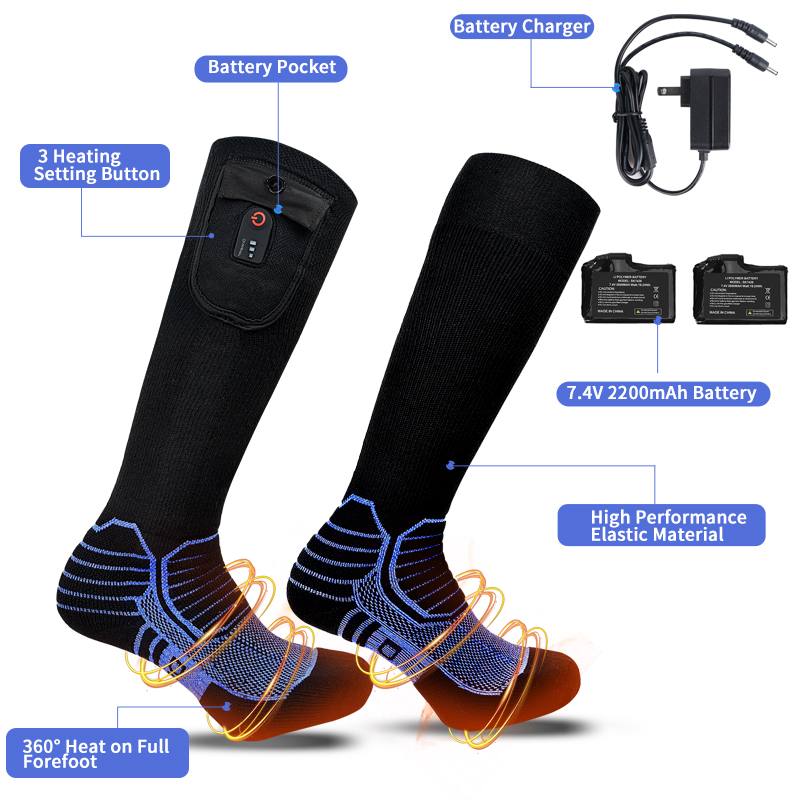
Gloves carry the pack at the wrist, insoles hide it under the foot, jackets put it in a pocket. A sock has to hold a battery on a moving calf, on a knitted tube that stretches. Three things go wrong if that is not designed properly:
The pocket droops. A 2,200mAh 7.4V pack is light enough for a tall cuff, but a heavier pack in an unsupported pocket pulls the sock down inside the boot within an hour. The fix is structural — a reinforced pocket panel and a cuff that grips below the knee — not a stronger elastic band.
The cuff fights the boot. A heated sock has to sit above the boot line while staying inside a ski or work boot at the ankle. Cuff height is a fit decision made per market: too tall and it bunches under a gaiter, too short and the pocket sits where the boot clamps.
Washing wrecks the wiring. Socks get washed far more often than gloves. The pack has to come out, the connector has to survive repeated mating, and the conductor has to tolerate flexing at the ankle every step — which is why we test socks through 3,000 to 5,000 bending cycles rather than by a single pull test.
Control: button, remote or app
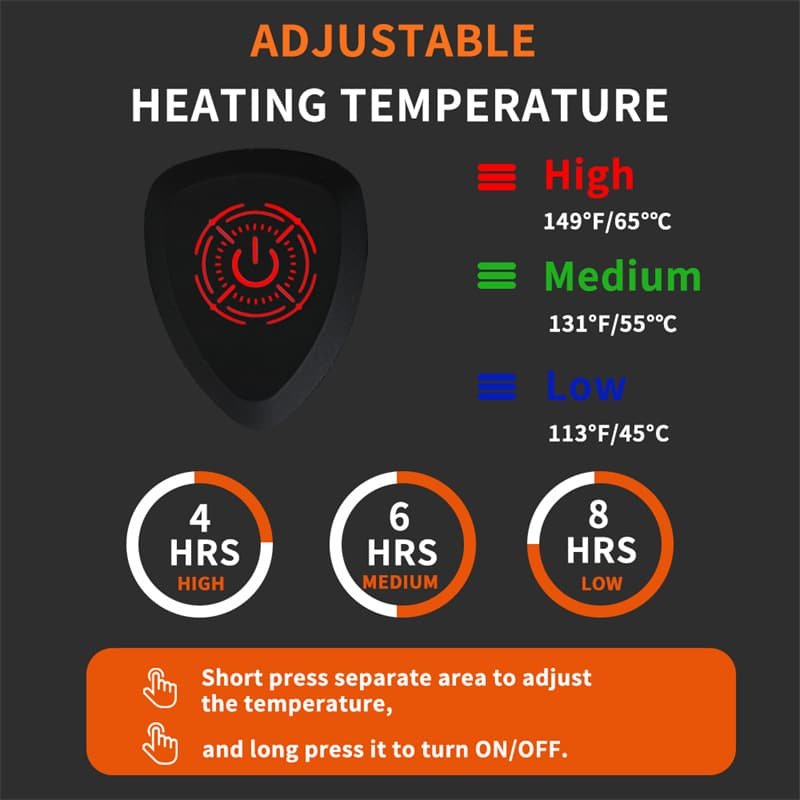
A three-setting button on the cuff is the default, and it is the right default — it works with gloves on, in the dark, with no pairing. App control adds two things that matter more than they sound: you can see the remaining battery level without taking the sock off, and you can set a shut-off duration so the sock stops heating instead of running flat in a boot.

What we would not do is put the only control in the app. A sock whose heat cannot be changed without a phone is a sock that gets returned by the first buyer whose phone battery dies.
Which version fits which use
Skiing and snowboarding
7.4V, 3,000mAh, tall cuff. A ski boot is rigid and cold-soaked, the foot does not move enough to make its own heat, and the sock has to hold warmth under a plastic shell for hours. This is where the larger pack and full-forefoot element earn their place.
Motorcycling and winter cycling
3.7V, or 7.4V for riders who are out for hours. On a bike the feet are less exposed than the hands, so a 3.7V sock on medium covers most commutes. Longer touring or riding in the rain shifts the balance toward 7.4V, because wet boots pull heat out of the foot continuously.
Everyday winter and indoor cold
3.7V, 2,200mAh. Thin, comfortable under normal shoes, and cheap enough to own two pairs. Nobody needs a 28Wh pack to sit at a desk.
Work and hunting
7.4V plus a spare pack. Standing on cold ground is the worst case: no activity heat, long duration, and boots that are worn for a whole shift. Two packs rotated at lunch is the practical answer.
What to specify if you are buying OEM
Voltage fixes the pack, the charger and the pocket structure, so settle it before sampling. Our battery solutions cover both platforms, and heating output is set per model between 30°C and 100°C rather than as one figure across the range.
Projects start from 100 units for OEM customisation of an existing sock platform, or 500 units for ODM development from a new design. Sampling runs 7 to 30 days, OEM production 20 to 25 days, ODM 50 to 60 days. Waterproofing is IPX4 as standard with IPX5 available, and socks are bending-tested through 3,000 to 5,000 cycles.
Compliance is documented per configuration and market — CE, UKCA, UL, FCC, RoHS, Reach, UN38.3 and DOE, with packs also covered against GB 47372-2026. What ships with each pack is a material safety data sheet, a transport document rather than a certification. Full documentation is on our certifications page, and the finished range is on the heated socks product page.
Three mistakes worth avoiding
Sizing the pack to the spec sheet rather than the pocket. A pack that does not fit the pocket either hangs loose or forces a pocket so large it shows through trousers. Decide the pocket geometry first, then choose capacity inside it.
Treating washability as an afterthought. If the connector is hard to unplug, the customer washes the sock with the pack in it exactly once. Make the connector obvious and the pocket label explicit.
Assuming 7.4V always means hotter feet. Coverage and placement matter more than voltage. A 3.7V element across the whole forefoot beats a 7.4V element concentrated at the toes, whatever the label says.
Develop Custom Heated Socks with Dr. Warm
Dr. Warm builds rechargeable heated socks in Dongguan for brands, distributors and retailers, covering heating-element design, pack and charger selection, knit construction, cuff height, private labelling and retail packaging. If you are choosing between a 3.7V and 7.4V platform for a sock programme, send the target footwear, market and runtime expectation, and we will specify the configuration around it through our OEM and ODM service.
Frequently Asked Questions
Do 7.4V heated socks stay up on the calf?
They can, but only with a structured pocket and a cuff that grips below the knee. A two-cell pack is heavier than a single cell, and in a thin sock with an unsupported pocket it pulls the sock down inside the boot within an hour. This is why 7.4V sock designs use a reinforced pocket panel rather than a tighter elastic.
How long do heated socks last on one charge?
On medium heat a 3.7V 2,200mAh sock runs about 3 to 4 hours, and 5 to 7 hours on low. A 7.4V 3,000mAh build runs about 5 to 7 hours on medium and 9 to 12 hours on low. A pack that starts cold delivers less, so warm it before a long day out.
Can heated socks be washed with the battery in?
No. The pack must come out before washing, every time. The connector has to unplug easily and the pocket should be labelled so the step is obvious — a sock washed once with the pack inside is usually a dead sock.
Is app control worth having on heated socks?
It adds two things that matter: you can read the remaining battery level without taking the sock off, and you can set a shut-off duration so the sock stops instead of running flat inside a boot. Keep a physical button as well, because a sock that cannot be adjusted without a phone gets returned.