
Short answer: 3.7V is the right choice for anything that has to disappear inside a normal shoe — dress shoes, sneakers, everyday boots — because the pack is small enough to keep the insole thin. 7.4V earns its place when the shoe has room and the wearer needs heat that holds against real cold: ski boots, work boots, long hours standing still.
The decision is not really about voltage. It is about how much energy you can fit under a foot without the wearer feeling it, and what the shoe will give you. This guide covers what each system costs you in thickness, how long each actually runs, and where the two cross over.
What 3.7V heated insoles are
A 3.7V insole runs from a single-cell lithium pack — 2,200mAh to 5,000mAh in our standard range, which works out to 8.1Wh at the bottom and 18.5Wh at the top. The cell is small enough to sit in the arch or under the heel without lifting the foot out of the shoe, which is why this is the platform most slim insoles are built on.
The pack charges from a 5V 2A adapter. On our cut-to-fit models the connection is magnetic, so the cable seats itself at the heel rather than needing a plug pushed into a recess that fills with grit over a winter.
What 7.4V heated insoles are
A 7.4V insole uses a two-cell pack — 2,200mAh, 3,000mAh or 4,000mAh, or roughly 16.3Wh, 22.2Wh and 28.1Wh. Doubling the voltage halves the current for the same heating power, so the element reaches temperature faster and the wiring can stay thin even when the heated area is larger.
What you pay for that is space. A two-cell pack is physically bigger, and an insole is the least forgiving place on the body to find room — there is a shoe upper above it and a sole below. This is why 7.4V insoles exist mainly for boots, and why a 7.4V design in a low-profile shoe usually ends up either thick or short on runtime.
The number that actually decides the runtime
Milliamp-hours only compare packs at the same voltage; the figure that carries across systems is watt-hours. Read the middle column below rather than the capacity column — a 3.7V 3,200mAh pack holds 11.8Wh, while a 7.4V 2,200mAh pack holds 16.3Wh with a smaller number printed on the label.
| System | Battery options | Watt-hours | Matched charger |
|---|---|---|---|
| 3.7V | 2,200 / 2,500 / 3,200 / 5,000mAh | 8.1 / 9.3 / 11.8 / 18.5Wh | 5V 2A |
| 7.4V | 2,200 / 3,000 / 4,000mAh | 16.3 / 22.2 / 28.1Wh | 8.4V 1.5A |
Note that the two systems do not share a charger. A 7.4V pack on a 5V adapter will not charge, and a 3.7V pack on an 8.4V adapter is a fire risk rather than a mistake. If a programme mixes both platforms for different models, label the chargers and keep them apart in the box.
Runtime in a real shoe
These are ranges we see on our own insole builds, with the pack at room temperature at the start. A pack that has spent the night in a cold car gives less — the chemistry delivers less usable capacity when it is cold, which is covered in our guide to how long heated clothing batteries actually last.
| Insole build | Low | Medium | High |
|---|---|---|---|
| 3.7V, 2,200mAh | 5–7 h | 3–4 h | 2–3 h |
| 3.7V, 3,200mAh | 7–9 h | 4–5 h | 2.5–3 h |
| 7.4V, 2,200mAh | 7–9 h | 4–5 h | 2.5–3.5 h |
| 7.4V, 3,000mAh | 9–12 h | 5–7 h | 3–4 h |
One thing the table cannot show: on high, a 7.4V insole is genuinely hotter under the forefoot than a 3.7V one at the same stated level. So the shorter runtime is buying comfort in deeper cold, not just draining faster.
Thickness is the constraint that decides everything
An insole has less room than any other heated product. A glove can carry a pack in the cuff; a jacket has pockets. An insole sits between the foot and the sole, inside a shoe that was designed with no battery in mind. Every millimetre of pack is a millimetre the wearer feels under the arch, and in a tight shoe that is the difference between “I forgot I was wearing it” and “I took it out after twenty minutes”.
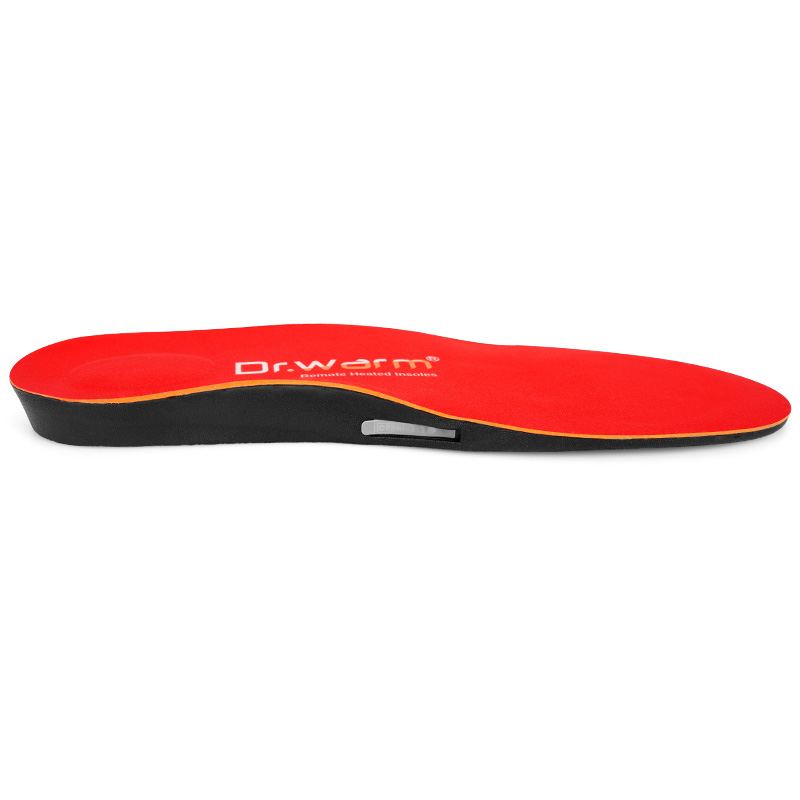
This is the practical argument for 3.7V in daily footwear. A single 2,200mAh cell fits in the arch; a 5,000mAh cell of the same chemistry takes noticeably more room, and a two-cell 7.4V pack more again. If a shoe has a removable factory insole and a deep heel cup, an insole can be built thicker. If it is a low-profile derby or a cycling shoe, the ceiling is much lower.
Cut-to-fit construction solves the other half of the problem. Insoles are supplied in a size range and trimmed to the shoe, which means the heating element has to be laid out so that trimming does not cut through a conductor. That is a design decision made at tooling, not something a buyer can correct later.
Charging: magnetic connectors change daily use
An insole is charged in place more often than it is removed. A magnetic connector at the heel lets the wearer drop the shoe on the cable without pulling the insole out, which matters in a boot that has been laced up for a shift. On our cut-to-fit models the same connector serves both the 3.7V and 7.4V platforms, but the charger behind it differs: 5V 2A for 3.7V, 8.4V 1.5A for 7.4V.

Charge time tracks pack size. A 7.4V 2,200mAh pack on its matched charger takes roughly 3.5 to 4 hours; a 3,700mAh-class 3.7V pack takes a similar span on 5V 2A; the largest 5,000mAh cells run longer. Charging overnight is the normal pattern, and quick-charge circuits shorten it at the cost of heat inside a sealed shoe component — not a trade we recommend for a pack that lives under a foot.
Which version fits which use
Commuting and dress shoes
3.7V, 2,200mAh. The shoe is the constraint, not the cold: a thin insole that fits a derby on medium heat covers a commute and recharges overnight. Going to 7.4V here forces either a thicker insole or a smaller pack that runs no longer than the 3.7V option.

Skiing and snowboarding
7.4V, 3,000mAh. A ski boot has volume to spare and the foot is immobile for hours in real cold, which is exactly the case where extra energy and a larger heated area pay off. Heat here is also a fit issue — cold feet make a boot feel tighter, and warmth restores the fit.
Hunting, ice fishing and long static work
7.4V, 3,000mAh or 4,000mAh, plus a spare pack. Standing still is the worst case for runtime because there is no activity producing heat, and a second pack costs less than ending a session early.
Work boots and motorcycling
7.4V in a boot, 3.7V if the footwear is a normal work shoe. On a motorcycle the foot is out of the wind behind a fairing more than riders expect, so the insole is topping up warmth rather than fighting windchill — but a cold commute still starts at the sole.
What to specify if you are buying OEM
Voltage choice locks in the pack, the charger and the insole construction, so settle it before tooling. Our battery solutions cover both platforms, and heating output is set per model between 30°C and 100°C rather than as one figure across a range.
Projects start from 100 units for OEM customisation of an existing insole platform, or 500 units for ODM development from a new design. Sampling runs 7 to 30 days, OEM production 20 to 25 days, ODM 50 to 60 days. Insoles are bending-tested through 3,000 to 5,000 cycles, because a foot flexes every step and a conductor that fails at the arch fails in the first month. Waterproofing is IPX4 as standard with IPX5 available.
Compliance is documented per configuration and market — CE, UKCA, UL, FCC, RoHS, Reach, UN38.3 and DOE, with packs also covered against GB 47372-2026. What ships with each pack is a material safety data sheet, a transport document rather than a certification. Full documentation is on our certifications page, and the finished range is on the heated insoles product page.
Three mistakes worth avoiding
Chasing watt-hours in a shoe that has no room. A 28Wh pack that lifts the heel out of the shoe is worse than an 8Wh pack the wearer forgets about. Fit first, then energy.
Assuming 7.4V is always hotter. Voltage sets the current for a given power, not the power itself. A 3.7V insole with a well-placed element over the forefoot can feel warmer than a 7.4V design that wastes heat under the arch.
Mixing chargers across a range. If one programme ships 3.7V insoles and another 7.4V, the two adapters must never be interchangeable in the box. Colour-code them or use different plug barrels.
Develop Custom Heated Insoles with Dr. Warm
Dr. Warm builds rechargeable heated insoles in Dongguan for brands, distributors and retailers, covering heating-element design, pack and charger selection, insole construction, private labelling and retail packaging. If you are deciding between a 3.7V and 7.4V platform for a new insole programme, send the target footwear, price band and runtime expectation, and we will specify the configuration around it through our OEM and ODM service.
Frequently Asked Questions
Will 7.4V heated insoles fit inside normal shoes?
Usually not comfortably. A 7.4V pack uses two cells, and an insole has almost no spare room between the foot and the sole. In a low-profile shoe that extra volume either lifts the foot or forces a smaller pack that runs no longer than a 3.7V option. Reserve 7.4V insoles for boots with volume to spare.
How long do heated insoles last on one charge?
On medium heat, a 3.7V 2,200mAh insole runs about 3 to 4 hours, and 5 to 7 hours on low. A 7.4V 3,000mAh build runs about 5 to 7 hours on medium and 9 to 12 hours on low. A pack that starts cold delivers less, so warm the pack before a long day outdoors.
Can heated insoles be cut to fit my shoe size?
Yes on cut-to-fit models. The heating element is laid out so that trimming along the marked line does not cut through a conductor. Trim in small increments from the toe end and check the fit before cutting further, and never cut beyond the marked line.
Do 3.7V and 7.4V insoles use the same charger?
No. A 3.7V pack charges from a 5V 2A adapter, while a 7.4V pack needs an 8.4V 1.5A charger matched to it. The two are not interchangeable — a 3.7V pack on an 8.4V adapter is a safety risk, and a 7.4V pack on a 5V adapter simply will not charge.