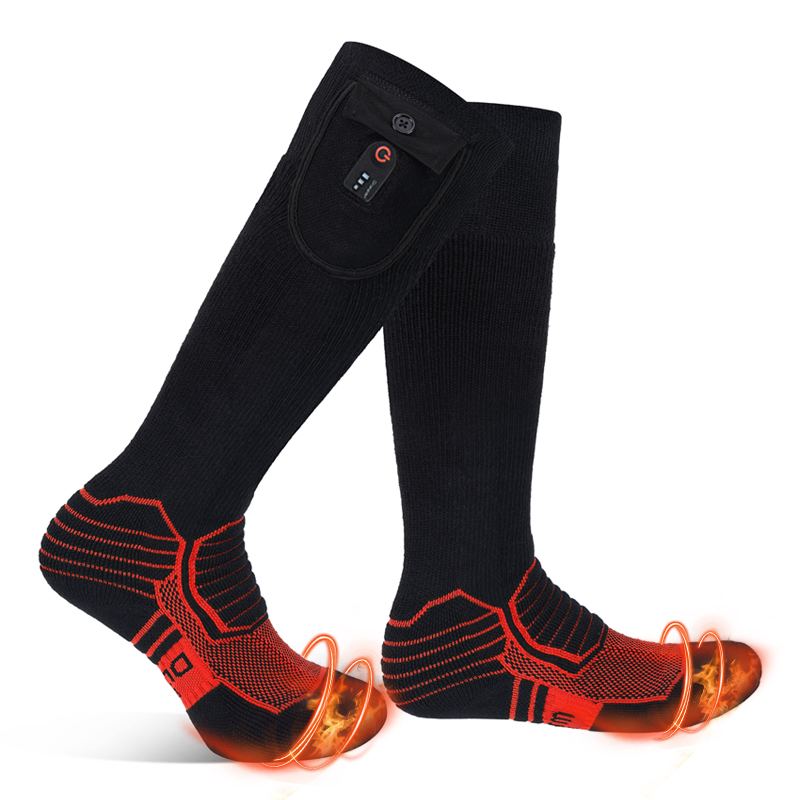
Short answer: there is no best heated sock in the abstract, because a heated sock is the only heated product whose performance is decided by something the buyer does not buy — the shoe. A riding boot, a snow boot and a trainer each allow a different thickness, a different sock height and a different place for the battery, and the length of the stop-over decides how much capacity is worth carrying. Choose the shoe first, and the sock specification follows.
The three use cases in the title are usually presented as three lists of features. They are really three constraint sets, and the constraints come from footwear and from how long the wearer is away from a socket. That is what this guide sorts out.
Three scenarios, four differences that matter
| Scenario | Room inside the footwear | Time away from a charger | What the foot has to feel | What that decides |
|---|---|---|---|---|
| Motorcycling | Tight, stiff, with armour at the ankle and instep | One to two hours, then a socket | Gear lever and brake pedal | Thin foot, mid-calf height, pack clear of the ankle armour, buttons operable with a riding glove |
| Camping and ice fishing | Generous — snow boots are built with spare volume | A day or more, often with no power at all | Nothing precise; the foot is standing or sitting still | Capacity over peak heat, a higher sock, and a spare pack carried warm |
| Daily winter use | Minimal — trainers and leather shoes have no spare room | Charged every night at home | Normal walking; the sock should be invisible | Thinnest construction, modest capacity, and a build that survives frequent washing |
1. Motorcycling: the boot limits more than the weather
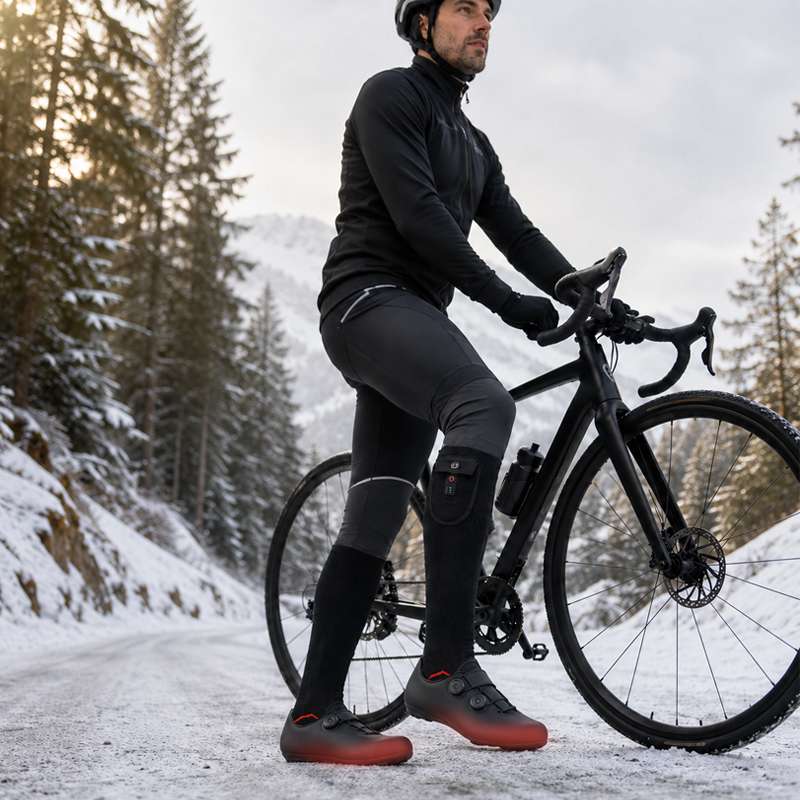
A riding boot is the most hostile environment in the whole category. It is stiff, it is tight across the instep, it has a gear-shift pad and often an ankle cup, and it is designed to protect a foot rather than accommodate a sock. Four consequences follow.
- The foot has to be thin. Thickness at the instep does not just feel tight; it changes where the gear lever contacts the boot, and a rider notices that within the first kilometre.
- The pack has to sit clear of the ankle. A battery pocket that lands under an ankle cup is pressed against bone for the whole ride. Mid-calf is the safe position, which is why a sock that works in a trainer may be unusable here.
- The control has to work with a glove on. Riding gloves are thick and the road is vibrating. A button that needs a thumbnail is a button that will not be pressed until the next stop.
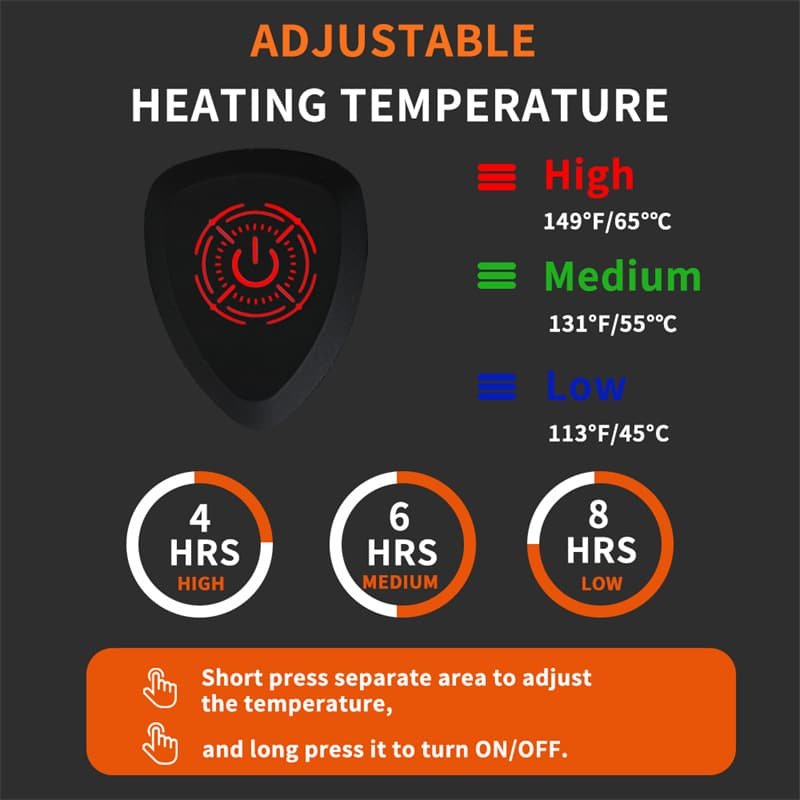
- Steady beats peak. A rider loses heat to wind continuously, so a stable medium setting is worth more than a high setting that trips the protection circuit twenty minutes in. The watt-hour arithmetic behind that is in our runtime analysis.
One behaviour is worth designing for as well: feet get coldest after the ride stops, not during it. A sock that can be left on a low setting while the rider walks into a building solves a complaint that no higher wattage will.
2. Camping: duration and charging, not peak heat

Camping and ice fishing invert the priorities. The footwear is roomy, so thickness is free; what is not free is energy. A day outdoors with no mains supply means the decision is capacity and redundancy, not maximum temperature.
Three practical points. A low setting held for eight hours will keep a stationary foot warmer than a high setting that dies at two and a half — the energy is the same, the distribution is not. A spare pack carried inside a jacket keeps its capacity, because a pack that has sat at -10°C all night delivers noticeably less than its rating. And a 5V USB platform earns its place here in a way it does not for riding: a 10,000 or 20,000mAh pack doubles as a phone charger, which matters when the trip is three days long.
For a stationary activity, the heating area is also worth a second look. A layout built for a walking foot concentrates on the toe and forefoot, where the cold and the ground contact are; a foot that is not moving benefits from coverage further back as well. This is the same geometry that makes heated insole selection a separate decision rather than a substitute.
3. Daily winter use: thin, and the wash decides the lifespan
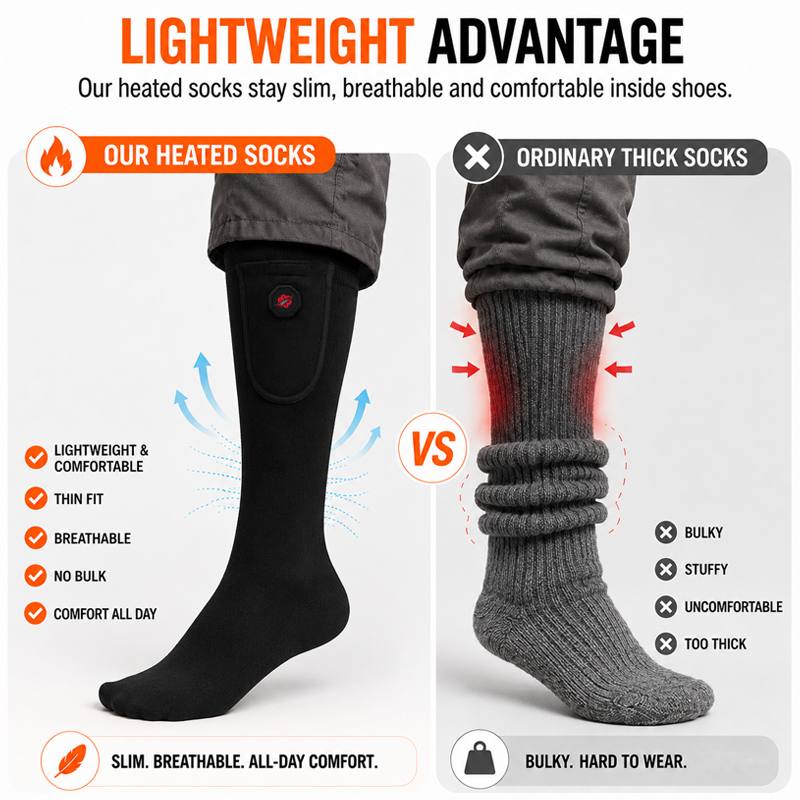
Daily use is the least demanding scenario thermally and the most demanding structurally. A trainer or a leather shoe has no spare volume, the commute is short enough that a 3.7V pack in the 2,200 to 3,200mAh range is sufficient, and the wearer has a socket every night — so capacity is not the constraint.
What limits the product here is washing. A sock worn to work is washed several times a month, which is far more often than any other heated garment, and it is the single largest cause of care-related failure in the category. If daily use is the plan, the specification that matters is a laminate and a connector built for repeated washing, plus a care routine the owner will actually follow — which is exactly what our care guide is for. A sock that fails in March is usually a sock that was washed correctly but dried incompletely.
4. Four specifications, and what choosing them wrongly feels like
| Specification | Chosen too far one way | What the wearer reports |
|---|---|---|
| Foot thickness | Too thick for the shoe | “My feet are squeezed” or “I cannot feel the lever” — and a sock that gets left in a drawer |
| Sock height | Too high for the boot | Bunching at the cuff, and a battery pocket fighting the boot collar |
| Heating area | Toe-only on a stationary activity | “The toes are warm and the rest of the foot is cold” — often read as a fault rather than a layout |
| Control | Pocket-level button with no lock | Heat that changes level by itself when a boot is pulled on, or a button that cannot be reached with gloves |
5. The thing no product page tells you: the insole is competing for the same space
A heated sock and a heated insole are sold as separate products and used in the same shoe. Together they take two layers of the little volume that exists, they add two heat sources with two controllers, and they are harder to dry than either one alone. For most buyers the honest answer is one or the other: the sock for walking and riding, where the foot moves and the cold arrives at the toe, and the insole for standing and hard soles, where the ground is the heat sink. Our guide to socks versus insoles sets out where the line falls.
Dr. Warm builds heated socks for brands, distributors and retailers on 3.7V and 7.4V platforms, with knit thickness, sock height, heating area, pack position, control method and packaging specified against the footwear the product is sold for rather than against a general “winter” brief. The compliance file covers CE, UKCA, UL, FCC, RoHS, Reach, UN38.3, DOE, ISO 9001 and GB 47372-2026 with CCC. If you are building a range that has to serve riding, outdoor and everyday retail at once, send the three use cases and the footwear through our OEM and ODM service and we will specify what differs between them. The finished range is on our heated sock category page.
Frequently Asked Questions
Are heated socks worth it for motorcycling?
They solve a specific problem rather than the whole of it. A riding boot is stiff, tight and armoured, so the sock has to be thin at the foot with the pack above the ankle, and it has to hold a steady medium setting rather than a short burst of high heat. What they do not fix is the cold that arrives after the ride stops, which is why being able to leave the sock on low afterwards matters more than the headline temperature.
How long will heated socks last on a camping trip?
Plan on capacity and a spare rather than on the label. A low setting held for eight hours usually beats a high setting that dies in two, and a pack that has spent the night at -10 degrees Celsius delivers less than its rating, so the spare should be carried inside a jacket. On a three-day trip a 5V pack that also charges a phone is often the more useful choice.
Can I wear heated socks in normal trainers?
Yes, if the sock is built for it. The constraint is volume: a trainer or a leather shoe has no spare room, so a bulky construction changes the fit and the shoe becomes uncomfortable within the hour. Look for a thin foot with the pack on the calf rather than at the ankle, and check that the sock is no thicker than the ordinary sock it replaces.
Should I use heated socks or heated insoles?
Usually one, not both. They compete for the same space inside the shoe and each brings its own heat source and controller. Socks suit walking and riding, where the foot moves and the cold arrives at the toe; insoles suit standing on hard or frozen ground, where the sole is the heat sink. Using both at once makes the shoe tight and the pair harder to dry.