Short answer: yes, and the constraint is not whether custom heated socks can be made but how precisely you describe them. A factory can quote two products from the same sentence — “custom heated socks, 500 pairs” — and the difference between those two quotes is usually 30 to 40 percent, because five separate purchases are hiding inside that sentence. An enquiry that names all five gets comparable numbers; one that does not gets a placeholder price that will move three times before the order is placed.
This is written for the first message rather than the whole programme. The process itself — sampling stages, approvals, inspection — is covered in our guides to MOQ, lead time and custom options and to private-label production. What follows is how to write the enquiry so those stages start from the right product.
A sock quote is five purchases, not one
| Cost line | Options that exist | What moves the price |
|---|---|---|
| The knit | Plain circular knit, jacquard zoning, terry padding; single-piece or cut-and-sew | Jacquard and terry cost more, and each extra size splits the same order into smaller runs |
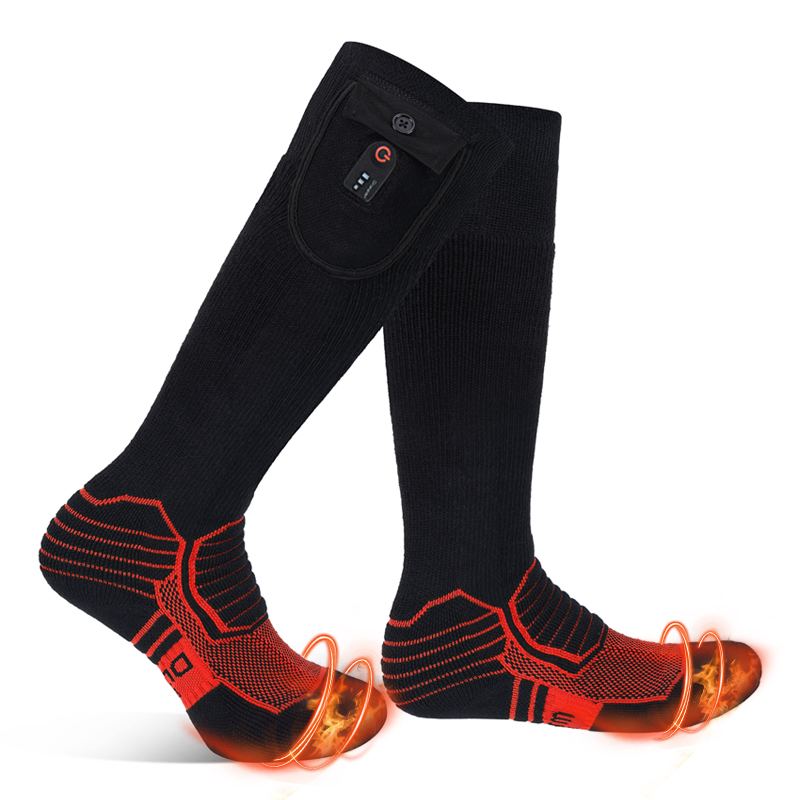
| The heating system | Wire, carbon fibre or film; toe and forefoot, or extended to the instep; single or dual zone | Covered area and zone count both raise the element cost and the power draw |
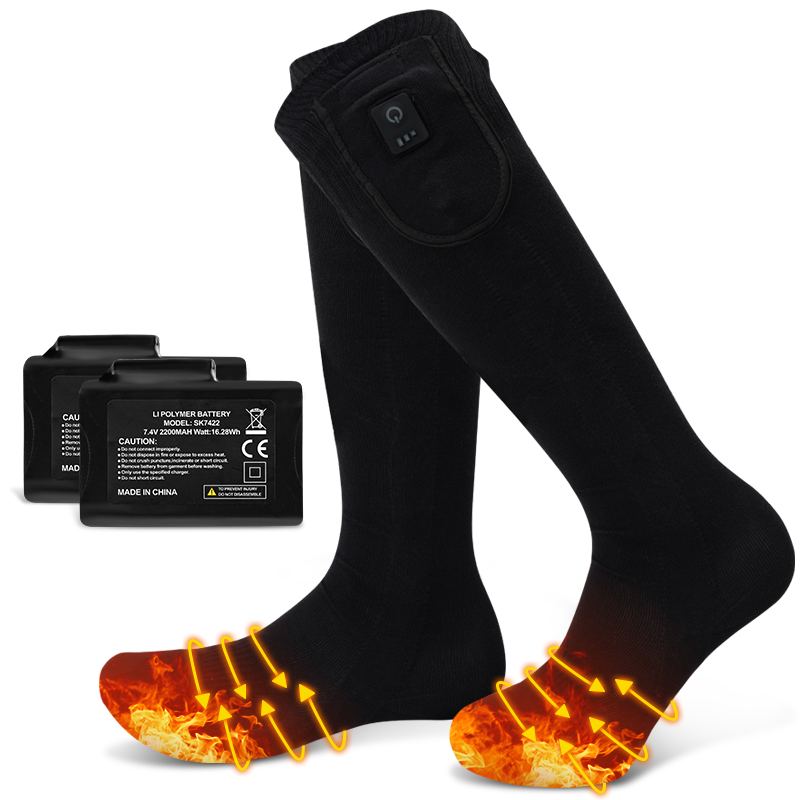
| The packs | 3.7V at 2,200, 2,500, 3,200 or 5,000mAh; 7.4V at 2,200, 3,000 or 4,000mAh | Cell count, and whether a custom protection board is required |
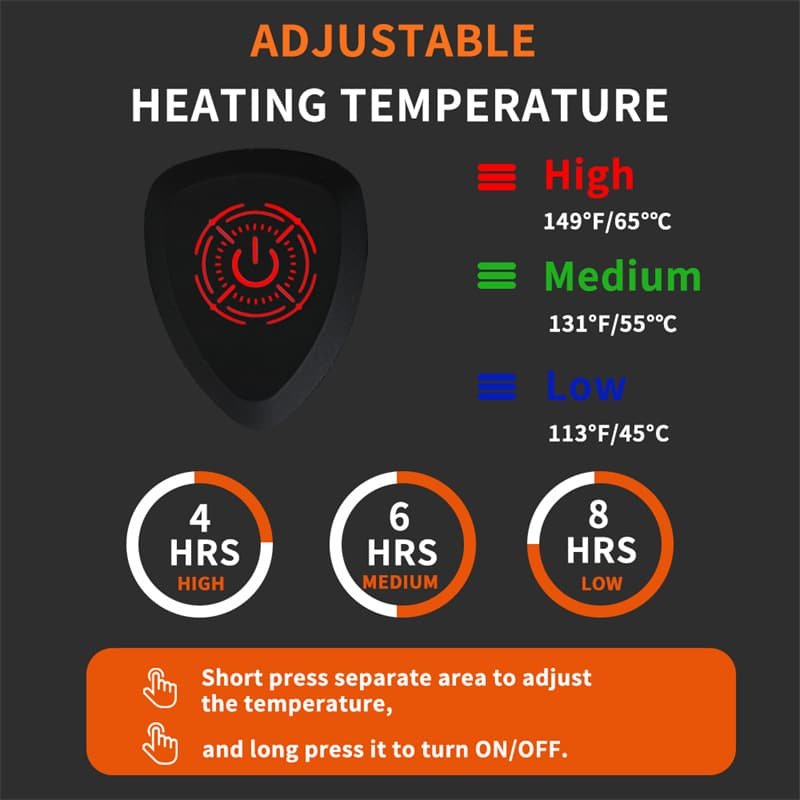
| The control | Single button with three levels, dual channel, remote, or app | Every additional channel or wireless module adds a board and a certification question |
| The packaging | Poly bag, printed retail box, gift box, with barcode, manual and label set | A per-unit cost that does not scale down with quantity — the line most often left out of a first quote |
Two suppliers can therefore both be honest and still be 40 percent apart. One quoted a plain knit with a wire element, a 3.7V 2,200mAh pack and a poly bag; the other quoted jacquard zoning, film heating across the forefoot, a 7.4V pack and a printed box. Neither price is wrong. Only one of them is the product you asked for, and the enquiry is what decides which.
Write the sock, not the adjective
The single biggest improvement a buyer can make is replacing evaluative words with physical ones. A supplier cannot quote “premium” or “long-lasting”; it can quote a knit structure, a covered area and a capacity.
- “High quality warm heated socks” becomes “knee-high sock, jacquard knit, heating across the toe and forefoot, no heat at the calf”.
- “Long battery life” becomes “7.4V 2,200mAh pack, at least 4 hours on the middle setting at -5 degrees Celsius”.
- “Waterproof” becomes “water-resistant foot with a sealed battery pocket; state which seams are taped and how the cuff closes”.
- “Custom packaging” becomes “printed retail box with barcode and a four-language manual, one box per pair”.
None of these sentences is longer than the adjective it replaces, and each one removes a decision the supplier would otherwise make for you — at the cheapest available option, because that is what an open specification invites.
The parameters that belong in the first message
| Send this | Example of a usable answer |
|---|---|
| Market and use case | Canada, outdoor work and ice fishing, sold through farm and hardware retail |
| Sock height and knit | Knee-high, terry foot, jacquard at the ankle |
| Heating area | Toe and forefoot, single zone, no calf heat |
| Voltage and capacity | 7.4V, 2,200mAh to start, 3,000mAh as a premium variant |
| Control | Single button, three levels, no app |
| Connector family | Name it — USB, micro, Type-C, DC barrel, magnetic or DC socket — because a plug that fits is not the same as a plug that matches |
| Size range and split | S to XL with the quantity split per size, not just the total |
| Quantity and programme | 500 pairs; stock from 1 unit, OEM from 100, ODM from 500 — say which one you are asking for |
| Branding and packaging | Woven label, printed box, barcode, manual languages, logo files in vector |
| Compliance and destination | Which documents the market requires — the file covers CE, UKCA, UL, FCC, RoHS, Reach, UN38.3, DOE, ISO 9001 and GB 47372-2026 with CCC |
| Dates and price frame | Goods-in date, target FOB, and the retail price the product has to sit at |
The target retail price matters more than buyers expect. It tells the supplier which of the five cost lines can absorb the difference, and it prevents the most common waste in the whole process: a beautiful sample for a product that cannot be sold at the price the market pays.
What the sampling fee buys, and what it does not

Sampling runs from 7 to 30 days depending on whether the knit and the element already exist. The fee usually covers materials and a small production run, and it is normally credited against the bulk order rather than refunded — worth confirming in writing, because the two arrangements behave very differently if the programme is cancelled.
What a sample does not prove is durability. One pair, worn indoors for ten minutes, tells you the fit, the button feel, the heat distribution and whether the pocket sits where it should. It cannot tell you whether the element survives a hundred washes, and no supplier can honestly promise that from a sample. That question is answered by the test programme behind the product and by the warranty terms — 12 months as standard — not by the sample itself.
Four questions that separate a factory from a trader
Most sourcing problems are not quality problems; they are visibility problems. A trader can answer a price question and cannot answer these four, and the answers cost nothing to ask for.
- Where is the element made and where is it laminated? A factory names the process and the line. A trader names a supplier.
- Who programmed the controller, and can the firmware be changed? Custom behaviour — a lower low setting, an auto shut-off, a battery indicator — lives in firmware, and a trader cannot commission it.
- What does your outgoing inspection test, item by item? Ask for the list. Resistance per unit and a heat-up check per unit are the two that matter, and a genuine factory writes them down.
- If the pack changes capacity, does the controller need re-certifying? The answer reveals whether the compliance file is the factory’s own or a document borrowed from someone else’s product.
Packaging carries claims as well as cost
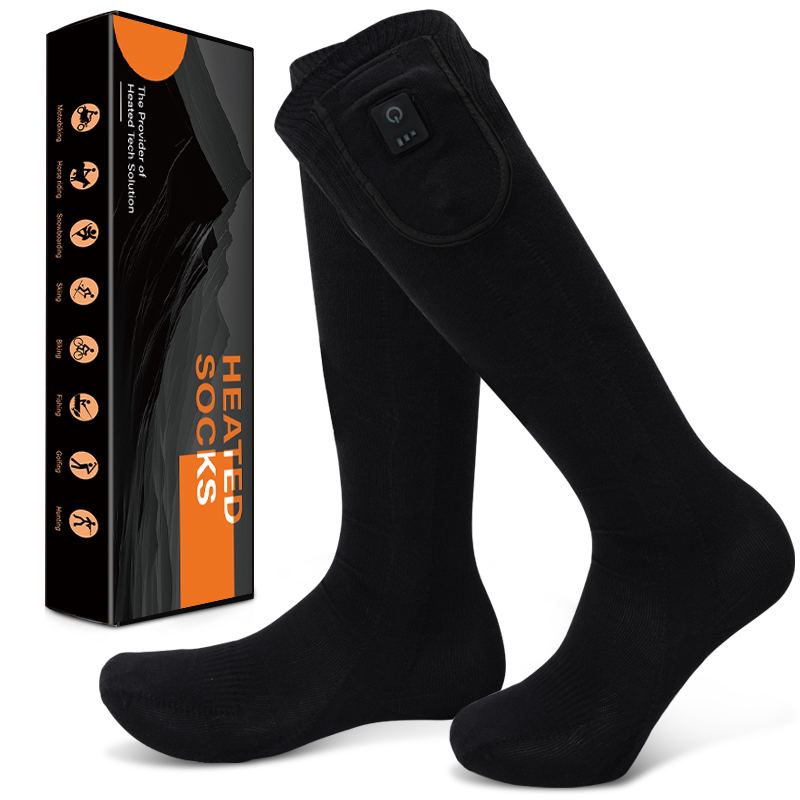
A retail box is priced per unit, so it is the line that hurts most at low volume and the line that gets cut first when a quote has to come down. It is also the one place where a claim can be created by accident: an icon saying a sock is waterproof, or a temperature range with no test behind it, becomes the buyer’s statement once the goods are imported and the box is on a shelf.
So specify the box and audit the artwork. Approve the icons as carefully as the logo, and keep the wording consistent with what the product actually does — water-resistant at the foot is a different promise from waterproof, and only one of them is defensible at a returns desk. Our list of sourcing mistakes covers the rest of the pattern, and the difference between the two manufacturing models is set out in OEM versus ODM.
Dr. Warm builds custom heated socks for brands, distributors and retailers on 3.7V and 7.4V platforms, with knit structure, heating area, pack capacity, connector family, controller, labelling and retail packaging developed as one specification. Stock starts at 1 unit, OEM at 100 and ODM at 500, sampling runs 7 to 30 days, mass production within 45 days, and standard cover is a 12-month manufacturer warranty. Send the eleven points above through our OEM and ODM service and the first reply will be a comparable quotation rather than a starting figure. The finished range is on our heated sock category page.
Frequently Asked Questions
What is the MOQ for custom heated socks?
Stock orders start from 1 unit, OEM from 100 units and ODM from 500 units. The number that matters is not the total but the split per size: 500 pairs across four sizes is a different production run from 500 in one size, and the per-unit price reflects it. Ask for the quotation to show the size split you gave it.
How long do sampling and production take?
Sampling runs 7 to 30 days depending on whether the knit and the element already exist in the factory’s library. Once the sample is approved, OEM production is typically 20 to 25 days and ODM 50 to 60 days, with mass production inside 45 days. A schedule shorter than that is paid for in overtime or in testing that gets skipped.
Is the sample fee refundable?
Usually it is credited against the bulk order rather than refunded, and the two arrangements behave very differently if the programme is cancelled. Confirm in writing whether the fee is credited, deducted from the first invoice or returned, and what happens to the sample if the order does not go ahead.
Can I use my own packaging and logo?
Yes, from the woven label and printed box to the barcode and manual. Two things to watch: packaging is priced per unit so it does not scale down with volume, and every icon or claim printed on the box becomes the buyer’s statement after import. Approve the artwork as carefully as the logo.