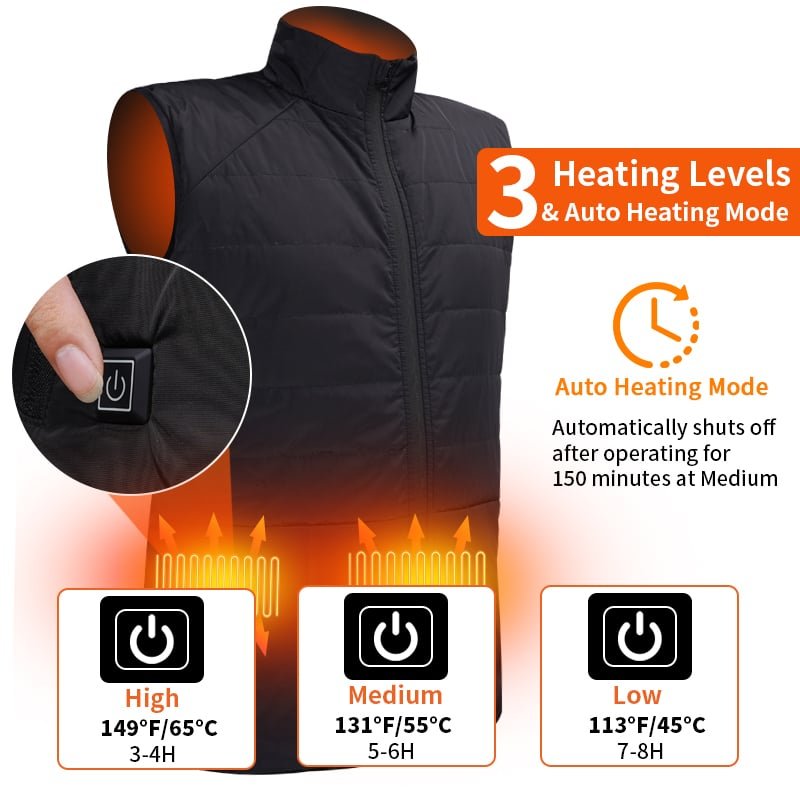

Quick answer: A graphene heated vest uses a thin conductive film that spreads heat across a wider surface than a wire element. In principle that means more even warmth in a lighter, flatter layer. In practice the result depends on the film quality, the zone drawing, the controller and how the element is bonded into the garment — so the specification sheet and heating-uniformity test data matter more than the material name.
This guide is for buyers comparing element technologies for a private-label vest programme. For the broader garment decision, see heated jackets vs heated vests and our heating system explanation.
How a Graphene Heated Vest Works
A heated garment is a low-voltage circuit: a battery feeds a controller, which regulates current to a resistive element bonded into the fabric. In a conventional vest the element is a carbon-fibre or metal wire routed in a pattern across the chest, abdomen and back. In a graphene version the resistive layer is a flexible film or printed sheet, so current flows across an area rather than along a line.
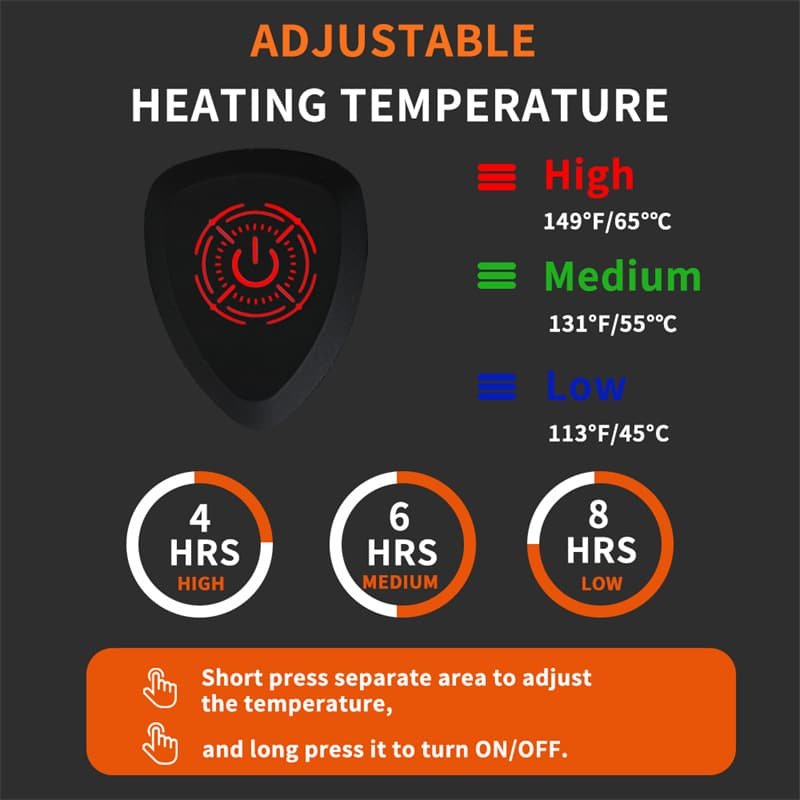
That changes the heat distribution, not the physics. The controller still decides how much power reaches the element, and the battery still sets the ceiling on runtime. On the standard garment platform used across vests, jackets, base layers and heated trousers, three levels run Low 35-40°C, Medium 45-50°C and High 55-60°C, specified per model in degrees Celsius. A film element does not make a vest hotter; it changes where the warmth appears.

Potential Benefits — and What to Verify
| Claimed benefit | Why it can be true | What to ask for |
|---|---|---|
| More even surface heat | Current spreads across a film rather than a narrow wire | Heating-uniformity mapping at Low, Medium and High |
| Thinner, more flexible layer | Printed films add little bulk at the chest | Flexing and wash-cycle test results |
| Fast warm-up | A broad area reaches target temperature quickly | Time-to-temperature data at a stated ambient temperature |
| Lower hot-spot risk | No single wire carrying all the current | Over-temperature cutoff and thermal monitoring evidence |
Be cautious with any claim that a material alone improves efficiency. Published comparisons are usually made under different garments, batteries and control logic, so they are not like-for-like. The honest way to compare is to hold the battery, zone count and controller constant and change only the element.
Graphene vs Carbon Fibre vs Traditional Wire
| Factor | Graphene film | Carbon fibre / wire |
|---|---|---|
| Heat pattern | Broad, diffuse area | Defined paths with clear zone boundaries |
| Thickness and hand-feel | Very thin, flat | Slightly more structure along the wire route |
| Zoning flexibility | Zone shape set by the printed film layout | Easy to route separate independent channels |
| Repair and diagnosis | Usually replace the panel | A single break can often be located and reworked |
| Track record | Newer in heated apparel | Long service history in gloves, socks and vests |
Standard platforms cover 3.7V, 5V, 7.4V and 12V, with 24V available as a custom build. Many vests use a 5V USB power bank with a 5V / 2A or 5V / 3A charger; other garment platforms use 7.4V with an 8.4V / 1.5A charger. Battery capacity is configured to the order, not fixed, so runtime depends on capacity, active zone count, heat level and ambient temperature.

What OEM Buyers Should Evaluate
- Heating-uniformity mapping across every zone at each heat level
- Flexing and wash-cycle testing — a vest folds at the waist and is cleaned repeatedly
- Overcharge, over-discharge and short-circuit protection, plus over-temperature cutoff
- Battery and charger compatibility and final aging inspection
- A temperature specification for the exact model, in degrees Celsius
- Runtime quoted at a named heat level, not a headline number
Compliance documentation commonly requested includes CE, UKCA, UL, FCC, RoHS, Reach, UN38.3, DOE and ISO 9001, plus GB 47372-2026 with CCC on the battery side; see what each covers. UN38.3 documentation and the SDS accompany lithium battery shipments — the SDS is a shipping document, not a certification. Certificate holder is Dongguan S-KING Limited; production is by Dongguan Ditewang Intelligent Technology Co., Ltd.
For OEM projects the MOQ is 100 pieces, full ODM 500 pieces and a single stock sample is available. Sampling takes 7-30 days, OEM production 20-25 days, full ODM development 50-60 days, and standard bulk orders are completed within 45 days. Warranty is 12 months, with cells rated for 500+ cycles. See our OEM/ODM development guide or the factory.

Frequently Asked Questions
What are the benefits of a graphene heated vest?
A graphene film spreads heat across a broad area rather than concentrating it along a wire, which can produce a more even surface temperature with a thin, flexible layer. Whether that matters depends on the element design, the controller and the garment construction — ask for heating-uniformity test data rather than relying on the material name.
Is graphene heating better than wire heating?
Neither is automatically better. Graphene films can distribute heat evenly and stay thin; carbon-fibre and wire elements are well understood, easy to zone and straightforward to repair. Judge the finished garment on uniformity, flex life, current draw and temperature control.
Does graphene heating use more battery?
Runtime depends on battery capacity, the number of active zones, the selected heat level and ambient temperature, not on the element material alone. Ask for a runtime figure at a named heat level and compare it with a carbon-fibre version on the same platform.
What should OEM buyers evaluate before choosing a graphene vest?
Request heating-uniformity mapping, flexing and wash-cycle testing, over-temperature cutoff, battery and charger compatibility, and the temperature specification for the exact model. Also confirm the MOQ (100 OEM / 500 ODM) and the 7-30 day sampling window.
Comparing element options for a vest line? Send your target market and price band and we will share uniformity and flex-test data for the platforms that fit.