
Short answer: a heated insole on a 3.7V 2,200mAh pack (8.1Wh) holds warmth for about 5–7 hours on low, 3–4 hours on medium and 2–3 hours on high. A 3,200mAh pack (11.8Wh) adds roughly two hours to the low figure. Below about -10°C, expect less from every row — and what you lose depends at least as much on the boot under the insole as on the battery inside it.
That is the part buyers get wrong. An insole is the only product in the range where the wearer stands on the heating element for the whole day, with the ground on the other side. Half of the heat goes down, into a sole that is cold-soaked to ambient. This guide covers what that does to runtime, why the insole pack runs colder than any other, and which habits genuinely add hours.
The sole is the biggest heat sink in the system
Heat does not know which way is up. An element in an insole sits between the foot above and a rubber or PU sole below, and both are cooler than the element. On a bare or thin-soled shoe, the sole of the boot is effectively a large metal plate held at ground temperature, and it pulls energy out of the insole continuously.

The practical consequence is that two wearers with identical insoles and identical packs can report completely different runtimes. The one in a thick-soled winter boot is standing on an insulator; the one in a leather dress shoe is standing on a heat sink. Neither is wrong, and no datasheet can capture the difference — which is why “how many hours” is the wrong first question and “in what boot” is the right one.
Why the insole pack runs colder than any other pack
Follow the pack. On a glove it sits at the wrist, on a sock at the calf, on a vest at the small of the back. On an insole it sits at the ankle, clipped to the boot, or outside the cuff — the lowest point of the whole system and the one closest to frozen ground.
A lithium pack at -10°C gives up part of its usable capacity and its internal resistance rises, so under load the voltage sags and the controller reads a lower state of charge than the pack really holds. In practice the wearer experiences exactly what they describe: warm for two hours, then suddenly weak. The pack is not failing; it is cold, and the electronics are protecting it.
This is the single most fixable thing about insole runtime, and it costs nothing: carry the spare pack in a trouser or jacket pocket rather than in a bag on the snow, and let the pack warm up before the first switch-on.
Pack size, and where it has to sit
Unlike a vest, an insole cannot hide a large pack. Whatever the wearer is willing to have strapped near their ankle sets the ceiling, which is why most insole programmes top out around 8–12Wh and the longer-runtime versions use an external pack on a short cable.
| Pack | Energy | Where it sits | Charger |
|---|---|---|---|
| 3.7V 2,200mAh | 8.1Wh | Ankle pouch or under the laces | 5V 2A |
| 3.7V 3,200mAh | 11.8Wh | Outside the boot cuff, short cable | 5V 2A |
| 7.4V 2,200mAh | 16.3Wh | External clip, wired to the insole | 8.4V 1.5A |
If the question is which platform to choose rather than how long it lasts, the trade-offs between 3.7V and 7.4V insoles are covered separately in our voltage comparison for heated insoles, including why the deciding factor there is thickness rather than volts.
Runtime by pack and setting
Measured at 20–25°C ambient inside a winter boot, on a wearer who is walking rather than standing still. The low setting is the number to plan a session around.
| Pack | Energy | Low | Medium | High |
|---|---|---|---|---|
| 3.7V 2,200mAh | 8.1Wh | 5–7 h | 3–4 h | 2–3 h |
| 3.7V 3,200mAh | 11.8Wh | 7–10 h | 4–6 h | 3–4 h |
| 7.4V 2,200mAh | 16.3Wh | 10–13 h | 6–8 h | 4–5 h |
The 2,200mAh row is our published figure; the other two scale with watt-hours on the same forefoot circuit. Note that the 7.4V row assumes an external pack — putting 16.3Wh under the ankle does not work ergonomically, which is exactly why that platform exists as a clip-on. Comparable figures for the rest of the range are in our battery lifespan data.
The element heats toes, not the whole foot
Look at where the traces actually run on a heated insole and you will see the reason for most of the confusion around these products. The element sits under the forefoot and toes — the part of the foot that is coldest first, and the part with the least material between it and the ground. The arch and heel are unheated.
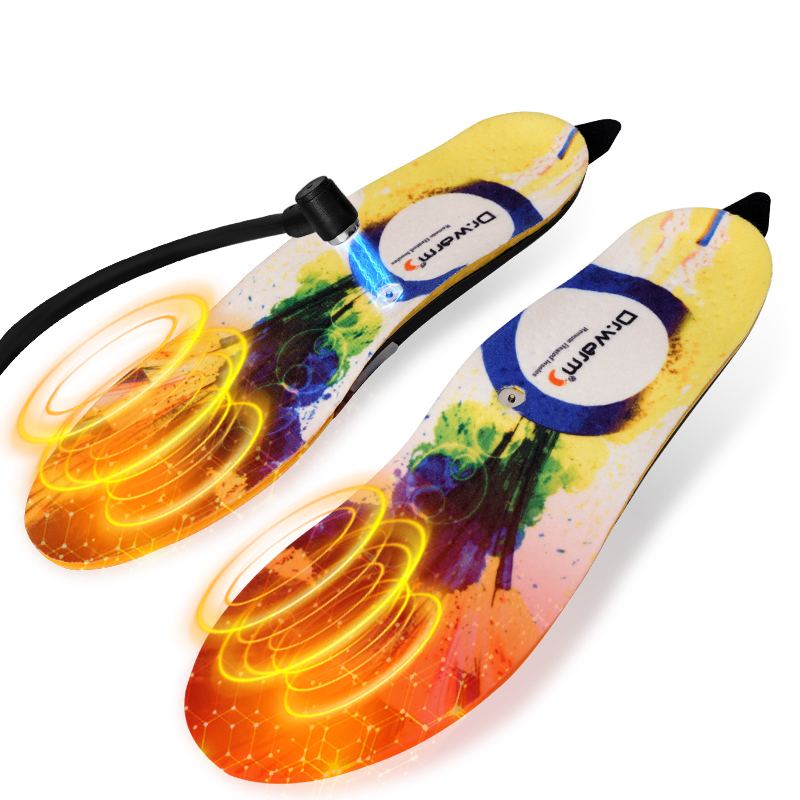
Two consequences follow. First, a wearer who tests the insole with a thumb on the arch will feel nothing and conclude it is broken — so the product needs to be explained, not just shipped. Second, the forefoot zone also sets the minimum size the insole can be trimmed to; cut-to-fit only works while the element stays intact, which is why the smallest sizes usually swap to a shorter heating layout rather than a trimmed one.
The charging habit that actually adds hours
Most heated insoles today charge through a magnetic connector that stays accessible with the insole still in the shoe — no unlacing, no pulling the insole out. That sounds like a convenience feature. It changes runtime behaviour, because a product that is easy to top up gets topped up.

The reverse is also true: an insole that has to be pulled out, unplugged and remembered will be charged less often than it should be, and the complaint that follows is about battery life rather than about friction. If a programme is being designed from scratch, put the connector where it can be reached with the shoe on.
What to expect as the temperature drops
Three broad bands, in plain terms rather than invented numbers:
- Around freezing — the published table applies, provided the boot is insulated and the pack starts warm. This is the band the numbers were measured in.
- Around -10°C — expect noticeably fewer hours and a shorter high-setting phase. The pack loses usable capacity and the controller steps down earlier. A spare pack carried against the body is worth more here than any specification change.
- Below -20°C — the boot decides the outcome. A double-insulated snow boot with a warm pack performs; a thin-soled shoe with the same insole does not, and no battery upgrade fixes it. Sell the insole with the boot in mind, or sell it with a spare pack.
Specifying insoles for a market
Four inputs fix the configuration: the coldest ambient, the footwear the insole will live in, the length of a session, and whether the pack can be external. The footwear matters more than the market — an insole sold into workwear and one sold into ski retail need different packs to make the same promise, because the soles are not comparable.
Dr. Warm builds heated insoles on 3.7V and 7.4V platforms for brands, distributors and retailers, covering element layout, cut-to-fit construction, pack and charger matching, connector placement and retail packaging. Tell us the boot, the climate and the session length, and we will specify the pack around it through our OEM and ODM service. The finished range is on our heated insole category page.
Frequently Asked Questions
How many hours do heated insoles last in snow?
About 5 to 7 hours on low from a 3.7V 2,200mAh pack in an insulated winter boot, with 3 to 4 hours on medium and 2 to 3 on high. Below about minus 10 degrees expect noticeably less, and expect the boot under the insole to matter as much as the pack inside it.
Why do my heated insoles feel cold after two hours?
Usually because the pack got cold, not because it emptied. The pack sits at the ankle – the lowest, coldest position of any pack in the range – so its usable capacity drops and the voltage sags under load. The controller then steps the insole down to protect it. Carry the spare in a pocket against the body and let a cold pack warm up before switching on.
Do heated insoles heat the whole foot?
No. The element runs under the forefoot and toes, which is where cold is felt first and where there is least material between the foot and the ground. The arch and heel are unheated, so a wearer who tests the insole by pressing the arch will feel nothing and may think it is faulty. Explain the layout on the product page.
Is a bigger insole battery worth it?
Usually not, if the bigger pack has to sit under the ankle. Ergonomics caps an ankle-mounted pack at roughly 8 to 12Wh. Beyond that, the sensible options are an external pack on a short cable, or a second 8.1Wh pack swapped at lunch, which is lighter on the foot and cheaper to build.