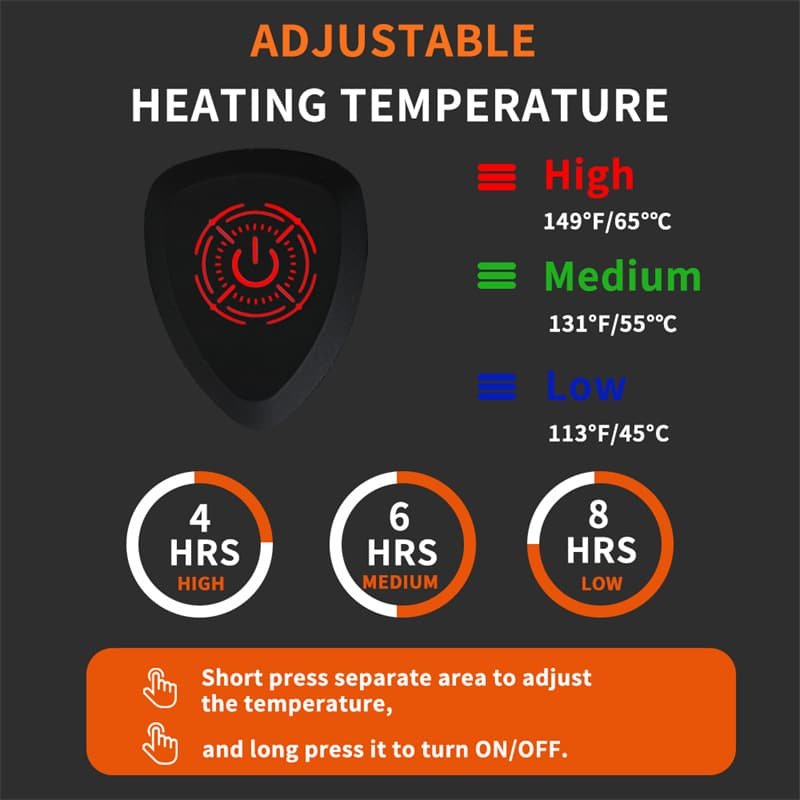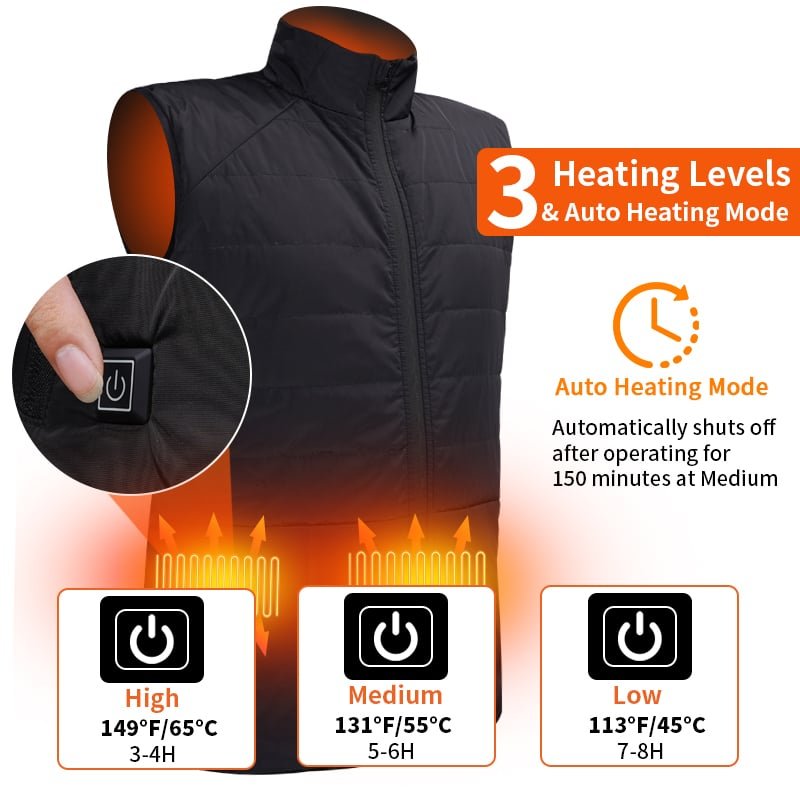
Short answer: a pair of battery heated gloves runs about 4–6 hours on low, 3–4 hours on medium and 1.5–2 hours on high from a 3.7V 2,200mAh pack (8.1Wh). A 7.4V 2,200mAh dual-cell pack (16.3Wh) roughly doubles that. Sub-zero air does not change the circuit — it changes how much of the pack’s capacity you can actually draw, and how fast the glove loses the heat you paid for.
That is the honest version. The number printed on the box is usually the best of three different measurements, and knowing which one you are being quoted is worth more than any single figure. This guide shows the arithmetic behind a runtime claim, why gloves use up a pack faster than any other heated garment, and what to change when the label and the mountain disagree.
Where the number on the box comes from
There is no harmonised runtime test for heated apparel in CE or UKCA. Two suppliers can both be truthful and still quote 3 hours and 8 hours for the same glove, because they measured different things:
- Room temperature, low setting, continuous — the most flattering test, and the source of most headline figures.
- Cold chamber, low setting — closer to reality, still usually run with the glove lying still rather than in wind.
- Time to first felt temperature drop on the hand of a test wearer — not a battery figure at all, which is why it can be so much longer.
When a quotation gives you hours but not the test conditions, you cannot compare it to anything. Ask two questions instead — how many watt-hours is the pack, and how many watts does the heating circuit draw at each level. Runtime then falls out of a division, and it will match what the wearer experiences.
The arithmetic behind a runtime claim
Watt-hours divided by heating watts gives hours, minus a small loss in the controller — call it 10–15%. Run that backwards on our own published figures and the glove circuit comes out at roughly 1.5W on low, 2.5W on medium and 4.5W on high. The numbers line up: 8.1Wh ÷ 4.5W is about 1.8 hours, which is the 1.5–2 hour band on high.
This is the fastest way to sanity-check any claim. Anyone offering 8 hours of glove heat from an 8.1Wh pack is describing a circuit of about 1W. At 1W a glove does not feel heated — it feels slightly less cold. The claim is not a lie about the battery; it is a quiet statement about how little heat the design produces.
mAh is not energy — Wh is
Milliamp-hours only compare packs at the same voltage. A 2,200mAh pack holds 8.1Wh at 3.7V and 16.3Wh at 7.4V — identical labels, double the energy. Watt-hours is the figure that carries across systems, and it is the one most often left out of a quotation.
| Pack used in gloves | Energy | What it buys | Charger |
|---|---|---|---|
| 3.7V 2,200mAh | 8.1Wh | Commuting, dog walking, a morning on the slopes | 5V 2A |
| 3.7V 2,500mAh | 9.3Wh | Same build, a little more margin in the cold | 5V 2A |
| 3.7V 3,200mAh | 11.8Wh | Half a day outdoors on medium | 5V 2A |
| 7.4V 2,200mAh (dual cell) | 16.3Wh | A full riding or ski day, spare not required | 8.4V 1.5A |
| 7.4V 3,000mAh | 22.2Wh | The practical ceiling for a wrist-mounted pack | 8.4V 1.5A |
If you are comparing a USB glove against a 7.4V glove, note that “USB” describes the charging port, not the system — plenty of USB gloves are 3.7V packs with a USB input. Our USB vs 7.4V heated glove comparison breaks that confusion down; the full energy table across every system is in our battery lifespan guide.
Why gloves use up a pack faster than any other heated garment
A heated vest with a 22.2Wh pack is quoted at 2.5–3.5 hours on medium. A glove with 8.1Wh is quoted at 3–4 hours on medium. Per watt-hour, the glove is doing far more work with far less energy, and three structural reasons explain it.
The hand is the hardest place on the body to heat
Fingers are thin — around 16–20mm across — which gives them the highest surface-area-to-volume ratio of any part of the body. Heat leaves almost as fast as it arrives. Worse, in cold conditions the body deliberately restricts blood flow to the extremities to protect the core, so the glove is not supplementing circulation; it is replacing it. In a vest the wearer’s own metabolism is doing half the work. In a glove it is doing almost none.
Heating coverage is where the hours come from
The same 8.1Wh pack will run twice as long on a glove that heats only the back of the hand as on one that heats the back of the hand, every finger and the palm. Both are legitimate products. Only one of them keeps fingertips usable at -5°C, and only one of them deserves the longer number on the box.

So when a glove is quoted at 8 hours and feels cold at the fingertips by hour two, the two facts are usually describing the same design.
The pack is sized by the wrist, not by the budget
There is a hard ceiling on glove batteries that has nothing to do with cost. A 12V 5,000mAh pack is 60Wh — enough for 12 hours of glove heat — but it weighs around 300g, and 300g swinging at the end of a forearm is unusable on a motorcycle or a ski pole. So glove packs stop at roughly 16–22Wh, and everything above that point is expressed as a second pack rather than a bigger one.
The geometry follows the same logic. Cuff diameter, zip pocket depth and connector position set the maximum cell size long before the cell datasheet does. Custom glove packs are designed from the wrist backwards, which is why a pack that works in a vest will not drop into a glove.

Runtime by pack and heat level
The table below is the practical version, measured at normal indoor ambient on a static glove. Treat the low setting as the number to plan around and the high setting as a warm-up tool rather than a mode.
| Pack | Energy | Low | Medium | High |
|---|---|---|---|---|
| 3.7V 2,200mAh | 8.1Wh | 4–6 h | 3–4 h | 1.5–2 h |
| 3.7V 3,200mAh | 11.8Wh | 6–8 h | 4–5 h | 2–3 h |
| 7.4V 2,200mAh (dual cell) | 16.3Wh | 8–11 h | 6–8 h | 3–4 h |
Figures are for a full-coverage glove at 20–25°C ambient. The 2,200mAh row is our published figure; the 3,200mAh and 7.4V rows are scaled by watt-hours, since the same circuit drawing the same power runs proportionally longer. At -10°C with wind, expect noticeably less from every row — the pack gives up capacity and the glove gives up heat, and both happen at once.
What sub-zero temperatures actually do to a lithium pack
Cold does not drain a pack. It makes part of the pack unreachable. Two effects combine:
- Usable capacity falls. A pack at -10°C delivers meaningfully less energy than the same pack at room temperature before it hits its cut-off voltage.
- Internal resistance rises. Under load the voltage sags, the controller reads a lower state of charge and steps the glove down a level — or switches off — while the pack is still half full by label.
That is the mechanism behind the most common complaint we hear: “it was fine for two hours and then it just got weak.” The pack did not fail. It was cold, and the electronics correctly protected it.
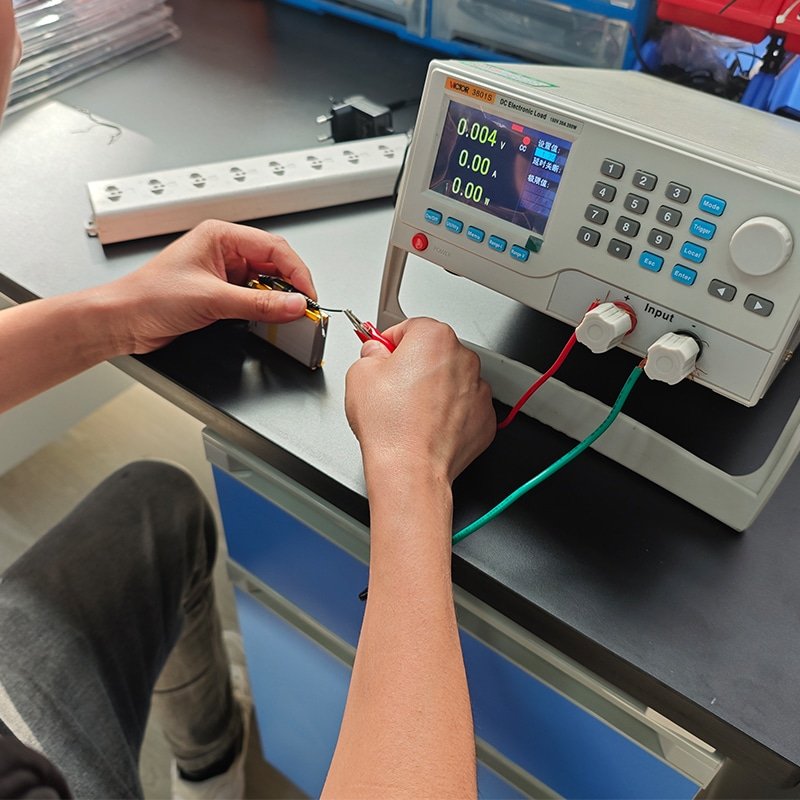
The countermeasure costs nothing and is routinely ignored: carry the spare pack in an inside jacket pocket against the body, not in a backpack, a sled box or a tank bag. A pack that starts at 20°C delivers close to its rating; one that starts at -8°C does not.
Five things that actually add hours
- Warm up on high, then drop to medium. Reaching temperature is the most expensive phase per minute; holding it is cheap. Eight minutes on high and the rest of the day on medium beats four hours on high by a wide margin.
- Keep the spare against your body. Body-warm cells, as above, are worth more than a marginally larger pack.
- Keep the connector dry. A damp joint is a resistive joint, and resistance turns watt-hours into wasted heat inside the cuff.
- Charge at room temperature. Charging a cold pack, or leaving one in a cold vehicle overnight, shortens both the session and the pack’s working life.
- Switch off during breaks. Gloves lose their heat the moment your hands come out, so idling on low between runs buys nothing and costs hours.
Spare pack or bigger pack?
For most wearers, a spare wins. Two 8.1Wh packs cost less to build than one 16.3Wh dual-cell pack, weigh less on the wrist at any moment, and cover a full day by swapping at lunch. The weight argument matters more than the price argument: an extra 100g at the cuff is felt on every arm movement for the whole session.
A bigger pack only wins in two situations — when the wearer genuinely cannot stop to swap, such as patrol or industrial work, or when the heated area is large enough that the extra energy is needed to reach temperature at all, not to extend the session.
If you are specifying gloves for a brand
Give the factory four numbers and the specification writes itself: the coldest ambient the product must work in, the length of a typical session, the coverage map you are promising (back of hand only, or plus fingers and palm), and whether a spare pack ships in the box. Watt-hours and pack size follow from those, and the runtime claim stops being a guess.
Dr. Warm builds heated gloves for brands, distributors and retailers on 3.7V and 7.4V platforms, with heating-element layout, pack and charger selection, cuff construction and retail packaging developed together. If you are weighing a longer runtime against a lighter cuff, send the intended use and market, and we will specify the configuration around it through our OEM and ODM service. The finished range is on our heated glove category page.
Frequently Asked Questions
Do battery heated gloves really last 8 hours?
Not on high. Eight hours from a glove pack means a heating circuit of roughly 1 watt, which is hand-warmer output rather than glove output. Eight hours is realistic on low from a 16.3Wh dual-cell pack, or from a 3.7V 3,200mAh pack in mild conditions — not from an 8.1Wh pack in subzero wind.
Why do my heated gloves stop after two hours when the box says six?
Three causes cover almost every case. You were on high rather than low; the pack started the day cold, so part of its capacity was unreachable; or the pack has aged and no longer holds its rated energy. Many six-hour figures are also low-setting, room-temperature measurements, which no wearer ever reproduces outdoors.
Is a spare battery better than a bigger battery for heated gloves?
For most wearers, yes. Two 8.1Wh packs cost less to produce than one 16.3Wh dual-cell pack, and neither one adds a permanent 100g to the cuff. A bigger pack only wins when the wearer cannot stop to swap, or when the heated area is large enough that the extra energy is needed to reach temperature at all.
Do heated gloves work at minus 20 degrees Celsius?
They heat, but you should plan on a spare rather than on the label. At that temperature the pack gives up usable capacity, internal resistance rises so the controller steps the glove down early, and the glove loses heat faster than a thin finger can be supplied. Keep the spare pack in an inside pocket so it starts warm.