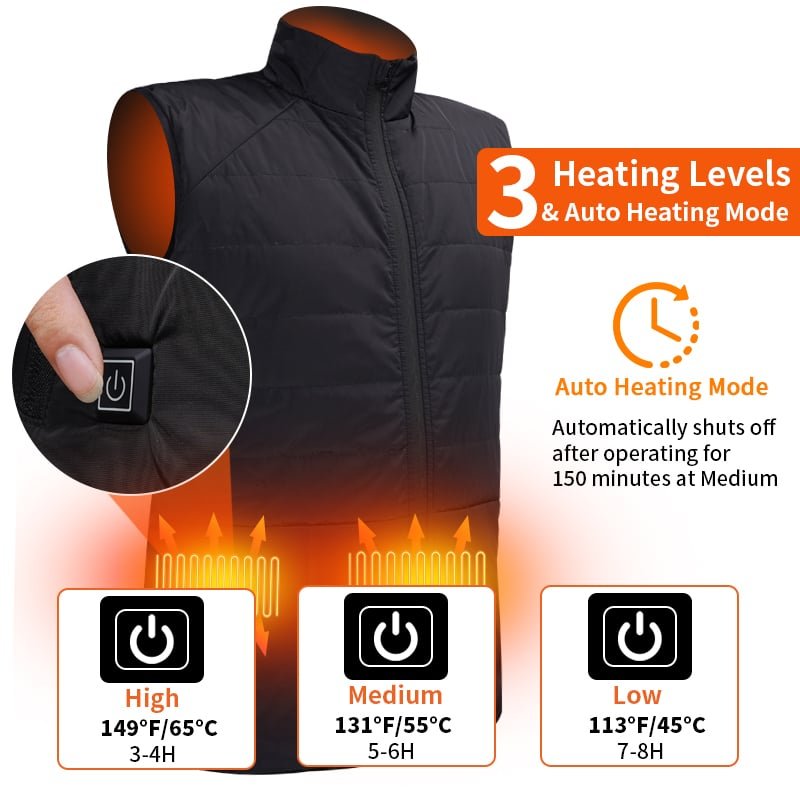

Short answer: a battery heated vest on a 7.4V 3,000mAh pack (22.2Wh) runs about 4–5 hours on low, 2.5–3.5 hours on medium and 1.5–2 hours on high. A 12V 5,000mAh pack (60Wh) reaches roughly 8–9 hours on low — not three times as long, because the bigger pack is usually driving twice as many heating zones.
A vest is the most efficient heated garment we build, and the reason is structural rather than clever: the torso has the lowest surface-area-to-volume ratio on the body, it is the part the body itself prioritises for warmth, and it is the part a wearer can put a jacket over. That last point alone is worth more runtime than an extra cell. This guide covers the real numbers, why zone count keeps pace with pack size, and what actually changes the figure a buyer experiences.
Why a vest gets more hours per watt-hour
Put 22.2Wh in a vest and 22.2Wh in a pair of gloves. The vest will run longer, and not because the electronics are different. Three things work in its favour:
- The torso leaks heat slowly. A chest is a large volume with a comparatively small surface, so a given amount of heat stays in the garment longer. Fingers are the opposite case entirely.
- The body heats the same region. Core temperature is what the body defends first, so a warmed torso reduces the cold-stress response that shuts down blood flow to the extremities. The vest is working with the physiology instead of against it.
- It can be layered over. An outer jacket traps the heat the vest produces. No glove can be layered like that, and a sock is already inside the least breathable thing the wearer owns.
The practical consequence is that vest runtime is the easiest of any garment to extend without buying anything: put a shell over it. We cover the garment-by-garment comparison in our battery lifespan data, and the glove and sock figures sit in their own guides.
Zone count is the runtime multiplier nobody quotes
Two vests with identical packs and identical settings can differ by 40% in runtime if one heats three zones and the other heats six. Each zone is a parallel load on the same pack, so the honest way to read a runtime claim is alongside the zone count that produced it.

This is also why a supplier quoting “up to 10 hours” without stating the zone count is not giving you a specification. Six zones on high is a different product from three zones on low, even when the model number is the same.
What pack a vest can actually carry
The vest has a structural advantage here too. A pack can ride in an inside pocket at the small of the back or on the hip, where the body is happy to carry 200–300g — the same mass that makes a glove unusable. That is why the vest is the garment where 12V systems make sense.
| System | Pack | Energy | Zones it usually drives | Charger |
|---|---|---|---|---|
| 5V | 10,000 / 20,000mAh | 50Wh / 100Wh | 3–5 | 5V 2A or 3A |
| 7.4V | 3,000 / 4,000mAh | 22.2Wh / 28.1Wh | 4 | 8.4V 1.5A |
| 12V | 5,000mAh | 60Wh | 5–6 | 5V 3A |
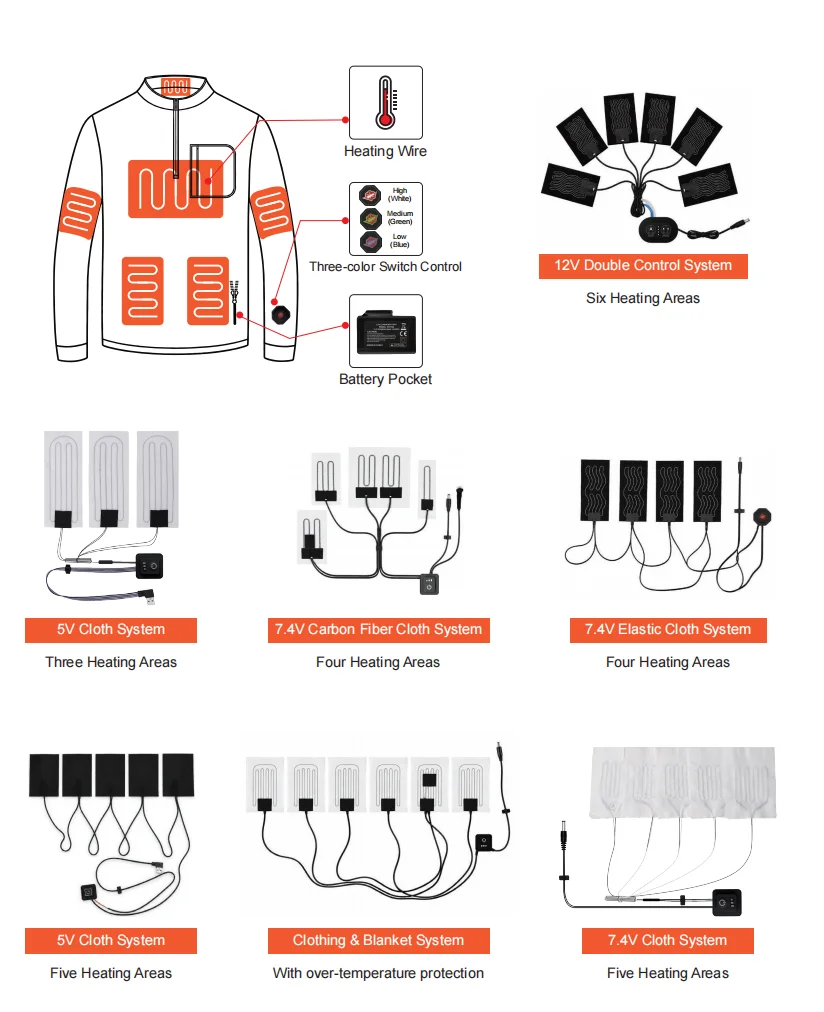
Runtime by pack and heat level
Measured at 20–25°C ambient with the vest worn over a base layer, on a wearer who is outdoors but not sitting still. The medium column is the one to sell against.
| Pack | Energy | Low | Medium | High |
|---|---|---|---|---|
| 7.4V 3,000mAh | 22.2Wh | 4–5 h | 2.5–3.5 h | 1.5–2 h |
| 7.4V 4,000mAh | 28.1Wh | 5–6 h | 3.5–4.5 h | 2–3 h |
| 12V 5,000mAh | 60Wh | 8–9 h | 5–6 h | 3–4 h |
The 7.4V 3,000mAh row is our measured figure; the 4,000mAh row scales with watt-hours on the same four-zone circuit; the 12V row is our jacket-class figure, because a 12V vest is normally a five- or six-zone build. Note what the third row implies: 60Wh is 2.7 times the energy of 22.2Wh, but the hours are roughly double, because the extra energy is being spent on extra zones.
5V, 7.4V or 12V — which platform suits a vest
All three platforms are in production, and none of them is better in the abstract. What changes is the pack bulk, the peak heat, and how many zones you can afford to feed.
5V — power-bank class
A 5V vest runs from a 10,000 or 20,000mAh pack, which is 50Wh or 100Wh, and drives three to five zones. It recharges from a standard 5V 2A or 3A adapter, which is convenient for retail because the customer already owns one. The trade-offs are a bulkier pack for the same energy and a lower peak temperature, so 5V suits gift and e-commerce programmes, and vests intended to sit under a suit or a uniform without being noticed.
7.4V — the mainstream choice
A 7.4V vest runs 22.2Wh or 28.1Wh across four zones from an 8.4V 1.5A charger. The pack is light enough to sit in a hip pocket without the hem dragging, heat-up is quick, and the runtime figures in the table above belong to this platform. For workwear, mid-layers and most private-label programmes, this is the sensible default.
12V — maximum zones, maximum heat
A 12V vest at 60Wh is the only platform where a five- or six-zone layout with a genuine eight-hour low setting is realistic, and it still charges from a 5V 3A adapter rather than a dedicated dock. Weight, pack cost and controller cost all rise together, so it belongs in programmes sold on warmth rather than on price — outdoor retail, motorcycle, industrial cold-store work.
The mistake to avoid is choosing a voltage first and a promise second. Decide the zone count and the hours, then pick the platform that can feed them. If the question is vests against jackets rather than volts against volts, our jacket versus vest comparison for brands covers the garment side.
The layer over it changes the number more than the battery
A vest worn over a base layer and under a shell holds its heat; the same vest over a shirt in wind does not. The controller cannot tell the difference — it delivers the same watts either way — but the wearer can, and they respond by turning the setting down, which is where the extra hours come from.

For a brand, this is a merchandising decision as much as a technical one. A vest sold as outerwear will generate more runtime complaints than the same vest sold as a mid-layer, with identical hardware and identical batteries.
What “low” actually means inside the controller
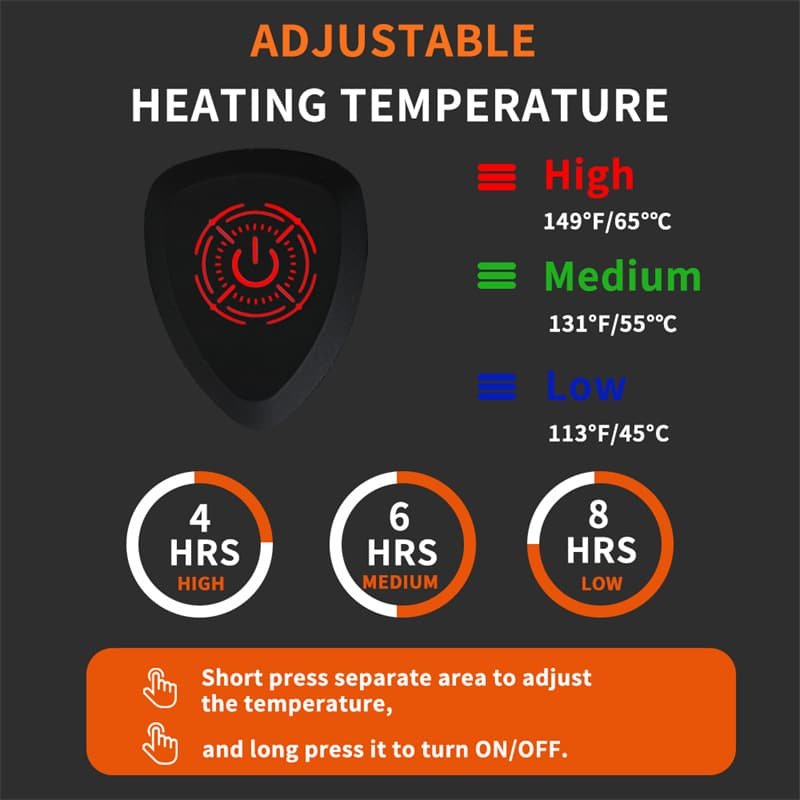
On our three-level controllers, low does not deliver a lower voltage to the element — it switches the element on and off in a shorter duty cycle. That distinction matters to a buyer because it explains the most common complaint about heated vests: “low does nothing, it just feels cold.”
What they are feeling is a duty cycle, not a lower temperature. It is also why low is genuinely efficient: the element is off for part of every cycle, so no energy is spent during that portion at all. If a programme needs a low setting that holds a steady temperature rather than pulsing, that is a controller specification, and it has to be agreed before tooling rather than after.
Four ways to get the hours you were promised
- Wear it as a mid-layer. A shell over the vest is worth more than any realistic pack upgrade.
- Warm on high, then drop to medium. Reaching temperature is the expensive part; holding it is cheap.
- Keep the spare pack off the cold ground. A pack at -5°C gives up usable capacity before it is empty, and the controller steps the vest down early.
- Match the zone count to the promise. If the marketing says eight hours, spec four zones on a 7.4V pack, not six on a 12V and hope.
Specifying a vest programme
Four inputs decide the pack: the coldest ambient, the session length, the zone count and where the pack sits on the body. Zones and energy have to be chosen together — a six-zone 12V build and a four-zone 7.4V build can promise the same hours, but they are not the same product to wear or to price.
Dr. Warm develops heated vests on 5V, 7.4V and 12V platforms for brands, distributors and retailers, covering zone layout, controller behaviour, pack and charger matching, shell construction and retail packaging. Tell us the market, the session length and the layer the vest will be worn as, and we will specify the pack around it through our OEM and ODM service. The finished range is on our heated vest category page.
Frequently Asked Questions
Can a heated vest really last 10 hours?
Only on low, and only from a large pack with a modest zone count. Ten hours from a 60Wh 12V system works out at about 6W of heating. Ten hours from a 22.2Wh pack would mean 2.2W, which is warmth maintenance rather than heat. Ask for the watt-hours and the zone count before you believe the number.
Does wearing a jacket over a heated vest extend runtime?
Yes, and usually by more than a battery upgrade would. The shell traps the heat the vest produces, the wearer feels comfortable at a lower setting, and the pack therefore lasts longer at the same comfort level. The controller delivers identical watts either way – what changes is how many of them the wearer needs.
Do more heating zones reduce runtime?
They do, because each zone is a parallel load on the same pack. Two vests with identical batteries can differ by around 40% in runtime when one drives four zones and the other drives six. This is why a runtime claim is only meaningful when the zone count is stated alongside it.
Is 12V better than 7.4V for a heated vest?
It is not automatically longer-running. 12V exists to feed more zones and to reach temperature faster, and packs grow alongside the zone count. A 60Wh 12V build gives roughly double the hours of a 22.2Wh 7.4V build, not 2.7 times, because the extra energy is spent on the extra zones.
Related Reading
- How Long Do Battery-Powered Heated Gloves Last in Subzero Temperatures?
- How Many Hours Can Heated Socks Work Under Freezing Outdoor Temperatures?
- How Long Does the Battery Last on a Fully Charged Electric Heated Jacket?
- How Long Do Heated Clothing Batteries Last? (Real Lifespan Data)
- our heated vest range