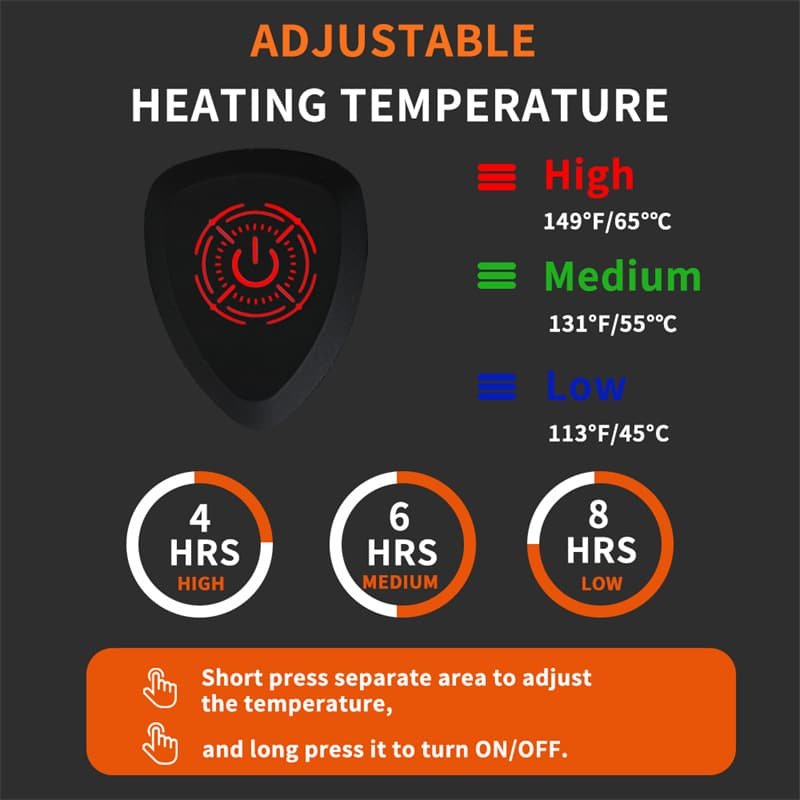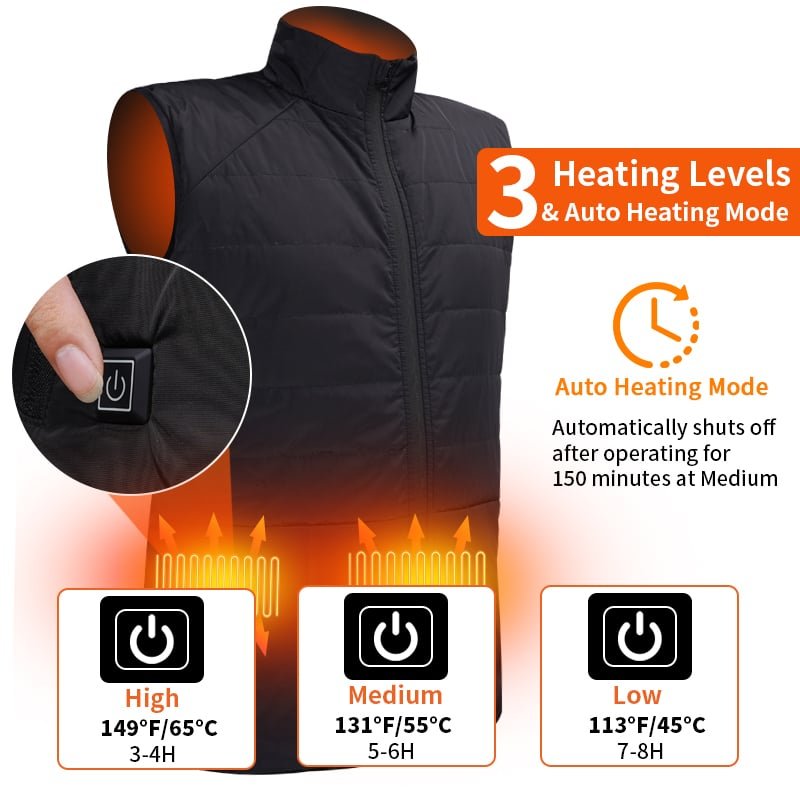
Short answer: a fully charged electric heated jacket on a 12V 5,000mAh pack (60Wh) runs about 8–9 hours on low, 5–6 hours on medium and 3–4 hours on high with all six heating zones live. Switch the two arm circuits off and run only the back, and the same pack lasts roughly twice as long — because you have halved the load, not because the battery changed.
That switch is the single most useful thing a jacket buyer can be told, and it is almost never mentioned in a listing. A jacket is the only garment in the range with two independent heating circuits; nearly every other product has one switch for one load. This guide covers what each circuit costs, why a jacket loses hours that a vest keeps, and how to read a runtime claim for what it actually measured.
Two circuits, not one — the runtime switch nobody mentions
Look at the controller on a proper heated jacket and you will find two sets of buttons rather than one: back heat, and left/right arm. They are separate outputs. Pressing one does not switch the other, and running only the back does not draw the same current as running everything.
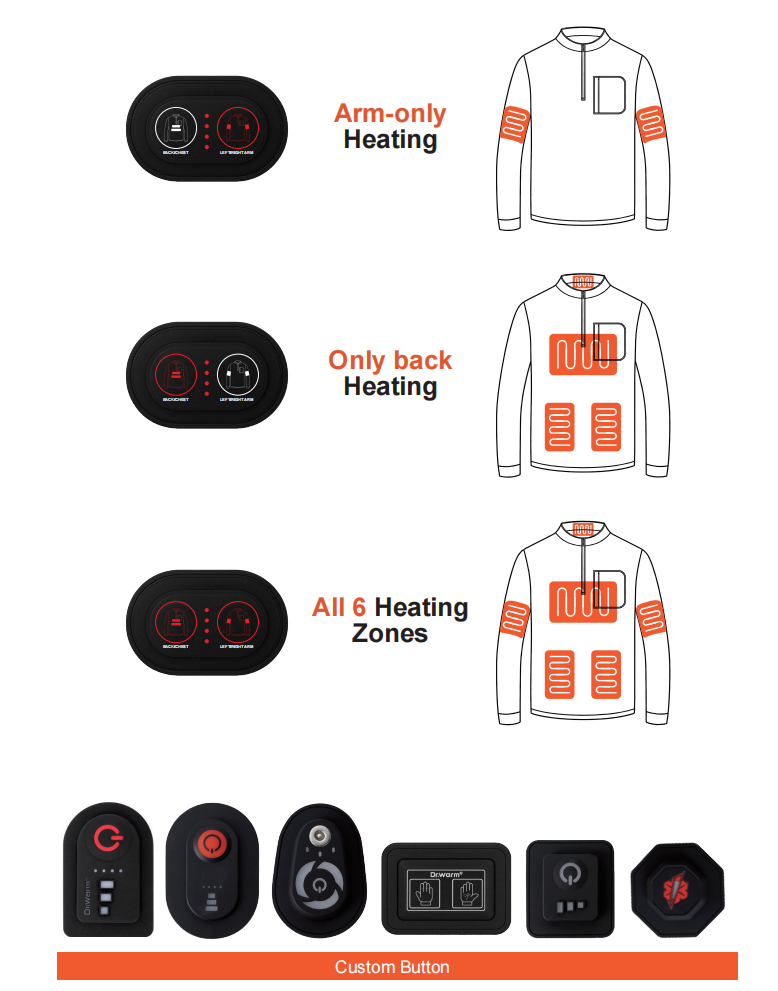
What the double button actually does
Each output is a parallel load on the same pack. Two arm elements plus a back panel is a six-zone build; the back panel alone is three. Since the pack delivers a fixed amount of energy, halving the connected load roughly doubles the time it lasts at the same setting. Nothing clever is happening in the electronics — it is Ohm’s law doing the work.
What turning the arms off is worth
In practice it is the difference between a jacket that dies at the end of a commute and one that is still warm when the wearer gets home. Arms matter most when the wearer’s hands are out in the wind — motorcycling, cycling, ski patrol. For a walk to the station, the back circuit alone is usually enough, and it costs half the energy.
The merchandising lesson is blunt: a jacket sold with a dual-button controller can honestly claim a longer low-setting runtime than an identical jacket with a single button, and it can do it without a bigger battery. If a programme is being priced on runtime claims, this is where the claim comes from.
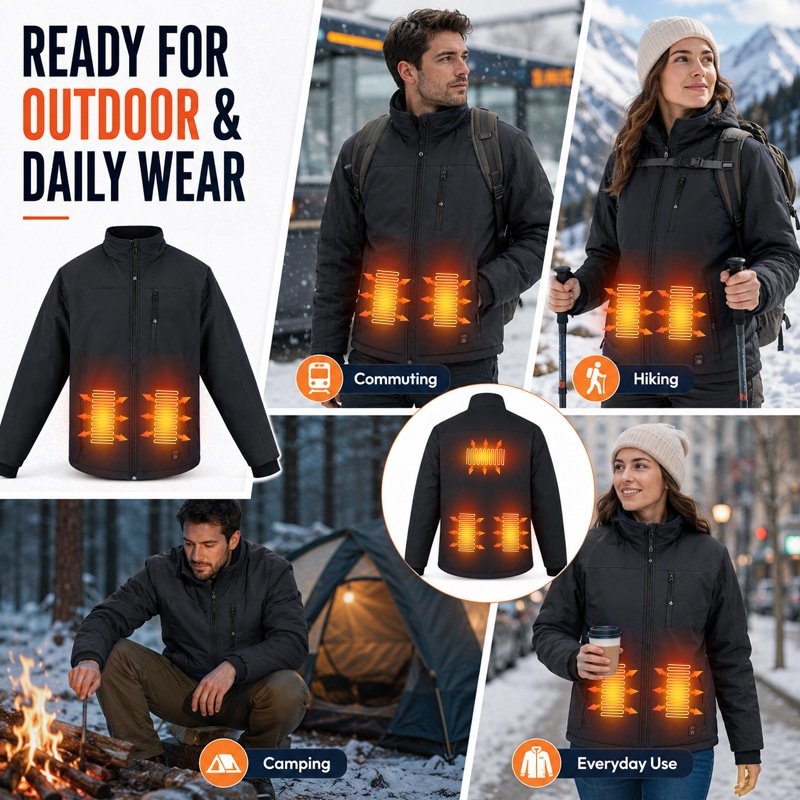
What the label usually means
Arithmetic is the only way to test a jacket runtime claim, because the same 60Wh pack supports every number on this list:
- “Up to 8 hours” — 7.5W average. That is six zones on low, and it is a real figure.
- “Up to 12 hours” — 5W average. Same pack, three zones. Also real, and a different jacket to wear.
- “3–10 hours” — not a claim at all, but a range spanning every setting and both circuits. It tells the buyer nothing they can plan around.
- “24 hours” — 2.5W. At that output the jacket is holding a temperature it never really built, and the number belongs to a heated cushion rather than a jacket.
Notice that 8 and 12 are both honest from the same 60Wh pack; what separates them is the circuit, which is the one piece of information a listing never carries. When two suppliers quote eight and twelve hours for the same price bracket, the difference is usually a button, not a battery.
The pack a jacket needs
Six zones need energy, which is why the jacket is the one garment where a 12V system beats a 7.4V one on more than marketing. The pack usually rides in a lower-inner pocket or a dedicated pouch at the hem, where the weight is carried by the waist rather than the shoulders.
| System | Pack | Energy | Zones it comfortably drives | Charger |
|---|---|---|---|---|
| 7.4V | 4,000mAh | 28.1Wh | 3–4 | 8.4V 1.5A |
| 12V | 5,000mAh | 60Wh | 6 | 5V 3A |
Two notes on that table, both of which come up in every sourcing conversation. A 12V pack still charges from a 5V 3A adapter rather than a dedicated dock, which keeps the retail accessory list short. And a 7.4V 4,000mAh pack will run a six-zone jacket, but the hours become the marketing problem rather than the engineering one.
Runtime by pack and circuit
Measured at 20–25°C ambient, outdoors but sheltered, with the jacket worn as an outer layer over a base layer. The circuit column matters as much as the pack column.
| Pack | Circuit in use | Low | Medium | High |
|---|---|---|---|---|
| 12V 5,000mAh (60Wh) | All 6 zones | 8–9 h | 5–6 h | 3–4 h |
| 12V 5,000mAh (60Wh) | Back 3 zones only | 14–16 h* | 9–11 h* | 5–6 h* |
| 7.4V 4,000mAh (28.1Wh) | Back 3 zones only | 6–8 h* | 4–5 h* | 2.5–3.5 h* |
The all-zones 12V row is our measured figure. The rows marked * are scaled by connected load and watt-hours rather than individually bench-tested, because a six-zone jacket on a 7.4V pack is not a combination we would recommend to a brand. Treat them as the arithmetic, not as a datasheet line.
Why a jacket loses hours that a vest keeps
A vest sits against the body under a shell. A jacket is the shell — the largest exposed surface in the whole system, on the part of the body with the most wind on it. On a motorcycle at 60km/h the convective loss from a jacket chest is not marginal; it is the dominant term in the energy balance.
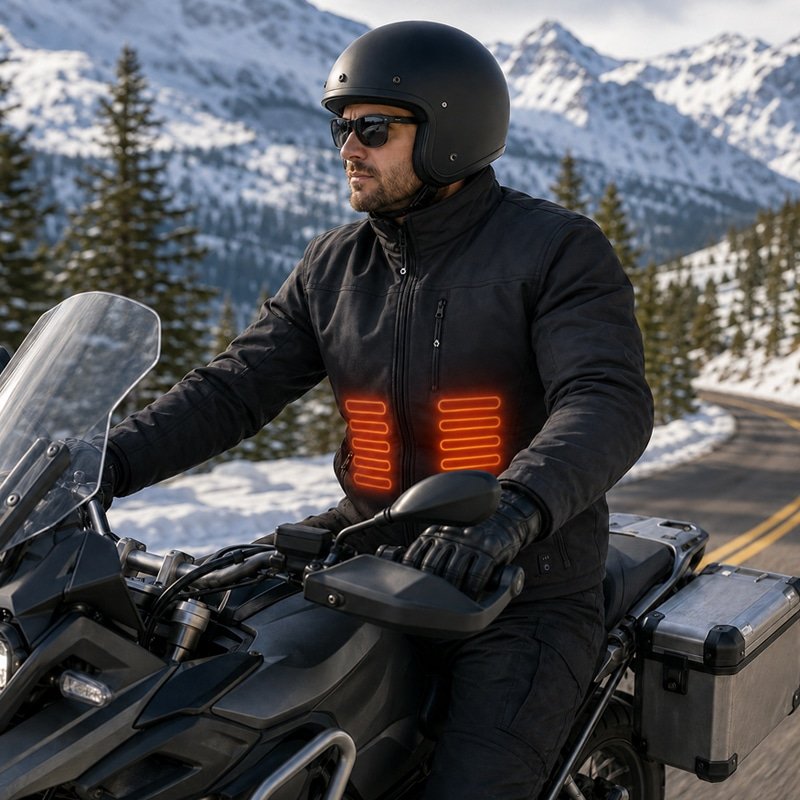
This is why the same jacket, on the same setting, can feel generous on a walk and thin on a bike. It is also why a rider should run the back circuit at medium rather than everything at high: the arms are the most exposed zones, and heating them hard is the least efficient use of the pack. The garment comparison across jackets, vests and gloves is in our battery lifespan data; the vest-specific numbers are in the heated vest runtime guide.
A jacket’s hours are spent in segments
Nobody wears a heated jacket for eight continuous hours. They wear it for twenty minutes, take it off indoors, put it back on, and the pack keeps its charge in between. That pattern is the reason jacket runtime claims feel pessimistic on paper and generous in real life — but it only works if the wearer switches the jacket off rather than leaving it idling under a coat rack.
A controller that defaults back to high on power-up is a small specification decision with a large effect on perceived battery life. Ask for a controller that remembers the last setting, and tell the customer that the jacket is designed to be switched off rather than left running.
Charging is the number people forget
A 60Wh jacket pack on a 5V 3A charger needs the better part of five hours to fill from empty. That is physics, not a slow charger — charge time tracks watt-hours. It is also the honest argument for a second pack: two 28.1Wh packs cost less than one 60Wh pack, charge in roughly half the time each, and can be rotated through a week of commuting.
For a brand, this shows up as a support question two weeks after launch: “how long does it take to charge?” If the answer is four to five hours, the product page should say so, and a second pack should be an option rather than an afterthought.
Specifying a jacket programme
Five inputs fix the configuration: the coldest ambient, the session pattern, the circuit layout (back only, or back plus arms), the market, and whether a spare pack ships in the box. Circuits and energy have to be chosen together — a six-zone 12V build and a three-zone 7.4V build can both promise eight hours, and only one of them is telling the truth about the same jacket.
Dr. Warm develops heated jackets on 7.4V and 12V platforms for brands, distributors and retailers, covering circuit layout, controller behaviour, pack and charger matching, shell and insulation construction, private labelling and retail packaging. Send the market, the session pattern and the zones you want to promise, and we will specify the pack around it through our OEM and ODM service. The finished range is on our heated jacket category page.
Frequently Asked Questions
Does a heated jacket really last 8 hours?
On low, with all six zones connected, at normal outdoor ambient – yes. Eight hours from a 60Wh pack works out at about 7.5W, which is a real low-setting output. In wind, on a motorcycle, or below freezing, expect less, and expect the jacket to spend more of the day on a lower setting rather than a higher one.
Can I double my jacket runtime by turning the arms off?
Roughly, yes. The two arm circuits are a parallel load on the same pack, so running the back only draws around half the current of a six-zone build at the same setting. That is arithmetic rather than a marketing claim – it is the reason a dual-button controller can honestly quote a longer low-setting runtime than a single-button jacket.
Why does my heated jacket last less on a motorcycle?
Because the jacket is the outer layer and the whole of it is in the wind. Convective loss at riding speed is the dominant term in the energy balance, so the controller has to work harder for the same felt warmth. Run the back circuit at medium rather than all six zones on high – the arms are the most exposed zones and the least efficient place to spend the pack.
Is 12V or 7.4V better for a heated jacket?
12V if the jacket has six zones and the promise is eight or nine hours on low. A 7.4V 4,000mAh pack is fine for a three- or four-zone build, but putting it behind six zones makes the runtime the marketing problem rather than the engineering one.