Quick answer: Yes — heated insoles can be built for bulk wholesale. OEM starts at 100 pairs, full ODM development at 500 pairs, and a single stock sample pair is available. Customisation covers the moulded base, top fabric, heating-zone layout, battery platform, control method, size run, branding and packaging. Sampling takes 7-30 days; OEM production 20-25 days.
An insole is the hardest heated product to engineer: it carries full body weight, flexes thousands of times a day and lives in a damp, confined space. That is why an OEM insole project is not just a logo on a stock footbed. This guide sets out what is customisable, how the product is validated and what a buyer should put in the first brief. See also our OEM and ODM services and the factory.
What an OEM Heated-Insole Project Actually Includes
| Element | Options | Why it matters |
|---|---|---|
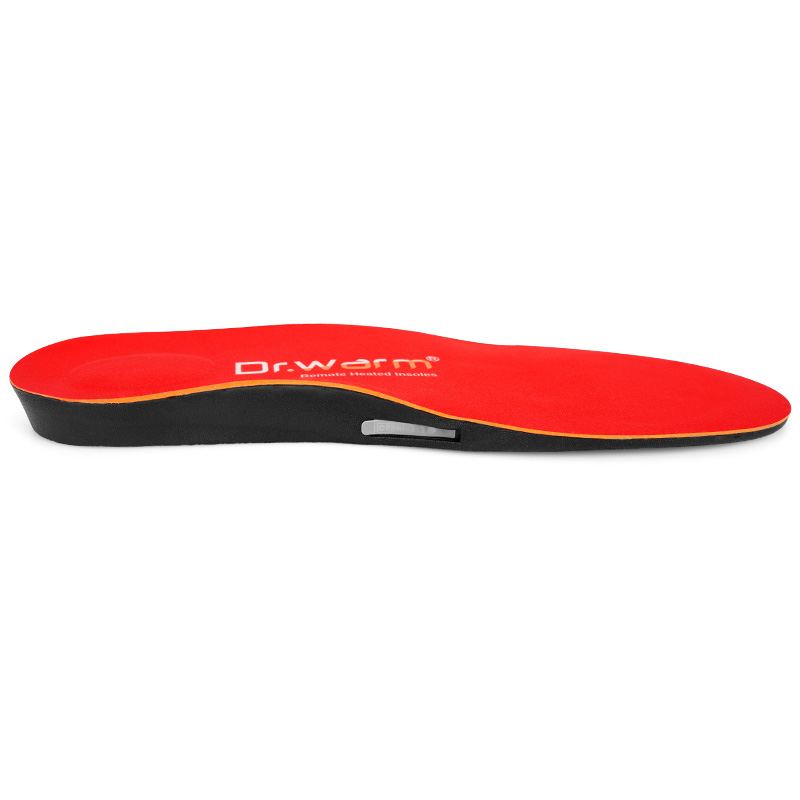
| Base and shape | Moulded EVA base, arch profile, heel cup, thickness, cut-to-fit vs fixed sizes | Determines fit, support and how the foot presses on the element |
| Top sheet | Fabric colour and print, anti-slip texture, moisture management | Brand visibility and in-boot comfort |
| Heating layout | Forefoot, full-foot or heel-focused element routing | Drives current draw and where warmth is felt |
| Power system | 3.7V or 7.4V platforms, internal or ankle-mounted battery, wired or wireless remote | Determines runtime, charger and certification path |
| Control and branding | Button, wireless remote or app; printed manuals, retail box, barcode labels | User experience and shelf presentation |
The base is usually the expensive part to change, because a new mould means tooling. If your programme is a first line, starting from an existing shape and changing the top sheet, zone layout and branding gets a product to market in one sampling cycle. A genuinely new shape is a full ODM project.
What Can Be Customised
- Size system: cut-to-fit with printed trim lines, or a fixed size run with a graded mould; confirm the size chart against your market’s shoe lengths.
- Heating zones: forefoot-only for toe warmth, full-foot coverage, or a heel-focused layout; the element drawing is fixed before tooling.
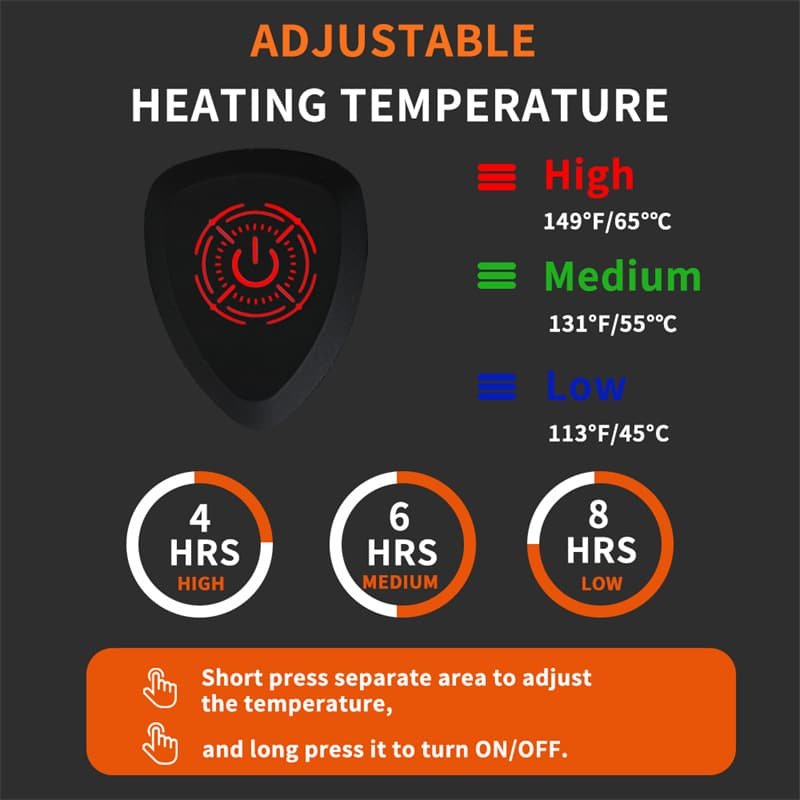
- Heat settings: three levels are defined per model — on one standard insole platform Low 35-40°C, Medium 45-50°C, High 50-55°C; on another Low 35-45°C, Medium 45-55°C, High 55-65°C. All values in degrees Celsius.
- Battery and charging: 3.7V or 7.4V platforms, with 5V / 2A or 8.4V / 1.5A chargers respectively; USB, DC, Micro, Type-C or magnetic connectors.
- Brand layer: printed top sheet, logo, care label, instruction manual, retail box and barcode label.
Battery capacity is configured to the order, not fixed, so runtime should always be quoted together with the heat level used. IPX4 is the standard water-resistance rating and IPX5 is optional; neither covers connecting power while the port is wet. Warranty on finished products is 12 months and cells are rated for 500+ charge cycles.

Typical Development Process
| Stage | Timing | Output |
|---|---|---|
| Brief and feasibility | Before sampling | Target market, size run, zone drawing, voltage platform, artwork list |
| Engineering and sample | 7-30 days | Physical insole pair, wiring harness, controller and packaging mock-up |
| Validation and approval | With the sample | Flexing, compression, heating uniformity, charger compatibility |
| OEM bulk production | 20-25 days | Production run with final aging inspection |
| Full ODM development | 50-60 days | New mould and pattern, then production within 45 days for standard orders |
The checks that matter most are flexing and compression testing, because the element sits under body weight, and heating-uniformity testing, because a local hot spot is both a comfort complaint and a return. Also ask for overcharge, over-discharge and short-circuit protection, over-temperature cutoff, battery and charger compatibility and final aging inspection. UN38.3 test documentation is required for lithium battery transport; the SDS is a shipping document, not a certification.

What Buyers Should Provide
- Target market, shoe-size conventions and the compliance documents your channel requires
- Insole type (cut-to-fit or fixed sizes), intended footwear and activity
- Expected quantity and whether this is OEM branding or full ODM development
- Preferred heating area, heat settings, voltage platform and control method
- Artwork files, packaging dieline and manual language requirements
Buyers commonly request CE, UKCA, UL, FCC, RoHS, Reach, UN38.3, DOE and ISO 9001, plus GB 47372-2026 with CCC on the battery side; see what each covers. Certificate holder for the conformity documentation is Dongguan S-KING Limited, and production is carried out by Dongguan Ditewang Intelligent Technology Co., Ltd. For care guidance that belongs in the manual, see cleaning heated insoles and the insoles buying guide.
Production covers 3 lines in a 6,000 m² main plant plus a separate 2,074 m² electronics assembly workshop, with a team of 56 and 8 in-house R&D engineers. Dr. Warm has supplied heated products Since 2013.
Frequently Asked Questions
Can heated insoles be custom made for wholesale?
Yes. OEM starts at 100 pairs and covers the moulded base, top fabric, heating-zone layout, battery platform, controller, size run, trim lines, branding and packaging. Full ODM development of a new insole shape starts at 500 pairs.
What is the minimum order for custom insoles?
100 pairs for OEM, 500 pairs for full ODM development and 1 pair for a stock sample. Sampling takes 7-30 days and OEM production 20-25 days.
Can you match my brand on the packaging?
Yes. Printed top sheets, logos, care labels, instruction manuals, retail boxes and barcode labels can all be matched to your brand, with artwork approved against a physical sample.
What should a buyer specify about heating and power?
Specify the heating area (forefoot, full foot or heel), the heat settings for the chosen model, the voltage platform (3.7V or 7.4V for insoles), the control method and the size range. Battery capacity is configured to the order, so runtime must be quoted at a named heat level.
Planning an insole programme? Send your size run, target market and quantity and we will map the closest existing platform before quoting.