
Quick answer: Switch the vest off, remove the battery, protect the connector, then clean gently following the care label. Never wring it, never machine-dry it, and air-dry it completely before reconnecting power. A damp charging port is the single most common cause of a vest that will not heat after washing.
A heated vest is a garment with a low-voltage circuit bonded into it. Cleaning is safe when the electrical parts are out of the equation and the fabric is not twisted. This guide gives the routine, explains why each step exists and covers what private-label buyers should put in their manuals. For runtime and selection questions, see how many heating hours to expect.
The three rules that prevent nearly all wash-related returns are simple: no battery in the garment, no twisting of the fabric, and no heat in the drying process. Most damage appears as a cold zone or a loose connection rather than a visible tear, which is why a short low-heat test after the vest is fully dry is worth adding to the routine.
| Part | Why it is vulnerable | Protection step |
|---|---|---|
| Charging connector | Moisture causes corrosion or protection-mode shutdown | Cover or seal before cleaning; dry fully before power |
| Bonded heating panels | Wringing concentrates stress along the bond lines | Press water out with a towel instead of twisting |
| Internal wiring routes | Tumble heat and mechanical action fatigue the wire | Air-dry flat at room temperature, no dryer |
| Battery pocket | Dries last and can hold residual moisture | Check it separately before reconnecting |
Remove the Battery First
- Switch off the controller and disconnect the battery completely.
- Take the battery out of the pocket — disconnecting alone is not enough.
- Close or cover the connector as the care label instructs.
- Check that no cable is still plugged into a pocket or routing channel.
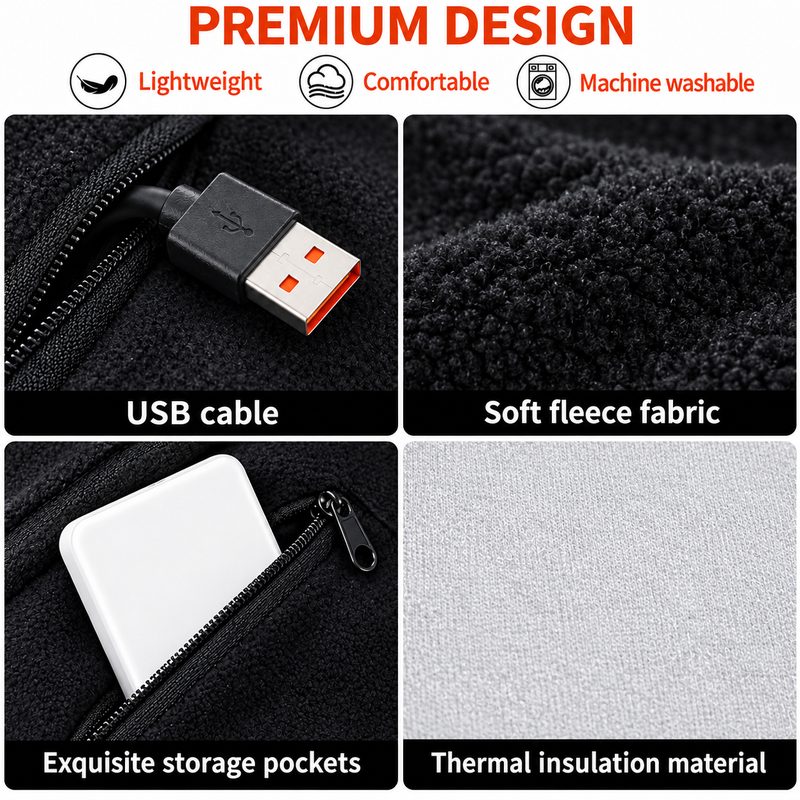
Moisture around a live charging port can cause unstable output, corrosion or a protection-mode shutdown. Most heated vests use a 5V USB power bank or a 7.4V dedicated pack, and the connector types include USB, DC, Micro, Type-C and magnetic. Whatever the connector, it must be dry before power is restored. IPX4 is the standard water-resistance rating and IPX5 is optional; neither covers charging with a wet port.
Choose a Gentle Cleaning Method
| Method | When to use it | Precautions |
|---|---|---|
| Wipe with a damp cloth | Small marks, after a single day of wear | Lowest risk; keep the cloth away from the connector |
| Hand wash, gentle | A full clean after heavy use | Cool water, mild detergent, no soaking, no scrubbing the zone panels |
| Machine, gentle cycle | Only if the care label allows | Laundry bag, no spin-heavy cycle, battery removed, connector protected |
| Never | Any situation | No wringing, no bleach, no dry cleaning, no machine dryer, no direct heat |
The elements are bonded into the fabric across the chest and abdomen. Twisting the garment concentrates stress along those bond lines, which is why wringing causes more damage than the wash itself. Press water out with a towel instead.
Do Not Machine-Dry
Tumble drying combines heat and mechanical tumbling — the two things most likely to degrade a bonded heating element, an adhesive layer or a wire route. Dry the vest flat at room temperature, away from radiators and direct sunlight. Wait until the fabric and the connector area are completely dry before reconnecting power; “mostly dry” is not enough.

Make Sure It Is Completely Dry, Then Inspect
- Check the inside of the battery pocket — it dries last.
- Inspect the connector for moisture, corrosion or a bent pin.
- Run a short test on a low heat setting before the first full use.
- If output is unstable or one zone is cold, disconnect and let it dry longer.
If a burning odour, a swollen battery, a melted connector or a sudden change in heat output appears, stop using the vest and do not recharge it. Lithium cells can present overheating, fire and burn hazards when damaged or paired with unsuitable charging equipment.
What Brands Should Put in the Manual
Care-related returns are preventable with clear instructions. For each model, specify the allowed cleaning method, whether a machine cycle is permitted, the connector protection step, the drying method and the “reconnect only when fully dry” rule. Print the same guidance on the care label and in the manual in every market language.
For OEM programmes the MOQ is 100 pieces, full ODM 500 pieces, sampling 7-30 days and OEM production 20-25 days. Warranty is 12 months and cells are rated for 500+ cycles. Buyers commonly request CE, UKCA, UL, FCC, RoHS, Reach, UN38.3, DOE and ISO 9001, plus GB 47372-2026 with CCC on the battery side; see what each covers. UN38.3 documentation and the SDS accompany shipments — the SDS is a shipping document, not a certification.
Frequently Asked Questions
Can I machine wash a heated vest?
Follow the care label for your exact model. Many heated vests allow a gentle machine cycle in a laundry bag after the battery is removed and the connector is protected, but hand-washing or wiping is the lower-risk option. Never wring the garment, and never machine-dry it.
Do I need to remove the battery before washing?
Yes, always. Switch the vest off, remove the battery and protect the connector before any cleaning. Moisture around a live charging port can cause unstable output, corrosion or a protection-mode shutdown.
Can I put a heated vest in the dryer?
No. Tumble drying combines heat and mechanical stress that can damage the heating elements, the wiring and the bonded layers. Air-dry the vest flat at room temperature and only reconnect power once it is completely dry.
How should a brand write washing instructions?
Give the exact steps for the model: power down, remove battery, protect the connector, gentle wash or wipe, no wringing, no bleach, air-dry fully, reconnect last. Print the same guidance in the manual and on the care label in each market language.
Need model-specific care copy for your manuals? Send us the platform and market and we will supply the text.